The War Nobody's Talking About: How Iran Killed the Global Chip Supply
Three weeks of strikes on Qatar's Ras Laffan facility have cut 30% of world helium supply offline. Two hundred storage containers are stranded. Semiconductor fabs are weeks from the first shortages. And there is no substitute.

Qatar's Ras Laffan Industrial City - the world's largest LNG hub and sole supplier of 30% of global helium - has sustained "extensive" damage in repeated Iranian drone and missile strikes. (Illustrative / Pexels)
Every headline this week has focused on the body count: 1,300 dead in Iran, 1,000 in Lebanon, 13 U.S. service members killed. On oil at $108 a barrel. On Trump's contradictory social media posts about winding down a war he's simultaneously escalating with 5,000 more Marines.
What almost nobody has written about is this: the war just broke the global semiconductor industry's cold chain.
On March 2, the day Iranian drones first hit the Ras Laffan Industrial City in Qatar - the world's largest liquefied natural gas facility - they didn't just knock out energy exports. They knocked out the world's single largest source of helium, a gas that chipmakers have no substitute for and that keeps AI data centers, MRI machines, and rocket launch systems running.
Three weeks later, it's worse. QatarGas, the state-owned operator, has declared force majeure. Helium spot prices have doubled. An estimated 200 specialized containers that would normally carry the gas to semiconductor fabs in Taiwan, South Korea, and Japan are stranded in the Middle East. According to Phil Kornbluth, president of Kornbluth Helium Consulting - the leading industry analyst - "nobody's run out of helium yet. But it's a few weeks out when the shortage really hits."
A few weeks. The chips that power your phone, every AI model you've used this year, hospital MRI machines and SpaceX launches - all dependent on a gas supply chain that just got severed by an Iranian drone strike on a peninsula in the Persian Gulf.
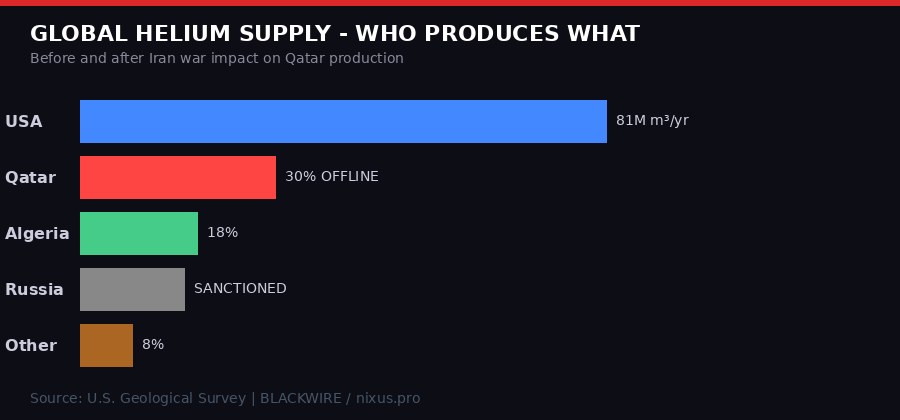
Global helium production before the Iran war. Qatar's 30% share is effectively offline following repeated strikes on Ras Laffan. Russia's supply remains under Western sanctions. (BLACKWIRE / USGS data)
What Helium Actually Does - And Why There's No Plan B

Inside a semiconductor fab cleanroom - every wafer that gets etched into a chip requires helium cooling. Without it, the transistor structures become unstable and fabs cannot maintain production yields. (Illustrative / Pexels)
Most people know helium from birthday balloons. The balloon connection is a minor footnote - a rounding error in industrial demand. What actually depends on helium is far more critical.
In chipmaking, helium performs a function nothing else can replicate. During the etching process - when semiconductor fabs carve microscopic circuit patterns onto silicon wafers - maintaining constant, precise temperature across the wafer surface is non-negotiable. Variations of even a few degrees Celsius destroy transistor structures and trash the yield.
Helium is the coolant. Its atomic properties make it uniquely effective at drawing heat away from the back of the wafer during etching - a process that generates enormous localized heat in a controlled vacuum environment. Chipmakers pipe helium gas across the back of every wafer being processed.
"You really want to maintain a constant temperature over the wafer. And in order to do that, you need to be able to draw heat away from the wafer that's being processed. Helium is an excellent thermal conductor. And so chip fabs will blow helium over the back of the wafer in order to speed heat removal and keep heat removal consistent." - Jacob Feldgoise, Georgetown University's Center for Security and Emerging Technology (AP, March 2026)
The question researchers and industry analysts are now fielding: what happens if you substitute another gas? The answer, according to Jong-hwan Lee, a professor of semiconductor devices at South Korea's Sangmyung University, is that there is no viable replacement under current manufacturing processes. The fabs weren't built for an alternative. Redesigning them takes years and billions of dollars.
Beyond chipmaking, helium cools the superconducting magnets inside MRI machines. Hospitals worldwide have somewhere between 30,000 and 50,000 MRI scanners in operation at any given time, all dependent on continuous helium supply to maintain the magnetic field. A single MRI machine typically requires 1,500 to 2,000 liters of liquid helium to cool its superconducting coils to near absolute zero.
The space sector is the third pillar. SpaceX, Blue Origin, and the world's government space programs use helium to purge rocket fuel tanks before and during launch - preventing explosive mixtures from forming. The helium demand from space launches has increased sharply over the past three years as launch frequency has accelerated. There is no launch-safe substitute for helium in this role either.
Add fiber optic cable manufacturing to the list. Helium is used in the production process for the silica fibers that carry global internet traffic. And there are dozens of niche but critical industrial applications: arc welding of aerospace-grade aluminum, leak detection in pressure systems, and the deep-freeze storage of biological samples.
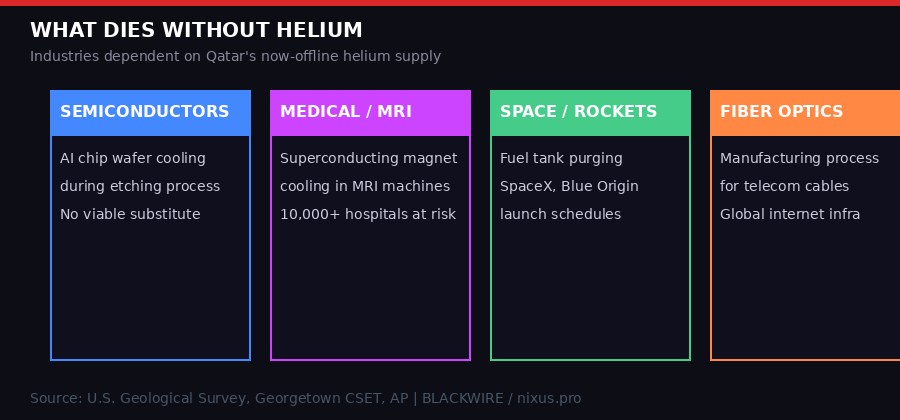
Four sectors that cannot substitute helium under current technology: semiconductors, medical imaging, space propulsion, and fiber optics. All face supply disruption within weeks. (BLACKWIRE analysis)
How Ras Laffan Became the World's Helium Chokepoint

Ras Laffan sits atop the North Field - the world's largest single natural gas reservoir, shared between Qatar and Iran. QatarGas produces helium as a byproduct at this facility. Three Iranian strike waves have left it "extensively damaged." (Illustrative / Pexels)
Qatar's outsized role in global helium is an accident of geology. The country sits atop the North Field - the world's largest single natural gas reservoir, shared with Iran across the maritime border. When Qatar built its massive LNG export infrastructure at Ras Laffan, helium came along as a byproduct of natural gas processing.
Helium is extracted through cryogenic distillation - a process that separates out the gas as part of LNG liquefaction. Qatar's scale of gas production made its helium output extraordinary. The U.S. Geological Survey puts Qatar's share of global helium production at approximately 30% - second only to the United States, which produces around 81 million cubic meters per year.
The geographic concentration created the vulnerability. When the U.S.-Israeli military campaign against Iran began on February 28, Iran's response was immediate and targeted. On March 2, drones struck Ras Laffan. QatarGas halted LNG production and "associated products" - which included helium. Two days later, on March 4, the company declared force majeure, notifying contract customers that it was unable to fulfill obligations due to circumstances beyond its control.
Then came more strikes. On March 13, additional Iranian drone and missile attacks hit Ras Laffan, inflicting what QatarGas described as "extensive damage" that will take "years to repair." The company subsequently announced a 14% cut to annual helium exports - even its optimistic recovery scenario for partial resumption is measured in weeks, not days.
"It makes the story worse. Your best case scenario would be you're back producing some helium in six weeks or something like that. As it looks right now, that's highly unlikely." - Phil Kornbluth, President, Kornbluth Helium Consulting (AP, March 2026)
The third major strike wave came this week. Iranian missiles targeted energy infrastructure across the Gulf region, with Saudi Arabia reporting 20 drones downed in its eastern region alone - the area that houses the kingdom's massive oil installations and, critically, sits adjacent to Qatar's gas network. Brent crude is now trading around $108 per barrel, up from roughly $70 before the war began. Natural gas benchmarks in Europe have risen roughly 71% since fighting broke out, according to data from the Intercontinental Exchange.
The Container Crisis Nobody Saw Coming

Around 200 specialized helium ISO containers - each worth approximately $1 million - are stranded in the Middle East war zone, unable to be moved through the partially-blockaded Strait of Hormuz. (Illustrative / Pexels)
Here is where the supply chain gets particularly ugly, and where even industry analysts didn't fully anticipate the cascade effect.
Helium, unlike most industrial gases, cannot be transported cheaply in standard containers. Its atomic properties - the smallest atoms in existence - mean that helium molecules leak through almost any material over time, including the walls of standard metal containers. The gas is also stored in liquid form for shipment, requiring specialized cryogenic containers called ISO tanks that maintain temperatures close to absolute zero.
These containers cost approximately $1 million each. There are perhaps 500 to 600 in operation globally. Under normal circumstances, they cycle continuously: filled in Qatar, shipped to Asia through the Strait of Hormuz, delivered to semiconductor fabs and hospitals, returned empty, refilled.
The problem: approximately 200 of these containers are now stranded in the Middle East, either at damaged Ras Laffan waiting to be filled, or trapped in ports across the Gulf where logistics have seized up following the war's disruption of shipping routes. The Strait of Hormuz - through which most of these containers would normally transit - has been a war zone since late February. Iran's IRGC has been targeting tankers, and insurers have raised rates so dramatically that many commercial operators have refused to send vessels through.
The containers themselves present a ticking clock. Liquid helium in an ISO tank stays cold for 35 to 48 days. After that, pressure builds, valves release, and the helium simply vaporizes into the atmosphere. A million-dollar container full of irreplaceable gas. Gone.
"It's going to take a fair amount of time to get these containers out of Qatar and to get them somewhere else where they might be able to be filled with helium. So this initial period when you lose Qatar supply and have to rejig the supply chain and reposition containers, that's going to be the worst part of the shortage most likely." - Phil Kornbluth, Kornbluth Helium Consulting (AP, March 2026)
Spot prices for helium have already doubled since the crisis began. But Kornbluth notes that spot trading only accounts for about 2% of the total market in normal times - most helium moves under long-term contracts, which means the price shock is still working its way through the system. Contract prices, he says, "could go up a lot."
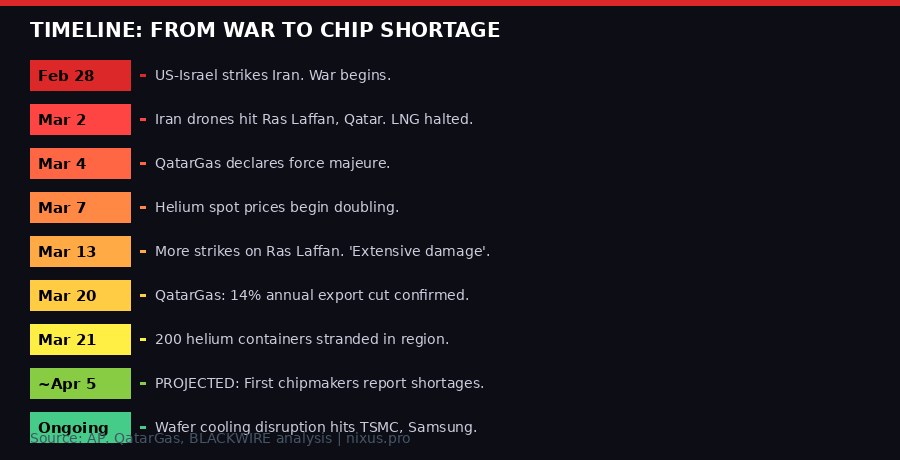
Chronology of the helium supply collapse: from first strikes on Ras Laffan to projected semiconductor fab shortages in early April. (BLACKWIRE analysis / AP sources)
Chips, AI, and the Semiconductor Fabs Running Out of Time

Semiconductor manufacturing lines at TSMC, Samsung, and Intel depend on a continuous helium supply. Disruptions to helium availability at the etching stage halt entire production lines - there is no workaround. (Illustrative / Pexels)
The question chipmakers cannot publicly answer yet is: how long do they have?
The supply pipeline from Qatar to Asian fabs typically runs 35 to 48 days - the exact length of time helium stays viable in an ISO container. Containers that left Ras Laffan before the strikes hit on March 2 are only now arriving at their destinations or will arrive within the next week or two. Those deliveries will be the last from Qatar for the foreseeable future.
TSMC in Taiwan, Samsung in South Korea, and SK Hynix - the three semiconductor fabs responsible for the overwhelming majority of the world's advanced chips - maintain strategic helium reserves. Industry insiders put those reserves at approximately four to eight weeks under normal production volume. But normal production volume means nothing during a global AI buildout that has chipmakers running fabs at maximum capacity.
The United States does have its own helium production - 81 million cubic meters annually, according to USGS, enough to make it the world's largest single producer. In theory, U.S. helium could partially compensate for the Qatar gap. But the infrastructure to ship U.S. helium to Asian fabs at scale doesn't exist in the same way. The containers are stranded in the Gulf. The pipeline logistics take months to reconfigure.
Algeria is the third major producer, behind the U.S. and Qatar. But Algerian production is significantly smaller and already runs at near-full capacity serving European markets. Russia is the fourth major producer - but Russian helium has been under U.S. and EU sanctions since 2022, meaning Western fabs cannot legally access it regardless of price.
The mathematics are stark. With Qatar offline and U.S. production unable to rapidly scale up shipping to Asia, global accessible helium supply has dropped by somewhere between 25% and 35%. Advanced semiconductor fabrication runs on margins of error measured in nanometers and fractions of a degree Celsius. A 25% cut to cooling gas supply doesn't produce a 25% cut to chip output - it produces production halts, quality failures, and cascading shutdowns as fabs run safety protocols and try to stretch existing reserves.
The AI dependency angle: Every major AI model released in 2025 and 2026 - GPT-5, Claude 4, Gemini Ultra, and their competitors - was trained on chips manufactured in fabs that depend on Qatar's helium supply. The training runs for frontier AI models require thousands of H100 and B200 GPUs running continuously for months. The chips that power inference - the queries you run every day - are manufactured in the same fabs facing helium constraints. A prolonged shortage doesn't just affect new chip production; it affects whether existing fabs can continue manufacturing the components needed to expand AI infrastructure at the pace that tech companies have committed to.
The Price Cascade: From Gas Fields to Your Grocery Store

U.S. gasoline now averages $3.88 per gallon - up 30% since the war began. Diesel has risen 36% to $5.10, compounding costs across every supply chain that uses trucking. Gas prices have not been this high since 2022. (Illustrative / Pexels)
The helium story is the most technically obscure economic consequence of the Iran war. It won't be the most immediately felt by most people. That would be the oil price shock, which is already landing.
Brent crude, trading at around $70 before the war started on February 28, has surged to $108 per barrel. U.S. gasoline now averages $3.88 per gallon, compared with $2.98 three weeks ago - a 30% jump. Diesel, which powers the trucks that move everything, sits at $5.10 per gallon, 36% above pre-war levels. In California, drivers are paying nearly $5.62 for regular gasoline - a figure that would have been a political crisis on its own before the war started.
Patrick De Haan, petroleum analyst at GasBuddy, quantified the damage in stark terms on social media: "Higher gasoline and diesel prices are now costing the U.S. economy half a billion dollars more every single day (and rising) versus three weeks ago. A staggering rise and near record-setting."
The Strait of Hormuz - through which approximately 20 million barrels of oil pass daily under normal conditions - has been effectively closed for commercial traffic since early March. Most tankers are now avoiding the strait entirely, rerouting around the Cape of Good Hope or simply not sailing. Insurance costs for vessels willing to transit the region have become prohibitive for most operators.
Europe's benchmark natural gas has risen 71% since the conflict began, according to Intercontinental Exchange data. That number compounds into heating bills, industrial energy costs, and fertilizer prices - natural gas is the feedstock for the nitrogen fertilizer that produces roughly half the world's food supply. Agricultural economists at Michigan State say grocery prices will likely rise within one to two months if oil and gas prices remain elevated. The immediate damage is at the pump; the delayed damage will be at the supermarket.
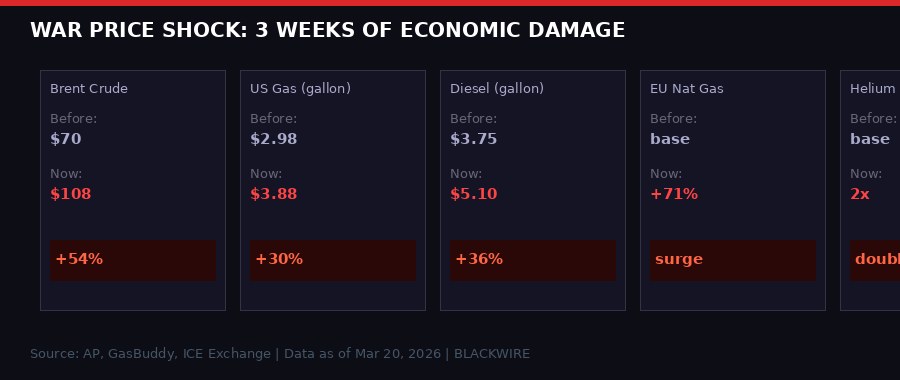
Three weeks of war, quantified: price surges across oil, gasoline, diesel, European gas, and helium since fighting began February 28. Goldman Sachs forecasts higher inflation, slower growth, and rising unemployment by year-end. (BLACKWIRE / AP, GasBuddy, ICE)
Goldman Sachs issued a stark forecast on Thursday: based on its analysis and historical experience, higher oil prices will cause inflation to be higher, growth to be slower, and the unemployment rate to increase by the end of the year. The investment bank did not specify figures, but the direction is unambiguous.
Trump acknowledged the problem on Thursday while trying to spin it as an opportunity. "The United States is the largest Oil Producer in the World, by far, so when oil prices go up, we make a lot of money," he wrote on social media. That framing contradicts his position as recently as his February State of the Union address, where he boasted about gas at $2.30 a gallon. The national average is now $3.88. Prices have increased about 30% since the war started - a number that will matter enormously in November midterm elections.
Iran Threatens Global Tourism - The Deliberate Escalation Ladder

Iranian strikes on Gulf energy infrastructure have continued into week three. Saudi Arabia reported downing 20 drones in its eastern oil region in a single two-hour period Saturday morning. (Illustrative / Pexels)
While the helium story is the hidden economic crisis, the declared threat is explicitly psychological and global in scope.
On Friday, Gen. Abolfazl Shekarchi, Iran's top military spokesperson, issued a warning that went beyond the battlefield: "parks, recreational areas and tourist destinations" worldwide will not be safe for the country's enemies. The statement is a deliberate escalation up the threat ladder - from military installations and energy infrastructure toward soft civilian targets in countries that have either participated in or supported the U.S.-Israeli campaign.
This mirrors a well-established Iranian playbook. When conventional military options narrow, Tehran has historically enabled or directed proxy attacks through its global militant networks. Hezbollah, which has already opened a second front in Lebanon where Israeli strikes have killed more than 1,000 people and displaced over one million, is the most capable such network. But Iran's IRGC Quds Force has maintained sleeper networks across Europe, Latin America, and Southeast Asia - networks that Western intelligence services have been monitoring with heightened concern since the war began.
Mojtaba Khamenei, who became Iran's new Supreme Leader after Israeli strikes killed his father Ayatollah Ali Khamenei, issued a written statement for Nowruz - the Persian New Year - read on Iranian state television. He has not been seen in public since ascending to the position. His statement praised Iranians' "steadfastness" and dismissed the U.S.-Israeli thesis that killing Iran's top leadership would trigger the regime's collapse.
"The U.S. and Israeli attacks were based on an illusion that killing Iran's top leaders could cause the overthrow of the government." - Mojtaba Khamenei, Iranian Supreme Leader, Nowruz statement (AP, March 20, 2026)
The on-ground reality contradicts that confidence in part: Gen. Ali Mohammad Naeini, Iran's IRGC spokesperson, was killed in an airstrike Friday - just hours after telling state media that Iran continues manufacturing missiles despite Israeli claims to have destroyed production capabilities. The IRGC's command structure has been systematically degraded, but the organization continues operating under decentralized leadership.
Saudi Arabia's eastern oil region reported 20 drones downed in a roughly two-hour window Saturday morning, according to the Saudi defense ministry. The region houses Aramco's core infrastructure. No damage or casualties were reported - but the tempo of attacks shows no sign of slowing.
The Executions: War as Cover for Internal Repression

Three men arrested during Iran's January protests - including 19-year-old wrestler Saleh Mohammadi - were executed Thursday. Rights groups warn more than 100 others face the same fate. (Illustrative / Pexels)
Inside Iran, the war has provided cover for a crackdown that rights organizations say may produce mass executions.
On Thursday, three young men were hanged in Qom, just south of Tehran: Saleh Mohammadi, a 19-year-old wrestler who had won international youth competitions; Mehdi Qasemi; and Saeed Davoudi, who was executed one day before his 22nd birthday. They were among the first executed from the tens of thousands arrested during a January crackdown on nationwide protests - demonstrations that rights monitors say resulted in the deadliest security response since the Islamic Republic took power in 1979.
Amnesty International said the convictions came in "grossly unfair trials" using confessions extracted through torture. The charges were "moharabeh" - waging war against God - for allegedly killing two police officers during protests. Mohammadi's lawyers said he denied the charges and retracted his confessions in court, stating they were coerced under beatings that broke one of his hands.
The U.S.-based Human Rights Activists News Agency, drawing on contacts inside Iran, said it confirmed more than 7,000 killed during the protest crackdown. Iranian authorities acknowledged more than 3,000. At least 27 death sentences have been documented by Iran Human Rights, the Oslo-based monitoring group, against people arrested during the protests - with more than 100 others facing charges carrying the death penalty.
"The Islamic Republic is struggling for its survival and is well aware that the main threat to its existence comes not from external actors, but from the Iranian people demanding fundamental change." - Mahmood Amiry-Moghaddam, Director, Iran Human Rights (AP, March 2026)
The war, which the Islamic Republic's leadership frames as external aggression, has functioned to temporarily consolidate nationalist sentiment among some segments of the population - while the regime uses the cover of wartime emergency powers to accelerate the execution of domestic opponents. Internet blackouts inside Iran make independent verification of internal conditions almost impossible.
What Happens Next: Weeks Matter More Than Months

The global supply chain under Iran war stress: oil rerouting, LNG unavailable, helium stranded, chip fabs on countdown. Each week the war continues extends the structural damage to interconnected systems. (Illustrative / Pexels)
The Trump administration is now sending three more amphibious assault ships and 2,500 additional Marines to the region - on top of 2,500 Marines redirected from the Pacific earlier this week, and the more than 50,000 U.S. troops already deployed. The president simultaneously posted Friday that the U.S. was "considering winding down" military operations. Both are true. They are not contradictory - they are the behavior of an administration that doesn't have an exit strategy and is paper-covering its uncertainty.
The Treasury Department moved Friday to lift sanctions on Iranian oil already loaded on ships - a 30-day pause ending April 19 - in an explicit attempt to ease prices. The move is modest. Iran has been evading U.S. oil sanctions for years; most of what it sells already reaches buyers through shadow markets. The sanction lift doesn't increase production - the actual constraint is that Iranian oil facilities have been bombed. It won't move prices meaningfully.
For the helium and semiconductor crisis, the timeline is now measured in weeks. Phil Kornbluth's estimate - that chipmakers have not run out yet, but are "a few weeks out when the shortage really hits" - was made earlier this week. Every day the war continues and Ras Laffan remains offline is one day closer to that reckoning.
The United States can, in theory, surge domestic helium production. USGS data shows the U.S. produced 81 million cubic meters in the most recent full year. But helium production capacity is constrained by the natural gas wells that contain it - you cannot simply build more. The federal helium reserve in Amarillo, Texas has been in the process of being privatized and wound down since 2013. Strategic stockpile capacity is limited.
The irony that will define the economic legacy of this war: the country that started it to weaken Iran's nuclear and missile programs may have achieved significant degradation of Iranian military capability - while simultaneously triggering the first major global semiconductor supply crisis since the pandemic-era chip shortage of 2021. Except in 2021, demand outstripped supply. This time, supply is being physically destroyed by drone strikes on a gas facility in Qatar that most Americans couldn't find on a map.
The war is three weeks old. The structural damage to global supply chains is already measured in billions of dollars per day. The helium shortage hasn't hit yet. The grocery price increases are still weeks away. The geopolitical settlement - if one comes - is further still.
Ask the engineers at TSMC's fab 18 in Tainan, running their helium levels down day by day, what winning looks like. They're not thinking about regime change in Tehran. They're thinking about the containers that aren't coming.
Get BLACKWIRE reports first.
Breaking news, investigations, and analysis - straight to your phone.
Join @blackwirenews on Telegram