Nowruz Under Fire: Bombs, Bodies, and the Iran War's Third Week
Iran enters Persian New Year 1405 under relentless bombardment. Three protest prisoners hanged as airstrikes hit Tehran. Trump sends 5,000 more Marines while claiming the war is nearly over. Oil sits at $108 a barrel. Nobody has an exit ramp.
Tehran, March 20, 2026. Fighter jets pierced the spring sky as Iranians marked Nowruz, the Persian New Year. [BLACKWIRE/illustration]
The spring equinox arrived at 18:15 Tehran time on Friday, March 20. For most of recorded history, that moment has meant something specific to Iranians: the start of Nowruz, the Persian New Year. Families gather. Tables are set with the Haft Sin - seven symbolic items beginning with the letter S. Children receive gifts. The country briefly breathes.
This year, the moment of the new year was marked by anti-aircraft batteries firing into the sky above the capital. Some residents cheered from rooftops. Others chanted "Death to the dictator." Israeli jets had struck Tehran hours earlier. [Al Jazeera, March 20]
Iran is celebrating its first wartime Nowruz since the 1980s, when Saddam Hussein's army crossed the western border and launched eight years of grinding attritional war. The parallels are not lost on anyone who lived through that period. But this time the strikes are coming from the air, not the ground, and the attacker is not a neighboring state - it is the world's most powerful military working alongside its closest ally in the region.
Three weeks in, the US-Israeli campaign against Iran has killed more than 1,300 Iranians, forced one million Lebanese from their homes, driven oil to $108 a barrel, and generated a cascade of contradictory signals from Washington about whether the war will continue or wind down. On the same day Trump posted on social media that the US was "considering winding down" operations, his administration announced the deployment of three more amphibious assault ships and 2,500 additional Marines. The Pentagon simultaneously requested $200 billion more from Congress to fund the war. [AP News, March 20-21]
The contradictions are structural, not accidental. They reflect a war that nobody designed a proper exit from.
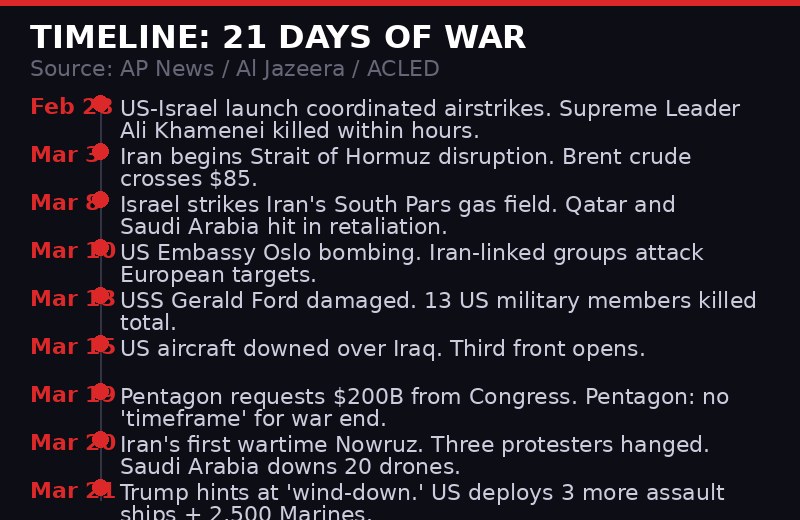
21 days of conflict: key events from the opening strikes on February 28 to the Nowruz bombardment. Source: AP News / Al Jazeera / ACLED.
How the War Began and Where It Stands
The war began on February 28, when US and Israeli forces launched coordinated airstrikes against Iran in a campaign that immediately distinguished itself by its ambition. Within hours of the first strikes, Iranian state media confirmed the killing of Supreme Leader Ayatollah Ali Khamenei. The IRGC command structure was decapitated in the opening phase. Multiple senior officials were killed in rapid succession. The operation was designed, as analysts later described it, to "paralyse decision-making" from the top down. [Al Jazeera, March 20]
Leadership continuity passed to Mojtaba Khamenei, the son of the killed supreme leader, who has not appeared in public since becoming Iran's new supreme leader. He delivered a written Nowruz message broadcast on state television, praising Iranian steadfastness and claiming that the enemy had been "defeated." The message offered no evidence for that claim. [AP News, March 20]
The war's stated objectives have shifted multiple times since February 28. The US and Israel have at different points described the goals as: eliminating Iran's nuclear program, destroying its ballistic missile capacity, decapitating its political and military leadership, fomenting internal uprising sufficient to topple the Islamic Republic, and securing free passage through the Strait of Hormuz. The objectives are not mutually exclusive, but they are not a coherent strategy either. Achieving all of them simultaneously would require an occupation. Neither Washington nor Tel Aviv has said anything about occupation.
Jon Alterman, a global security and geostrategy analyst at the Center for Strategic and International Studies, told Al Jazeera: "President Trump has outlined a wide array of goals. This will give him the option of stopping the assault whenever he wants. But what he won't be able to do is control what the Iranians do in response. A halt in American bombing alone will neither stop the war nor necessarily open the Strait of Hormuz, let alone lead to security in the Gulf." [Al Jazeera, March 20]
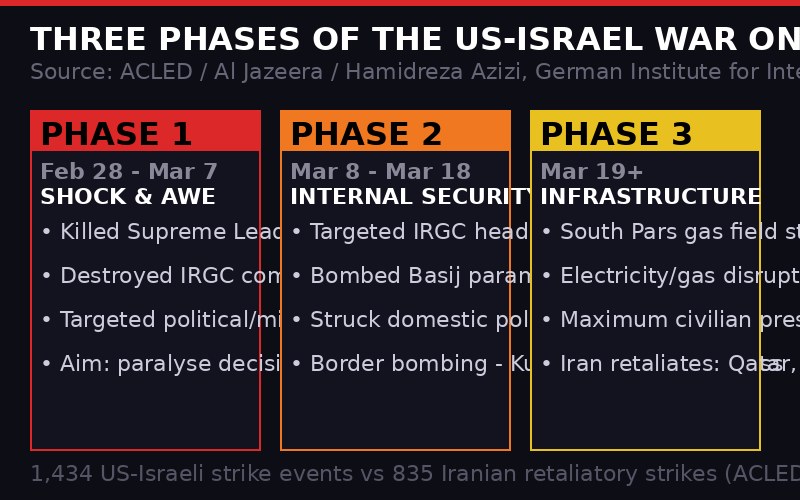
The war has moved through three identifiable phases, according to analysts at ACLED and the German Institute for International and Security Affairs. Sources: Al Jazeera, ACLED, Hamidreza Azizi / GIIA.
The most significant development of week three came on Wednesday, March 18, when Israeli jets struck Iran's South Pars offshore natural gas field - the largest single gas deposit in the world, shared with Qatar's North Field. Iran retaliated the same day with strikes on Qatar's Ras Laffan facility and Saudi Arabia's Samref oil refinery. The escalation drew a rare public rebuke from Trump, who said Israel had "lashed out" without US approval - the clearest signal yet of potential divergence between Washington and Tel Aviv. [Al Jazeera, March 20]
The Three Phases of Destruction
Hamidreza Azizi, a visiting fellow at the German Institute for International and Security Affairs, has outlined three distinct phases in the US-Israeli campaign, each with a different operational logic.
Phase one - running roughly from February 28 to early March - was a "shock and awe" opening that targeted both military capabilities and political leadership simultaneously. The killing of Supreme Leader Khamenei in the first hours was the centerpiece. IRGC generals were killed in rapid succession. The goal, according to Azizi, was to "paralyse decision-making in the system" and create conditions for "regime transformation" - installing leaders more amenable to US and Israeli demands. [Al Jazeera, March 20]
Phase two began in the second week and targeted internal security infrastructure. "Almost every single IRGC headquarters" was struck, along with the Basij paramilitary group headquarters and domestic police facilities. The operational logic was to erode Iran's capacity to maintain internal order - to make space for protests or armed insurgency. Heavy bombing along Iran's western border with Iraq was interpreted as an attempt to facilitate the entry of Kurdish armed groups that the CIA has reportedly been supporting. [Al Jazeera, March 20 / AP News]
Phase three - which appears to have begun with the South Pars strike on March 18 - is aimed at disrupting the Iranian government's ability to provide basic services, primarily electricity and gas, to its population. The strategic logic is civilian pressure: make conditions in Iran sufficiently intolerable that the government cannot maintain popular compliance, even in wartime. This approach carries obvious humanitarian costs and significant legal questions under international law regarding attacks on civilian infrastructure.
"The aim seems to be to also disrupt the government's ability to provide basic services, especially electricity and gas, to make the situation further untenable for residents of Iran." - Hamidreza Azizi, German Institute for International and Security Affairs, via Al Jazeera
By the numbers: the US and Israel have conducted 1,434 total "strike events" against Iran, compared with 835 retaliatory Iranian strikes. The Trump administration says it has hit more than 7,800 individual targets, flown over 8,000 combat missions, and damaged or destroyed 120 Iranian naval vessels. White House officials have described Iran's ballistic missile capacity as "functionally destroyed" and its naval assets as largely neutralized. Iran disputes each of these figures. [ACLED / Al Jazeera, March 20]
Nowruz 1405: A New Year in Digital Darkness
Ghazal - a Tehran resident with two young children who asked Al Jazeera not to use her full name - described sheltering at home through the moment of the new year. "We've been mostly hunkered down at home, but regardless of the bombs and missiles, Nowruz is always a blessed time, and we will give it value as people have been for millennia," she said. "There is still a lot to hope for this year, even though the war also makes you concerned about the future of your children and country." [Al Jazeera, March 20]
The Iranian government imposed a near-total internet shutdown on the country's more than 92 million people beginning on day one of the war. The shutdown has now been in place for 21 consecutive days. Internet monitoring organization NetBlocks reported that connectivity stands at less than 1 percent of pre-war levels - and pre-war levels were already heavily censored and throttled. A black market for VPN access and satellite connectivity has emerged, but the overwhelming majority of Iranians are confined to a state-controlled intranet offering limited local services. [Al Jazeera / NetBlocks, March 20]
"Iran is entering Nowruz in digital darkness," NetBlocks said in a statement. The phrase captures something beyond the practical difficulty of information access. The internet shutdown also means the world has limited visibility into what is happening inside the country - casualties, civilian displacement, infrastructure damage, food and fuel shortages. Iran's government controls nearly all the information flowing out.
Some traffic returned to Tehran's streets in the days before Nowruz, as residents who had fled to rural areas came back to their homes. Petrol stations continued to see queues, though the government maintained there was no fuel shortage - residents with fuel cards can access up to 30 litres per day. Blood donation centers have reported sustained supply from the public since the war began. Hospitals have not publicly declared crises, though independent verification is impossible under the information blackout. [Al Jazeera, March 20]
In Tehran's Behesht-e Zahra cemetery - the city's vast burial ground south of the capital - thousands of families visited graves on the last Thursday of the Persian year, a traditional pre-Nowruz ritual. For families of protesters killed in the January crackdown, the visits reopened wounds that are still raw. Footage circulating online showed the mother of Sepehr Shokri - a 19-year-old shot dead while protesting - weeping at his grave. "You have guns, and my son stood up to you with his chest," she told the crowd gathered around her. The family has reportedly been threatened with arrest and violence by state authorities. [Al Jazeera, March 20]
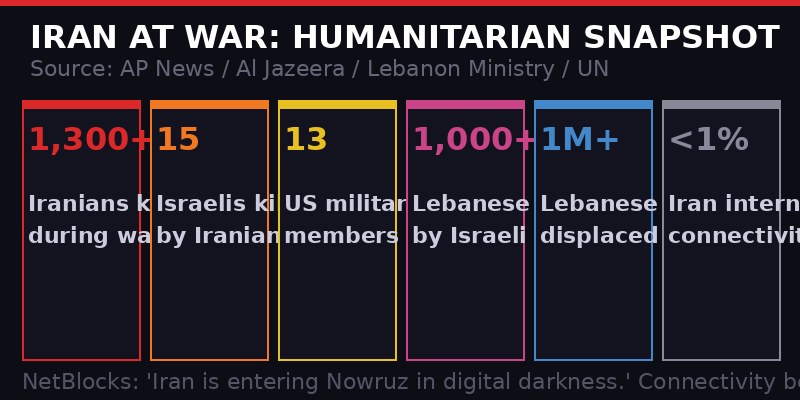
Casualty and displacement data as of March 21, 2026. Sources: AP News, Al Jazeera, Lebanon Ministry, UN, NetBlocks.
Executions Behind the Blackout: Three Men Hanged on Nowruz Eve
The war's humanitarian toll extends beyond airstrikes. On Thursday morning, March 19 - one day before Nowruz - the Iranian government hanged three men in the city of Qom, just south of Tehran. They were Saleh Mohammadi, 19, a nationally recognized youth wrestler; Mehdi Qasemi; and Saeed Davoudi. All three had been convicted of "moharabeh" - "waging war against God" - for allegedly killing two police officers during the January protests. [AP News, March 20]
Davoudi was born on March 20, 2004. He was executed one day before his 22nd birthday.
Mohammadi's background made his execution particularly visible. In 2024, he won a bronze medal at an international youth freestyle wrestling tournament in Krasnoyarsk, Russia. His Instagram account, still accessible before the internet shutdown, showed a young man deeply invested in sport - videos of training sessions, inspirational posts about discipline and endurance. His last post, from late December, showed him in a gym: "We endured beyond our imagination. Back again." [AP News, March 20]
Shiva Amelirad, an Iranian teacher living in Toronto who knew Mohammadi in 2022, told AP: "He was full of energy." He had first been arrested during the 2022 protests that erupted following the death of Mahsa Amini in police custody. [AP News]
Amnesty International condemned the executions, stating that the convictions of all three men came in "grossly unfair trials" that relied on confessions extracted by torture. The organization called for immediate stays of execution for others facing similar charges. [AP News, March 20]
"The executions were intended to instill fear in society and deter new protests amid the US-Israeli war on Iran." - Mahmood Amiry-Moghaddam, director, Iran Human Rights (Oslo), via AP News
The scale of potential executions is alarming. Iran Human Rights has documented at least 27 confirmed death sentences issued against protesters arrested during the January crackdown. Another 100 face charges that carry the death penalty. Iranian state television has broadcast hundreds of forced confessions to crimes punishable by death. Amiry-Moghaddam said he fears that "executions of protesters and political prisoners may be imminent" on a far larger scale. [AP News, March 20]
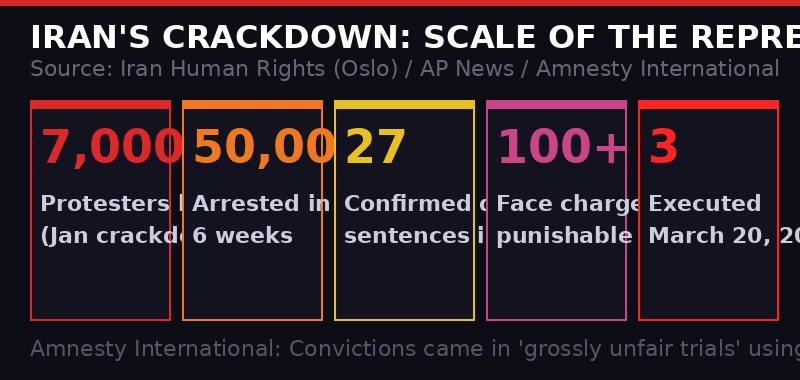
The scale of Iran's post-protest crackdown. Sources: Iran Human Rights (Oslo), AP News, Amnesty International.
The January protests themselves were unprecedented in their scale and violence. The US-based Human Rights Activists News Agency - which relies on a network of contacts inside Iran - said it confirmed over 7,000 killed and was investigating thousands more. More than 50,000 were arrested in just over six weeks. The Iranian government acknowledged more than 3,000 killed, describing all deaths as the result of actions by "terrorists" and "rioters" funded by the US and Israel. International human rights organizations reject that characterization entirely. [AP News]
What makes the executions politically notable is their timing. The war began on February 28, nominally targeting the same security apparatus that conducted the crackdown. US officials, including Trump himself, cited the January crackdown as partial justification for military action. Yet the crackdown is continuing - executions are proceeding, arrests are ongoing, and the internet blackout that helped conceal the January killings has simply been extended under wartime emergency powers. The war has not liberated the protesters. It has given the government new cover to execute them.
Trump's Contradiction Machine: Wind-Down or Escalation?
On Friday afternoon, Trump posted on social media: "We are getting very close to meeting our objectives as we consider winding down our great Military efforts in the Middle East."
The post landed while three more US amphibious assault ships were already underway toward the region, carrying 2,500 additional Marines. Days earlier, another 2,500 Marines had been redirected from Pacific deployments. They will join more than 50,000 US troops already in the Middle East. The Pentagon, on the same day Trump suggested wind-down, formally requested $200 billion from Congress to continue funding the war. Secretary of Defense Pete Hegseth had said the previous day there was no "timeframe" for ending the conflict. [AP News, March 20-21 / Al Jazeera]
The contradiction is not incidental. It reflects the operational reality of a war where the stated political objectives have never been matched by a realistic termination plan. The Trump administration's list of goals - nuclear program elimination, missile capacity destruction, regime change, Strait of Hormuz reopening - does not have a natural stopping point. You can degrade Iran's military indefinitely. You cannot bomb your way to a government that is "amenable to US and Israeli demands" while also bombing the country's civilian infrastructure and executing dissidents.
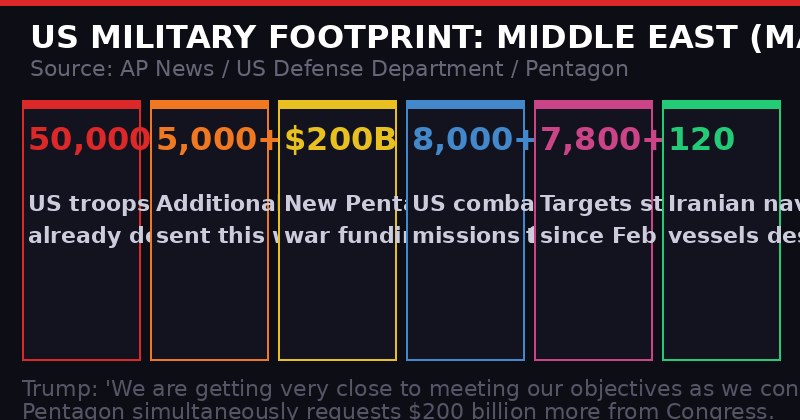
US military deployment scale as of March 21, 2026. Sources: AP News / US Defense Department.
The most consequential economic move of the week was the US announcement that it was temporarily lifting sanctions on Iranian oil already loaded on ships - a measure in effect until April 19 and specifically designed to address soaring fuel prices. Brent crude had reached approximately $108 per barrel by late week, up from roughly $70 before the war began on February 28. The sanctions pause does not increase actual production - the Strait of Hormuz remains disrupted - but it was intended to signal that Iranian oil already en route could reach markets without sanction risk. Treasury Secretary Scott Bessent had previously floated the idea as a way to prevent China from being the sole beneficiary of Iranian oil sales. [AP News, March 20]
The stock market responded negatively to the broader war signals. High oil prices knocked down US equities as investors processed a war with no visible end date, a $200 billion additional funding request, and contradictory messaging from the commander-in-chief. The economic feedback loop - war driving oil prices, oil prices hitting markets, markets pressuring policy - is now a central feature of the conflict's political dynamics. [AP News]
Regional Contagion: Lebanon, Saudi Arabia, Qatar, and the Gulf
The US-Israeli campaign's effects have radiated well beyond Iran's borders. Israeli military operations against Hezbollah in Lebanon continued in parallel with the Iran campaign. The Israeli military announced a new wave of strikes targeting Hezbollah positions in Beirut's southern suburbs early Saturday morning, with smoke rising over central Beirut and residents reporting explosions across multiple neighborhoods. Evacuation warnings were renewed for seven Beirut neighborhoods. [AP News, March 21]
The Lebanese death toll from Israeli strikes targeting Hezbollah has surpassed 1,000. More than one million Lebanese have been displaced. The Lebanese state, already structurally fragile before this conflict, is absorbing a humanitarian crisis that its health, shelter, and logistics infrastructure was not designed to handle. [AP News, March 21]
Iran has simultaneously escalated attacks on Gulf neighbors since Israel bombed the South Pars gas field on March 18. Saudi Arabia's eastern region - home to the kingdom's main oil infrastructure - came under drone attack on the night of March 20, with Saudi authorities reporting they downed 20 drones within a two-hour window. The Saudi defense ministry said there were no injuries or material damage, but the scale and speed of the attack demonstrated Iran's continued capacity to project force into the Gulf despite weeks of US-Israeli bombardment aimed at degrading exactly that capability. [AP News, March 21]
Iran continues to maintain a stranglehold on shipping in the Strait of Hormuz, the strategic waterway through which approximately one-fifth of the world's oil and a significant proportion of global trade flows. The closure or disruption of the Strait is not merely an energy price issue - it affects food and medicine imports for countries across the Indian Ocean basin. Trump has called on NATO allies to help guarantee shipping through the Strait, describing European partners as "cowards" for failing to provide military support. NATO has responded by relocating personnel from Iraq without committing to naval operations. [AP News / Al Jazeera, March 20]
The international coalition around the US-Israeli campaign remains thin. Switzerland - citing its longstanding constitutional neutrality - announced on Friday that it would halt weapons exports to the United States for the duration of the Iran conflict. The Swiss government simultaneously closed its airspace to US military flights directly linked to the Iran war. Switzerland was the second-largest importer of Swiss arms in 2025, with purchases worth approximately $119 million. The Swiss decision carries symbolic weight disproportionate to its military significance: a neutral state that refused to sanction arms exports even to Ukraine's defenders is now refusing to arm the United States. [Al Jazeera, March 20]
"The export of war materiel to countries involved in the international armed conflict with Iran cannot be authorised for the duration of the conflict." - Swiss Federal Government statement, March 20, 2026, via Al Jazeera
Sri Lanka added a separate diplomatic signal when President Anura Kumara Dissanayake confirmed that his government had denied a US request - made on February 26, two days before the war began - to land two military aircraft at Mattala Airport. The denial is notable because Mattala's strategic location near Indian Ocean shipping lanes made it a potentially useful logistics node. Sri Lanka's refusal signals how widely the war is generating friction with countries that might normally accommodate US military requests. [Al Jazeera, March 20]
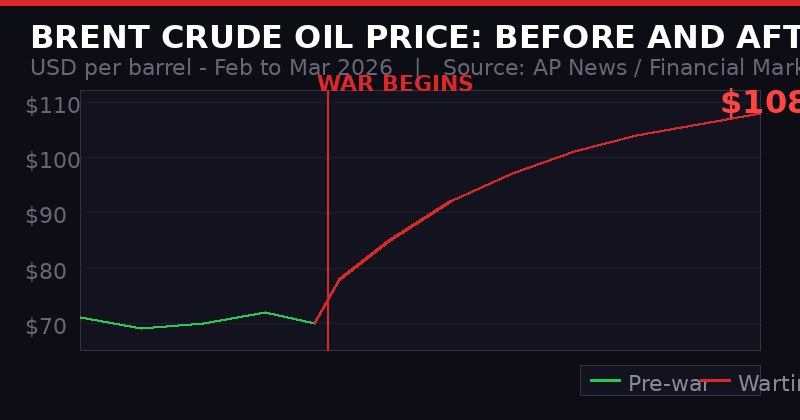
Brent crude oil at $108/barrel as of March 20 - up from roughly $70 before the war began February 28. Sources: AP News / Financial Markets.
The Information War: What Nobody Knows
One of the defining features of the first three weeks of this conflict is the extraordinary opacity around actual conditions inside Iran. The internet blackout - now at less than 1 percent of pre-war connectivity - has made independent verification of almost any claim about events inside the country essentially impossible. The Iranian government publishes official figures. The US and Israeli militaries publish strike counts. Neither set of numbers can be independently confirmed.
AP News reported that with "little information coming out of Iran, it was not clear how much damage its arms, nuclear or energy facilities have sustained in the punishing US and Israeli strikes - or even who was truly in charge of the country." The acknowledgment is significant coming from one of the world's largest newsgathering organizations. The fog of this war is deliberate and thick. [AP News, March 20]
What is known: Iran's General Ali Mohammad Naeini, spokesperson for the Revolutionary Guard, was quoted by a state-run newspaper on Friday claiming that Iran continues to manufacture missiles despite Israeli claims of destroyed production capacity. Shortly after that statement was published, Iranian state television announced that Naeini had been killed in an airstrike. The sequence - a denial of damage followed immediately by the spokesman's death - offers a compressed illustration of the information environment. [AP News, March 20]
The new Supreme Leader Mojtaba Khamenei's physical condition remains unknown. He has not been seen in public since his father was killed and he was reportedly wounded in strikes. His Nowruz message was delivered as written text read on state television - a format that provides no information about his location, his health, or the actual state of governance. Iran's Supreme National Security Council chief has also been reported killed. The chain of legitimate governmental authority inside the country is unclear, and no outside actor appears to have reliable intelligence about who is actually making decisions in Tehran. [AP News, March 20]
Iran's military spokesperson Gen. Abolfazl Shekarchi provided the week's most alarming public statement, warning that "parks, recreational areas and tourist destinations" worldwide will not be safe for Iran's enemies. The threat represents a potential shift in Iranian strategy toward asymmetric attacks beyond the immediate conflict zone - using Iran's network of allied militant groups and intelligence assets to target soft civilian infrastructure in third countries. Iran has used this approach before, including in the 1994 AMIA bombing in Argentina and various attacks on Israeli and Jewish targets in Europe. The current threat does not specify targets, timelines, or methods. It may be designed primarily for domestic political consumption. It may not. [AP News, March 20]
Key Facts - Week Three
- Day 21 of US-Israeli war on Iran
- 1,434 US-Israeli strike events vs 835 Iranian retaliatory strikes (ACLED)
- 1,300+ Iranians killed; 15 Israelis killed; 13 US military killed
- 50,000+ US troops in the Middle East; 5,000 more deploying this week
- Brent crude: $108/barrel (from $70 pre-war)
- Three protest prisoners executed March 20 in Qom; 27+ more sentenced to death
- Iran internet connectivity: below 1% of pre-war levels
- Switzerland halts US arms exports, closes airspace to war flights
- Trump signals "wind-down" while Pentagon requests $200B additional funding
What Comes Next: Three Scenarios
The conflict as it stands does not have an obvious resolution pathway. The following three scenarios represent the most plausible trajectories, though none are certain and the conflict's actual direction will depend on decision-making inside systems - the Iranian government, the Israeli cabinet, the Trump White House - that are all operating under significant internal stress.
Scenario One: Managed Wind-Down. The Trump administration, facing severe domestic economic pressure from $108 oil and stock market declines, finds a face-saving formulation to halt US operations. Trump declares victory based on the destruction of Iran's missile capacity and leadership decapitation. US airstrikes pause. The Strait of Hormuz remains partially disrupted for weeks or months, but Iranian naval pressure gradually eases as the IRGC assesses its options. Israel continues limited strikes in Lebanon. The executions inside Iran continue. The new Khamenei consolidates power. Oil gradually retreats toward $85-90. The war technically ends but its consequences persist for years. This scenario requires Iran to accept the elimination of its supreme leader and much of its military command without a formal settlement. Probability: possible but requires significant Iranian restraint.
Scenario Two: Prolonged Attrition. Neither side achieves its stated objectives within the next 30-60 days. US strikes continue targeting Iranian infrastructure. Iran maintains Hormuz disruption and periodically strikes Gulf targets. Oil remains above $100. Economic pressure builds globally. NATO fractures further. Trump faces domestic political crisis from sustained high fuel prices heading into the 2026 midterm cycle. This is arguably the most likely medium-term scenario - wars with no clear termination plan tend toward attrition rather than resolution.
Scenario Three: Escalation to Ground Operations or Wider Regional War. Iran's threatened attacks on tourist sites materialize in Europe or elsewhere, triggering a political crisis in allied states. Or Iran successfully damages major Saudi oil infrastructure, drawing the Gulf states into the conflict directly. Or domestic instability inside Iran tips into armed insurgency with CIA-backed groups. Any of these developments could trigger a logic of escalation that pulls additional actors in. Trump has explicitly reserved "all options" including ground force deployment, though he has stated he has no current plans to use them.
Alterman's analysis from CSIS puts it plainly: the US cannot control what Iran does in response to any action, including a ceasefire. The initiative is not entirely Washington's to take. A war that opened with the assassination of a supreme leader and the destruction of a nuclear program does not end with a handshake and a joint statement. The terms of any settlement - if there is one - will need to address the fundamental question of Iranian sovereignty and security guarantees in a post-nuclear, post-IRGC environment. Nobody is publicly discussing those terms yet. [Al Jazeera, March 20]
In Tehran, Ghazal watches her children set the Haft Sin table. Outside, jets cross the spring sky. Nowruz is supposed to represent new beginnings. Year 1405 of the Persian calendar began under bombardment. What it ends with depends on decisions being made in Washington, Tel Aviv, and whatever room in Tehran currently serves as the Islamic Republic's command center - assuming that room still exists.
Get BLACKWIRE reports first.
Breaking news, investigations, and analysis - straight to your phone.
Join @blackwirenews on Telegram