Iran Strikes Ras Laffan: The Gulf Energy War Goes Hot
Iran's missile barrage on Qatar's LNG complex, Saudi gas facilities, and UAE energy targets signals a catastrophic expansion of the conflict. With Hormuz blockaded, oil at $100 a barrel, and Trump threatening to obliterate South Pars, the war has graduated from a campaign against Iran into a regional energy crisis with global consequences.

Fires at an energy facility - the kind of image that is now daily reality across the Gulf. (Illustrative)
What Happened at Ras Laffan

LNG processing infrastructure of the kind targeted at Ras Laffan. (Illustrative)
Ras Laffan is not just a gas facility. It is the industrial heartbeat of Qatar - and by extension, a critical node in Europe's post-Russia energy supply chain. Overnight on March 18-19, Iranian missiles struck the complex, which Qatar's Ministry of Foreign Affairs described as causing "significant damage." Qatar moved swiftly, declaring the Iranian embassy's military and security attaches persona non grata - a severe diplomatic rupture that signals Doha considers Tehran's actions an act of war against a neutral neighbor.
The sequence of events runs as follows: Israel - without US coordination, according to Trump - struck Iran's South Pars gas field in the northern sector. South Pars is the world's largest natural gas field by reserve, shared with Qatar across the Persian Gulf seabed. Iran, describing itself as acting "out of justified retaliation," then fired on the energy infrastructure of its Gulf neighbors - an action that reframes the conflict entirely. Iran is no longer simply fighting Israel and the United States. It is now openly targeting the sovereign infrastructure of Qatar, Saudi Arabia, and the UAE.
Saudi Arabia said it was "thwarting" an attempted attack on one of its gas facilities, with four Riyadh residents injured by falling shrapnel. The UAE reported intercepting missiles on course for a gas facility and oil field near Abu Dhabi. In the Strait of Hormuz itself, a vessel was struck by an unknown projectile and caught fire east of Khawr Fakkan, according to the UKMTO maritime authority. (Source: BBC Live, March 19, 2026; Al Jazeera, March 19, 2026)
"Iranian brutal aggressions against neighbouring countries have crossed all red lines." - Qatari Ministry of Foreign Affairs, March 19, 2026
The Saudi foreign minister went further, warning that the patience of Gulf states is "not unlimited" and that regional neighbors possess "significant capabilities" to respond. These are not hollow words. Saudi Arabia has one of the most capable air defense networks in the world, supplemented by American Patriot batteries. The question is not whether Riyadh can defend itself - it is whether a Saudi military response against Iran would detonate the entire region.
The Hormuz Trap: How Iran Controls the World's Energy Jugular

Tanker traffic through Hormuz has collapsed to a trickle under Iranian threat. (Illustrative)
To understand what Iran has achieved in this conflict - at enormous cost to its own civilian population - requires grasping one geographic fact: the Strait of Hormuz is 33 kilometers wide at its narrowest. Through that corridor passes 20% of the world's oil and liquefied natural gas every single day. In 2025, that equated to approximately 20 million barrels of oil and oil products per day, according to the US Energy Information Administration - nearly $600 billion in annual energy trade flowing through a choke point that Iran sits directly astride.
Iran has not formally closed the strait. It has done something more insidious: it has made transit catastrophically risky without formally prohibiting it. At least 21 vessels have been hit, targeted, or reported projectile attacks since the war began on February 28, according to an AFP tally as of March 18. Eight people have been killed at sea, with four more missing. Marine insurers have effectively suspended coverage for Hormuz transits, or have set premiums so high that commercial operators are refusing to run the gauntlet. Only 21 tankers passed through in the first two weeks of March - down from approximately 3,000 ships per month in normal times. (Source: BBC/US EIA/AFP/CNBC)
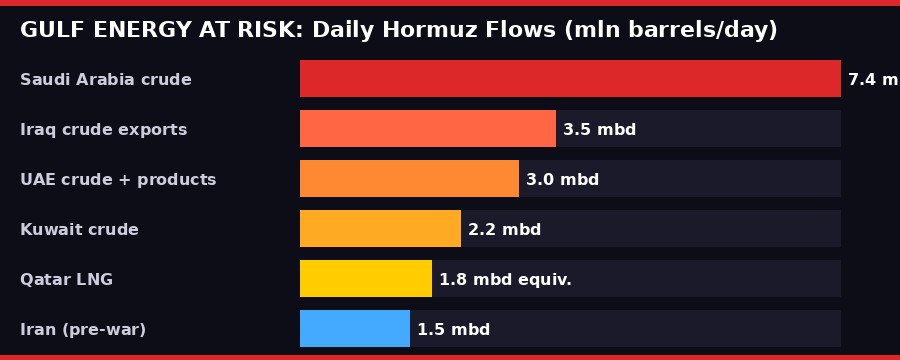
Daily energy flows at stake in the Strait of Hormuz - combined output from all major Gulf producers. (BLACKWIRE infographic / EIA data)
The economic implications are being felt globally. Crude oil has risen to approximately $100 per barrel - up nearly 70% since the start of 2026 and about 50% from a year ago. Jet fuel costs are spiking. British Airways, Emirates, Qatar Airways, and Qantas have suspended or dramatically reduced Gulf routes. Flights between London and Asia now route around the Middle East entirely, adding hours and enormous fuel costs. The ripple effects are global: fertilizer prices are rising because one-third of global fertilizer trade normally passes through Hormuz, and higher oil prices mean higher production costs for everything from food to electronics.
Saudi Arabia operates an overland bypass pipeline capable of routing up to 5 million barrels per day to the Red Sea port of Yanbu, avoiding the strait. The UAE has a similar bypass to Fujairah on the Gulf of Oman. But those alternate ports and loading facilities have themselves come under drone attack. And even fully utilized, they would still leave a shortfall of 8-10 million barrels per day compared to normal Hormuz traffic. The world simply has no ready replacement for this corridor. (Source: BBC/US EIA, March 2026)
Trump's Truth Social Threat and the US-Israel Disconnect

US carrier operations in the region continue even as the White House distances itself from Israeli strikes on South Pars. (Illustrative)
In the early hours of March 19, Donald Trump posted a lengthy statement on Truth Social that was simultaneously a denial, a threat, and an extraordinary public admission of the fracture between Washington and Jerusalem. The US "knew nothing" about Israel's strike on South Pars, Trump wrote. He described Israel as having "lashed out violently" out of "anger" - language that no US president would normally use about a core ally's military operation.
Trump insisted Israel would not strike South Pars again - a guarantee he apparently issued without consulting Netanyahu's government. He described South Pars as "extremely important and valuable," which reads less as reassurance to Tehran and more as a tacit acknowledgment that destroying it would be a line too far even for the current administration. But the threat he attached was not subtle: if Iran again attacks Qatar, "I will not hesitate" to "massively blow up" the South Pars field "at an amount of strength and power that Iran has never seen or witnessed before." (Source: BBC Live, March 19, 2026)
"If Qatar's LNG is again attacked, I will not hesitate to do so." - Donald Trump, Truth Social, March 19, 2026, threatening to destroy Iran's South Pars gas field
The strategic incoherence on display here is remarkable. The US is fighting an air war against Iran, dropping bombs on its nuclear program, oil infrastructure, and military commanders - while simultaneously trying to protect Qatar's LNG complex, which Iran has now struck. Trump wants to prevent further Iranian escalation against Gulf energy sites. His tool for doing so is threatening an escalation that would dwarf anything seen so far. The bluff - if it is a bluff - requires Tehran to believe that Trump would risk a global energy catastrophe to preserve Qatari gas exports.
Meanwhile, inside Washington, the cracks are widening. Joe Kent, Trump's former director of the National Counterterrorism Center who resigned earlier this week over the Iran war, told Tucker Carlson on March 19 that killing Ayatollah Khamenei was "the last thing that we ever should have done." Kent argued Khamenei was "moderating" Iran's nuclear ambitions and that his assassination has now produced exactly what the US claimed to fear: a harder-line supreme leader in Mojtaba Khamenei, the late ayatollah's son. The FBI is investigating Kent for alleged leaks of classified information, CBS News reported - which means the most damaging internal criticism of the war is now being treated as a counterintelligence matter. (Source: BBC, CBS, March 19, 2026)
The Pentagon has separately asked the White House to approve more than $200 billion in additional war funding - an amount the Washington Post reports would "far surpass" costs to date and is expected to "stage a major political battle in Congress." For context, the entire Iraq War cost approximately $2 trillion over two decades. The Pentagon is asking for $200 billion in fresh ammunition and weapons production capacity in week three of a conflict that has already killed seven US service members. (Source: Washington Post, via BBC, March 19, 2026)
The Decapitation Campaign: Every Senior Iranian Killed

Tehran residents describe a city under siege - from bombs above and regime forces on the streets. (Illustrative)
The Israeli-US strategy has involved a systematic campaign to kill Iran's senior leadership at a pace that has no historical precedent in the modern era. Intelligence Minister Esmail Khatib was confirmed dead on March 18-19, killed in an Israeli air strike on Tehran. Iranian President Masoud Pezeshkian confirmed the death, calling it a "cowardly assassination" that left Iran "in deep mourning." Israeli Defense Minister Israel Katz announced that Israel has authorized the IDF to kill "any senior Iranian official for whom the intelligence and operational circle has been closed, without the need for additional approval" - a standing kill order against the Iranian leadership class. (Source: BBC, March 19, 2026)
Khatib's death came after Ali Larijani - Iran's former parliamentary speaker and senior security advisor - was killed in an air strike on March 18, alongside Gholamreza Soleimani, a Basij Force commander. Larijani was one of the most politically connected figures in the Islamic Republic's history, a diplomat who had negotiated with Europe on nuclear matters and served as a confidant to multiple supreme leaders. His elimination removes a potential figure around whom any post-war political settlement might have been organized.
"Prime Minister Netanyahu and I have authorised the IDF to eliminate any senior Iranian official for whom the intelligence and operational circle has been closed." - Israeli Defense Minister Israel Katz, March 18, 2026
On the first day of the war, February 28, Israel and the US killed Supreme Leader Ayatollah Ali Khamenei himself - the defining act of the conflict. Mojtaba Khamenei, his son, has since been named Iran's new supreme leader by the Assembly of Experts. The regime's response to its own decapitation has not been collapse - it has been consolidation. Hundreds of people have been arrested in a sweeping internal crackdown. The streets of Tehran are flooded with regime loyalists and security forces. Independent journalists operate at mortal risk. The Islamic Republic is executing a wartime political purge in real time, eliminating anyone it suspects of cooperation with the United States or Israel. (Source: Al Jazeera, BBC, March 18-19, 2026)
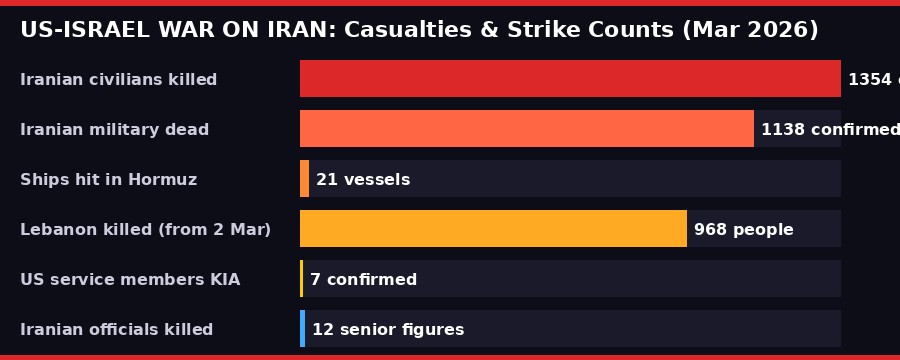
Confirmed casualty figures and strike counts as of March 19, 2026. Iranian civilian and military deaths combine to at least 2,492 confirmed. (BLACKWIRE infographic / Hrana, Iranian govt, AFP data)
The human cost inside Iran is staggering by any measure. The US-based Human Rights Activists News Agency (Hrana) reports at least 1,354 civilians and 1,138 military personnel killed since February 28, as well as 622 others it could not classify - a combined toll of over 3,100 in nineteen days. The Iranian government's own figures acknowledge at least 1,300 dead, including 226 women and 204 children. These are not casualty figures from a months-long campaign. This is nineteen days of intensive air strikes. For context, the Battle of Fallujah in 2004 - one of the most intense urban battles of the Iraq War - killed approximately 800 US-designated enemy combatants over 46 days. Iran has suffered multiples of that toll in less than three weeks.
Lebanon: A Second Front Fully Ablaze

The pattern of destruction in southern Lebanon mirrors what Gaza experienced in 2023-24. (Illustrative)
While the Gulf burns and Iran launches missiles across the Arabian Peninsula, Lebanon has become a second active front. Israel has destroyed at least two bridges over the Litani River in southern Lebanon, cutting links between the south and the rest of the country. The military cited Hezbollah's use of Lebanese state infrastructure to move fighters and weapons - the same justification it used during earlier campaigns, but now executed as part of a comprehensive campaign that has killed 968 people in Lebanon since March 2. At least 111 of the dead are children. (Source: BBC, Lebanese Health Ministry, March 19, 2026)
Israeli strikes have also extended into central Beirut, a significant escalation beyond the southern suburbs where Hezbollah's Dahieh stronghold is concentrated. At least 12 people were killed and 27 wounded in Wednesday's Beirut strikes. One multi-storey building collapsed after a pre-dawn warning strike. Bystanders watching the demolition raised posters of slain Hezbollah leader Hassan Nasrallah, marching them to the top of the rubble - a defiant gesture that captures the complicated politics of a country being bombed by its neighbor while its government is nominally neutral.
Hezbollah drew into the war when it fired missiles into Israel after the February 28 US-Israel opening strikes on Iran. Israel's response has been methodical and merciless: systematic destruction of Hezbollah's supply routes, command infrastructure, and financing networks - including the Al Qard Al Hassan organization, whose offices across Beirut have been targeted one by one. More than a million Lebanese civilians have been displaced, the Lebanese government says, mostly from the south and east and from southern Beirut. The echo of 2006, and of Gaza after October 7, 2023, is unmistakable to anyone in the region.
A "double tap" Israeli air strike near Beirut's Corniche seafront - where a location is hit twice in rapid succession - killed at least 12 people the previous week, many of them displaced civilians from other parts of Lebanon who had been sheltering in tents along the seafront. The Palestinian Red Crescent reported three Palestinian women killed in a beauty salon in the West Bank when falling shrapnel from an Iranian missile barrage on Israel - intercepted but not fully contained - came down on a civilian area in Beit Awa. Eight more were critically or moderately injured. Emergency crews faced "extreme difficulties" reaching the scene because of closed iron gates that blocked the road. (Source: BBC, Palestinian Red Crescent, March 18, 2026)
The Intelligence Failure That Started the War

US intelligence assessments that justified the war are now being challenged from within the administration itself. (Illustrative)
On March 18, US Director of National Intelligence Tulsi Gabbard testified before Congress in a session that produced one of the most politically damaging moments of the young conflict. Gabbard acknowledged that US intelligence assessment did not show Iran was actively rebuilding its nuclear enrichment capability prior to the war. This directly contradicts one of the core justifications Trump, National Security Advisor Michael Waltz, and other administration officials gave for launching the strikes on February 28. (Source: Al Jazeera, March 18, 2026)
The implications are significant but have largely been drowned out by the operational tempo of the war itself. If Iran was not rebuilding its nuclear enrichment capability, then the primary stated rationale for initiating the conflict - preventing Iran from obtaining a nuclear weapon before it could happen - was not supported by the intelligence that actually existed at the time. Gabbard's testimony does not necessarily mean the war was unjustified by other measures. Iran's support for Hamas, Hezbollah, Houthi attacks on shipping, and ballistic missile development provided ample alternative justifications. But the specific nuclear-prevention argument - the one most likely to survive international legal scrutiny as a legitimate casus belli - appears to have been weaker than advertised.
This matters operationally because it feeds the Joe Kent critique: that killing Khamenei was the "last thing" the US should have done, precisely because Khamenei was a restraining force on Iran's nuclear ambitions. The late supreme leader may have understood, at some level, that Iran crossing the nuclear threshold would be the trigger for exactly the kind of war that began on February 28. His son Mojtaba, the new supreme leader, has no such track record. What the new regime's nuclear policy will be - especially as its conventional military is degraded and its sense of regime survival becomes more desperate - is the central strategic uncertainty of the coming months.
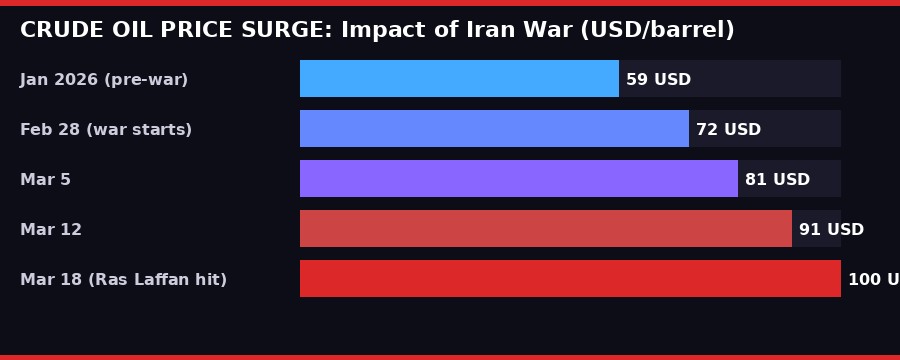
Crude oil prices from January to mid-March 2026. The Ras Laffan strike is expected to push prices further in Asian and European markets when they open on March 19. (BLACKWIRE infographic / Reuters data)
Macron's Moratorium and the Diplomatic Dead End

European diplomatic pressure is intensifying but finding few purchase points on a war driven by Israeli military objectives and US political calculations. (Illustrative)
French President Emmanuel Macron called on March 19 for a "moratorium" on strikes targeting civilian infrastructure, saying he had spoken with Trump and the Emir of Qatar. The two agreed, Macron wrote on X, that a halt was in the "common interest," particularly on energy and water supply facilities. "Civilian populations and their essential needs, as well as the security of energy supplies, must be protected from military escalation," he said. (Source: BBC Live, March 19, 2026)
Macron's statement is well-intentioned and substantively correct. It will have zero practical effect. The dynamics driving the conflict are not responsive to European diplomatic norms. Israel has a standing kill order against Iranian officials and is targeting Lebanon's infrastructure to degrade Hezbollah. The US is running a strategic bombing campaign against Iran's military, nuclear, and energy assets. Iran is retaliating against Gulf energy infrastructure. None of these actors will pause because Paris issued a strongly worded social media post.
The deeper problem for European diplomacy is that the continent simultaneously depends on Qatar's LNG for its energy security - LNG that largely replaced Russian gas after 2022 - and has no military leverage in the region. Europe can call for de-escalation. It cannot enforce it. The Royal Navy is reportedly considering a role in protecting Hormuz shipping, but the UK military's position is already stretched and the political appetite in London for a direct confrontation with Iran is close to zero. Meanwhile, US allies across the board - from Japan to Germany to Australia - have declined Trump's call to send warships to Hormuz to help secure the strait. The US is fighting this war largely alone, alongside Israel, with no NATO partner contributions and China watching carefully from the sideline. (Source: BBC, March 2026)
"There's no one here related to a political party. We are all civilians, not affiliated with anyone." - 25-year-old man in Beirut, after an Israeli strike destroyed a building in his neighborhood, to BBC, March 19, 2026
The civilian toll is the other dimension that diplomacy cannot ignore. In Iran, BBC reporters have obtained footage and interviews from Tehran that describe a city of "strained nerves" and "constant waiting." A businesswoman identified only as Baran told the BBC: "We sleep under rockets. Both skies give light, but different kinds of light." Ali, a middle-class man in his forties who had hoped Khamenei's death would bring change, now sees his streets occupied by regime loyalists and armed checkpoints. "The city looks like the city of the dead," he said. Independent journalists face arrest, torture, and worse. The people who most want the Islamic Republic gone are also the people most exposed to both the US-Israeli bombing campaign and the regime's wartime crackdown. (Source: BBC, March 18, 2026)
Timeline: 19 Days That Changed the Gulf
What Happens Next: Scenarios and Stakes

Global shipping patterns are being permanently altered by the Hormuz closure - even if the war ends tomorrow, the insurance and routing changes may take months to reverse. (Illustrative)
The Ras Laffan strike marks a qualitative shift in the war's geography. Until now, the conflict was primarily bilateral: the US and Israel against Iran, with Hezbollah as a secondary front. Iran has now opened a third vector - direct kinetic action against the sovereign energy infrastructure of Qatar, Saudi Arabia, and the UAE. Those states are now potential combatants, not just observers. If Saudi Arabia decides its patience has run out - and its foreign minister warned exactly that on March 19 - the war becomes a full Gulf conflict. Saudi Arabia has US-supplied F-15s, advanced Patriot missile systems, and a military budget that dwarfs Iran's. A Saudi entry into direct combat would change the balance decisively but would also shatter whatever remains of regional diplomatic architecture.
The alternative scenario is de-escalation anchored on energy. If Iran stops striking Gulf energy targets - perhaps in response to Trump's South Pars threat - and if Israel can be restrained from further South Pars attacks, there is a narrow path toward a Hormuz standstill agreement that stops short of ceasefire. India has been quietly negotiating with Tehran on exactly this basis, seeking passage for its own tankers. China, which imports 90% of Iran's oil exports and relies on Hormuz for its own energy security, has enormous economic incentive to broker restraint without publicly aligning with either side. Whether Beijing has the political will and leverage to operationalize that pressure remains the key variable that Western analysts cannot fully assess.
A third path is the one most dangerous to contemplate: continued escalation toward nuclear threshold questions. The new supreme leader Mojtaba Khamenei has no track record on nuclear policy. The regime's conventional military is being degraded. Its economy is in freefall - Hormuz closure is destroying Iran's own oil export revenue as much as it hurts the world. The historical record suggests that regimes under existential pressure do not become more moderate. If Tehran's leadership calculates that conventional retaliation is failing and that the regime's survival itself is at stake, the logic of nuclear deterrence - even the threat of breakout rather than actual weaponization - becomes thinkable in ways it was not two weeks ago.
The Gabbard testimony makes this harder, not easier. If the war began partly on the basis of an overstated nuclear threat, and if prosecuting that war has now brought Iran's political and military leadership to a point of desperation, the original intelligence failure compounds into a strategic trap. The US entered this war to prevent an Iranian nuclear weapon. It may have created the conditions that make an Iranian nuclear weapon the regime's only remaining deterrent option. That is not a prediction. It is the logic embedded in the current trajectory - and recognizing it is the first step toward disrupting it before it resolves into something irreversible.
"This war will not end soon, because this war is inside our homes, inside the families. The war has entered our blood and has entered our lives." - Baran, Iranian businesswoman speaking to BBC from Tehran, March 2026
On the streets of Tehran, a woman stands on a rooftop listening for the dogs to start barking. The dogs bark first, she says, before the aircraft come. Then the explosions. She has learned to read the city's sounds like a weather forecast for violence. She does not know about oil prices or congressional budget fights or intelligence failures. She knows that she lives under rockets, and that the war has entered her blood, and that she does not know how she will get through tomorrow. That is the human residue of every strategic decision made in Washington, Jerusalem, Tehran, and Doha over the past nineteen days. Every bomb that falls lands somewhere, on someone. The bills are still being presented.
Get BLACKWIRE reports first.
Breaking news, investigations, and analysis - straight to your phone.
Join @blackwirenews on TelegramSources: BBC News (live blog, March 19, 2026), Al Jazeera (March 18-19, 2026), AFP, Reuters, CNBC, Washington Post (via BBC), CBS News (via BBC), US Energy Information Administration, UKMTO, Palestinian Red Crescent, Human Rights Activists News Agency (Hrana), Iranian government casualty data, Lebanese Health Ministry, Israeli Defense Forces statements, Qatar Ministry of Foreign Affairs. All casualty figures current as of 04:00 UTC, March 19, 2026. War began February 28, 2026.