Unsanction the Enemy: The US Is Considering Lifting Iran Oil Restrictions While It Is Still Bombing Iran
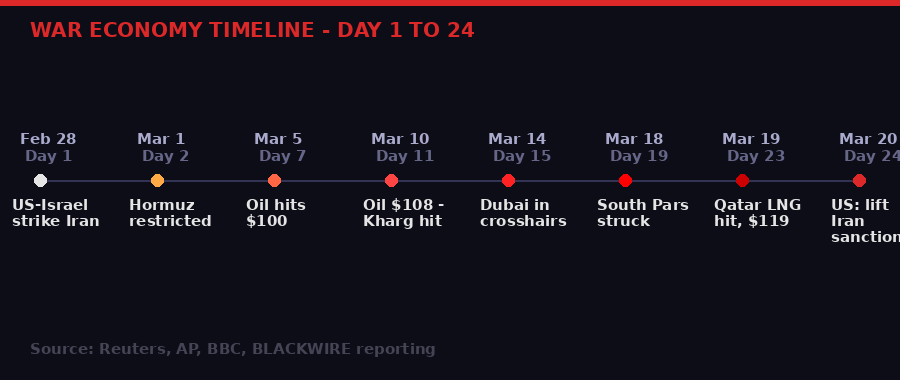
Treasury Secretary Scott Bessent went on Fox Business on Thursday and proposed something that has left sanctions experts slack-jawed: lifting restrictions on Iranian oil sales - the oil belonging to the country the United States is actively at war with - to relieve the energy price shock caused by that same war. "To put it mildly, this is bananas," one expert told the BBC. That is where we are on Day 24.

Israel's air force bombed Tehran overnight, striking what the IDF called "regime infrastructure" in the Nur district near the capital, as millions of Iranians marked Nowruz - Persian New Year. Iran fired back, launching four rounds of ballistic missiles at Jerusalem in under two hours. The UK's RAF Fairford base in Gloucestershire dispatched two B-52 strategic bombers on a 15-hour mission, returning before dawn with empty pylons where 24 JASSM cruise missiles had been loaded.
This is the 24th day of a war that the United States launched without a congressional declaration, without a clear exit strategy, and - according to three unnamed Israeli officials cited by Reuters - with at least partial foreknowledge of Israeli strikes that Trump later claimed to know nothing about.
The cracks are now structural. Netanyahu held a press conference Thursday and confirmed what those officials had hinted: Israel struck Iran's South Pars gas field alone, Trump was displeased, and the prime minister sees no contradiction in that. Meanwhile the Pentagon has submitted a $200 billion supplemental spending request to the White House - on top of $150 billion already distributed in Trump's tax-cut bill - and experts warn the math does not work even if Congress says yes.
The Bessent Proposal: Selling Enemy Oil to Pay for the Enemy War

What Bessent actually proposed, in an interview on Fox Business's "Mornings with Maria" on Thursday, was a waiver on sales restrictions covering Iranian crude already loaded at sea - roughly 140 million barrels. The logic: allow buyers other than China to purchase that oil at market price, diverting supply that currently goes to Beijing at a steep sanctions discount, and briefly easing global prices for 10 to 14 days.
The proposal was described by the Treasury Department in no greater detail after the broadcast. No mechanism was offered for preventing the proceeds from flowing back to the Iranian government - the government the US is simultaneously bombing.
"To put it mildly, this is bananas. Essentially we're allowing Iran to sell oil, which could then be used to fund the war effort." - David Tannenbaum, director of Blackstone Compliance Services, speaking to BBC
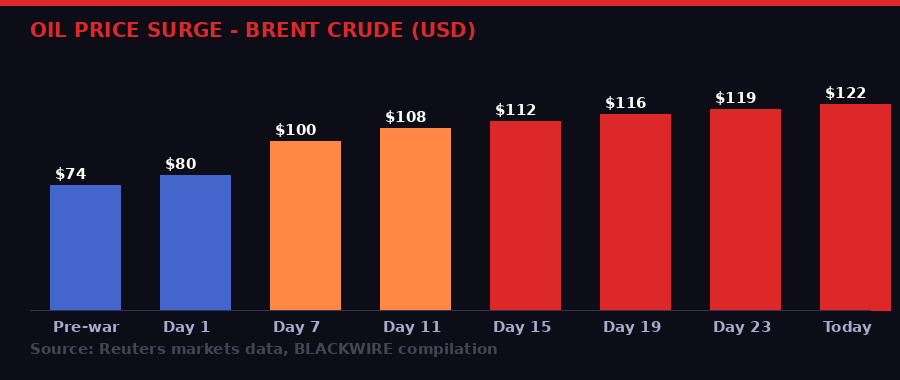
Rachel Ziemba, an adjunct senior fellow at the Center for a New American Security, acknowledged the logic of an "every-barrel-counts situation" but said the impact would be limited. Most of the sanctioned oil was already reaching markets through shadow fleet routes. The theoretical supply unlock could not substitute for the roughly 20 million barrels per day - one-fifth of global consumption - that normally transit the Strait of Hormuz, which has been functionally closed since the war began.
Trump, when asked directly whether the waiver would move forward, cut himself off mid-sentence: "We will do whatever is necessary to keep the price -" He did not finish.
The House of Representatives, in a separate and apparently uncoordinated development this week, passed a bill aimed at strengthening Iranian oil sanctions. Mike Lawler, the Republican from New York who sponsored it, did not respond to press inquiries about whether he found Bessent's proposal consistent with his legislation. He did not need to answer. The contradiction answers itself.
$200 Billion and Counting: The Pentagon's War Tab

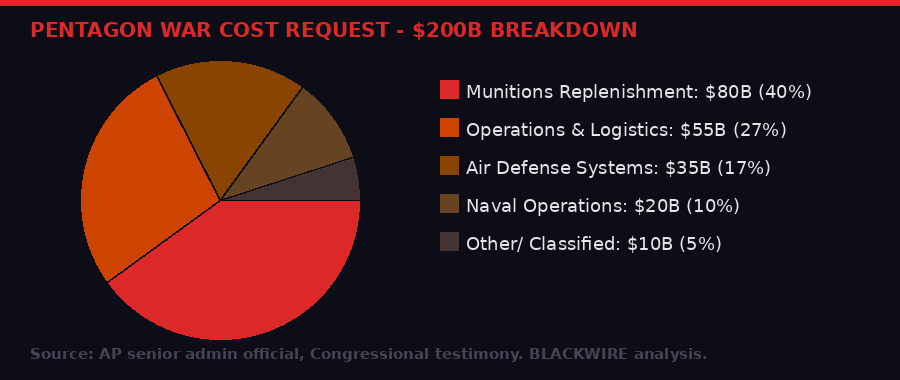
The Pentagon sent a $200 billion supplemental spending request to the White House this week, according to a senior administration official who spoke to AP on condition of anonymity. Defense Secretary Pete Hegseth, asked directly about the figure at a press conference, declined to confirm the amount but declined to deny it either.
"It takes money to kill bad guys." - Defense Secretary Pete Hegseth, press conference, March 19
The figure is extraordinary in context. The Pentagon's full annual budget approved by Congress for the current fiscal year was $800 billion. The $200 billion request comes on top of $150 billion already allocated to the Defense Department through Trump's tax and spending cuts bill - money Congress is still waiting for the administration to account for in any detail.
The nonpartisan Congressional Budget Office has projected a $1.9 trillion annual deficit this year - before any supplemental. National debt has already surpassed $39 trillion.
Congressional reaction split along predictable but significant lines. House Speaker Mike Johnson said "it's a dangerous time" and "we have to adequately fund defense." Rep. Ken Calvert, the Republican chair of the House defense spending subcommittee, said replenishing munitions was already necessary before the war. He sounded resigned: "That's where we're at."
Democrats were not resigned. Rep. Betty McCollum, ranking Democrat on the same subcommittee, said flatly: "This is not going to be a rubber stamp for the president of the United States. I'm not writing blank checks to the Department of Defense."
Rep. Rosa DeLauro called the $200 billion figure "outrageous." Senate Democrats have demanded the administration first explain where the prior $150 billion went. No answer has been provided.
House Majority Leader Steve Scalise acknowledged what will actually happen: "Ultimately we're going to have negotiations with the White House on an exact amount. We're not at that point yet." To pass without Democratic votes, Republicans would need to run the supplemental through a difficult budget reconciliation process. With Democrats, they would need to offer concessions that would likely balloon the package further.
Netanyahu Breaks Cover: Israel Acted Alone at South Pars

Israel's Prime Minister Benjamin Netanyahu held a news conference Thursday and confirmed what three Israeli officials had already told Reuters anonymously: Israel struck Iran's South Pars gas field in an independent operation. The US was not the author of that attack. Trump's subsequent public statement - expressing surprise and displeasure - was authentic, the officials said, though they added they were not surprised by his reaction.
Netanyahu denied that Israel had "misled" Trump or "dragged" the US into anything. He said no one could tell Trump what to do - a characteristically ambiguous formulation that served as both a denial and a claim.
"We can create the conditions, but they have to exploit those conditions at a certain point." - Israeli PM Benjamin Netanyahu, on whether Iranians might overthrow their own government
Netanyahu stated that Trump had requested no further attacks on energy targets following the South Pars strike. Within hours of that press conference, Israel struck Tehran again - targeting what the IDF described as "infrastructure" in the Nur district. Whether this constitutes compliance with Trump's request is currently unanswered.
The Israeli military's own assessment, released Friday morning, said Iran still possesses more than 150 functioning missile launchers and several hundred ballistic missiles. Since the war began, Iran has fired approximately 900 ballistic missiles - 350 at Israel, with nearly all the remainder directed at Arab Gulf states. The IRGC issued a statement Friday saying production lines remain fully operational despite the war.
Israel's Haifa oil refinery - the country's largest, processing roughly 60% of its diesel and 50% of its gasoline - sustained "localised hits" in Thursday's Iranian missile strike but reported no casualties and said most production facilities remained operational. An Iranian attack on a refinery in northern Israel that supplies more than half the country's diesel underscores how far the war has moved from its original framing as a precision counterproliferation campaign.
Nowruz Under B-52s: The War Hits Persian New Year

Nowruz - the Iranian and wider Persian cultural new year, celebrated on the spring equinox - began on March 20 this year. It is among the oldest holidays on earth, observed by more than 300 million people across Iran, Afghanistan, Central Asia, and the diaspora. For Iranians inside the country, it arrived with Israeli jets overhead and missile launch alerts on state television.
Two US B-52 Stratofortress strategic bombers departed RAF Fairford in Gloucestershire, England, Thursday evening, each carrying 12 AGM-158 JASSM or JASSM-ER cruise missiles. They returned approximately 15 hours later, BBC weapons analyst Chris Partridge confirmed, with empty pylons. The JASSM-ER has a range exceeding 900 miles - meaning the aircraft never needed to enter contested Iranian airspace to deliver their payloads.
The UK has authorized US use of its military bases for "defensive" strikes against Iranian missile sites. Prime Minister Keir Starmer said Britain had learned from "the mistakes of Iraq" and was not involved in the initial strikes that began February 28. Iran's foreign ministry has told London it considers allowing US use of British bases to constitute "participation in aggression." Whether the JASSM missions out of Fairford qualify as "defensive" is not a distinction Iran is likely to observe.
Iran's overnight counterstrikes on Jerusalem came in four waves within 90 minutes, followed by two more at dawn Friday. No casualties were reported. Israeli missile defense batteries continued to demonstrate high interception rates - the military said Iran's operational missile capacity has declined substantially over 24 days, though the IRGC contests this assessment publicly.
The Global Winners and Losers Scorecard

The BBC's deputy economics editor published an analysis Friday that offers a clear-eyed accounting of who is gaining and losing from the war's economic fallout - a question increasingly urgent as day 24 turns into day 25 with no ceasefire in sight.
Winners: Norway and Canada are the most direct beneficiaries of diverted energy demand. After the post-2022 pivot away from Russian gas following the Ukraine invasion, Norway demonstrated it could rapidly ramp production to fill European gaps. Canada's Energy Minister Tim Hodgson has been explicit: Canada is "a stable, reliable, predictable, values-based producer of energy." Russia, despite being a nominal adversary of the US on Ukraine, is projected to earn up to $5 billion in additional revenue by end of March alone - potentially its best fuel-revenue year since 2022. Indonesia, as a major coal exporter, benefits from the surge in coal prices as some nations revert to older energy sources.
Losers: The United States itself occupies an ambiguous position. American oil producers are banking windfall revenues at elevated prices, but the US is the world's largest per-capita consumer of oil and gas. Economists at Oxford Economics warned that if crude reaches $140 and stays there, the US economy risks contraction. ExxonMobil, which has operations at Qatar's Ras Laffan industrial hub - now damaged by Iranian missiles - is directly exposed. European consumers face a projected 0.5% inflation increase from sustained energy price elevation. Asian economies are hardest hit: South Korea sources 70% of its crude from the Middle East, and its critical semiconductor manufacturing sector faces energy cost pressure. Sri Lanka, Bangladesh, and the Philippines have already introduced fuel rationing and four-day work weeks.
China is, as usual, positioned more carefully than it appears. Beijing has been buying Iranian crude at a steep discount for years and has built strategic reserves covering several months of usage. It is reportedly continuing to ramp purchases from Iran - meaning Bessent's proposed sanctions waiver, designed partly to force China to pay "market price," may have less leverage than advertised.
The Alliance Fracture Map

Japanese Prime Minister Sanae Takaichi arrived at the White House Thursday having already stated privately that the visit would be "difficult." Her country's refusal to provide military assets for Hormuz operations - citing constitutional constraints - had infuriated the Trump administration. Japan joined six other countries in pledging to "contribute to appropriate efforts to ensure safe passage through the Strait of Hormuz" before the talks, a gesture that satisfied neither side.
Then came the Pearl Harbor moment. Asked by a Japanese journalist why the US had given no warning to allies before striking Iran on February 28, Trump looked at the Japanese prime minister and said: "Who knows better about surprise than Japan? Why didn't you tell me about Pearl Harbor?"
The room laughed. Takaichi's eyes widened. She leaned back and drew her hands in. "Clear discomfort," in the words of Mineko Tokito, a senior Yomiuri Shimbun correspondent present in the Oval Office.
The remark will resonate for months in Japanese domestic politics. Pearl Harbor - the 1941 attack that killed 2,403 Americans, triggered US entry into World War Two, and ultimately ended in the atomic bombing of Hiroshima and Nagasaki - is not casual conversational material between Tokyo and Washington. A retiree named Tokio Washino captured the reaction simply: "It makes me feel a bit uneasy as a Japanese citizen."
Takaichi told reporters afterward that she had briefed Trump on what Japan could provide "under its laws" - meaning: without military action. The US president described Japan as "friends" and said Tokyo was "really stepping up to the plate." No one at the briefing identified specifically what plate was meant.
Day 24 - War Situation Report
- Israeli strikes overnight: Tehran (Nur district), Iranian navy in Caspian Sea
- Iranian strikes overnight: 4 missile barrages at Jerusalem, 2 at dawn; Haifa refinery hit
- US bomber activity: Two B-52s from RAF Fairford, 15-hour mission, 24 JASSM missiles expended
- Bessent proposal: Lifting sales restrictions on 140M barrels Iranian crude at sea
- Pentagon request: $200B supplemental spending, submitted to White House
- Brent crude estimate: ~$119-122 range (Reuters data)
- Iranian missile capacity: IDF estimates 150+ functional launchers, several hundred ballistic missiles remaining
- Qatar LNG export impact: ~17% of export capacity affected by Ras Laffan damage
- UK energy price cap forecast: Rising to £1,973/year (+£332) in July due to war-driven wholesale energy costs
What Happens Now

The Bessent proposal is likely to generate more attention than action. A 140 million barrel unlock would cover roughly 1.4 days of global demand - a statistical noise event in a market that has lost access to 10% of global supply through Hormuz. The legal mechanism for preventing Iranian government revenue from flowing through a US-approved sanctions waiver does not appear to exist yet. The House just passed a bill strengthening those sanctions. The administration has not publicly reconciled these positions.
The $200 billion supplemental will begin a congressional process that House Majority Leader Scalise acknowledged is nowhere near a resolution. Democrats will demand accountability for the prior $150 billion. Fiscal conservatives will resist the price tag. Bipartisan dealmaking - the only realistic path to passage - requires the White House to offer concessions it has historically refused to make.
Israel and the US are fighting the same adversary in increasingly uncoordinated ways. Netanyahu confirmed Israel acted alone at South Pars. Israeli jets struck Tehran again within hours of Trump's reported request for restraint. The war is now running on two parallel command structures with overlapping objectives and visible disagreements over method and target.
Iran, meanwhile, launched 900 missiles in 24 days and insists its production capacity remains unimpaired. The IRGC's claim is not verified. But the rate of fire sustains it: four barrages at Jerusalem in 90 minutes, overnight, on the same day the US is discussing whether to let Iran sell oil to pay for the war.
Nowruz is supposed to begin with the smell of hyacinths and the sound of family. This year, for millions of Iranians, it began with explosions in Tehran and missile alerts in the cities of their diaspora relatives. The Persian new year marks the spring equinox - the moment the earth tips toward the sun, and nights stop winning. Whatever happens next in the Hormuz corridor and the committee rooms of Congress, the war is now old enough to have seasons. That is not a sign that it is ending.
Get BLACKWIRE reports first.
Breaking news, investigations, and analysis - straight to your phone.
Join @blackwirenews on TelegramSources
AP News - Pentagon $200B supplemental reporting, Hegseth press conference, Congressional reaction (March 19-20, 2026)
BBC News - Bessent proposal analysis, Nowruz strikes live blog, Netanyahu press conference, Trump-Takaichi Pearl Harbor exchange (March 20, 2026)
Reuters - Three unnamed Israeli officials on South Pars coordination (March 19, 2026)
BBC Deputy Economics Editor Dharshini David - Winners and losers analysis (March 20, 2026)
BBC Weapons Analyst Chris Partridge - B-52 Fairford mission confirmation (March 20, 2026)
Blackstone Compliance Services - David Tannenbaum quote via BBC
Center for a New American Security - Rachel Ziemba analysis via BBC
Cornwall Insight - UK energy price cap forecast (March 2026)
Oxford Economics - $140 oil GDP contraction modeling
QatarEnergy - Ras Laffan production statement
Oil Refineries Ltd (Israel) - Haifa refinery damage statement
Iran's WANA news agency - missile launch video, IRGC production statement