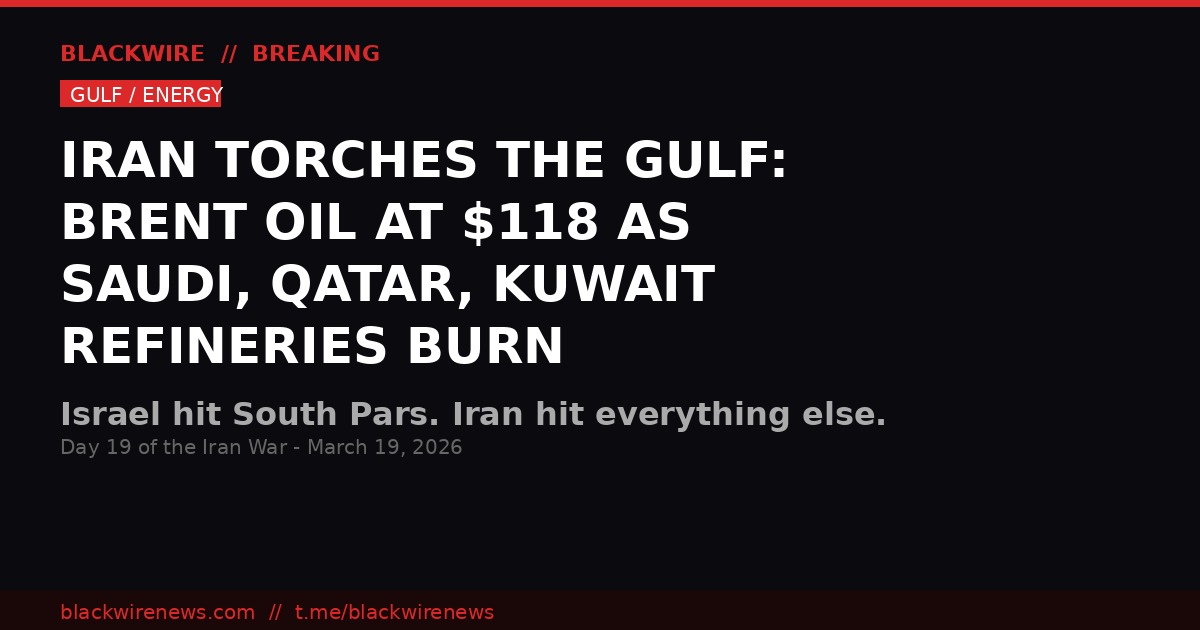
Iran Torches the Gulf: Brent at $118 as Saudi, Qatar and Kuwait Refineries Burn
Tehran's most destructive strike package yet ignited fires across Gulf Arab energy infrastructure on March 19 - retaliation for Israel hitting South Pars, the world's largest gas field. The global energy market is fracturing in real time.
Iran has set the Gulf on fire.
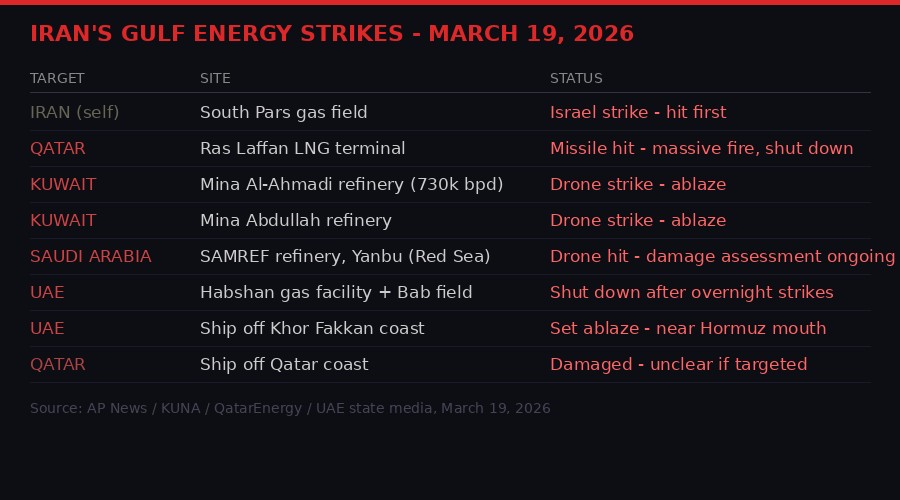
In the span of a few hours on the morning of March 19, Iranian missiles and drones struck Qatar's single most important energy export terminal, set two of Kuwait's largest refineries ablaze, hit a Saudi facility on the Red Sea coast, and forced the shutdown of two major Abu Dhabi gas operations. A ship was set ablaze off the UAE coast near the mouth of the Strait of Hormuz. Another vessel was damaged off Qatar.
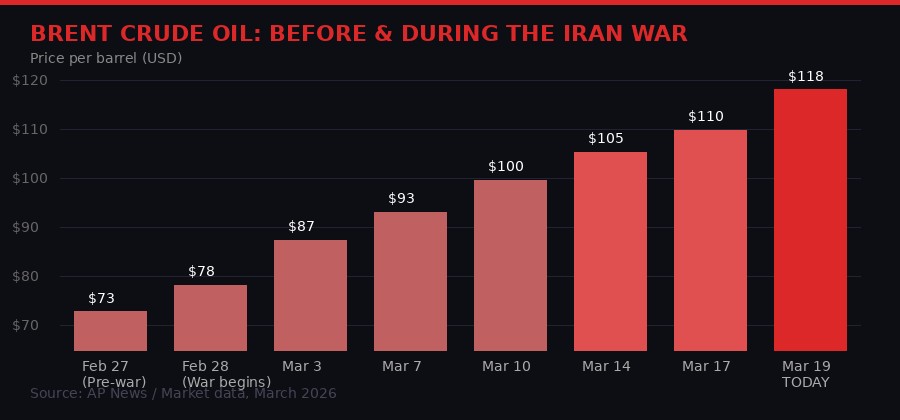
Brent crude - the international benchmark for oil prices - spiked to $118 a barrel. That is a rise of more than 60 percent since the United States and Israel launched the war with coordinated strikes on Iran on February 28. European natural gas prices surged 24 percent in a single session. Asian stock markets shed between 2 and 3.4 percent across the board. The word used by markets: wrecking ball.
This is the Iran War's most consequential single day for the global economy so far. And by evening, it was clear no one had a credible plan to stop it.
up >60% since war began
in a single session
blocked at Hormuz
since Feb 28 strikes
The Trigger: Israel Hits South Pars - the World's Biggest Gas Field
The cascade started on Wednesday, March 18. Israeli forces struck South Pars - the Iranian side of the world's largest natural gas field, located offshore in the Persian Gulf near Asaluyeh on Iran's coast. Iranian state media confirmed fires burning at facilities associated with the field. The Soufan Center, a New York-based security think tank, called it "a clear expansion of the conflict."
The logic of the strike was surgical but brutal. South Pars is not primarily an export facility - it is Iran's domestic energy spine. According to the International Energy Agency, some 80 percent of all power generated in Iran comes from natural gas. South Pars is the dominant source of that supply. Heating, cooking, electricity generation, industrial feedstock - all of it flows through that field.
Hitting it does not primarily hurt Iran's oil export revenues. It threatens to make life genuinely unliveable for ordinary Iranian citizens - a cold, dark country that cannot generate power. The Soufan Center noted in its analysis that Israel's targeting in this war has "heavily focused on the institutions, leaders and infrastructure," and that the South Pars attack represents a deliberate choice to "inflict additional pressure on the regime by making the living conditions for civilians intolerable."
Iranian President Masoud Pezeshkian responded with an explicit warning of "uncontrollable consequences" that "could engulf the entire world." It was not a bluff. By dawn on March 19, Tehran was proving it. (Sources: AP News, Iranian state media, IEA, Soufan Center)
"The attack is a serious escalation which threatens retaliatory strikes on Gulf and Israeli production facilities." - Andres Cala, geopolitical analyst at energy intelligence firm Montel News
The Retaliation: A Strike Package Across the Entire Gulf
Iran did not confine its response to Israel. It went after every major energy asset it could reach across the Gulf region. The scope was designed to shock - and it did.
In Qatar, missiles hit the Ras Laffan industrial complex, the beating heart of global LNG exports. Qatar Energy confirmed on X that the blast caused "sizable fires and extensive further damage." The facility had already been shut down after earlier Iranian attacks, but the renewed strikes deepened structural damage that will delay its return to operation even after the war ends. Qatar normally supplies roughly 20 percent of the world's LNG - the liquefied natural gas that keeps European homes heated and Asian factories running. (Source: QatarEnergy statement, AP News)
In Kuwait, two of the largest refineries in the Middle East took direct hits. A drone struck the Mina Al-Ahmadi refinery, which has a petroleum processing capacity of 730,000 barrels per day - one of the biggest single facilities in the region. The state-run Kuwait News Agency confirmed fires but said no injuries had been reported. Shortly after, a second drone struck the nearby Mina Abdullah refinery, igniting a second blaze. Kuwait, which has no direct involvement in the US-Israeli campaign against Iran, is being punished for geography. (Source: KUNA - Kuwait News Agency)
In Saudi Arabia, the SAMREF refinery in the Red Sea port city of Yanbu was hit by an Iranian drone. Riyadh intercepted six additional drones targeting its natural gas facilities overnight. SAMREF - the Saudi Arabia Mobil Refinery Company - is a joint venture between Saudi Aramco and ExxonMobil. Saudi Arabia's foreign minister said the attack meant that "what little trust there was before has completely been shattered." This matters because Saudi Arabia had been attempting to keep Riyadh's oil flowing west, through the Red Sea, to bypass the Strait of Hormuz blockade. Iran just demonstrated it can reach that route too. (Source: AP News, Saudi Defense Ministry)
In the UAE, authorities shut down the Habshan gas facility and the Bab oil field after Iranian attacks overnight - calling the strikes "a dangerous escalation." Abu Dhabi did not disclose the extent of damage. A ship was also set ablaze off Khor Fakkan, near the mouth of the Strait of Hormuz, in circumstances that remained unclear - whether targeted directly or hit by interceptor debris from the missile volleys overhead.
The Market Response: A Macro Wrecking Ball
Financial markets absorbed the news and reflected back a single verdict: this is a systemic shock.
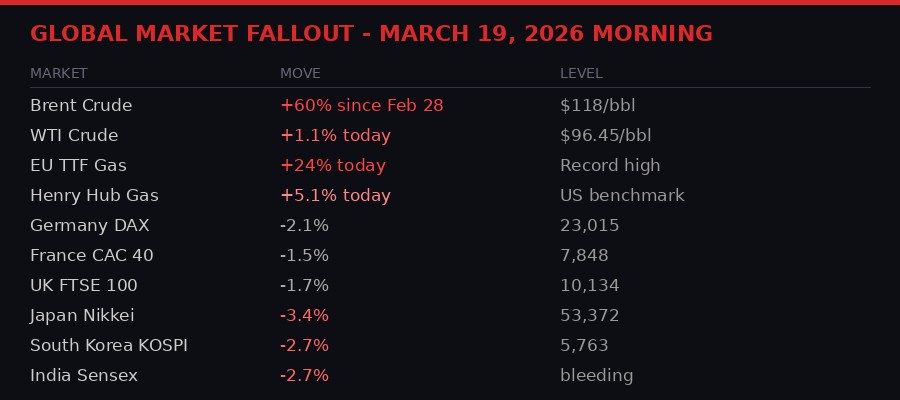
Brent crude peaked at $118 a barrel on Thursday morning - a level not seen since the peak energy crisis years. WTI, the US benchmark, gained 1.1 percent to $96.45 a barrel. The European TTF benchmark for natural gas surged 24 percent in a single session, driven primarily by fears of the lasting damage to Qatar's Ras Laffan facility. The Henry Hub US natural gas future contract gained 5.1 percent. (Source: AP News / Bangkok, March 19 2026)
Asian equity markets were hammered. The Bank of Japan held its benchmark rate at 0.75 percent and explicitly cited the Iran war as a reason for caution, saying "crude oil prices have risen significantly; future developments warrant attention." The Nikkei 225 in Tokyo fell 3.4 percent to 53,372. Seoul's Kospi lost 2.7 percent. India's Sensex - representing an economy that imports the vast majority of its oil - fell the same 2.7 percent. Hong Kong's Hang Seng shed 2 percent. Taiwan's Taiex fell 1.9 percent. Australia's ASX 200 dropped 1.7 percent.
In Europe, Germany's DAX fell 2.1 percent to 23,015. Paris's CAC 40 dropped 1.5 percent. London's FTSE 100 lost 1.7 percent.
The US Federal Reserve, which had held interest rates steady on Wednesday, offered no comfort. Chair Jerome Powell said simply: "We just don't know" - referring to oil prices and tariff pass-through effects. A report released Wednesday showed US wholesale inflation had already accelerated to 3.4 percent before the war, the highest reading in a year. (Source: AP News, Bank of Japan statement)
"The combination of higher oil, rising U.S. yields, and a stronger dollar is acting as a macro wrecking ball across Asian assets and currencies." - Stephen Innes, SPI Asset Management
The broader picture: this is not a temporary oil spike. Iran has now systematically attacked export infrastructure from multiple angles - the Hormuz strait (blocked to most tankers), Qatar's LNG terminal (damaged twice), Saudi Arabia's Red Sea pipeline route (now in range), and Kuwait's refining capacity (ablaze). The redundancy that energy markets depended on is being systematically dismantled.
The Strait of Hormuz: Suicidal to Enter, Impossible to Ignore
Through the narrow chokepoint of the Strait of Hormuz passes approximately one-fifth of all the world's traded oil. It has been effectively closed to tanker traffic since the war began. More than 20 vessels have been attacked since February 28.
The international community has been attempting to organize a coalition to escort ships through the strait. That effort remains theoretical. Retired French Vice Admiral Pascal Ausseur was blunt in his assessment to the AP: "In today's context, sending warships or civilian vessels into the Strait of Hormuz would be suicidal." Any escort mission, he argued, would only become viable after a ceasefire agreement - and even then it would shift from "suicidal to dangerous."
Iran's military capabilities in the strait region are significantly greater than those of its Houthi proxies in Yemen, who spent over a year tormenting Red Sea shipping with inferior weapons. Iran can reach all of the strait and its approaches with anti-ship cruise missiles developed from Chinese-origin systems. It also deploys longer-range ballistic missiles, swarm drones, fast attack craft and naval mines - the last of which it used extensively during the 1980s Iran-Iraq war and has already deployed in this conflict. US strikes on Iranian mine-laying vessels were confirmed earlier in the war. (Source: AP News, US Defense Intelligence Agency, French Navy)
France's Charles de Gaulle aircraft carrier is positioned in the Mediterranean. French, British, American and other naval crews have relevant combat experience from Red Sea operations against the Houthis. But Rear Admiral Michel Olhagaray, a former head of France's center for higher military studies, noted that even a well-coordinated escort force would face "much greater" risks in Hormuz than anything seen in the Red Sea - and would require Iran's cooperation to avoid catastrophic casualties.
The key detail buried in the coverage: Iran has told multiple countries it will allow their vessels through - just not American or allied ships. Iran's Foreign Minister Abbas Araghchi told CBS that "a group of vessels from different countries" had been allowed through. The strait is not sealed to the world. It is sealed specifically to the US and its allies. That distinction is Tehran's primary leverage point in any potential negotiation. (Source: AP News, CBS interview with Araghchi)
Allies Refuse. Trump Fumes. The Coalition That Wasn't.
President Trump has been demanding since at least March 15 that allied nations send warships to help police the Strait of Hormuz. He told reporters aboard Air Force One that he had asked "about seven" countries. The replies have been, in the words of veteran French defense analyst François Heisbourg, "a global raspberry."
Britain was the sharpest refusal. Prime Minister Keir Starmer - who had carefully cultivated a close relationship with Trump, secured an early trade deal with the administration, and agreed to allow US bombers to operate from British bases for strikes on Iran's ballistic missile program - drew a hard line at direct combat involvement. Starmer said Britain "will not be drawn into the wider war" and that any British military commitment would require both a basis in international law and "a proper thought-through plan." He implied neither was currently present.
Trump described the UK as "the Rolls-Royce of allies" and said he was "not happy" with Starmer's position. "They should be involved enthusiastically," he said. "We've been protecting these countries for years." (Source: AP News, Trump White House statements)
Germany's Defense Minister Boris Pistorius was equally direct: "It is not our war; we did not start it. We want diplomatic solutions and a swift end to the conflict. Sending more warships to the region will certainly not contribute to that."
France's Macron occupies the middle ground - the most accommodating of the European leaders. He envisions a possible naval escort role but only "when circumstances permit" - meaning after the shooting stops. He has been in active contact with Iranian President Pezeshkian, holding two calls in eight days. Trump assessed Macron as "an eight out of ten. Not perfect, but it's France. We don't expect perfect."
The EU's foreign policy chief Kaja Kallas put the European position in plain terms: "This is not Europe's war. We didn't start the war. We were not consulted."
China has been asked and is ignoring the request. Japan's Prime Minister Sanae Takaichi meets Trump at the White House on Thursday - and expectations are high that the request will be put directly to Tokyo. South Korea said it would "carefully review" the situation. Neither has committed.
"Allies, or at least the Europeans, aren't willing to be at the beck and call of a demand from Donald Trump - and even in asking for a helping hand, he is doing so in a brutal manner." - Sylvie Bermann, former French Ambassador to China, UK and Russia
Retired Lt. Gen. Ben Hodges, former commanding general of the US Army in Europe, offered perhaps the most damning assessment: "Allies are looking at the United States in a way that they never have before. And this is bad for the United States."
The Nuclear Question: 970 Pounds of Enriched Uranium
Beneath the energy crisis and the coalition politics sits the war's most consequential unresolved question: what happens to Iran's stockpile of highly enriched uranium?
According to intelligence assessments, Iran held approximately 970 pounds of near-bomb-grade enriched uranium before the war began. Much of it is believed to be buried under rubble at Fordow, a mountain facility hit in US bombings that Trump claimed had "obliterated" Tehran's nuclear program. The claim is contested by independent nuclear experts.
If that uranium can be weaponized, Iran could potentially build up to 10 nuclear devices, according to assessments cited by AP. The scenario of a regime that has just survived an existential war, hardened in its hostility toward Israel and the US, possessing or racing toward nuclear weapons is the nightmare that keeps US policymakers awake. (Source: AP News, IAEA assessments, Senate Armed Services Committee statements)
Trump's stated primary objective when joining Israel's campaign was ensuring that Iran would "never have a nuclear weapon." But asked directly about the uranium stockpile, Trump deflected: "I'm not going to talk about that." Defense Secretary Pete Hegseth refused to say "how far we're willing to go."
Democratic Senator Richard Blumenthal put the dilemma in stark terms: "Some of the objectives that he continues to espouse simply cannot be achieved without a physical presence there - securing the uranium cannot be done without a physical presence." Republican Senator Rick Scott acknowledged no one had briefed him on how to do it "without boots on the ground."
The question of US ground troops entering Iran - the most politically toxic military option available - is now being discussed openly in Senate committee rooms. No decision has been made public. No timeline has been given. The uranium sits under rubble, and no one has confirmed whether it is recoverable, destroyed, or quietly being moved.
What Happens Next: Scenarios and Stakes
As of the afternoon of March 19, there is no ceasefire in sight, no functioning diplomatic channel between the US and Iran, no coalition of nations willing to confront the Strait of Hormuz under fire, and no plan that US lawmakers have been briefed on for securing Iran's nuclear material.
Several scenarios are now in play simultaneously:
Scenario 1 - Escalation spiral continues. Iran has demonstrated it can reach Saudi Arabia's Red Sea pipeline route, Qatar's LNG exports, Kuwait's refining capacity, and UAE gas fields. Each new Israeli or US strike on Iranian territory invites another round of Gulf energy attacks. Brent crude at $130 or $140 is no longer a fringe forecast. Global recession risk is climbing by the week.
Scenario 2 - Forced negotiation via economic pain. Trump has imposed new Venezuelan oil sanctions waivers to try to inject more supply into the market. He is pressing Saudi Arabia to pump harder. He has urged OPEC+ to maximize output. But the economic pain from $118 oil is already biting in every major economy except the US. European inflation is reaccelerating. Asian export economies are getting hammered. The pressure for a negotiated exit is building - from allies, from markets, from his own Fed chair's admission that he "just doesn't know" what comes next.
Scenario 3 - Iran accepts a face-saving de-escalation. Iran's domestic situation is severe. South Pars is on fire. Power generation is under threat. The regime is running a war on two economic fronts simultaneously - sanctions and infrastructure damage. Iran's Foreign Minister Araghchi told CBS his government had received approach requests from multiple countries seeking safe passage for ships. That suggests Tehran still views Hormuz as a negotiating tool, not a permanent closing. A ceasefire with face-saving conditions for both sides is not impossible - but there is currently no intermediary with credibility in both Washington and Tehran.
Scenario 4 - Ground troops.) The most dangerous scenario. If Trump concludes the only way to permanently neutralize Iran's nuclear program is to send Special Forces into Fordow and extract or destroy the enriched uranium, the war metastasizes into a full-scale ground invasion. No senator who has been briefed has explained how to do this without significant US casualties and without triggering a wider regional war. Iran's president warned of "consequences that could engulf the entire world." That phrase was chosen carefully.
The Soufan Center and multiple retired military officers have noted that every path forward carries catastrophic risk. The question is not whether there will be more damage - there will be. The question is how much damage the global economy can absorb before governments have no choice but to stop the fight. (Sources: AP News, Soufan Center, retired US/French naval officers)
Timeline: The Iran War's Energy Escalation
Key Figures in the Crisis
Donald Trump (US President): Started the war alongside Israel on February 28. Primary stated objective: prevent Iran from ever having a nuclear weapon. Currently demanding allied support he cannot get. Threatened to "massively blow up" South Pars if Iran continues striking Qatar's infrastructure - then quickly walked it back. Has eased Venezuela sanctions to try to compensate for lost Gulf supply.
Masoud Pezeshkian (Iranian President): Has maintained public lines of communication with Macron (two calls in eight days) while authorizing the most aggressive Iranian military action in years. Warning of "uncontrollable consequences" suggests he either genuinely fears escalation has gone beyond Tehran's control, or is deploying the phrase strategically to create space for negotiation.
Keir Starmer (UK Prime Minister): Carefully cultivated Trump ties. Agreed to allow US bombers at UK bases for strikes on Iran's ballistic missiles. Drew a hard line at direct combat. Trump publicly expressed displeasure. The UK relationship - once described as the "Rolls-Royce of allies" - is now visibly strained.
Emmanuel Macron (French President): The most engaged European leader on the diplomatic track. Positioned France as a potential honest broker. Has the Charles de Gaulle carrier in position for future escort operations. Rated "an eight out of ten" by Trump, who noted: "It's France. We don't expect perfect."
Jerome Powell (Fed Chair): Held rates steady Wednesday. Admitted openly: "We just don't know" what oil will do to the economy. Inflation already running hot at 3.4% wholesale before the war began. Every passing week tightens his options.
The Iran War entered a new phase on March 19. The question of whether it was started rationally - whether the US and Israel had a clear plan for what came next - is now largely academic. What is not academic is $118 oil, burning refineries from Yanbu to Kuwait City to Doha, global equity markets deep in the red, and a US president demanding allied help that no one will give.
Twenty countries are watching the Strait of Hormuz and calculating. The chokepoint that carries a fifth of the world's oil trade is closed. The world's largest LNG terminal is burning. The ceasefire clock is ticking not in diplomatic offices but in energy trading pits, central bank meeting rooms, and the supermarkets where the price of everything is about to rise.
Reporting: BLACKWIRE Gulf bureau. Sources: AP News, QatarEnergy, Kuwait News Agency (KUNA), UAE state media, US Defense Intelligence Agency, Bank of Japan, International Energy Agency, Soufan Center, SPI Asset Management, Senate Armed Services Committee statements.
Get BLACKWIRE reports first.
Breaking news, investigations, and analysis - straight to your phone.
Join @blackwirenews on Telegram