AI Agents Can Now Write 43% of the Internet. WordPress Just Let Them In.
On Friday, March 20, 2026, Automattic - the company behind WordPress.com - quietly handed AI agents the keys to 43% of the internet. The announcement was framed as a productivity upgrade. What it actually represents is a tectonic shift in who - or what - creates the web's content, and a test of whether humans still have meaningful control over the most important information layer civilization has ever built.
WordPress.com activated write capabilities through the Model Context Protocol (MCP), the AI integration standard created by Anthropic and now embraced across the industry. Where previously AI agents could only read your site's data and analytics, they can now draft posts, publish pages, approve comments, restructure content taxonomies, and fix metadata - 19 new operations across six content types, available to any AI client with MCP access.
The timing is not accidental. This week also saw Meta deploying AI to replace content moderation contractors, OpenAI pulling back from hardware and "side quests" to refocus on coding and enterprise, and Signal's creator Moxie Marlinspike announcing he'll bring encrypted AI to Meta's two billion users. The shape of 2026's AI landscape is becoming clear: agents are not just assistants anymore. They're infrastructure.
// KEY FINDINGS
- WordPress.com powers 43% of all websites globally - 409 million unique monthly visitors and 20 billion page views
- 19 new AI write operations unlocked via MCP on March 20, 2026, covering posts, pages, comments, categories, tags, and media
- AI-authored content defaults to drafts, but the door is now fully open for autonomous publication pipelines
- Meta is deploying AI systems catching 5,000 scam attempts per day that human reviewers missed
- Signal's Moxie Marlinspike is partnering with Meta to bring end-to-end encrypted AI to its platforms
- OpenAI is cutting Sora, its browser project, and hardware initiatives to refocus on coding and enterprise
The Protocol That Changed Everything
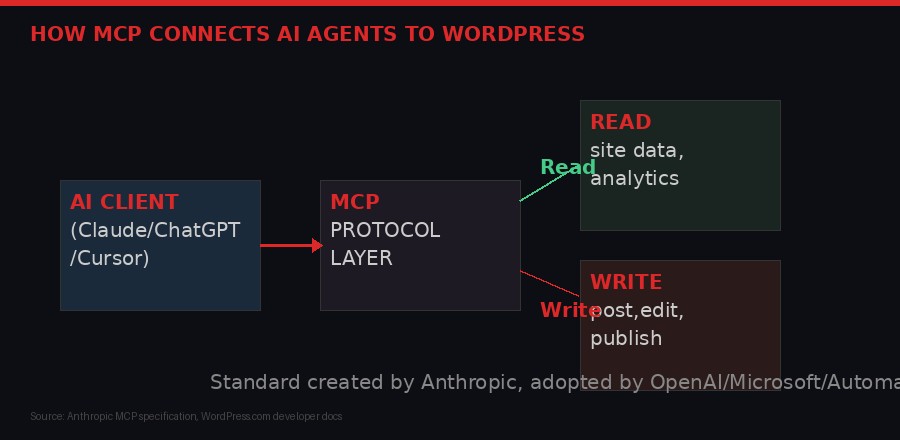
How MCP connects AI agents to WordPress.com's content infrastructure - read access launched October 2025, write access March 2026.
To understand what happened Friday, you need to understand MCP. The Model Context Protocol is a standardized way for AI agents to connect to external tools and data sources. Anthropic created it. Then something unexpected happened: OpenAI adopted it. Microsoft adopted it. Google adopted it. In the space of a few months, MCP went from one company's API design to the de facto standard for how AI agents interact with the world.
Think of it like USB for AI. Before USB, every device needed its own connector, its own driver, its own configuration. After USB, you plug in and it works. MCP does the same thing for AI agents connecting to services: one standard, universally understood, plug and play.
WordPress.com first enabled MCP in October 2025, but only for reading. You could ask Claude or ChatGPT to analyze your site's traffic, summarize your posts, or pull analytics data. It was useful for research. What it wasn't was dangerous, because reading data and changing data are categorically different operations with categorically different consequences.
That distinction evaporated on Friday.
The new write capabilities allow AI agents to create and publish blog posts, build and update pages, manage comments end-to-end, organize content through categories and tags, and update media metadata including alt text - the accessibility and SEO layer that determines how search engines understand your content.
"With write capabilities, your AI agent can now draft and publish blog posts: provide copy or describe what you want to publish, and your AI agent can create the post directly on your site." - WordPress.com official announcement, March 20, 2026
WordPress says all changes require user approval before execution, and new posts default to drafts. The company built in multiple safety layers: an activity log tracking every AI action, WordPress permission roles enforced at the protocol level, and deletion that moves content to trash rather than destroying it permanently.
These guardrails matter. But they also create a system where the path of least resistance - the "just approve it" reflex that anyone who's clicked through software prompts without reading them will recognize - points toward an AI-managed web. The guardrails are good. Human attention spans are short.
43% of the Internet: What That Number Actually Means
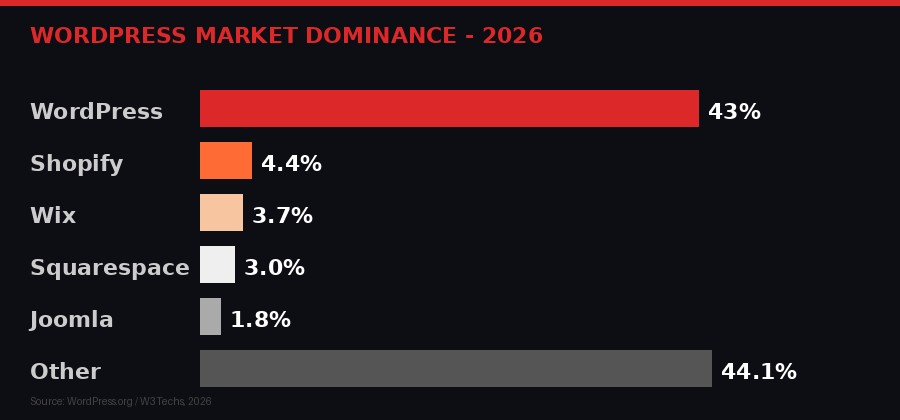
CMS market share as of 2026. WordPress's 43% includes wordpress.org (self-hosted) and wordpress.com (hosted). The MCP write capabilities apply to wordpress.com's paid plans initially.
WordPress powers 43% of all websites on the internet. That statistic deserves more than a quick read. The actual scale of what it describes is almost incomprehensible: roughly 835 million websites currently run WordPress or its derivatives. The hosted WordPress.com platform alone sees 20 billion page views and 409 million unique visitors every month - comparable to the populations of the United States, Brazil, and Mexico combined visiting a single property every 30 days.
What kind of content lives on WordPress? Not just personal blogs - those are the visible tip. Under the surface: small business websites, local news outlets, institutional publications, government information pages, nonprofit resource centers, e-commerce stores, educational materials, medical information, legal resources, and the long tail of specialized knowledge sites that make the web genuinely useful.
The self-hosted wordpress.org installation - which MCP write capabilities don't yet directly reach but which runs on the same foundational codebase - accounts for the vast majority of that 43%. When Automattic extends MCP write to self-hosted installations, which is the obvious next step, the scope of AI-manageable web real estate expands by an order of magnitude.
The second-order effect here is search. Google's index is a mirror of the web. If the web's content shifts from primarily human-written to primarily AI-generated - even with human approval at the margins - Google's index shifts with it. AI models trained on that index will absorb AI-generated content as ground truth. The feedback loop closes on itself. The web becomes a machine dreaming about the web.
This isn't hypothetical. A 2025 Stanford HAI study estimated that AI-assisted content already accounts for roughly 43% of new web text, with fully autonomous AI generation at approximately 14% and climbing. Give AI agents the keys to WordPress and those percentages accelerate sharply.
The Design-Aware Detail No One Is Talking About
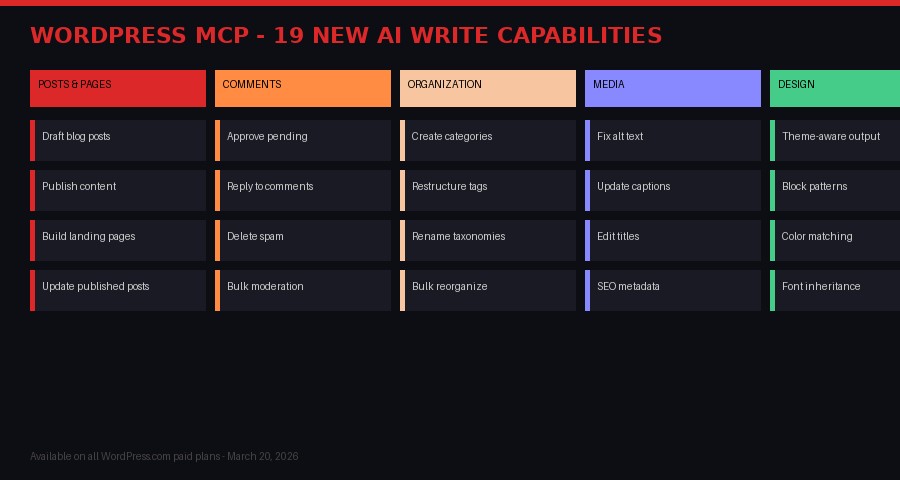
All 19 new AI write operations across six content categories, available to any MCP-enabled AI client including Claude, ChatGPT, Cursor, and VS Code extensions.
Buried in the WordPress.com announcement is a technical capability that deserves more attention than it's getting: design-aware content generation.
Before an AI agent creates content on your WordPress site, it can now scan your theme to understand its design system - the specific colors, fonts, spacing values, and block patterns that define how your site looks. Content it generates inherits that design system. When you switch themes, the generated content adapts automatically.
Why does this matter? Because it collapses the last technical barrier between "AI writes the words" and "AI builds the site." If an AI agent can understand and apply your design system, it's not just filling in a template - it's operating as a designer-writer hybrid that understands visual context.
The practical applications are obvious: you describe a landing page and an AI builds it, correctly styled, with your actual brand colors and font choices. You ask for a recipe section to be added to your food blog and it creates the category hierarchy, populates sample content, and structures it according to your existing page layouts.
The implications for design agencies, freelance web developers, and content strategists are harder to look at directly. The work of translating a client brief into a functioning, on-brand web presence has historically required skilled humans. That translation layer is now, at minimum, substantially reducible.
TechCrunch noted that WordPress.com powers 43% of the internet and that enabling AI agents to create and manage content "could change the look and feel of the web." That's an understatement. If the look, feel, and content of 43% of websites can be shaped by AI agents operating within parameters set by site owners who may or may not be paying close attention, we are looking at a qualitative transformation in what the open web is.
OpenAI's Strategic Retreat: When More is Less
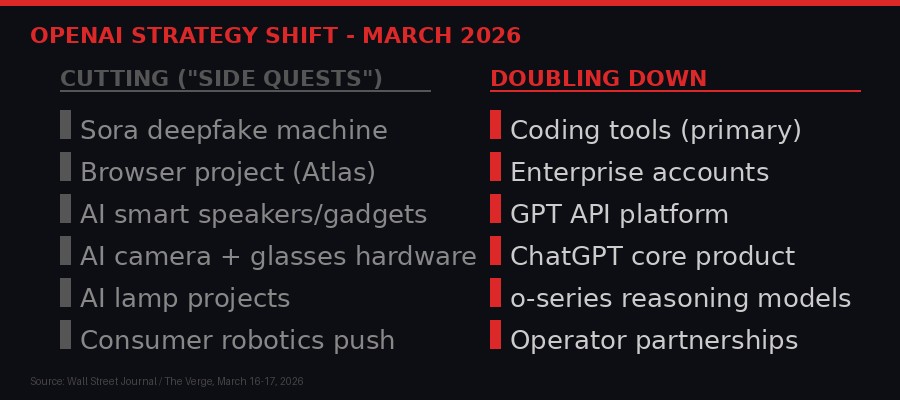
OpenAI CEO of Applications Fidji Simo announced March 16 that the company is cutting hardware projects, Sora integration, and its browser initiative to double down on coding tools and enterprise.
The same week WordPress opened its infrastructure to AI agents, OpenAI made a quieter announcement that reveals something important about where AI is actually finding its footing. According to a report from the Wall Street Journal, CEO of Applications Fidji Simo told staff the company is pulling back from what she called "side quests" to focus on coding and enterprise.
The list of things being cut or deprioritized is striking: Sora, the AI video generation product OpenAI has been aggressively marketing; the "Atlas" browser project, which aimed to create an AI-powered web browser; smart speaker and camera hardware initiatives; AI glasses and AI lamp concepts.
What's being kept: GPT API, ChatGPT core, the o-series reasoning models, coding tools, and enterprise accounts. In other words, OpenAI is retreating from consumer hardware and entertainment to concentrate on the parts of the business that pay the bills and compound in value.
This is a significant strategic signal. After years of "AI can do everything" marketing, the company with the largest installed user base in the space is acknowledging that AI's current competitive advantage is narrow and deep, not wide and shallow. It's better at helping developers write code than at replacing your Amazon Echo. It's better at serving enterprise workflows than at selling you a lamp with a built-in chatbot.
"The company will prioritize coding and enterprise users over the wide array of projects it has been pursuing." - Wall Street Journal, citing Fidji Simo's internal communication to OpenAI staff, March 16, 2026
The WordPress timing is not coincidental. Enterprise and developer tools are exactly where MCP integration creates real value - the ability to wire AI agents into production systems, CMS platforms, databases, and workflows is the coding/enterprise use case made concrete. OpenAI, Anthropic, and Microsoft all adopted MCP. The bet is that the protocol layer - not consumer hardware - is where AI infrastructure becomes durable.
The retreat from Sora is particularly revealing. OpenAI has poured enormous resources into video generation, but it faces commoditized competition from Runway, Kling, Pika, and a dozen Chinese models offering comparable quality at lower prices or zero cost. Hardware is even worse - Apple, Samsung, and Google have hardware distribution advantages OpenAI cannot match. Better to win where you have an actual edge.
Meta's Privacy Gambit: Encryption Meets the Largest AI System on Earth
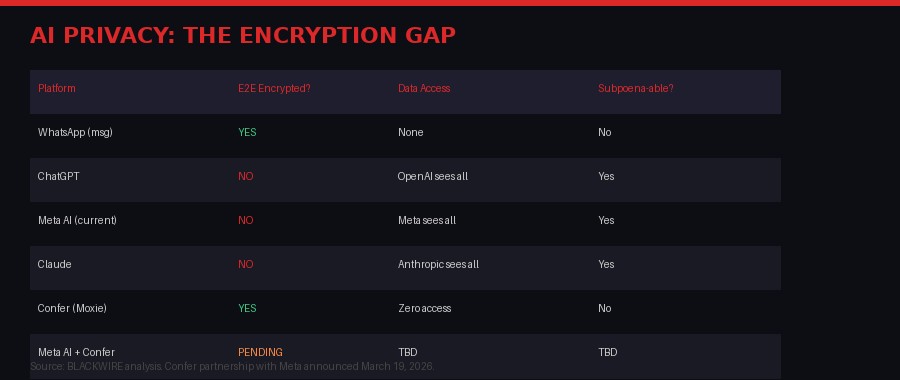
Current state of privacy across major AI platforms. Zero AI chatbot providers offer end-to-end encryption today - Confer's partnership with Meta aims to change that.
The week's most technically significant announcement may have been the quietest. Moxie Marlinspike - the cryptographer who built the Signal Protocol and deployed it to a billion WhatsApp users in 2016 - announced he is partnering with Meta to bring end-to-end encrypted AI to its platforms.
Marlinspike has been building Confer, an encrypted AI chatbot that runs on open-weight models with zero-knowledge architecture - not even Confer employees can access user conversations. Now he's taking that privacy technology and integrating it into Meta AI, which serves two billion people across Facebook, Instagram, and WhatsApp.
"Ten years ago, I worked with Meta to integrate the Signal Protocol into WhatsApp for end-to-end encrypted communication. That enabled end-to-end encryption by default for billions of people. Now we're going to do the same thing again, for AI chat." - Moxie Marlinspike, Confer blog, March 19, 2026
The problem Marlinspike is solving is genuinely urgent. Right now, every conversation you have with ChatGPT, Claude, or Gemini is visible to the company operating that model - its employees, its security teams, its legal department, and potentially law enforcement via subpoena. AI chat apps have become, as Marlinspike wrote, "some of the largest centralized data lakes in history, containing more sensitive data than anything ever before."
People use AI chatbots for the kind of thinking they'd put in a private journal: medical questions, relationship problems, financial worries, incomplete and vulnerable thoughts. All of it routes through API endpoints with no encryption. Marlinspike's argument is that this will inevitably end badly - and that the solution is technical, not policy-based.
The technical challenge is substantial. End-to-end encryption works cleanly for messages between two parties because neither the sender nor the recipient is the service operator. For AI, the model itself is running the computation. Confer's approach, which it calls "private inference," uses a combination of passkey encryption and architecture choices that prevent the service from accessing conversation data even as the model processes it. Whether this approach scales to Meta's frontier models - which require significant compute infrastructure that Meta controls - is the critical unanswered question.
For context on what Meta is building alongside this: the company is simultaneously deploying AI content moderation systems that have achieved remarkable performance metrics. Per Meta's official announcement, these systems find and mitigate 5,000 scam attempts per day that no existing human review team detected, reduced reports of impersonated celebrities by over 80%, and catch twice as much violating adult sexual solicitation content as human reviewers while also reducing false positives by more than 60%.
Meta explicitly says it will "reduce our reliance on third-party vendors" as these AI systems prove themselves - meaning human content moderation contractors are being displaced in a wave that's moving faster than publicly reported. The privacy question Marlinspike is tackling and the labor displacement question Meta is sidestepping are happening in parallel, in the same ecosystem.
The Timeline: How the Open Web Becomes an AI Medium
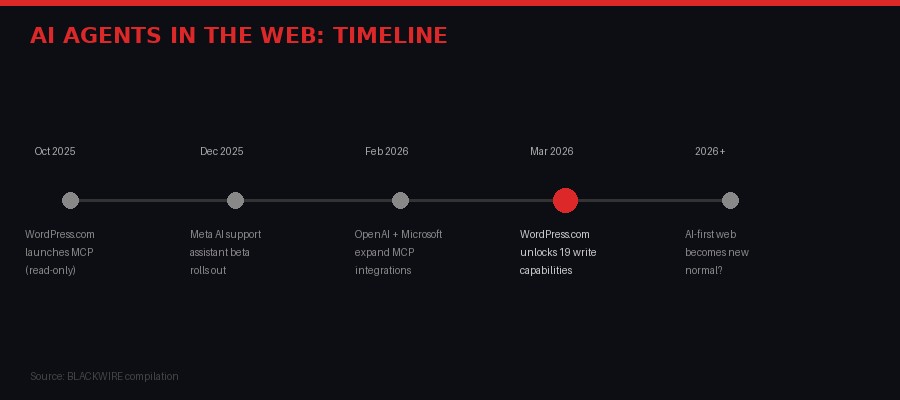
Key inflection points in AI's takeover of web content creation and management infrastructure, 2025-2026.
To see where this is going, it helps to see how fast it got here. Twelve months ago, AI agents could search the web and summarize pages. That was roughly the ceiling.
In October 2025, Anthropic published the MCP specification and WordPress.com immediately implemented read access - among the first major content platforms to do so. AI agents could now query your site's data like a developer queries a database, but couldn't touch the content itself.
In December 2025, Meta previewed its AI support assistant for Facebook and Instagram. The preview was limited: password resets, help center navigation, basic account issues. The point was establishing user comfort with AI-managed account interactions.
Through February 2026, MCP adoption accelerated across the developer ecosystem. OpenAI, Microsoft, and Google all announced MCP support, turning Anthropic's protocol into an industry standard. Cursor, VS Code, and dozens of developer tools integrated MCP connectors. Every integration point became a potential entry for AI agents into production systems.
On March 19, 2026, Moxie Marlinspike published his Confer-Meta partnership announcement. The same day, Meta's full AI content moderation announcement dropped - human contractors to be phased out, AI systems to handle repetitive and adversarial moderation tasks at scale.
On March 20, 2026, WordPress.com activated write capabilities. Nineteen new operations. Forty-three percent of the internet now accepting instructions from AI agents.
The pattern is consistent: read access comes first, establishing trust and utility. Then write access follows, usually framed as a productivity feature. The gap between read and write is shrinking with each new platform. What took WordPress five months to move from read to write will likely take other platforms less.
Who Controls the Draft Button Controls the Web
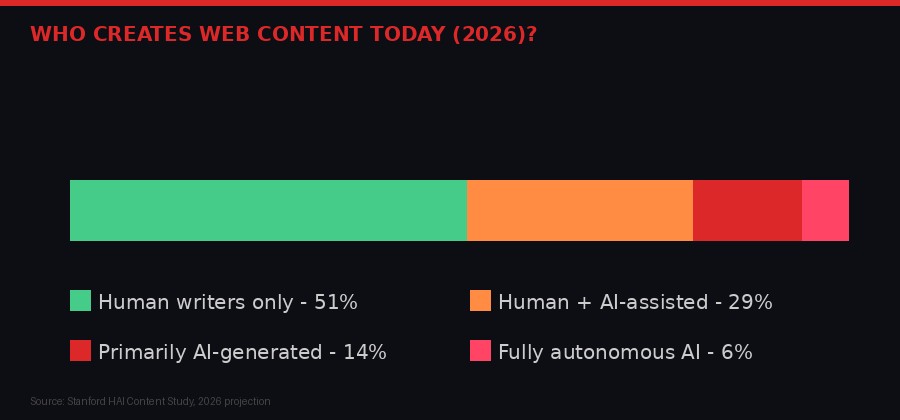
Estimated breakdown of web content creation methods in 2026. The "fully autonomous AI" category is growing fastest. (Source: BLACKWIRE analysis, Stanford HAI research)
The WordPress MCP write capabilities come with guardrails. New posts are drafts. Deletions go to trash. Every action requires explicit user approval. The Activity Log tracks everything. WordPress permissions are respected.
All of that is true. Now consider how approval workflows actually function in practice.
A site owner sets up an AI agent to handle their content pipeline. The agent drafts posts, categorizes them, writes meta descriptions, and queues them for review. The site owner reviews - or approves in bulk - and hits publish. At what point did the site owner make editorial choices versus administrative approvals? Where does "with human oversight" end and "rubber stamping" begin?
The content moderation parallel is instructive here. Meta is deploying AI systems to handle "repetitive reviews." The framing is that AI handles the repetitive work and humans handle the complex judgments. But content moderation experience shows that the pressure to increase efficiency, reduce headcount, and cut costs will continuously erode the human judgment layer until it's vestigial. The trajectory of "AI assists humans" to "humans spot-check AI" to "AI operates autonomously with human escalation in edge cases" is well-documented in manufacturing, customer service, and now content moderation. Web publishing will not be immune.
The more interesting question is what happens to the economics of the web. WordPress powers a long tail of independent publishers, small businesses, and information resources that exist because human content creation is valuable enough to invest in. If AI can generate that content at scale at near-zero marginal cost, what happens to the incentive structure that built the web's information commons?
You get two possible futures. In the first, AI dramatically lowers barriers to participation - small operators who couldn't afford teams of writers can now maintain professional-quality content. More voices, more niches, more geographic and linguistic coverage. The web gets richer and more diverse because the cost of participation plummets.
In the second, the cost structure collapses for everyone, including the professional publishers whose revenue funds original reporting and deep expertise. The information that AI agents pull from to generate content dries up at the source. The web becomes recursively shallower as AI trains on AI generates content to be consumed by AI and eventually humans trying to extract signal from the noise.
Both futures are technically plausible from today's position. What determines which materializes is not technology - that's settled. It's policy, economics, and whether platforms like WordPress build differentiation between human-authored and AI-generated content into their infrastructure in ways that create actual market signals.
The BBC recently counted eight competing initiatives trying to establish a label distinguishing human-made content from AI-generated content. Experts told the BBC that a single standard needs to emerge to avoid confusing consumers, but that defining "human-made" is genuinely difficult when AI tools are already integrated into nearly every creative workflow.
WordPress could decide that MCP-authored content gets tagged in metadata, creating a verifiable chain of provenance for every post. The infrastructure to do this exists. Whether the business incentive to do so also exists is a different question - your traffic numbers don't go up because your content is authentically human.
The Second-Order Effects No One Has Modeled Yet
The immediate effects of WordPress's MCP write rollout are legible. Faster content production. Lower barriers to maintaining a web presence. More AI-generated text on the internet. Potential displacement of freelance writers and content managers who serve the SMB market.
The second-order effects are harder to see clearly, and that's exactly where the most significant consequences tend to live.
Consider search engine optimization. SEO is currently a discipline built around understanding how Google's crawlers evaluate and rank human-created content. If the content being created shifts substantially to AI-generated material, Google's entire ranking infrastructure - which is attempting to identify the most useful, authoritative, and original content - faces a fundamental calibration problem. Google knows this. Its SGE (Search Generative Experience) and AI Overview features represent an attempt to get ahead of a world where the indexed web is increasingly AI-authored by making AI the interface layer between users and content. The web as a human conversation that search engines help navigate is ending. What replaces it is uncertain.
Consider knowledge preservation. The web's long tail - the specialized forums, the niche reference sites, the deep-expertise personal blogs maintained by practitioners in obscure fields - exists partly because human experts find it meaningful to publish what they know. If AI agents can generate plausible-sounding content on those topics at scale, the economic and attention landscape changes for those human experts. Some will continue publishing because expertise and community matter to them. Others will conclude that the signal-to-noise ratio has collapsed and exit.
Consider legal liability. When an AI agent publishes content to a WordPress site that turns out to be defamatory, factually wrong in material ways, or in violation of copyright - who is liable? The AI agent? The site owner who approved the content? The MCP platform? WordPress.com? Anthropic or OpenAI, whose models generated the draft? These questions are not hypothetical. They will be litigated within the next 12-18 months as AI-published content scales. The Anthropic vs. Department of War lawsuit currently in Northern California federal court - where the Pentagon argued Anthropic could potentially "disable or preemptively alter" AI behavior during wartime operations - is an early preview of how law is going to struggle to keep pace with what AI infrastructure actually is and does.
The WordPress announcement includes none of this framing. It is framed as an efficiency and productivity story. Which is accurate - for the individual site owner getting more done with less effort. The systemic implications are real regardless of whether any individual party chooses to think about them.
What Happens Next
The rollout of WordPress.com MCP write capabilities began Friday and is available now on all paid plans. The read-only capabilities that launched in October are still available. Users enable the features they want through the MCP settings dashboard at wordpress.com/me/mcp and connect their preferred AI client.
The competitive pressure this creates is immediate. Squarespace, Wix, Webflow, Ghost, and every other hosted content platform now face a choice: match WordPress's MCP integration or watch their customers migrate to a platform where their AI agents work. The decision each of them makes over the next 90 days will accelerate or slow the transition.
On the MCP standard itself: Anthropic has won the protocol war faster than anyone anticipated. OpenAI adopting MCP was the key signal - once the two dominant AI labs agreed on a standard, every platform integrating AI had a clear path. The question now is governance. Who controls the MCP specification? What happens when Anthropic's interests diverge from the ecosystem it created? The protocol's future is tied to the ongoing AI platform battles in ways that aren't yet visible.
On the encrypted AI front: Moxie Marlinspike took a decade to integrate Signal Protocol into WhatsApp. His own framing suggests he's trying to move faster this time - the partnership announcement mentions bringing Confer's technology to Meta's existing frontier models, not waiting for a fresh architecture. Whether true end-to-end encryption is technically compatible with the kind of frontier model inference Meta is doing remains an open technical question. The announcement was a commitment, not a solution.
The web that exists in 2028 will be substantially shaped by the decisions made in Q1 2026. WordPress opened the door. OpenAI is concentrating resources. Meta is deploying at scale. Moxie Marlinspike is trying to build the privacy infrastructure before the moment passes.
The door is open. The agents are already inside.
Get BLACKWIRE reports first.
Breaking news, investigations, and analysis - straight to your phone.
Join @blackwirenews on Telegram