
Dubai's waterfront skyline. Four luxury villas here were quietly purchased by men with Caribbean passports named "Hugo Hayek" and "Sami Hayek." Neither name is real. [Pexels]
The property records in Dubai list two ordinary-sounding names: Hugo Hayek and Sami Hayek. Brothers from Dominica, apparently. Four luxury villas. A seahorse-shaped man-made island. A golf course community. Combined value at purchase: nearly $29 million.
None of it is real.
"Hugo Hayek" is Mohammad Hossein Shamkhani - son of Ali Shamkhani, the top political advisor to Iran's now-dead Supreme Leader Ayatollah Ali Khamenei. "Sami Hayek" is his younger brother Abolfazl. The Dominican passports were bought. The names were fabricated. The Dubai properties were purchased to hide wealth generated by one of the most sophisticated sanctions-evasion operations the US Treasury has ever documented.
An investigation by OCCRP, published this week, combined with a US Department of Justice civil forfeiture action filed March 6, exposes the full architecture of the scheme: Caribbean "golden passport" identities used to purchase European and Gulf real estate, Turkish front companies used to route Iranian and Russian crude oil, Singapore trading firms used to move the proceeds through the US financial system, and a family with direct access to Iran's military-industrial complex quietly accumulating assets across continents while Western sanctions were supposed to stop them.
The amount already documented: $29 million in Dubai alone. Over 100 million British pounds frozen in London. A 15-million-euro villa in Marbella. $15.3 million seized by the DOJ. And a fleet of ships described by the US Treasury as generating "billions" in oil revenue annually for Iran and Russia.
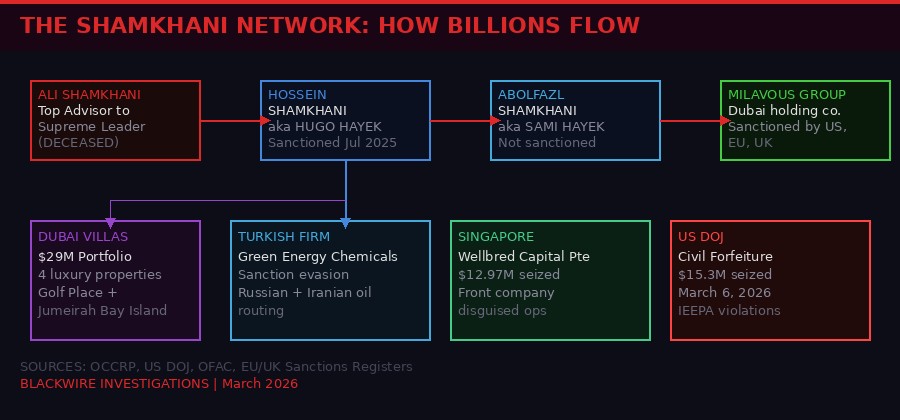
How the Shamkhani network connects: from the IRGC at the top through front companies to real estate holdings across three continents. [BLACKWIRE / Sources: OCCRP, DOJ, OFAC]
The Father: Iran's Most Connected Insider

Ali Shamkhani held the most sensitive national security positions in the Islamic Republic for three decades. His sons inherited his connections - and his methods. [Pexels]
Ali Shamkhani was not a minor figure. He served as Iran's Defense Minister from 1997 to 2005. Then as Secretary of the Supreme National Security Council - the most powerful security body in Iran - for a decade between 2013 and 2023. By the time US-Israeli strikes began battering Iran in early 2026, he had risen to serve as a direct political advisor to Supreme Leader Khamenei himself.
His death in the strikes was confirmed by ILNA, a semi-official Iranian news agency. His family had anticipated the risk. The financial architecture was already in place.
The US Treasury's Office of Foreign Assets Control described the family network with unusual specificity when it sanctioned Hossein Shamkhani in July 2025. Hossein, OFAC stated, had "leveraged corruption through his father's political influence to build and operate a massive fleet of tankers and containerships."
"These passports allow them to travel undetected and hide their connections to Iran when conducting business overseas in furtherance of their corrupt schemes." - OFAC Sanctions Notice, July 2025, on the Shamkhani family's use of Dominican passports
The network, OFAC said, "comprises a vast fleet of vessels, ship management firms, and front companies - some posing as legitimate financial services firms - that launder billions in profits from global sales of Iranian and Russian crude oil and other petroleum products, most often to buyers in China."
The Shamkhani family "employs significant measures to disguise its operations and obfuscate its ties to the Shamkhani family, Iran, and Russia," OFAC added.
That system of disguise included, at its most fundamental level, simply not being named Shamkhani at all.
The Passports: Buying a New Identity in the Caribbean

Dominica's Citizenship by Investment program grants full passports in exchange for real estate investment or government fund contributions. The program has been used repeatedly by sanctioned individuals to acquire alternate identities. [Pexels]
Dominica - the small Eastern Caribbean island nation, not to be confused with the Dominican Republic - runs a Citizenship by Investment program that sells passports in exchange for a $100,000 government fund contribution or a $200,000 real estate investment. Applicants face background checks, but the due diligence has been repeatedly criticized as inadequate for sanctioned individuals or those under investigation.
Hossein Shamkhani obtained a Dominican passport under the name "Hugo Hayek" - a name with no visible connection to Iran, the IRGC, or his sanctioned family. His brother Abolfazl obtained a Dominican passport as "Sami Hayek."
The utility was immediate and practical. When Hossein wanted to buy a villa on Jumeirah Bay Island in Dubai in July 2022, he presented his Dominican passport. When Abolfazl bought the neighboring property three months later, he used the same documentation. The real estate records show Caribbean identities, not Iranian ones. Without active investigation, the connection to the Shamkhani family is invisible.
Dominica has since reportedly revoked Hossein Shamkhani's passport following the US sanctions - but this occurred after years of the alias being used to accumulate assets, open companies, and route money across jurisdictions.
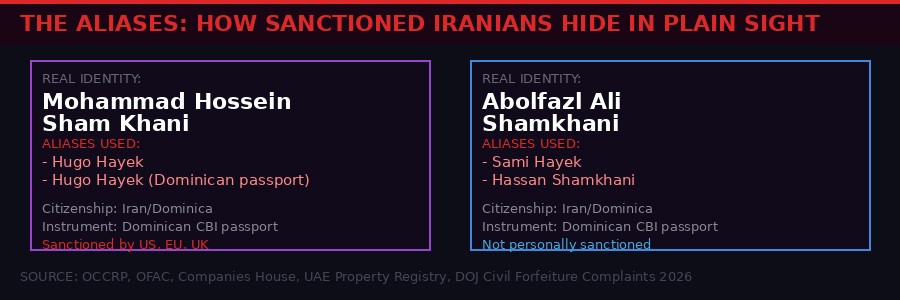
The two identities: real names versus Caribbean aliases. Hossein used at least one alias. Abolfazl used at least two - including "Hassan Shamkhani" in business documents predating the sanctions era. [BLACKWIRE / Sources: OCCRP, DOJ filings]
Abolfazl, notably, has not been personally sanctioned by any government. But US DOJ civil forfeiture filings allege he "manages several firms belonging to the network" and is linked to a front company responsible for $2 million of the seized wire transfers. Court documents reveal Abolfazl uses multiple aliases: "Hassan Shamkhani" in earlier business records, and "Sami Hayek" for his Caribbean identity.
A 2015 article from the Daily Shipping Times, an Indian trade publication, showed Abolfazl - identified as "Hassan Shamkhani" - alongside his brother Hossein at what appears to be a maritime industry event. The same yearbook from Lebanon American University in Beirut, where both brothers studied, identifies Abolfazl by his real name. The OCCRP found both documents while mapping the family's corporate history.
The Villas: Dubai's Luxury Laundromat

Dubai's Golf Place development and Jumeirah Bay Island are among the emirate's most exclusive addresses. Both featured in the Shamkhani brothers' real estate portfolio, acquired under aliases. [Pexels]
The Dubai property portfolio was assembled methodically over four years. The brothers started early, before sanctions closed in.
In July 2019, property records show two villas purchased in the Golf Place complex - a luxury gated community featuring "lush fairways, winding walkways, meticulously landscaped parks and gardens" according to the developer's marketing material. The buyers at that point were listed under their real names: "Mohammad Hossein Sham Khani" and "Abolfazl Ali Shamkhani." They bought properties three doors apart from each other.
The Golf Place villa belonging to Abolfazl was later featured on the website of an interior design firm that described working on the property for a "private client" in 2022. Published photographs showed sleek contemporary interiors, an outdoor terrace with lounging areas, and an azure swimming pool overlooking manicured golf greens. The estimated purchase value at the time of the Golf Place acquisitions: around $14.5 million per villa.
At some point after the purchases, the title records for both properties were changed to list the buyers' Caribbean alias names - "Hugo Hayek" and "Sami Hayek" - rather than the Iranian names. OCCRP was unable to pinpoint exactly when the title transfers occurred.
The brothers then expanded. In July 2022, Hossein - now operating as Hugo Hayek - purchased a villa on Jumeirah Bay Island, the exclusive man-made neighborhood shaped like a seahorse off Dubai's main waterfront. Abolfazl followed in October 2022, buying a neighboring luxury property on the same island under the "Sami Hayek" identity.
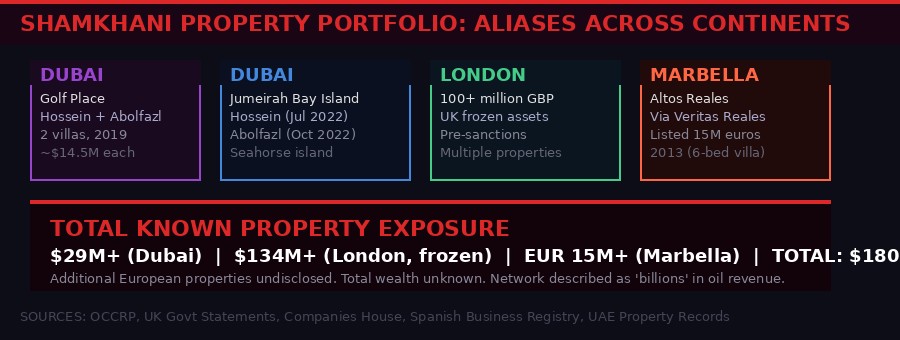
Known property assets across three continents. Dubai alone accounts for $29 million. UK assets total over 100 million GBP, frozen by authorities. The Marbella villa was listed at 15 million euros in 2013. Total known exposure exceeds $180 million. [BLACKWIRE / Sources: OCCRP, UK Govt, Companies House]
The total assessed value of the four Dubai properties at time of acquisition: nearly $29 million. All held under aliases. All in one of the world's least financially transparent real estate markets.
Dubai has become the destination of choice for sanctioned individuals, oligarchs, and kleptocrats seeking to park wealth beyond the reach of Western enforcement. The UAE has faced intense international pressure over its weak anti-money-laundering controls, but property ownership transparency remains limited. Acquiring real estate through aliases - particularly with foreign passports - creates a layer of separation that requires active investigative work to penetrate.
The Network: Billions Routed Through Turkey, Singapore, and Beyond

The Shamkhani Network operated a "vast fleet of vessels" to ship Iranian and Russian crude oil, primarily to buyers in China. [Pexels]
The Dubai properties are the visible tip. The operational infrastructure underneath is far more complex - and far more profitable.
According to the DOJ civil forfeiture complaints and OFAC sanctions documentation, the Shamkhani Network operated through a layered series of front companies spread across multiple jurisdictions, each layer adding distance between the Iranian oil trade and the identifiable Shamkhani family name.
One key instrument was Green Energy Chemicals Enerji Kimyasallari Sanayi Ticaret Anonim Sirketi - a Turkish company incorporated in 2021. Corporate records show "Hugo and Sami Hayek" among the founding shareholders. In November 2023, the brothers transferred their shares to Dubai-based Milavous Group Ltd. The timing predated US sanctions by roughly two years, suggesting long-term planning.
In July 2025, OFAC sanctioned both the Turkish firm and Milavous Group. OFAC alleged that Milavous helped Hossein Shamkhani "arrange sales of Iranian oil and gas and launder the proceeds" while "disguising the Iranian and Russian origin of the oil it sold." The EU imposed separate sanctions for similar conduct. The UK sanctioned Milavous for alleged links to Hossein.
The DOJ forfeiture complaints describe Milavous Group as the "de facto corporate holding or management company for many of the Shamkhani associated businesses."
"Shamkhani runs a vast network of shell companies used to evade U.S. sanctions and launder funds for the Iranian regime and its terrorist proxies." - Assistant Attorney General for National Security John A. Eisenberg, DOJ Press Release, March 6, 2026
The DOJ identified two specific front companies at the center of the $15.3 million in seized funds. The first: Wellbred Capital Pte Ltd and its subsidiary Wellbred Trading DMCC - Singapore-registered firms that Shamkhani and associates "acquired and operated" to maintain a "brand" not publicly perceived as affiliated with Iran. Internal organizational charts obtained by prosecutors showed Wellbred's placement within the wider Shamkhani Network. The seized funds destined for Wellbred entities: $12.97 million.
The second company: Sea Lead Shipping Pte Ltd and its Indian affiliate Sea Lead Shipping Agency India PV - shipping service providers for the Network. Funds destined for Sea Lead: $2.4 million. In both cases, the money moved through US financial institutions - wire transfers that triggered seizure by US authorities in early 2026.

The Shamkhani Network attempted to route tens of millions through the US financial system. Wire transfers through American correspondent banks triggered the seizures. [Pexels]
Hossein Shamkhani denied the allegations in a statement reported by Bloomberg, saying he had "neither founded nor owned" Milavous Group and had "no role" in the company's management. He said he operated only in countries "not under sanctions."
Prosecutors disagree. Their organizational charts - extracted from Shamkhani's own files - show Wellbred's position in the network. The DOJ argument is not that the companies are secretly Iranian. It is that Shamkhani secretly controlled companies that publicly appeared to have nothing to do with him.
The Marbella Connection: Iran Meets the Costa del Sol

Marbella's Altos Reales - "Royal Heights" - is one of the Costa del Sol's most exclusive gated communities. A UK-controlled Spanish firm linked to a sanctioned Iranian banker acquired a six-bedroom villa there in 2020. [Pexels]
The Shamkhani brothers are not the only sanctioned Iranian figures to have quietly embedded themselves in Europe's luxury property markets. Parallel OCCRP reporting from March 17 documents a separate but structurally identical operation run by Ali Ansari - a banker sanctioned by the UK for allegedly "financially enabling" the IRGC.
Ansari's case illustrates how the same blueprint gets replicated across individuals with IRGC connections: British shell company, Spanish subsidiary, luxury real estate purchase, ownership buried under multiple layers of corporate registry.
Using a Cypriot passport, Ansari controls a London-registered firm called Veritas Reales Investment Limited - incorporated in 2019, now listed on Companies House with Ansari as the sole "Person with Significant Control." That London firm controls a Spanish subsidiary, Veritas Reales Marbella SL. That subsidiary owns a villa in Marbella's Altos Reales development - a gated community on Spain's southern Costa del Sol - acquired in 2020.
The villa was marketed in 2013 for 15 million euros, described as an "Outstanding Residence with Spectacular Views." Six bedrooms. An imposing central tower. A terrace overlooking a Mediterranean-view pool. A chandelier "bought from a 15th century church." Temperature-controlled wine cellars. Staff quarters. The kind of property where a billion-dollar front company's cash becomes marble and sea views.
UK authorities have frozen over 100 million British pounds ($134 million) worth of Ansari's UK real estate assets since sanctioning him in October 2025. The Financial Times, reporting in January 2026, found Ansari had acquired hundreds of millions of euros in commercial real estate across several European countries. The Marbella villa adds yet another piece to the portfolio.
"I was subjected to extensive legal and regulatory pressures - a process that ultimately led to the bank's dissolution. It is self-evident that had there been any organized relationship or special political backing, such an outcome would not have occurred." - Ali Ansari, public statement, March 12, 2026, through lawyers
Ansari's lawyers deny any IRGC connections. But the UK sanctions notice is explicit: Ansari "funds the work of the IRGC," which the UK government describes as "one of the most powerful military organisations in Iran, reporting directly to the Supreme Leader," with extensive business interests across telecommunications, transport, oil, and construction.
The Veritas Reales Investment Limited filings at Companies House are currently overdue. The firm faces forced dissolution within months unless cause is shown otherwise. Whether that dissolution comes before or after Spanish authorities pursue the underlying property remains an open question.
Timeline: How the Cover-Up Unraveled
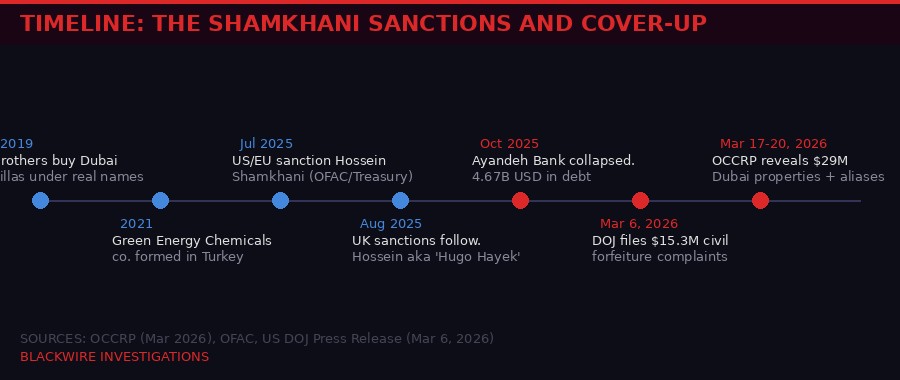
Seven years of property accumulation, alias use, and financial maneuver - and two weeks of enforcement. The DOJ filed in early March. OCCRP published March 17-20. [BLACKWIRE / Sources: OCCRP, DOJ, OFAC]
The Shamkhani operation ran undetected for years. It did not fail because of surveillance or informants. It failed because of document trails - property records, corporate filings, leaked border crossing data, sanctions-notice language, and the rigorous cross-referencing work of investigative journalists.
In 2019, the brothers bought Dubai real estate under real names - probably because they had no reason yet to think they needed aliases. They were the sons of one of Iran's most powerful officials. The money was flowing. The sanctions clock had not started.
By 2021, the Turkish company Green Energy Chemicals was operational - the Caribbean passports already in hand, the alias framework already functional. By 2022, the Jumeirah Bay Island properties were purchased directly under the Hayek aliases, suggesting the brothers now understood that real-name property purchases were a liability.
The title transfers on the earlier Golf Place villas - changing ownership from Iranian names to Hayek aliases - happened at some point before OCCRP's investigation, but the precise date remains unclear. The implication is deliberate: retroactively scrubbing the Iranian identity from the property record.
US sanctions hit Hossein in July 2025. UK sanctions followed in August. Ayandeh Bank - in which Ansari held shares, and which had deep links to the same financial ecosystem - collapsed in October 2025, its books revealing 5 quadrillion Iranian rials ($4.67 billion) in misallocated funds.
Then came the strikes. US and Israeli military action in late February and early March 2026 killed Khamenei and eliminated Ali Shamkhani, along with other senior Iranian officials. The political protection that had sheltered the Shamkhani network's operations disappeared overnight.
On March 6, 2026 - days after the strikes - US prosecutors filed the civil forfeiture actions. The timing was not coincidental. With Ali Shamkhani dead and the Iranian political structure in chaos, the window for enforcement action had opened.
The Bigger Picture: How Golden Passports Enable Financial Crime

Caribbean Citizenship by Investment programs have faced sustained criticism from the EU and FATF for inadequate due diligence on applicants. [Pexels]
The Shamkhani case is not an outlier. It is the recurring pattern.
Caribbean Citizenship by Investment programs - run by Dominica, St Kitts and Nevis, Antigua and Barbuda, Grenada, and St Lucia, among others - have become a standard tool for sanctioned individuals, kleptocrats, and organized crime figures seeking to acquire travel documents unlinked to their real identities. The programs generate significant government revenue. The due diligence is inconsistent. The results are predictable.
The EU has repeatedly warned member states about the risks of these programs. In 2022, the European Commission moved to terminate its own "golden visa" programs after sustained criticism that they provided entry points for oligarchs and money launderers. But Caribbean programs operate outside EU jurisdiction, and their passports - depending on the country - provide visa-free access to Schengen Area countries, the UK, and major financial centers.
For a sanctioned Iranian oil magnate who needs to open bank accounts, sign corporate documents, and acquire property without triggering watchlists linked to his real name, a Dominican passport is not a luxury. It is infrastructure.
Key figures: The Shamkhani network at a glance
- Ali Shamkhani - Former Iranian Defense Minister, Security Council Secretary, Supreme Leader advisor. Killed in US-Israeli strikes, early 2026.
- Hossein Shamkhani (aka Hugo Hayek) - Sanctioned by US (OFAC, July 2025), EU, and UK. Alleged to operate "vast fleet" generating billions in Iranian/Russian oil revenue.
- Abolfazl Shamkhani (aka Sami Hayek, Hassan Shamkhani) - Not personally sanctioned. Alleged in DOJ filings to manage network firms. Listed in civil forfeiture complaints.
- Milavous Group Ltd - Dubai-based, sanctioned by US, EU, UK. Alleged "de facto holding company" for Shamkhani businesses.
- Green Energy Chemicals - Turkish company. Sanctioned by OFAC. Alleged oil routing and sanctions evasion.
- Wellbred Capital Pte Ltd - Singapore. Alleged front company. $12.97M seized by DOJ.
- Sea Lead Shipping Pte Ltd - Singapore. Alleged shipping services for network. $2.4M seized.
- Saleya Fund RAIF LP - Cyprus-incorporated alternative investment fund. Abolfazl listed as limited partner under "Sami Hayek" alias.
The Shamkhani network illustrates how a single politically connected family can span jurisdictions, combine legitimate-looking corporate structures with alias identities, and generate billions in sanctioned revenue - for years - while remaining largely invisible to enforcement agencies that are not actively looking.
The DOJ seized $15.3 million. By OFAC's own accounting, the network generates "billions." The ratio between what was seized and what was generated is a measure of how much remains hidden - in Dubai villas, in Cypriot investment funds, in Turkish energy companies, in London commercial real estate, in the accounts of dozens of subsidiary firms that have not yet been identified.
What Comes Next: Enforcement in a Post-Strike Environment

Two civil forfeiture complaints are now active in the US District Court for the District of Columbia. But the DOJ's own filings describe a network orders of magnitude larger than the $15.3 million seized. [Pexels]
The legal machinery is now moving on multiple fronts.
In the US, the two civil forfeiture actions are active in federal court in Washington, DC. Attorney General Pamela Bondi has publicly framed the enforcement action as part of a broader posture of "zero tolerance for foreign actors using the US financial system to prop up our nation's enemies." The DOJ has FBI, HSI, and IRS Criminal Investigation all listed as participating in the investigation - a resource commitment that suggests the forfeiture cases are not the endpoint but the opening move.
In Spain, the Veritas Reales Investment Limited situation is approaching a forced dissolution deadline. It remains unclear whether Spanish financial intelligence authorities have opened any proceedings related to the Marbella villa. The property sits in a gated community under the ownership of a UK company whose parent is a sanctioned Iranian banker who says he plans to fight his sanctions designation in court.
In Dubai, the four Shamkhani villas remain in the names of "Hugo Hayek" and "Sami Hayek." UAE authorities have faced sustained international pressure to freeze or seize assets linked to sanctioned individuals. Whether the Dubai Real Estate Regulatory Authority will take action on properties held under aliases - after the underlying owners have now been publicly identified - is an open question that will test the sincerity of UAE anti-money-laundering reform commitments.
In Cyprus, the Saleya Fund RAIF LP - in which Abolfazl is a limited partner under the Sami Hayek alias - has filed no accounts. Its activities remain unknown. Cypriot authorities have been repeatedly criticized for inadequate oversight of the alternative investment funds registered under their jurisdiction.
The Dominican Republic revoked Hossein's passport following the US sanctions. But the aliases persist in property records, corporate filings, and financial systems across multiple countries. Revoking a passport does not retroactively clean the registry entries that were created while it was valid.
The fundamental problem is jurisdictional fragmentation. Each piece of the Shamkhani network sits in a different country, under a different regulatory regime, requiring different legal instruments to pursue. The DOJ can seize funds that pass through US banks. UK authorities can freeze London property. Spanish authorities may act on the Marbella villa. But no single enforcement agency has a complete picture of the full network, and the coordination required to dismantle it simultaneously across eight or nine jurisdictions is an order of magnitude harder than any single enforcement action.
Meanwhile, Hossein Shamkhani's lawyer in London - the firm has not been publicly named in connection with the UAE properties - has not commented on the Dubai findings. Gherson, Ansari's lawyer, did not answer questions about his client's Marbella holdings or the UK company's overdue filings.
The money is not gone. The assets are not frozen. The network is documented but not dismantled. The father who built the political access to make all of it possible is dead. His sons are sanctioned, exposed, and under active legal pursuit - but sitting on properties worth hundreds of millions of dollars across three continents.
Follow the money. This story is not finished.
Source documents
- OCCRP Investigation (March 20, 2026): "Slain Iranian Official's Sons Hold $29M in Dubai Property Using Assumed Names" - occrp.org
- OCCRP Scoop (March 17, 2026): "Sanctioned Iranian Banker Owns Luxury Spanish Villa via UK Company" - occrp.org
- US DOJ Press Release (March 6, 2026): "United States Files Civil Forfeiture Complaints Against $15M in Funds Allegedly Linked to Iranian Oil Shipping Network" - justice.gov
- OFAC Sanctions Notice (July 30, 2025): Sanctions against Mohammad Hossein Shamkhani, Milavous Group Ltd, Green Energy Chemicals Enerji - US Treasury
- UK Government Statement (October 2025): Sanctions against Ali Ansari for "financially enabling the IRGC" - gov.uk
- UK Government Statement (August 2025): Sanctions against Hossein Shamkhani - gov.uk
- Companies House (UK): Filings for Veritas Reales Investment Limited - Cypriot passport, Person with Significant Control: Ali Ansari
- UAE Property Records: Obtained by OCCRP - Golf Place and Jumeirah Bay Island acquisitions under real and alias names
Get BLACKWIRE reports first.
Breaking news, investigations, and analysis - straight to your phone.
Join @blackwirenews on Telegram