The $1.3 Billion Heist: Dan Gertler, Glencore, and the DRC Mining Racket
A Dutch court just handed down a €25.8 million fine against a shell company owned by sanctioned Israeli billionaire Dan Gertler. It closes an eight-year investigation. It charges no individuals. And it leaves the $1.36 billion stripped from the Congo's treasury almost entirely unaddressed - a settlement so small it reads like a receipt, not a reckoning.
The Katanga province of the Democratic Republic of Congo holds some of the world's richest copper and cobalt deposits - a fact that attracted deal-makers, middlemen, and looters in roughly equal measure. (BLACKWIRE/Illustrated)
On March 10, 2026, the Dutch Public Prosecution Service announced a settlement. A company called Fleurette Properties Ltd - a Netherlands-registered shell entity linked to sanctioned Israeli billionaire Dan Gertler - had agreed to pay €25.8 million to close an eight-year bribery investigation involving cobalt and copper mining licenses in the Democratic Republic of Congo.
No individuals were charged. No admission of criminal wrongdoing was entered on the record. Fleurette paid the fine, issued a press release, and declared the matter closed. Under Dutch law, the case is now settled.
But the numbers tell a different story. The DRC reportedly lost over $1.36 billion in mining revenues between 2010 and 2012 alone - directly traceable to the scheme of which Fleurette was a central component. The €25.8 million fine represents roughly 1.9 cents on every dollar stolen. For a country where 73 percent of the population survives on less than $2 a day, that ratio isn't accountability. It's insult compounded on injury.
This is the story of how that money disappeared - through shell companies, presidential friendships, lobbyists, offshore accounts, and the world's largest commodity trader. It is also the story of how a corrupt network survived U.S. Treasury sanctions by relocating its operations into the Congo itself, laundering proceeds through a Cameroonian bank, and using proxies to acquire new mining licenses while still officially frozen out of the global financial system.
The Numbers at a Glance
Sources: U.S. Treasury / OFAC, OCCRP, Global Witness, Dutch Public Prosecution Service, Carter Center
The Friendship That Became a Pipeline
The architecture of the DRC mining racket was deceptively simple: one man with access to a president, a string of companies to launder the access into paper legitimacy, and a global commodity giant willing to look the other way.
Dan Gertler is an Israeli diamond trader turned mining magnate who, by his late 20s, had forged a relationship with Joseph Kabila - the DRC's long-serving president and son of the country's previous leader, Laurent-Desire Kabila, who was assassinated in 2001. The relationship gave Gertler something no amount of money can buy outright: the ability to act as mandatory middleman for some of the world's most valuable mineral assets.
The DRC's copper and cobalt deposits in the Katanga province are extraordinary by any measure. The country holds an estimated 70 percent of the world's cobalt reserves - the metal that powers lithium-ion batteries in every electric vehicle and smartphone on earth. Controlling access to those reserves, even briefly, is worth billions.
According to the U.S. Treasury Department, which sanctioned Gertler in December 2017 under the Global Magnitsky Act, he "used his close friendship with DRC President Joseph Kabila to act as a middleman for mining asset sales in the DRC, requiring some multinational companies to go through Gertler to do business with the Congolese state." The mechanism was straightforward: mining companies paid Gertler for access. Gertler used offshore shell companies - including his flagship holding company Fleurette Properties, then incorporated in Gibraltar - to receive those payments and route them into his personal fortune.
The losses to the Congolese state were not incidental. They were structural. A 2017 report by the Carter Center documented that between 2010 and 2012 alone, the DRC lost over $1.36 billion in revenue from the underpricing of mining assets that were sold to offshore companies linked to Gertler. That figure - $1.36 billion - could have funded nearly half of the DRC's annual health budget at the time. Instead it funded Dan Gertler's next acquisition.
"The scale and nature of the corruption Gertler facilitated had a significant impact on the human rights of many Congolese." - Coalition of Congolese and international NGOs, letter to U.S. Treasury Secretary, February 2021
Glencore: The Giant That Needed a Fixer
Dan Gertler did not operate in a vacuum. His business required counterparties - legitimate, multinational corporations willing to pay for the access he offered. Chief among them was Glencore, the Swiss commodity trading and mining giant, which as of 2026 remains one of the world's largest producers of cobalt and copper.
The relationship between Glencore and Gertler stretches back to 2007, and the terms of it came into sharp focus with the Paradise Papers - a 2017 leak of offshore financial documents obtained by the International Consortium of Investigative Journalists (ICIJ). Those documents revealed that Glencore had furtively loaned Gertler tens of millions of dollars while the well-connected businessman helped the company secure a controversial mining agreement in the DRC.
As part of that deal, two companies later controlled by Glencore received a combined $440 million discount in 2008 on payments to Gecamines, the DRC's state-controlled copper mining company. A report by Resource Matters, based on the leaked documents, concluded that Gertler had helped these companies obtain access to an extremely rich copper-cobalt deposit at 48 times below market rate. At the time, $440 million exceeded the DRC's entire education budget.
When the U.S. Treasury sanctioned Gertler in December 2017, Glencore formally cut ties with the billionaire. But the separation was messier than the press release suggested. A legal dispute broke out over unpaid royalties from Congolese mines. According to reporting by the Guardian, the companies eventually settled by agreeing to pay royalties in euros rather than dollars - a structural workaround specifically designed to avoid triggering U.S. sanction violations. The arrangement allowed Gertler to continue receiving income from assets linked to Glencore while remaining formally sanctioned.
In July 2018, the U.S. Department of Justice served Glencore with a subpoena under the Foreign Corrupt Practices Act, requesting documents pertaining to business in Nigeria, the DRC, and Venezuela from 2007 to the present. The subpoena explicitly covered potential violations of U.S. money laundering laws. Glencore's share price dropped 13 percent on the day the news broke, wiping roughly $8.8 billion from its market value.
Glencore eventually settled with the DOJ in 2022, pleading guilty to bribery charges related to operations in the DRC, Nigeria, and other countries, and paying $1.5 billion in penalties to U.S., UK, and Brazilian authorities. The DRC component was central to that settlement. The Gertler connection ran directly through it.
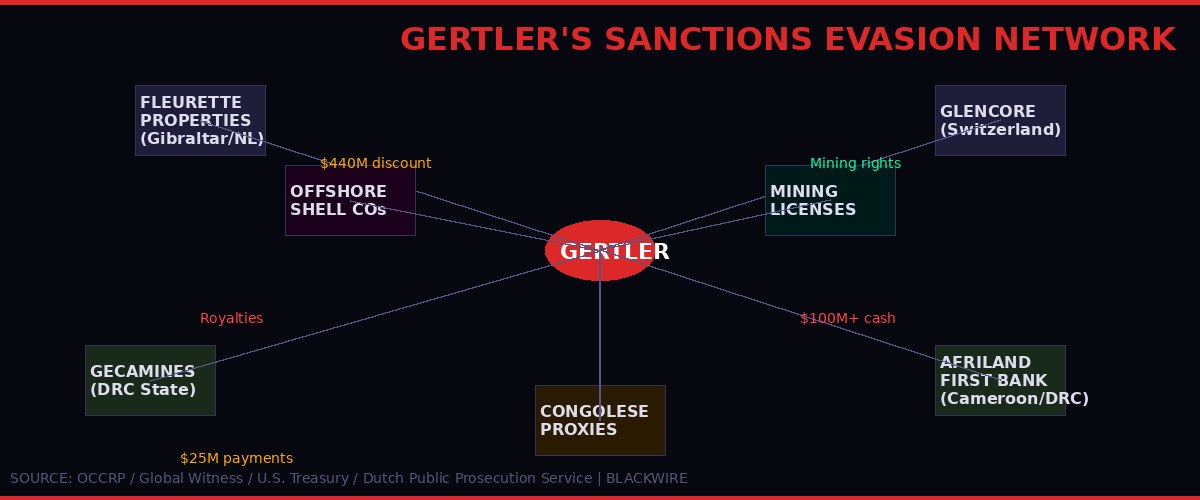
How Gertler's network moved money: shell companies in Gibraltar, a Dutch holding company, a Cameroonian bank's Congo branches, state miner Gecamines, and Glencore royalty payments - all flowing back to a sanctioned billionaire. (BLACKWIRE/Illustrated)
The Sanctions That Didn't Stick
The U.S. Treasury's December 2017 action against Gertler was widely described as a landmark use of the Global Magnitsky Act - a law designed to freeze out corrupt businesspeople and human rights abusers from the American financial system. By July 2018, the number of sanctioned entities in Gertler's network had grown to 34, encompassing holding companies, subsidiaries, and associates across multiple jurisdictions.
In theory, being designated under the Magnitsky Act means frozen U.S. assets, prohibition on transactions with American companies and banks, and severe reputational damage in global capital markets. In practice, for a man with Gertler's resources and connections, it was the beginning of a very expensive workaround project.
A joint investigation by Global Witness and the Platform to Protect Whistleblowers in Africa (PPLAAF), published using documents provided by whistleblowers, revealed that Gertler had constructed an elaborate sanctions evasion architecture centered on the DRC itself. Rather than trying to route money through the international financial system - where U.S. dollar transactions would flag immediately - his network relocated operations locally.
The mechanism worked as follows: Congolese proxies opened bank accounts at the DRC branches of Afriland First Bank, a Cameroon-headquartered institution. New names appeared on company registrations and account documents - names connected to Gertler through subtle paper trails rather than direct ownership. New mining permits were acquired by these proxy entities, with payments routed to Gecamines, the state miner, just before the 2018 DRC elections - a pattern that echoed Gertler's pre-election moves before the 2011 vote.
Between June 2018 and May 2019 - while Gertler was actively sanctioned - at least $100 million flowed through bank accounts associated with this network. Nearly 70 percent of it was deposited in cash. At least $21 million was sent to unknown accounts outside the DRC. At least $25 million went to Gecamines in exchange for new mining licenses. And it was denominated largely in U.S. dollars - the very currency the sanctions were designed to cut off.
Glencore, meanwhile, continued making royalty payments - now in euros - throughout this period. Sicomines and ERG, two other international mining companies operating in the DRC, also appeared to have made payments to customs and logistics agencies controlled by Gertler associates, according to the Global Witness report.
"This investigation appears to show how the machinery of the global economy can be employed by bad actors for their own personal profit, and in this case to the detriment of the Congolese population, over 73% of whom live on less than $2 a day." - Margot Mollat, Global Witness Campaigner
The Last Act of the Trump Administration
January 15, 2021. Five days before Joe Biden was inaugurated. The Director of the U.S. Treasury Department's Office of Foreign Assets Control (OFAC) signed a document that authorized a one-year special license for Dan Gertler. The license did two things: it allowed Gertler and his companies to resume transactions with U.S.-based entities, and it unfroze all of his U.S. assets.
The timing was not accidental. Gertler had spent the three years since his 2017 designation assembling what amounted to a high-powered lobbying operation. His team, according to reporting by the New York Times, included a former federal prosecutor, a former FBI director, and Alan Dershowitz - the Harvard law professor who had represented Donald Trump during his first impeachment trial. The price tag for such representation runs into the millions. It apparently paid off.
The move stunned anti-corruption advocates. Margot Mollat at Global Witness called it "an outrage," noting that the original 2017 designation had been "a significant win for mining transparency and global anti-corruption efforts." Sasha Lezhnev of The Sentry went further: the unilateral license, he said, "sends a message to the world's most corrupt businesspeople that the U.S. will let them walk free after a bit of lobbying."
The Biden administration revoked the license on March 8, 2021 - less than two months into office, and one month after a coalition of Congolese and international NGOs wrote directly to the Treasury Secretary and Secretary of State demanding action. The Treasury statement made the administration's view clear: the Trump-era license was "inconsistent with America's strong foreign policy interests in combating corruption around the world."
But the damage had already been done. For more than a month - between January 15 and the Biden reversal - Gertler had access to frozen U.S. assets and the ability to transact with American entities. How much moved during that window has never been publicly established. What is clear is that the episode exposed the fragility of Magnitsky designations when subjected to sustained political pressure at the highest levels of the U.S. government.
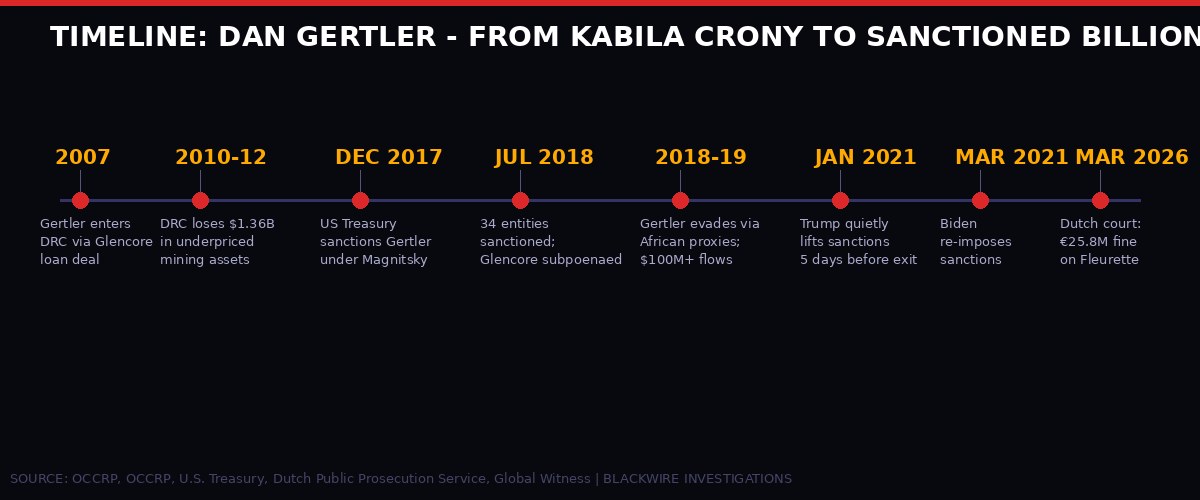
A decade of manipulation: from the first corrupt deals with Kabila's DRC to the 2026 Dutch settlement that closes an eight-year probe with a fine that is, by any proportional measure, a gift. (BLACKWIRE/Illustrated)
Fleurette, the Netherlands, and the Art of Jurisdictional Shopping
The Dutch settlement announced on March 10, 2026 is, in one respect, a success for European law enforcement. An eight-year investigation resulted in a financial penalty against a company that bribed a Congolese official to secure cobalt and copper mining licenses. The facts are, at least in part, established. A price - €25.8 million - has been attached to the misconduct.
But the details of how Fleurette Properties ended up as a Dutch entity at all illuminate something important about how the global corruption machinery actually operates. The Dutch Public Prosecution Service spokesperson Jeroen Toet noted what he called a "striking aspect" of the case: Fleurette was originally established as a shell company in Gibraltar, a British Overseas Territory known for light-touch corporate regulation. It relocated its headquarters to the Netherlands during the very investigation period - specifically to take advantage of what Toet described as "the favorable Dutch business and tax climate."
Gibraltar to Amsterdam, mid-investigation. The company moved jurisdictions while prosecutors were already circling it. That maneuver - relocating a shell company to a more favorable legal environment while under scrutiny - is a standard playbook for sophisticated financial crime. It creates procedural delays, forces investigators to restart certain lines of inquiry, and sometimes allows statutes of limitations to run in favorable jurisdictions. In this case, it bought Fleurette roughly eight years of process before settling for a fine that U.S. Treasury's own language suggests represents a fraction of the corruption's value.
Dutch media reports suggested that a director of Fleurette who reportedly served as a Dutch tax official was involved in the case. The Dutch Public Prosecution Service declined to comment on individual names. "The fine was imposed on Fleurette Properties Ltd. The Public Prosecution Service will not comment further on specific names circulating in the media," spokesman Toet told OCCRP.
No individuals were charged. No individuals were named in the settlement. The company paid, issued a statement denying that the Congolese official it bribed was a "public official during the relevant period" - a defense that legal experts have described as highly technical, relying on the specific status of Augustin Katumba Mwanke at precise moments during the 2010-2011 period - and the matter was declared closed.
Dan Gertler himself remains under U.S. Magnitsky sanctions. He has not been charged criminally in any jurisdiction. His fortune, built substantially on DRC mining assets obtained through the kind of dealings described in U.S. Treasury designations, global court filings, and investigative journalism spanning a decade, remains largely intact.
The Cobalt Connection: Why This Keeps Mattering
The Gertler story is not a historical curiosity. It connects directly to the present-day supply chains that power the electric vehicle transition, the smartphone in your pocket, and the energy storage systems that underpin the green economy's aspirations.
The DRC holds somewhere between 50 and 70 percent of the world's proven cobalt reserves. The specific deposits in the Katanga province - the Mutanda mine, the Kamoto Copper Company, the assets Glencore obtained through the $440 million discount deal - have become among the most strategically important natural resource sites on earth. As electric vehicle demand has driven cobalt prices through cycles of extraordinary volatility, the question of who controls those mines, and on what terms, has acquired geopolitical weight.
The answer, in significant part, is Glencore. And behind Glencore's entry into those assets, at favorable terms, was Dan Gertler. And behind Gertler was his friendship with Joseph Kabila. And behind Kabila was a state apparatus that sold the country's mineral wealth at a discount to benefit a small circle of officials and their foreign partners.
The DRC's new president, Felix Tshisekedi, has taken a more aggressive posture toward renegotiating mining contracts inherited from the Kabila era. But structural change in the DRC's extractive sector has proved difficult to achieve. The same multinational companies that benefited from discounted access have long-term concession agreements, access to global capital markets for litigation if agreements are challenged, and decades of established presence in the country. The asymmetry between a resource-rich but institutionally weak state and a well-resourced global commodity giant is not easily corrected by political will alone.
Meanwhile, the cobalt in those mines flows through supply chains with layers of trading intermediaries before reaching the battery manufacturers that supply Tesla, Samsung, and every other company racing to electrify transportation. Transparency advocacy groups have made significant progress in mapping those chains and identifying conflict mineral exposure. But the financial corruption at the extraction end - the bribes, the underpriced licenses, the proxy networks - remains largely invisible to the end consumer and often to the manufacturers themselves.
The Broader Pattern: How the Accountability Gap Works
The Gertler case is unusual in the specificity of its documentation - the U.S. Treasury designations, the Paradise Papers, the Global Witness whistleblower-based investigation, the OCCRP reporting, the Dutch prosecution, the Glencore DOJ settlement. Few cases of this scale accumulate such a comprehensive public record across so many jurisdictions over such an extended period.
What makes it representative is not its exceptionalism but its outcome. After a decade of international scrutiny, involving at least four national investigative and prosecutorial agencies across multiple continents, the concrete consequences are as follows: one company fined €25.8 million. One corporate settlement with the DOJ - Glencore - that totaled $1.5 billion but covered multiple countries and involved no admission of guilt regarding the specific DRC mining license deals. No individual criminal convictions for any of the principals involved in the original corruption scheme. The sanctioned billionaire at the center of the network remains at large, his assets substantially intact, his companies continuing to operate under various names.
The gap between documented damage - $1.36 billion to the DRC state alone, by conservative estimates - and concrete accountability is so large that it effectively signals to the global financial and extractive industries that large-scale corruption in resource-rich developing countries carries limited personal risk. The expected value calculation for someone in Gertler's position is clear: the potential upside of corrupt access to DRC mining assets runs into hundreds of millions of dollars. The downside risk, measured in actual legal consequence, has proven to be manageable.
That signal is what makes cases like this matter beyond their immediate facts. Every time an investigation ends with a fine on a shell company - no individuals charged, no admission of guilt, the principal network intact - it calibrates the risk-reward calculus for the next deal. The Dutch settlement isn't just an inadequate resolution of the Gertler case. It's a data point in a model that many sophisticated financial operators are watching closely.
"Treasury is sanctioning companies that have enabled Dan Gertler to access the international financial system and profit from corruption and misconduct. A financial toll will be imposed on individuals and companies that exploit innocent people and vulnerable jurisdictions for their own personal gain." - Sigal Mandelker, U.S. Under Secretary of the Treasury for Terrorism and Financial Intelligence, July 2018
What Justice Would Actually Look Like
The International Federation of Human Rights (FIDH) and a coalition of DRC civil society organizations have long argued that the Gertler case demands not just financial penalties on corporate vehicles but criminal prosecution of the individuals who designed and operated the corruption network. Several jurisdictions have the legal authority to pursue such cases: the United States under the Foreign Corrupt Practices Act and money laundering statutes, Switzerland as the domicile of Glencore's headquarters, the United Kingdom through the Serious Fraud Office's jurisdiction over UK-listed entities, and the DRC itself through its own judicial system - though institutional independence there remains limited.
The U.S. sanctions regime, the most powerful tool deployed against Gertler to date, is a financial instrument, not a criminal one. Magnitsky designations freeze assets and restrict transactions. They do not result in criminal convictions, prison sentences, or asset forfeiture on the scale of the documented harm. For them to function as a genuine deterrent rather than a reputational nuisance for very wealthy operators, they need to be backed by criminal prosecution - something that has not materialized in Gertler's case despite years of documented evidence in the public domain.
There is also the question of asset recovery for the DRC. The $1.36 billion documented by the Carter Center as lost between 2010 and 2012 - before the period covered by the Dutch investigation, before the period covered by the Global Witness whistleblower documents - represents a specific, quantifiable harm to a specific population. Mechanisms exist under international law for countries to seek restitution of proceeds of corruption funneled through foreign financial systems. The DRC government, with adequate legal support, could in theory pursue such claims through U.S. courts, Swiss courts, or English courts, depending on where Gertler's assets are held. That process has never seriously been pursued, for reasons that speak to the resource and legal capacity asymmetries between a fragile state and a billionaire with access to former FBI directors and Harvard lawyers.
What the Dutch settlement does, despite its inadequacy on quantum, is establish a public legal record that Fleurette Properties bribed a Congolese official. That record - accepted facts in a prosecutorial settlement - may be usable in future civil proceedings by DRC interests. Whether any such proceedings materialize will depend on whether the political will exists in Kinshasa, and whether the international legal support infrastructure that civil society organizations have been slowly building for DRC resource cases can be mobilized.
Conclusion: The Permanent Price of Impunity
The Democratic Republic of Congo is, by almost any measure, one of the poorest countries on earth. It is also one of the most resource-rich. That paradox - the poverty amidst abundance that development economists call the "resource curse" - is not an accident of geology or culture. It is the product of decades of systematic looting, enabled by the same international financial infrastructure that processed the proceeds, and by the foreign corporations and governments that accepted the terms offered by whoever controlled access to the resources.
Dan Gertler is not an anomaly. He is an example of a well-documented type: the well-connected foreign intermediary who exploits a relationship with a kleptocratic government to extract wealth from natural resources that belong, in any legitimate sense, to the country's population. The mechanism is old. What is newer is the documentation - the whistleblowers, the investigative journalists, the sanctions designations, the court filings that have together assembled a more complete picture of how this particular extraction machine worked than has been available for most similar operations throughout history.
That documentation should, in principle, enable accountability. The Dutch settlement suggests it does not, automatically, do so. €25.8 million against $1.36 billion in documented losses. No individuals charged. The principal network intact. A company that moved jurisdictions during an investigation, settled at an amount it could absorb, and declared the matter closed.
The cobalt from those mines continues to flow. The electric vehicles powered by it continue to be sold. The supply chain continues to benefit from the access that was purchased with Congolese public money. And the population that lost $1.36 billion continues to live on less than $2 a day. That is the permanent price of impunity - not just for the DRC, but for every country where the next Gertler is watching this case and drawing his own conclusions about the risk-adjusted returns on corruption.
Get BLACKWIRE reports first.
Breaking news, investigations, and analysis - straight to your phone.
Join @blackwirenews on TelegramU.S. Treasury / OFAC designation notices (December 2017, July 2018) - home.treasury.gov
Dutch Public Prosecution Service statement (March 10, 2026) - om.nl
OCCRP reporting on Halkbank, Gertler sanctions, and DRC corruption - occrp.org
Global Witness / PPLAAF: "Undermining Sanctions" (2021) - globalwitness.org
Carter Center: DRC Mining Revenue Loss Report (November 2017) - cartercenter.org
Resource Matters: "The $440 Million Discount" (November 2017) - resourcematters.org
ICIJ Paradise Papers reporting on Glencore-Gertler loans (November 2017) - icij.org
The Sentry: Report on Trump administration Gertler license (January 2021) - thesentry.org
New York Times: Gertler lobbying network (January 2021) - nytimes.com
Fleurette Properties press release on Dutch settlement (March 10, 2026) - prnewswire.com
DOJ: Glencore FCPA guilty plea and $1.5B settlement (May 2022) - justice.gov