Iran's $11 Billion Black Hole: How IRGC-Linked Trustees Looted the National Oil Treasury
The Islamic Republic spent years telling its citizens that U.S. sanctions were to blame for their collapsing economy. The rial cratered, inflation hit triple digits, and ordinary Iranians could not afford cooking oil. But as a former oil industry executive has now revealed, a parallel story was unfolding inside the system itself - one where IRGC-linked insiders were pocketing at least $11 billion in oil revenues through a web of UAE shell companies, fake bank receipts, and passport-holders from Pakistan and Afghanistan recruited specifically to launder the money. The victims were not Americans. They were Iranians.

The Confession That Shook Tehran

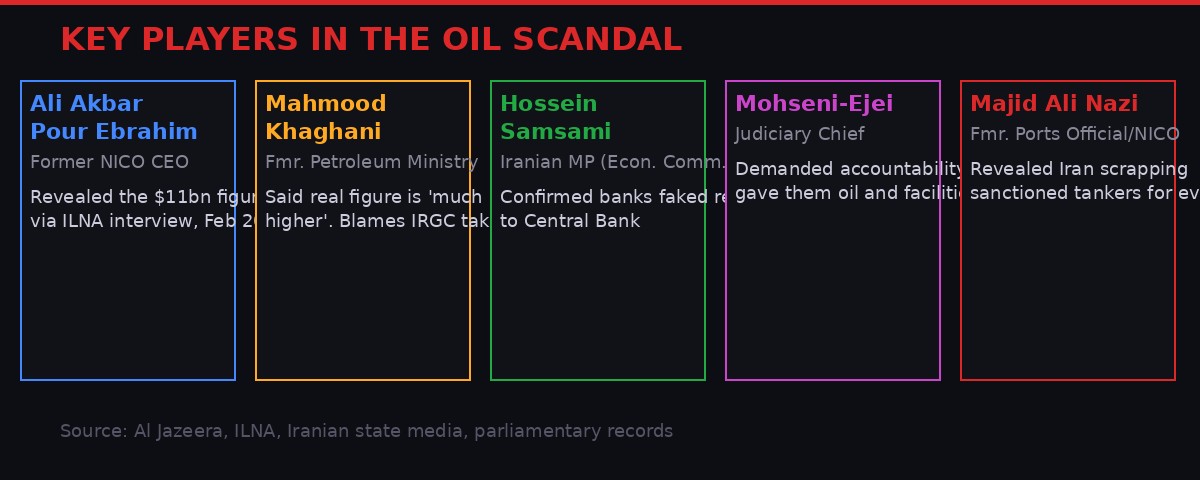
The bombshell landed quietly in mid-February 2026, buried in a wire from Iran's semiofficial Labour News Agency (ILNA). Ali Akbar Pour Ebrahim, a former chief executive of Naftiran Intertrade Company - better known as NICO, the arm of Iran's Petroleum Ministry that sells the country's crude oil to the world - sat down for an interview and described what he said was systematic looting of the national treasury.
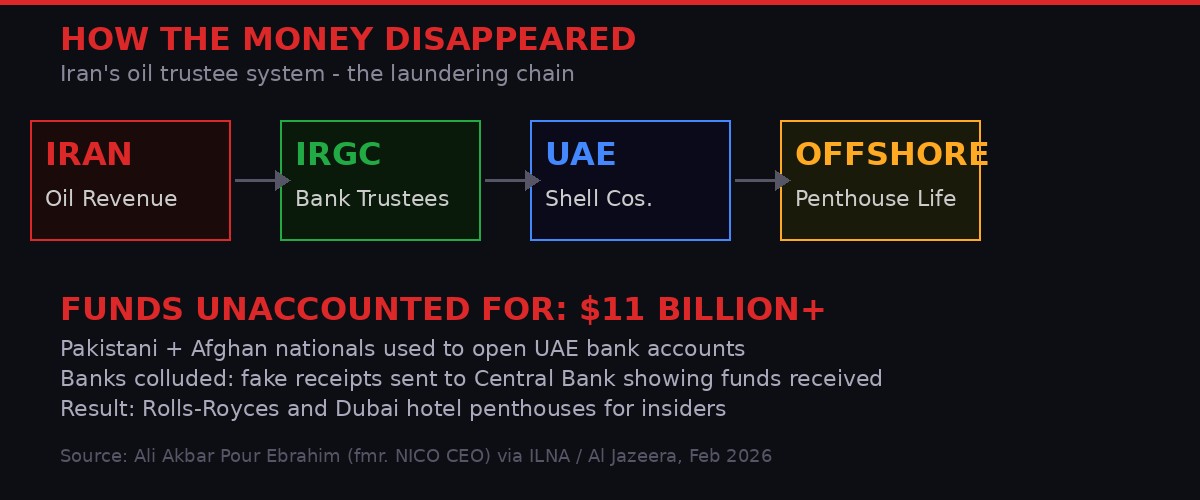
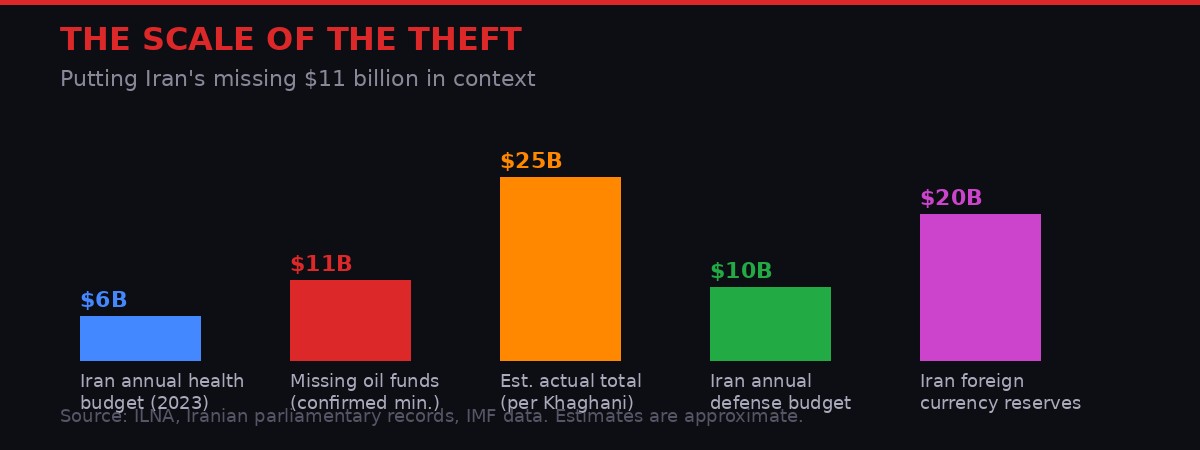
Pour Ebrahim was not speaking carelessly. He is now a banking and investment executive, deeply embedded in the very system he was criticizing. His account was precise and his numbers were specific: at least $11 billion in Iranian oil revenues had been handled by a network of so-called "trustees" and had not returned to Iran. The money was gone.
"Through the country's oil money, these people became Rolls-Royce owners in the UAE overnight and are now living in penthouses of expensive hotels there." - Ali Akbar Pour Ebrahim, former NICO CEO, speaking to ILNA, February 2026
The revelations were extraordinary not just for their content, but for who was making them and where. Pour Ebrahim was an insider - and he was speaking through state-adjacent media in a country where public admissions of systemic corruption at the highest levels carry serious risks. The fact that these statements were made at all suggests they reflect a broader factional battle inside the Iranian establishment, with reformist and pragmatist elements trying to force accountability on actors they cannot publicly name.
What has emerged since is a portrait of a corruption architecture so entrenched that Iran's own judiciary chief has publicly demanded to know who enabled it - and received no satisfactory answer. As war with the United States now looms over Iran's horizon, the establishment's response to this scandal is not to shut the system down. It is to expand it.
How the Trustee System Was Built - and Who Built It

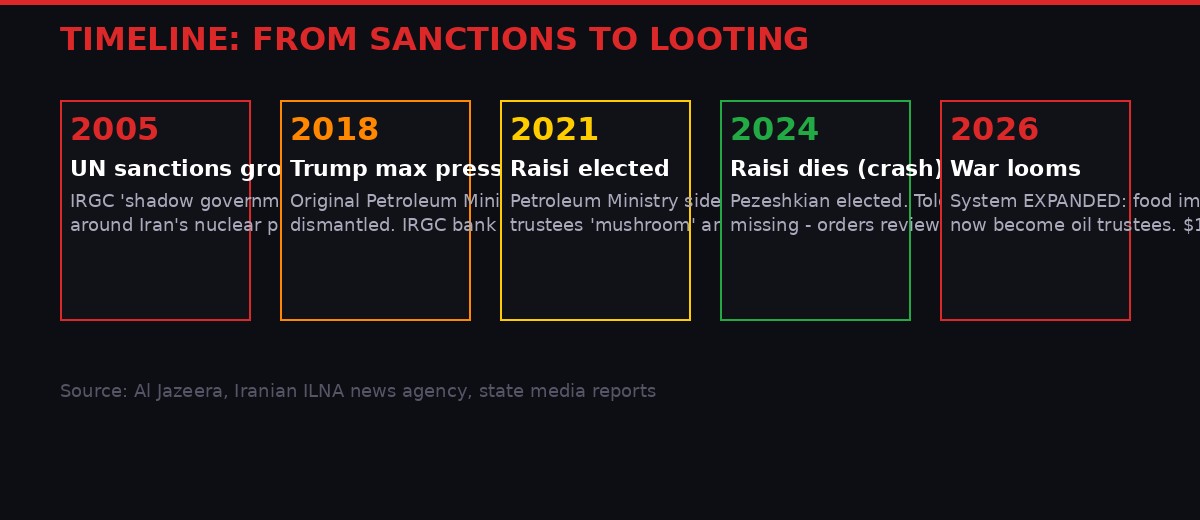
The trustee architecture did not appear overnight. According to Mahmood Khaghani - a career oil official who formerly led the Caspian and Central Asia department of Iran's Petroleum Ministry - the system was originally constructed roughly two decades ago as international pressure over Iran's nuclear programme intensified and the country began facing UN sanctions.
When the formal financial channels became too visible and too regulated, a "shadow government" emerged, Khaghani told Iranian state media. Experts were progressively sidelined from the Petroleum Ministry and other key economic bodies in favor of actors affiliated with the Islamic Revolutionary Guard Corps (IRGC) and other unelected security-intelligence structures.
"In effect, a number of people in the parliament, judiciary, government, and security and intelligence apparatuses entered oil deals. This did not remain limited to selling oil. The mafia is not active exclusively in oil but everywhere." - Mahmood Khaghani, former Petroleum Ministry official, quoted by Iranian state media
The original trustee model under President Hassan Rouhani was at least nominally managed by the Petroleum Ministry itself. When the Trump administration's first term began its "maximum pressure" sanctions campaign in 2018 - after Washington unilaterally exited the 2015 nuclear accord - the informal channels became the only channels.
But during Ebrahim Raisi's presidency from 2021, the Petroleum Ministry was actively pushed aside. Commercial banks took over the trustee function, operating under the nominal supervision of Iran's Central Bank - which, as subsequent revelations would show, was not actually supervising anything.
Pour Ebrahim says the outcome was predictable from the start: "They forced the Petroleum Ministry to shut down its own trustees and created bank trustees who operated under the purview of the country's commercial banks, which operated under the Central Bank. We knew from the start the trustees would take the money for themselves."
UAE Shell Companies, Fake Passports, and Phantom Bank Receipts

The mechanics of the looting were specific. Pour Ebrahim described the trustees using nationals from neighbouring Pakistan and Afghanistan to open bank accounts in the United Arab Emirates. These accounts received Iranian oil sale proceeds. The funds were then funneled through shell companies and did not return to Iran.
This is not a novel method. The use of third-country passport holders to open accounts that obscure ultimate beneficial ownership is a documented money laundering technique applied globally. What is unusual here is the scale and the institutional backing: this was not a rogue actor but what Pour Ebrahim describes as a systematic approach endorsed by the very banks and ministries meant to govern it.
The most damning detail came from a different source: Hossein Samsami, a member of Iran's parliament economic commission, who confirmed to state-affiliated media that some of the agent banks had been colluding with the trustees to declare receipt of oil money to the Central Bank even when no funds had actually been deposited. The receipts were fake. The Central Bank was shown paperwork indicating the money had arrived - and the money had not arrived.
Iranian commercial banks operating as oil trustees submitted fraudulent receipts to the Central Bank confirming receipt of oil revenues - even when no funds had been transferred. The Central Bank's audit system failed to detect or was complicit in not detecting the discrepancy. Source: Hossein Samsami MP, parliamentary economic commission, via state-affiliated media.
Khaghani, the former Petroleum Ministry official, went further. He told state media that if an independent audit were allowed - a significant caveat in a system that has resisted external scrutiny - the total misappropriated funds would emerge as considerably higher than $11 billion. The $11 billion figure, already staggering, may be a floor rather than a ceiling.
A Tehran-based oil expert, speaking with Al Jazeera on background in February 2026, confirmed the structural logic that enabled this outcome: "The nontransparent trustee model only begets corruption as powerful interest groups are given large sums with little to no accountability."
The Judiciary's Impotence - and the Silence of the Named

The response from Iran's official institutions has been loud on rhetoric and silent on action. Gholam-Hossein Mohseni-Ejei, the judiciary chief, addressed judges and provincial officials in early February 2026 with palpable frustration. His questions were pointed and public. His answers were not forthcoming.
"Who gave them this oil and other facilities? You at the Central Bank and the economy ministry and other places, was it not you who said you audited these trustees?" - Gholam-Hossein Mohseni-Ejei, Iran Judiciary Chief, speaking at an official meeting, February 2026
This is a remarkable public admission. The head of Iran's judicial system was standing in front of assembled officials effectively saying: the system that was supposed to catch this was either incompetent or complicit. And he was asking the institutions responsible for the oversight to account for themselves - knowing that some of those institutions are controlled by the same IRGC-affiliated power structures that benefited from the looting.
President Masoud Pezeshkian - elected in 2024 on a reform platform and now facing an economy hammered by both sanctions and internal corruption - was informed of the missing $11 billion and ordered a review. No thorough investigation has been conducted as of the time of publication.
Former President Ebrahim Raisi, before his death in a helicopter crash in May 2024, was said to have been pursuing the matter. Whether that pursuit was genuine or cosmetic remains unclear. The key actors in the trustee network have not been publicly named. No major prosecutions have been announced. The money has not been publicly accounted for.
Economist Morteza Afghah told the reformist Shargh newspaper that the impact on ordinary Iranians was direct and measurable: the missing funds "could have played a crucial role in bringing some stability to the country's currency markets and reducing pressure on Iranians losing their purchasing power by the day." Instead, the rial continued to depreciate and inflation remained at record levels while the insiders bought Rolls-Royces in Dubai.
The Ghost Fleet: Sanctions Evasion as Institutional Policy

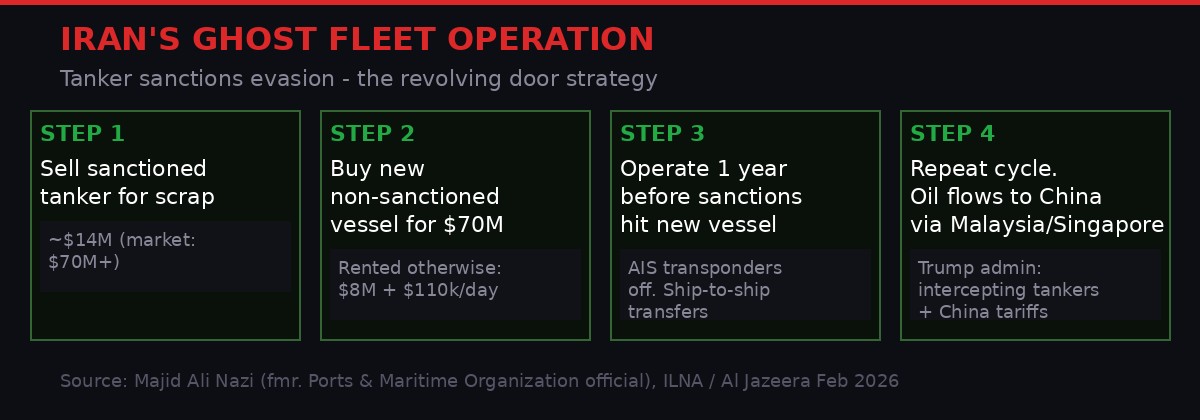
The trustee scandal is not the only financial corruption story emerging from Iran's oil sector. Running parallel is a story about the shadow fleet of tankers that Iran uses to move its crude oil to markets - primarily China, with routing through Malaysia and Singapore - in defiance of US and UN sanctions.
A former official from Iran's Ports and Maritime Organization, now consulting for NICO, told ILNA last month that Iranian authorities have approved a plan to sell sanctioned vessels for scrap metal and replace them with new non-sanctioned ships - on a rotating basis designed to stay one step ahead of the sanctions list.
The scale of the financial distortion this creates is significant. Majid Ali Nazi, the former ports official, said NICO had already sold one sanctioned vessel for approximately $14 million - a fraction of what a non-sanctioned tanker of equivalent capacity would cost on the open market ($70 million or more). To rent an equivalent non-sanctioned vessel for a single voyage from Singapore to China costs $8 million, plus a daily demurrage cost of $110,000.
"It costs $8m to rent nonsanctioned vessels from Singapore to China or Malaysia with a daily demurrage cost of $110,000. So if we purchase a nonsanctioned ship costing $70m that can work for us for a year, it is undoubtedly worth it, and we can take care so it does not enter the sanctions list for a year." - Majid Ali Nazi, former Ports and Maritime Organization official, speaking to ILNA
The system is, in effect, an institutionalized sanctions evasion carousel - one sanctioned by the highest levels of the Iranian establishment. The Trump administration has intensified efforts to intercept Iranian oil tankers and has pressured China with tariffs and secondary sanctions threats to reduce its purchases of Iranian crude. Iran has in turn threatened to shut the Strait of Hormuz, through which approximately 20 percent of global oil passes - a threat now carrying considerably more weight as direct military conflict between the US and Iran escalates.
Expanding the System: War as Cover for More Looting

The logical response to the revelation that a trustee system produced $11 billion in theft would be to shut the system down and pursue those responsible. Iran's establishment is doing the opposite.
Agriculture Minister Gholamreza Nouri Ghezeljeh announced in February 2026 that importers of essential goods - including food - would now be officially given oil allocations to sell, and would be allowed to barter that oil for food imports. A new class of trustees, this time called "food trustees," would be able to handle up to $1.5 billion in oil bartering.
This is the same system that produced the $11 billion scandal, extended now to a new category of actors. The logic offered is wartime necessity - with military conflict with the United States underway, Iran needs redundant import channels that can function outside formal banking. But the timing, structure, and lack of accountability mechanisms mirror precisely the conditions that enabled the original looting.
In late January 2026, President Pezeshkian convened governors of Iran's border provinces and announced on state television that he was delegating expanded economic authority to them - including the power to import goods without using foreign currency, through barter, and under simplified customs rules. These governors are now de facto economic fiefdoms operating outside central oversight.
According to state-affiliated media, the Mostazafan Foundation of Islamic Revolution - one of Iran's most powerful bonyads, or revolutionary charitable trusts, with deep IRGC ties and enormous economic holdings - could be among the new oil recipients. The foundation's head said in February it had received no shipments yet. That "yet" carries considerable weight given the foundation's track record.
Iran eliminated a preferential currency exchange rate for food imports because it was breeding corruption. Then it replaced it with an oil-bartering scheme that gives the same importers oil allocations instead. The mechanism changed. The opportunity for capture by insiders did not.
The structural pattern is now clear: each time a corruption mechanism is exposed and nominally reformed, a new mechanism with the same structural vulnerabilities takes its place. The beneficiaries are the same class of actors - IRGC-affiliated, unelected, and protected by the same security apparatus that would need to investigate them.
The International Angle: UAE Enablement and Global Sanctions Architecture

The use of UAE financial infrastructure as the primary laundering layer raises serious questions about the effectiveness of Western sanctions architecture - and about the UAE's own financial crime controls.
Pour Ebrahim's account is specific: Pakistani and Afghan nationals were recruited to open accounts in the UAE that received Iranian oil revenues. This methodology is consistent with the Financial Action Task Force's documented typologies for sanctions evasion - using low-risk national identities from countries not subject to the same scrutiny as Iranian passports.
The UAE has been under sustained pressure from the United States and Europe to close the loopholes that allow Iranian-linked funds to flow through its financial system. Dubai in particular has been identified repeatedly by US Treasury's Office of Foreign Assets Control (OFAC) as a key node in Iranian sanctions evasion networks. The country was placed on the Financial Action Task Force's "grey list" of jurisdictions under increased monitoring in 2022, and removed in 2024 after implementing a series of reforms.
If the trustee revelations are accurate - and the range of senior Iranian officials confirming aspects of the account strongly suggests they are - then either those reforms were inadequate, implementation was incomplete, or the operations predated the most recent crackdown and are ongoing through mechanisms not yet detected.
For the Trump administration, which has built its Iran policy around maximum economic pressure, the revelation that $11 billion in Iranian oil revenues was siphoned by insiders rather than reaching the government creates a complex picture. The sanctions may have worked in one sense - making formal oil sales so difficult that the Iranian state lost control of the proceeds. But the people who lost out were not the IRGC commanders in Dubai penthouses. They were the Iranian public.
What Comes Next: War, Accountability, and the Unrecovered Billions

Three interlocking crises are now converging. Iran faces direct US military action. Its economy is under maximum sanctions pressure. And its own insiders have reportedly siphoned at minimum $11 billion - an amount that Iran's own officials suggest could be considerably higher - from the oil revenues that should have cushioned its people from exactly this kind of crisis.
The accountability mechanisms are hollow. Iran's judiciary chief can demand answers. Iran's parliament can hold hearings. Reformist economists can write op-eds in reformist newspapers. But the actors at the center of this network - unnamed in public, protected by their security and intelligence affiliations, sitting in Dubai hotels - face no meaningful legal exposure as things stand.
The international legal architecture offers limited options. OFAC sanctions against Iranian oil networks are extensive, but target the selling of oil rather than the internal redistribution of proceeds. Anti-money laundering investigations in the UAE would require cooperation from Emirati authorities, whose commitment to genuine financial transparency in Iranian-linked cases has historically been inconsistent.
The most likely outcome, based on the pattern already visible, is that the war context will be used to further justify expanding informal economic structures that operate outside accountability. Each escalation provides cover for another layer of extraction. The Mostazafan Foundation, the border governors, the food importers-turned-oil-trustees - these are not emergency measures. They are the system reproducing itself.
Pour Ebrahim's interview, and the subsequent cascade of confirmations from parliamentarians and former officials, represents something rare in Iranian public life: a genuine moment of internal transparency about how the machinery of IRGC-affiliated corruption actually operates. But transparency, in this context, is not the same as accountability. The Rolls-Royces are still in Dubai. The penthouses are still occupied. The money is still gone.
And the next batch of trustees has just been appointed.
Get BLACKWIRE reports first.
Breaking news, investigations, and analysis - straight to your phone.
Join @blackwirenews on Telegram