IRGC Banker's Marbella Villa: How Ali Ansari Hid $15M Behind UK Shell Firms While Europe Looked Away
Wednesday, March 18, 2026 | Sources: OCCRP, UK Companies House, Spanish Business Registries, UK Government Sanctions Notices, Iran Central Bank

A luxury villa in Marbella's Altos Reales gated community - where sanctioned Iranian banker Ali Ansari hid assets behind two layers of corporate paperwork. (Illustrative image: Pexels)
A Cypriot passport. A London company with overdue filings. A Spanish subsidiary most people have never heard of. And at the end of the chain - a six-bedroom villa on the Costa del Sol, with mountain views, a church chandelier from the 15th century, and temperature-controlled wine cellars. That is how a man sanctioned by Britain for allegedly financing the Islamic Revolutionary Guard Corps kept one of his assets hidden in plain sight.
OCCRP investigators traced a chain of corporate structures this month connecting Ali Ansari - a British-sanctioned banker accused of bankrolling the IRGC - to a luxury property in Marbella valued at approximately 15 million euros. The villa sits in Altos Reales, or "Royal Heights," an exclusive gated community on Spain's southern coast, acquired in 2020. Ansari's ownership runs through a London firm called Veritas Reales Investment Limited, which in turn controls a Spanish subsidiary, Veritas Reales Marbella SL.
The discovery adds yet another address to what is becoming a sprawling property dossier. UK authorities have already frozen more than 100 million British pounds' worth of Ansari's real estate in Britain. A 52.8-million-dollar London mansion was previously exposed by OCCRP. And the Financial Times reported in January that Ansari had quietly accumulated hundreds of millions of euros in commercial real estate across multiple European countries.
Together, the picture that emerges is not just of one well-connected businessman's portfolio - it is of a systematic failure by Western jurisdictions to prevent sanctioned money from flowing into their property markets, lodging itself in corporate structures, and waiting for enforcement that rarely comes.
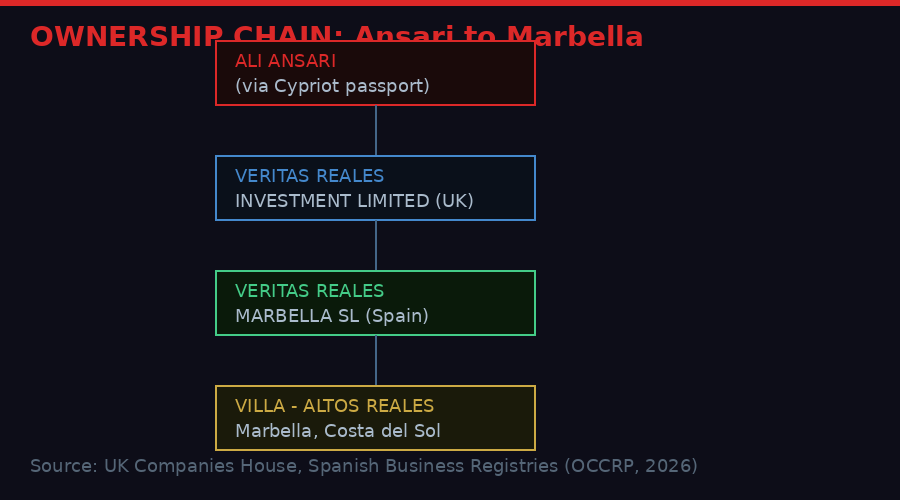
The chain of corporate ownership connecting Ansari to the Spanish villa. Source: OCCRP analysis of UK Companies House and Spanish Business Registry records.
The Man at the Center
Ali Ansari is not a minor figure in Iran's financial world. He was a major shareholder in Ayandeh Bank, one of Iran's largest private lenders - an institution that eventually imploded in one of the country's most spectacular banking failures. According to Hamidreza Ghaniabadi, Director General of Banking Supervision at Iran's Central Bank, Ayandeh had accumulated 5 quadrillion Iranian rials in debt - roughly $4.67 billion - about double what it held in deposits.
More damaging still: Ghaniabadi told the state news agency IRNA that "more than 90 percent of Ayandeh Bank's funds were allocated either to parties related to the bank or to projects managed by the bank itself." In plain language, the bank was being systematically looted by its own insiders.
"I was subjected to extensive legal and regulatory pressures - a process that ultimately led to the bank's dissolution. It is self-evident that had there been any organized relationship or special political backing, such an outcome would not have occurred." - Ali Ansari, public statement, March 12, 2026 (via PR Newswire)
Ansari's argument - that the dissolution of Ayandeh Bank proves he lacked political protection - is a curious one. It acknowledges the bank's collapse as a fact. It does not explain where the funds went, nor why a man operating a $4.67-billion-debt machine then held significant property portfolios across multiple European jurisdictions.
The UK saw it differently. In October 2025, His Majesty's Government sanctioned Ansari for allegedly "financially enabling the work of the Islamic Revolutionary Guard Corps." The IRGC is described in British government notices as "one of the most powerful military organisations in Iran, reporting directly to the Supreme Leader." It is also, as the Center for Strategic and International Studies has documented, "the most powerful controller of all important economic sectors across Iran" - encompassing telecommunications, oil, construction, transport, and increasingly, cryptocurrency.
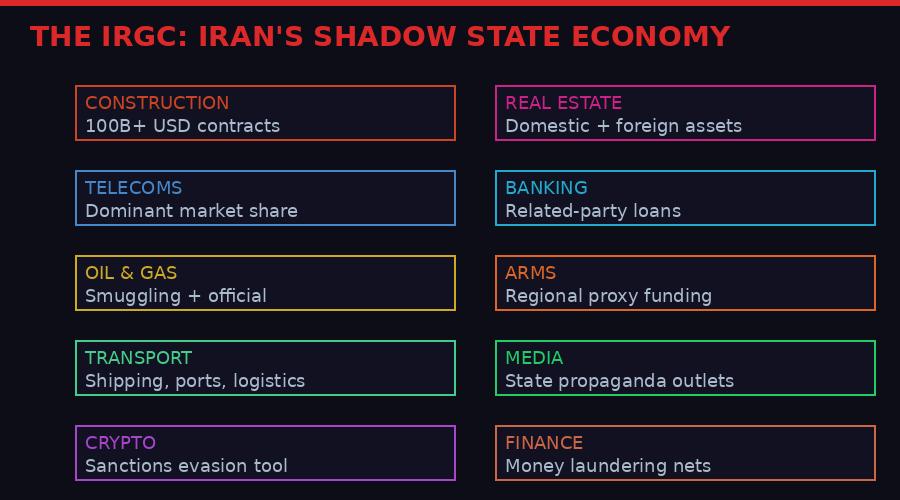
The IRGC operates across nearly every major sector of Iran's economy - and uses that reach to fund military and paramilitary operations globally. Source: CSIS, Jane's, OCCRP.
The Marbella Trail: Digging Through Corporate Layers
The Marbella villa did not appear in any straightforward public record linking it to Ansari. This is not an accident - it is the architecture of plausible deniability built into European corporate law.
The discovery required OCCRP reporters to work through three separate registries: UK Companies House, the Spanish Business Registry, and property records in the municipality of Marbella. The chain, once assembled, runs as follows.
Using a Cypriot passport, Ansari controls Veritas Reales Investment Limited, incorporated in London in 2019. UK's Companies House now lists him as the sole "Person with Significant Control." The firm describes its business as the "buying and selling of own real estate" and the "receiving and lending of money."
That London firm, in turn, owns a Spanish subsidiary: Veritas Reales Marbella SL. The subsidiary owns the villa in Altos Reales, acquired in 2020. The purchase price was not recorded in the documents obtained, but a 2013 real estate listing for the same property advertised it at 15 million euros as an "Outstanding Residence with Spectacular Views."
The listing described a six-bedroom residence with a central tower framed by mountain peaks, an outdoor pool on a Mediterranean-facing terrace, and interior features including a chandelier "bought from a 15th century church." Those architectural details match images from Google Earth 3D, confirming the property's continued presence at the location.
Ansari's Marbella villa is separated from his name by two corporate layers across three jurisdictions - UK incorporation, Spanish subsidiary, Costa del Sol property title. Each layer creates friction for enforcement agencies and deniability for the owner.
As of March 2026, Companies House records show that Veritas Reales Investment Limited's annual filings are overdue - and the company is facing possible forced dissolution within two months "unless cause is shown to the contrary." Whether Ansari or his representatives will act to preserve the structure, or allow it to lapse while the villa remains registered under the subsidiary, is not known.
What is known is that Ansari's lawyer Roger Gherson did not answer OCCRP's questions about either the UK or Spanish companies. Gherson did, however, provide a blanket denial: "Mr Ansari, in response to damaging allegations in the international media, vehemently denies any financial relationship with Iran's Islamic Revolutionary Guard Corps."
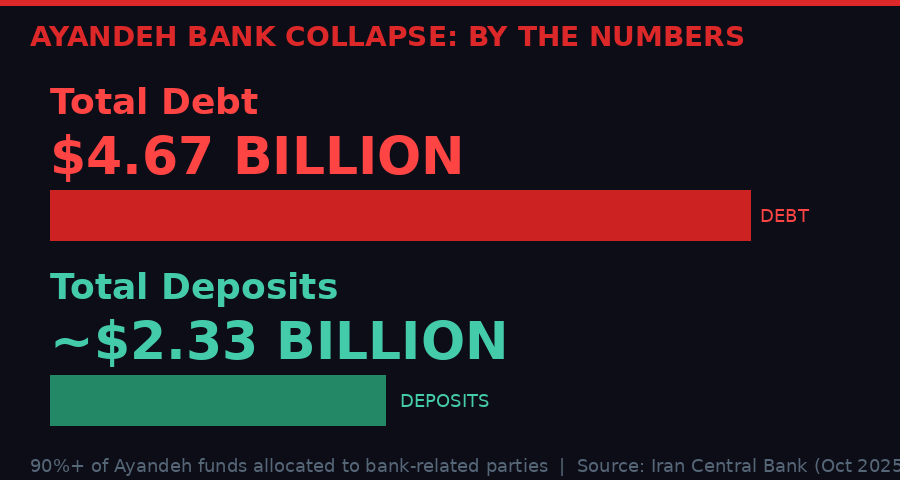
Ayandeh Bank's $4.67 billion debt - double its deposit base - was the direct product of insider lending that drained the institution. Iran's Central Bank ordered the merger with state-owned Melli Bank in October 2025. Source: Iran Central Bank Director, Tasnim News Agency.
The UK Shell Company Problem - and the Limits of Reform
The United Kingdom has spent years quietly serving as the world's premier address for corporate secrecy. Incorporation is cheap, fast, and - until very recently - entirely unverified. As anti-money-laundering expert Graham Barrow told OCCRP in a related investigation, submitting the name of a fictitious executive to Companies House was "actually the easiest thing in the world to do."
That this systemic vulnerability has been exploited by sanctioned individuals linked to the IRGC is not a surprise to anyone who has studied the problem. In the same reporting period, OCCRP exposed Zedcex and Zedxion - two UK-registered crypto exchanges run by a "CEO" named Elizabeth Newman, who turned out to be a stock-footage model from a Shutterstock clip titled "Pretty black woman talking to camera." Those firms, linked to Iranian financier Babak Zanjani, processed more than $94 billion since 2022, with TRM Labs blockchain analysis identifying over $1 billion directly attributable to IRGC-linked wallets.
The UK government's response has been the Economic Crime and Corporate Transparency Act 2023. The legislation moves Companies House from passive record-keeping to active identity verification - requiring all directors and "persons with significant control" to verify their identities. Existing directors were given a grace period. For firms like the Zedcex and Zedxion crypto exchanges, the verification deadline falls in May 2026.
For firms like Veritas Reales Investment Limited - Ansari's vehicle - the question is moot. By the time these identity checks are routine, the villa has already been acquired, the corporate chain has already been documented by investigators, and the sanctions have already been imposed. The damage was done in 2019 and 2020, under the old rules. Reform, as always, arrived after the money had already settled in.
"The measures aim to curb the widespread misuse of U.K. companies for financial crime - specifically the use of 'fake or stolen identities.'" - OCCRP summary of Economic Crime and Corporate Transparency Act 2023
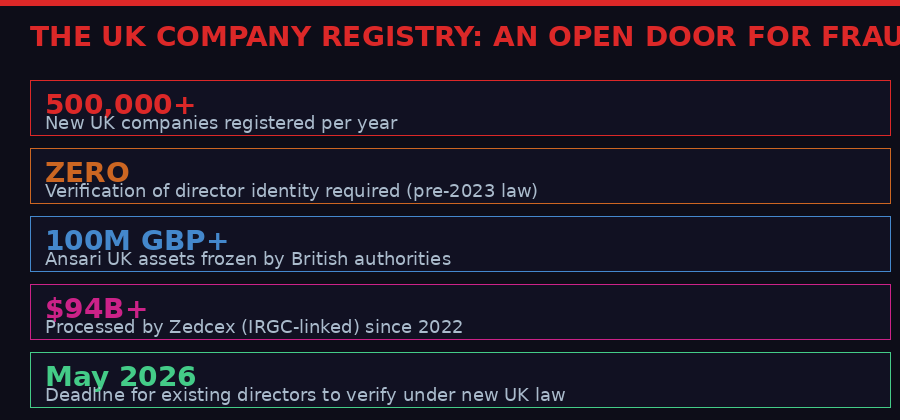
The scale of the UK's company registration vulnerability - and key data points on the Ansari case and related IRGC-linked entities. Source: OCCRP, UK Government, TRM Labs.
The Protests, the Crackdown, and the Money That Fueled Both
To understand what is at stake in tracing Ansari's assets, you have to understand what happened in Iran at the end of 2025.
The collapse of Ayandeh Bank was not a contained financial event. It was one pillar of an economic crisis that triggered the most severe wave of mass protests Iran had seen in years. Iranians took to the streets starting in late 2025, driven by soaring inflation and a standard of living that had fallen to levels not seen since the height of Western sanctions. Many protesters moved quickly from economic grievances to direct calls for the government's removal.
The IRGC and other security forces responded with mass arrests, torture, and killings that rights groups documented by the thousands. OCCRP reported separately that families of those killed during the protests were being asked by Iranian authorities to pay for the return of their relatives' bodies.
The IRGC did not carry out this crackdown as a disinterested military force. It did so as an organization with massive economic interests - in construction, banking, oil, transport, and increasingly in digital assets - that would be directly threatened if the protests succeeded. Every dollar or euro that flows to IRGC-connected financiers is, in the most direct sense, a subsidy for that repression.
Which is what makes the Marbella villa more than a real estate story. When a sanctioned IRGC financier parks 15 million euros in a Spanish gated community, the money is not just hidden. It is insulated. It is preserved for future use, or future repatriation, or future leverage - beyond the reach of ordinary accountability.

The architecture of sanctions evasion runs through legal corporate structures that look legitimate on the surface. (Illustrative: Pexels)
A Property Empire Across Europe
The Marbella villa is not an anomaly. It is a data point in a much larger pattern.
UK government ministers confirmed in public statements that British authorities have frozen more than 100 million pounds - roughly $134 million - of Ansari's real estate in the UK alone. It is not publicly confirmed whether this figure includes a 52.8-million-dollar London mansion that OCCRP previously exposed, or whether that property is counted separately.
In January 2026, the Financial Times reported that Ansari had accumulated hundreds of millions of euros in commercial real estate across several European countries. The FT's reporting, drawing on different sources than OCCRP, suggested the scope of the portfolio extended well beyond the UK and Spain - into multiple EU member states.
This raises a direct question for European regulators: at what point does a pattern of property acquisition by a sanctioned individual become a systemic enforcement failure? And who bears responsibility when the answer to that question is "after the fact"?
Spain's property market has long attracted large-scale foreign investment - some legitimate, much of it opaque. The Costa del Sol, and Marbella specifically, has been the subject of multiple money-laundering investigations over the decades, involving clients ranging from Russian oligarchs to Latin American cartel money. The addition of an IRGC-linked investor to that landscape is consistent with a broader pattern of Spain's luxury real estate market being used as a terminal destination for internationally dirty money.
Ansari's Known European Holdings (March 2026)
- UK real estate (frozen): 100M+ British pounds, frozen by UK authorities post-sanctions
- London mansion: $52.8M - previously revealed by OCCRP, freeze status unclear
- Marbella villa: ~15M EUR - Altos Reales gated community, Costa del Sol (newly revealed)
- Multiple EU nations: Hundreds of millions EUR in commercial property (FT, January 2026)
- Ayandeh Bank stake: Iran - bank dissolved Oct 2025, $4.67B in debts
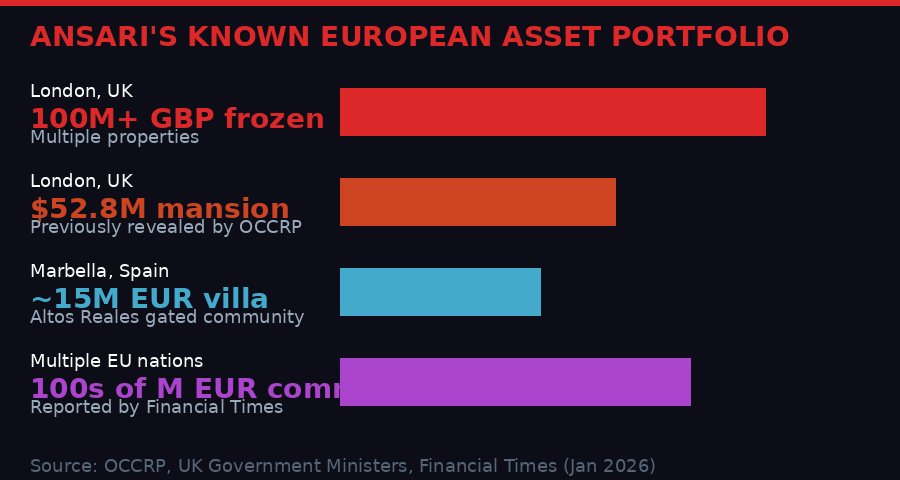
Known European holdings of Ali Ansari as of March 2026, based on confirmed reporting from OCCRP, UK government statements, and Financial Times. The actual total is believed to be larger.
Ansari Fights Back - and What It Reveals
On March 12, 2026, Ansari issued a public statement announcing that he had instructed lawyers to "initiate formal proceedings" against the UK sanctions.
The statement is worth reading carefully, because Ansari makes a specific - and self-defeating - argument. He points to the dissolution of Ayandeh Bank as evidence that he lacked IRGC protection.
"In the context of intensifying geopolitical tensions between Iran and the United States, efforts are underway in the United Kingdom and certain other countries to impose restrictions and sanctions against me without the presentation of credible evidence." - Ali Ansari, March 12, 2026 public statement
Ansari's implicit logic runs as follows: if he had truly been an IRGC financier, the Iranian state would have protected him and his bank. Because the bank was allowed to fail, and because he faced regulatory pressure in Iran, he cannot be an IRGC financier.
This reasoning contains at least two serious problems. First, the IRGC is not a homogeneous organization - it has competing factions, shifting alliances, and has historically been willing to sacrifice useful figures when exposure became politically costly. The dissolution of a mismanaged bank is not proof that its owner lacked IRGC ties; it may simply reflect changed political winds.
Second, and more fundamentally, the argument does not address the substance of British findings. The UK sanctions notice alleges that Ansari "funds the work of the IRGC." It does not say he is a permanent, protected IRGC insider. The pattern of property acquisition, the corporate structures across three jurisdictions, and the sheer scale of the assets involved - all of these remain unexplained by Ansari's statement.
The challenge to UK sanctions will be decided in court. But the Marbella villa - and the overdue Companies House filings for the entity that owns it - will continue to generate questions regardless of the legal outcome.

Ansari has launched legal proceedings against UK sanctions - a process that can take years, during which assets may remain in limbo. (Illustrative: Pexels)
The Broader Network: IRGC Money in Western Financial Systems
The Ansari case is not an isolated story. It sits within a documented ecosystem of IRGC-connected financial activity that has penetrated Western corporate and banking infrastructure in ways that regulators are only beginning to systematically map.
The Zedcex and Zedxion crypto exchange scandal - in which UK-registered firms fronted by a fictional stock-footage CEO processed over $94 billion in transactions, with at least $1 billion tied to IRGC wallets - used the same mechanism: UK corporate registration as a legitimacy shield.
TRM Labs, a blockchain analytics company, published a January 2026 report documenting how the IRGC's crypto operations have grown in sophistication. The Zedcex and Zedxion exchanges, according to TRM's analysis, also handled millions of dollars in transfers from the IRGC to a man the US accuses of financing Houthi attacks on commercial shipping in the Red Sea. The flows connect Iran's domestic repression apparatus to regional armed proxies through digital asset channels that run, at least in part, through London-registered companies.
US Treasury Secretary Scott Bessent addressed this pattern in a January 30, 2026 statement sanctioning Zanjani and the two UK exchanges: "Treasury will continue to target Iranian networks and corrupt elites that enrich themselves at the expense of the Iranian people. This includes the regime's attempts to exploit digital assets to evade sanctions and finance cybercriminal operations."
What Bessent's statement does not address - because it falls outside US Treasury's direct jurisdiction - is the structural complicity of European corporate law. Every IRGC-linked entity that passed through London's Companies House did so with the full technical compliance of British registration requirements. No fraud was committed in the registration. The system was used exactly as it was designed - with the trivial modification that the beneficial owners were sanctioned Iranian military financiers rather than legitimate businesspeople.
What Happens to the Villa
Under UK sanctions law, Ansari's assets in the UK are frozen. But the Marbella villa sits in Spain - an EU member state - and is owned by a Spanish subsidiary, not directly by Ansari or his UK holding company. The sanctioning jurisdiction is Britain. The asset jurisdiction is Spain. The gap between those two facts has not been closed.
As of the OCCRP reporting, no Spanish authority had moved to freeze or investigate the Marbella property. It is not clear that Spanish authorities were aware of the ownership chain prior to the investigation's publication. The UK Companies House filings for Veritas Reales Investment Limited were a matter of public record - but public records are only useful if someone is looking at them and connecting the dots.
The overdue annual filings create a further complication. If the UK company is struck off the register, the Spanish subsidiary does not automatically lose its ownership of the villa. Corporate dissolution law varies, but in many cases the assets of a dissolved company revert to the Crown or to creditors - a process that could take years, during which the villa remains in a legally ambiguous state.
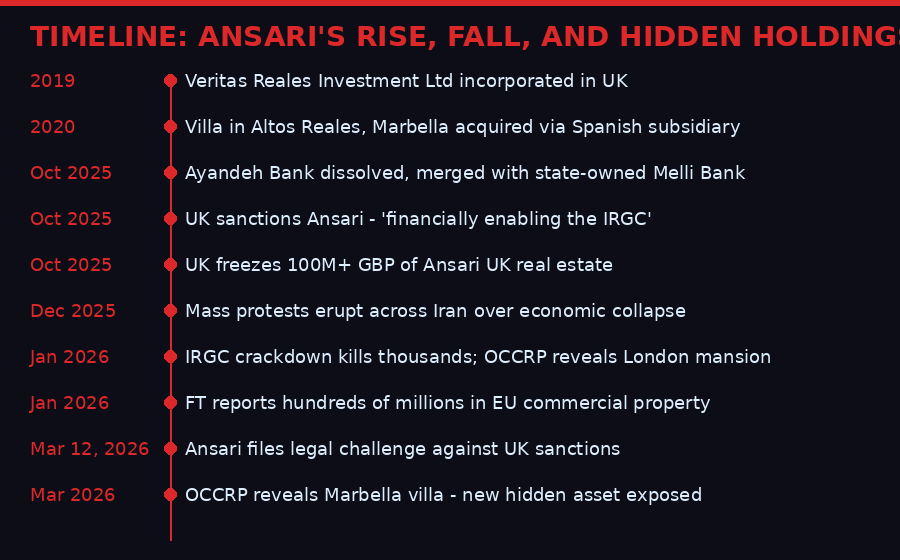
From incorporation to sanctions to legal challenge - the sequence of events in the Ansari case, spanning seven years across three countries. Source: OCCRP, UK government records, Spanish registries.
The Audit Trail That Should Have Worked
It is worth pausing to consider how long this trail existed in public records before anyone followed it. Veritas Reales Investment Limited was incorporated in 2019. The Spanish subsidiary acquired the Marbella villa in 2020. Ansari became a Person with Significant Control at Companies House at some point before October 2025, when UK authorities imposed sanctions.
That means the ownership chain linking a man who would eventually be sanctioned for IRGC financing to a 15-million-euro Spanish villa was visible, in principle, to any anti-money-laundering investigator with access to Companies House and Spanish registry data from at least 2020 onward. The villa was acquired after COVID-19 temporarily froze much of the world - a period when financial monitoring was stretched and enforcement capacity was reduced.
But even in normal circumstances, the cross-border nature of the structure creates friction that most enforcement agencies struggle to overcome. UK analysts looking at Companies House may not routinely pull Spanish registry records for every UK company. Spanish authorities may not systematically check incoming UK corporate owners against British government sanctions lists. The gaps between jurisdictions - legal gaps, database gaps, linguistic gaps, diplomatic gaps - are where the money lives.
Anti-money-laundering specialists have argued for years that the solution requires real-time, cross-jurisdictional beneficial ownership registries with automatic sanctions-list matching. Several EU member states have implemented elements of this under the Fourth Anti-Money Laundering Directive and its successors. Spain and the UK both have beneficial ownership registries. Both registries contain the Ansari chain. Neither appears to have triggered an alert before investigative journalists documented the connection.
"Until these measures were introduced, submitting the name of a fictitious executive to Companies House was 'actually the easiest thing in the world to do.'" - Graham Barrow, UK anti-money-laundering expert, speaking to OCCRP
If it was easy to submit a fictitious name, submitting a real name tied to a Cypriot passport - while keeping the beneficial owner's actual identity obscured behind a chain of corporate structures - was even easier. Ansari appears in the UK records under his own name and passport. The structure is not hidden. It is simply not connected, until someone does the work of connecting it.
Pattern Recognition: Europe's Luxury Property Problem
The Ansari case is one data point in a pattern that has been documented from Marbella to Monaco to Mayfair. Europe's luxury real estate markets have served for decades as convenient stores of value for internationally sanctioned money - and the Marbella property market in particular has attracted sustained scrutiny from Spanish prosecutors and anti-corruption investigators.
Marbella's history with dark money runs long. The municipality was the subject of a major corruption investigation - "Operation Malaya" - in 2006, which uncovered systematic bribery involving property developers, local politicians, and organized crime. That investigation resulted in over a hundred arrests and gave Marbella a reputation as a place where property development and corruption were structurally linked.
Two decades later, the players have changed. Russian oligarchs moved significant assets to the Costa del Sol before and after 2022 sanctions. Latin American business figures with criminal exposure have used the area's luxury market. Now, OCCRP's reporting documents a sanctioned Iranian banker with IRGC links holding a 15-million-euro villa in the same gated community that has historically attracted high-net-worth individuals seeking discretion.
The local real estate market is not a passive recipient of this money - it actively markets to international buyers seeking privacy and security. The gated community of Altos Reales - "Royal Heights" - is explicitly positioned as an exclusive, high-security environment. The 2013 listing described the Ansari villa as an "Outstanding Residence with Spectacular Views." It did not ask who the buyer was, where the money came from, or whether the purchasing entity's beneficial owner had any ongoing legal complications.
Spain has EU-level obligations under the Anti-Money Laundering directives to require real estate professionals to conduct due diligence on buyers. Whether those obligations were met in the 2020 acquisition of this specific property is not known from public records. What is known is that the acquisition happened, it was documented in public registries, and it was not caught by any enforcement mechanism until investigative journalists built the chain from scratch.

Marbella's Costa del Sol has attracted international money - clean and dirty - for decades. Enforcement lags far behind acquisition. (Illustrative: Pexels)
The Enforcement Gap and Who Pays for It
The people who pay most directly for Europe's enforcement failures in this area are not European taxpayers or Western policymakers. They are the Iranians who were arrested, tortured, and killed during the protests that began in late 2025.
The IRGC does not fund its repression apparatus from the central bank. It funds it from the economic empire it has built - from construction contracts, from oil revenues, from bank affiliates, and from the international financial flows that run through compliant or simply inattentive Western corporate infrastructure. When Ali Ansari allegedly funnels money to the IRGC, and that money arrives from a UK company and a Spanish subsidiary, the connection to the young Iranians being beaten in Tehran streets is not metaphorical. It is financial. It is traceable. And it ran through Marbella.
OCCRP's methodology - painstakingly tracing corporate registries across multiple jurisdictions to identify beneficial ownership - is exactly the work that anti-money-laundering frameworks are supposed to make routine. The fact that investigative journalists must do it, rather than it being caught automatically by cross-referenced government databases, reflects the scale of the gap between AML regulation as written and AML regulation as enforced.
Britain has now sanctioned Ansari and frozen significant UK assets. But the UK's sanctioning authority stops at the English Channel. Spain must now decide whether to act on OCCRP's findings - whether the Marbella villa of a UK-sanctioned IRGC financier constitutes sufficient grounds for a Spanish freeze order, and whether the local registry, real estate professionals, and banking institutions involved in the 2020 acquisition will face scrutiny.
History suggests the answer will be: eventually. After considerable delay. Following further pressure from NGOs, journalists, and European Commission infringement proceedings. The system is not designed for speed. The money is.
Get BLACKWIRE reports first.
Breaking news, investigations, and analysis - straight to your phone.
Join @blackwirenews on Telegram- Primary Source: OCCRP - "Sanctioned Iranian Banker Owns Luxury Spanish Villa via UK Company" (March 2026) - occrp.org
- OCCRP - "The Cat and the Stock-Footage CEO: How a Digital Trail Helped Unmask an Iranian Money Machine" (February 2026)
- UK Government Sanctions Notice - Ali Ansari, IRGC financing, October 2025 - gov.uk
- Ali Ansari Public Statement, March 12, 2026 - via PR Newswire
- Iran Central Bank - Hamidreza Ghaniabadi statement on Ayandeh Bank dissolution - Tasnim News Agency, October 23, 2025
- TRM Labs - "How Two UK-Registered Companies Moved Over a Billion in Stablecoins for the IRGC" - January 2026
- Center for Strategic and International Studies - IRGC economic analysis
- Jane's Intelligence - IRGC financial empire report
- US Treasury Secretary Bessent - Statement on Zanjani sanctions, January 30, 2026
- UK Companies House - Veritas Reales Investment Limited
- Spanish Business Registries - Veritas Reales Marbella SL
- Financial Times - Ansari EU commercial property report, January 2026 (paywalled)