The Intelligence Revolt: Trump's Own Counterterrorism Chief Quits, Says Iran Was Never a Threat
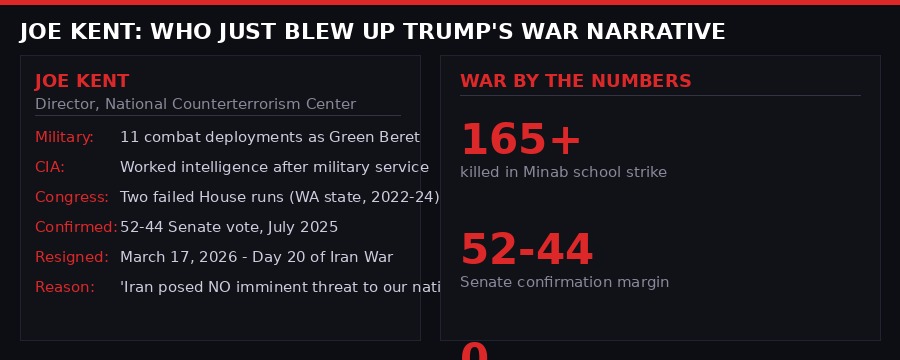
Joe Kent, the director of the National Counterterrorism Center, resigned on March 17 - Day 20 of the Iran war - saying Iran posed no imminent threat and the United States started this war under pressure from Israel. As the Minab school massacre investigation deepens and domestic terror attacks multiply, the justification for war is fracturing from inside Trump's own national security apparatus.

The resignation letter came from inside the building.
On the morning of March 17 - twenty days into the U.S.-Israeli war against Iran - Joe Kent, the director of the National Counterterrorism Center, announced he was quitting. Not because he opposed Trump in the abstract. Not over personnel disputes or bureaucratic turf wars. He quit because, in his professional assessment as the nation's top counterterrorism official, the war the United States is fighting right now should never have started.
"Iran posed no imminent threat to our nation," Kent wrote in a statement posted to social media, "and it is clear that we started this war due to pressure from Israel and its powerful American lobby." AP News, March 17, 2026
This is not a Democrat speaking. This is not an anonymous source, a whistleblower in protective custody, or a foreign critic of American foreign policy. This is the man Trump's own administration confirmed, on a 52-44 Senate vote, to run the agency responsible for detecting terrorist threats to the American homeland. He had 11 combat deployments as a Green Beret. He worked at the CIA. He was, until this morning, one of the most senior intelligence officials in the United States government.
And he just called the war a lie.
What the NCTC Director Actually Said - and Why It Matters
The National Counterterrorism Center is not a glamorous agency. It does not launch missiles or run special operations. What it does - its core function - is synthesize intelligence from across the entire American national security apparatus and assess threats to the U.S. homeland and interests abroad.
When the NCTC says a country poses an imminent threat, that assessment carries enormous legal and operational weight. It is the bedrock of any justification for offensive military action under the laws of armed conflict and the U.S. War Powers Act. When the NCTC director says a country does not pose an imminent threat, that is equally decisive - and devastating, if the bombs have already started falling.
Kent's statement was blunt. "I cannot in good conscience back the Trump administration's war," he wrote. He did not offer diplomatic ambiguity or carefully hedged bureaucratic language. He named what he believed to be the driving force: Israeli pressure and the pro-Israel lobby's influence over American foreign policy.
The political implications are substantial. Democrats have been making this argument for weeks. Progressives, antiwar groups, and several Republican isolationists have questioned whether Iran actually presented the "imminent threat" threshold required to bypass a formal congressional authorization of force. Now the man who ran the government's primary threat assessment office has answered that question directly: no, it did not.
"Iran posed no imminent threat to our nation, and it is clear that we started this war due to pressure from Israel and its powerful American lobby. I cannot in good conscience back the Trump administration's war." - Joe Kent, Director of the National Counterterrorism Center, resignation statement, March 17, 2026
Senator Mark Warner of Virginia, the top Democrat on the Senate Intelligence Committee, said Kent's concerns about the war were justified - though he was careful to note his broader disagreements with Kent's record. "I strongly disagree with many of the positions he has espoused over the years," Warner said. "But on this point, he is right: There was no credible evidence of an imminent threat from Iran that would justify rushing the United States into another war of choice in the Middle East." AP News
The White House did not immediately comment on Kent's resignation. A spokesperson for Director of National Intelligence Tulsi Gabbard also did not respond to questions.
The Minab School: The Strike That Started the Unraveling
The internal credibility crisis around the Iran war traces back to a single day: February 28 - the day the bombs started falling - and more specifically to a strike in the southern Iranian city of Minab that obliterated an elementary school full of girls.
More than 165 people were killed, most of them children, at Shajareh Tayyebeh Elementary School. AP News / Iranian state media The school sits adjacent to a compound associated with Iran's Revolutionary Guard - specifically a barracks for the Guard's coastal naval brigade near the Strait of Hormuz.
The U.S. military initially neither confirmed nor denied the strike. Defense Secretary Pete Hegseth told reporters: "We, of course, never target civilian targets. But we're taking a look and investigating that." Pentagon briefing, March 2026
But satellite imagery reviewed by the Associated Press told a different story. Experts examining the tight damage pattern said it was "consistent with a targeted airstrike." A U.S. official, speaking anonymously because they were not authorized to comment, told AP the strike was likely American. The USS Abraham Lincoln carrier strike group was operating in the Arabian Sea, within range of the target. Israel, which has focused its strikes on areas closer to its own borders, had not reported operations anywhere near that location. AP News
Pentagon procedures confirm the institutional assessment: when an internal review group makes an initial determination that the U.S. military may bear culpability for civilian deaths, a formal casualty assessment is launched. One was launched for Minab. That launch is itself a finding.
What appears to have happened is this: intelligence databases used to clear the Minab IRGC compound for targeting did not reflect that an active girls' school had been built within the blast radius. The databases were outdated. Farzin Nadimi, a senior fellow at the Washington Institute for Near East Policy who studies Iran's military, told AP: "My assumption is that probably there were some activities recently there and they detected and tracked them, but they weren't aware or didn't have an up-to-date database that a girls' school was there and they bombed it." AP News
The Minab massacre has become the defining atrocity of the Iran war's opening weeks. It has drawn "staunch criticism from the United Nations and human rights monitors." AP News It has fueled outrage in Muslim-majority communities worldwide. And it has become central to the broader debate over whether American military intelligence was adequate to justify launching a major war in the first place.
Blowback at Home: The Michigan Synagogue and the ODU Shooting
Kent noted in his resignation statement that he was departing amid "heightened concerns about terrorism in the homeland" - and named two specific attacks that occurred within the past week as the context for this moment.
On Thursday, March 12, a 41-year-old naturalized U.S. citizen named Ayman Mohamad Ghazali drove his vehicle into a hallway at Temple Israel, one of the largest Reform synagogues in the United States, located in West Bloomfield Township near Detroit. Ghazali was born in Lebanon and came to the U.S. in 2011. He was fatally shot by security officers after his car caught fire inside the building. No congregants or the 140 children at the synagogue's early childhood center were injured. AP News
FBI special agent Jennifer Runyan called it "a targeted act of violence against the Jewish community." Investigators had not yet determined a motive.
One parent, who arrived to pick up her 18-month-old daughter, told AP something that cut to the heart of the war's blowback problem: "I know that it's terrible. This morning I was mourning the loss of the school that got hit in Iran." AP News
The same day, a former Army National Guard member named Mohamed Bailor Jalloh opened fire in the business school building at Old Dominion University in Virginia. Jalloh had served eight years in prison for attempting to aid the Islamic State and was on supervised release when he attacked. He yelled "Allahu Akbar" before firing, killing one person - Lt. Col. Brandon Shah, an Army ROTC instructor who had flown helicopters over Iraq, Afghanistan, and Eastern Europe - and wounding two others. Jalloh was subdued and killed by ROTC students. FBI Director Kash Patel said the incident was being investigated as an act of terrorism. AP News
Both attacks fit a pattern that counterterrorism analysts had been warning about since the strikes on Iran began: a war against a Muslim-majority nation, particularly one accompanied by a high-profile civilian massacre, significantly elevates the risk of radicalization and retaliatory violence on American soil. This is the exact threat domain that the NCTC exists to monitor and prevent - which makes Kent's resignation, specifically at this moment, even more operationally significant.

A President Fabricating History in Real Time
As his administration was fracturing, President Trump offered a curious narrative flourish to justify the war: he claimed that a former U.S. president - one he liked, someone "smart" - had privately told him he wished he had attacked Iran himself.
Trump told the story twice on Monday at a Kennedy Center board meeting. "I've spoken to a certain president, who I like, actually, a past president, a former president. He said, 'I wish I did it, I wish I did,' but they didn't do it. I'm doing it," Trump said. Asked to identify the former president, Trump declined, saying he didn't want to "embarrass him." When a reporter asked if it was George W. Bush, Trump said "no." When asked about Bill Clinton, Trump deflected again. AP News
There is one problem: representatives for all four living former presidents - Clinton, George W. Bush, Barack Obama, and Joe Biden - said, speaking anonymously because they were not authorized to discuss private conversations, that none of them had been in contact with Trump recently. AP News
The claim appears to be fabricated, or at minimum unverifiable and almost certainly false. It is a president at war reaching for historical legitimacy he cannot actually find, from predecessors who are not providing it.
Trump has offered shifting rationales for the Iran war since it began on February 28. He has cited nuclear weapons, Iranian proxies, Israel's security, and decades of Iranian provocation. He has pushed back against reports that Israel pressured the U.S. into acting. Speaker Mike Johnson acknowledged that the White House believed Israel was determined to act unilaterally, leaving Trump with a "very difficult decision." AP News
That framing - a president bounced into a war he had to choose between leading or being sidelined from - does not exactly describe a commander in chief exercising independent strategic judgment. It describes a president managing an ally's ultimatum. And it echoes, almost word for word, what Joe Kent said when he resigned: pressure from Israel and its lobby.
The Congress Problem and the Intelligence Hearing Clock
The war is now in its twentieth day with no formal Authorization for Use of Military Force passed by Congress. The Trump administration has relied on executive authority and the vague residual authority of existing AUMFs - arguments that legal scholars, including those friendly to executive power, have found increasingly strained as the war expands in scope and duration.
This week carries significant institutional weight. Director of National Intelligence Tulsi Gabbard, CIA Director John Ratcliffe, and FBI Director Kash Patel are all scheduled to testify before congressional committees about threats facing the United States - the standard annual "Worldwide Threats" hearing. AP News
That hearing is now impossible to conduct as normal. The resignation of the NCTC director on the eve of it, combined with Kent's explosive allegation that Iran posed no imminent threat, means the intelligence community's leadership will face direct, aggressive questioning about the assessments that led to war. Senators on both sides of the aisle want to know: what did the intelligence actually say? Was there a credible imminent threat? Who approved targeting the Minab compound without current civilian pattern-of-life data?
Gabbard has her own complicated history with Iran. Before joining the Trump administration, she publicly warned that a war with Iran would "make the wars that we've seen in Iraq and Afghanistan look like a picnic - it will be far more costly in lives, American lives, and American taxpayer dollars." AP News / historical record Since the war began, she has not posted about Iran on her social media accounts. Her office did not respond when asked whether she supports the strikes. AP News
That silence, from an official who will now testify before Congress on the subject, is itself a data point.
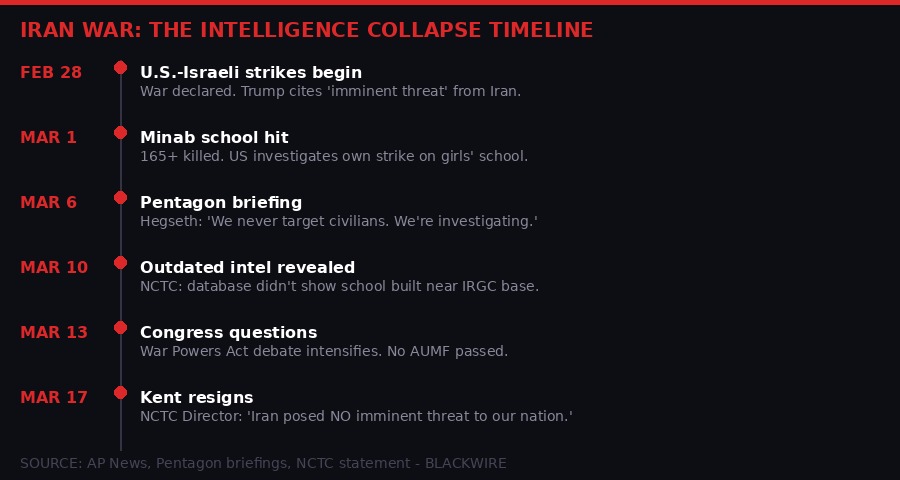
Timeline: The Intelligence Justification Collapses
20 Days of Escalating Doubt
Who Was Joe Kent - and Why His Voice Lands Differently
Understanding why Kent's resignation hits harder than a typical bureaucratic departure requires understanding who he actually is and where he came from politically.
Kent is not a deep-state career official hostile to Trump's agenda. He is, by most measures, a Trump loyalist who had to be dragged through a difficult confirmation process precisely because of his associations with the right wing of American politics. During his 2022 congressional campaign in Washington state, Kent employed a member of the Proud Boys as a campaign consultant. He worked closely with the founder of Christian nationalist group Patriot Prayer. He attracted support from figures well to the right of mainstream Republicanism. AP News
At his Senate confirmation hearing, Kent refused to distance himself from the conspiracy theory that federal agents instigated the January 6 Capitol attack, and declined to affirm that Trump lost the 2020 election. AP News Democrats opposed his confirmation 44-0. He was confirmed only because Senate Republicans held firm.
He was also, according to reporting at the time of his confirmation, present in the Signal group chat used by Trump's national security team to discuss sensitive military plans - a chat that became controversial after its contents were leaked. AP News / The Atlantic
This is not a man with obvious ideological reasons to undermine a Republican president's war. His resignation represents something more specific and harder to dismiss: a professional intelligence assessment, delivered by someone with 11 combat deployments, CIA experience, and the highest counterterrorism clearances in the U.S. government, that the threshold for this war was never met.
Senator Tom Cotton, the Republican chair of the Senate Intelligence Committee who had praised Kent at his confirmation, made no comment following the resignation as of publication time.
What Comes Next: Intelligence Hearings, Domestic Security Gaps, and the War's Third Week
The Kent resignation leaves a leadership gap at the NCTC at the worst possible moment. Domestic terrorism attacks are occurring. Iran's regional proxies are active. The FBI has warned of potential Iranian-directed drone operations targeting infrastructure inside California. AP News Two men were reportedly apprehended with explosives in the weeks since the war began. The NCTC, normally the coordinating hub for threat fusion across agencies, now has no confirmed director.
The congressional testimony this week from Gabbard, Ratcliffe, and Patel was always going to be politically charged. It is now potentially explosive. Senators will have Kent's resignation statement in hand - a statement that directly contradicts the administration's stated rationale for war - and will have legal authority to demand access to the underlying intelligence assessments that shaped the decision to launch strikes on February 28.
Iran, for its part, has not capitulated. Day 20 finds the war's military phase ongoing, with no ceasefire framework publicly announced. Iran's leadership has been deliberate about denying the U.S. a quick victory narrative. The Strait of Hormuz remains a pressure point. Gulf Arab states that host U.S. bases have been quietly signaling discomfort with the war's trajectory.
The domestic front is fracturing in ways the administration did not anticipate. Trump's base includes a significant isolationist wing that has been skeptical of Middle East entanglements since at least 2016. Kent's voice - coming from inside that ideological family - gives that faction a credible banner to rally around. The war coalition that existed on February 28 does not look the same today.
What began as a war sold on certainty - imminent nuclear threat, decisive action, American dominance - is entering its third week with its chief intelligence justification publicly demolished by the man who ran the most relevant agency in the federal government. The school in Minab is still rubble. The families of 165 dead are still waiting for an American acknowledgment. The NCTC directorship is vacant. And the president is telling stories about anonymous former presidents who never called.
The facts are not improving. They rarely do, once a war like this gets started.
Get BLACKWIRE reports first.
Breaking news, investigations, and analysis - straight to your phone.
Join @blackwirenews on Telegram