Trump's War, Nobody's Problem: Allies Refuse Hormuz Coalition, Congress Blocks Oversight
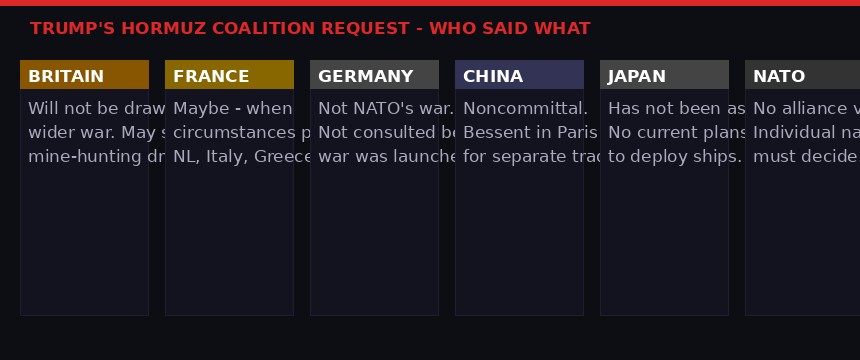
Seventeen days into a war he launched without consulting his allies, Donald Trump is now demanding those same allies send warships to reopen the world's most important oil chokepoint. So far, the answer from nearly every nation he has asked is some variation of no. Britain says it won't be drawn in. Germany says it's not NATO's war. Japan says it hasn't even been asked. China is "noncommittal." France offers a vague "maybe, when circumstances permit." Back in Washington, Republican leaders are blocking Democratic demands for public hearings on a conflict that has already killed 13 Americans, wounded 140, and is costing an estimated billion dollars a day.
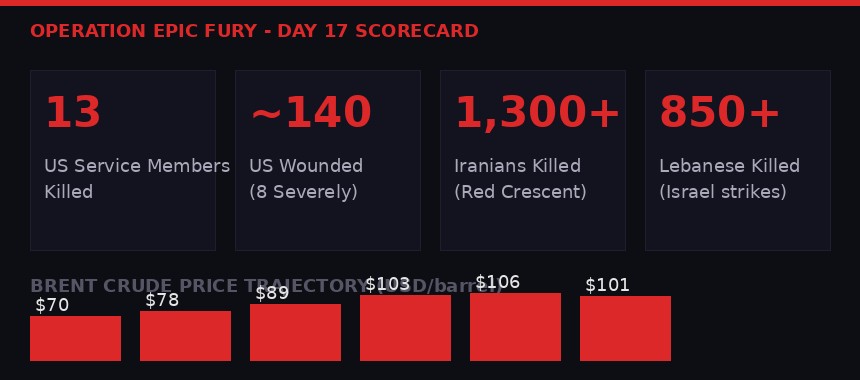
This is the diplomatic landscape of the Iran war on its 17th day. The Strait of Hormuz - through which a fifth of the world's traded oil normally flows - remains functionally closed. Brent crude is trading at $101 per barrel, up more than 40% since the first strikes on February 28. Iran struck Dubai International Airport with a drone early Monday, temporarily grounding flights at the world's busiest international hub. Hezbollah is firing rockets into northern Israel from Lebanon. And the coalition Trump promised would help police the straits does not exist.
The simultaneous collapse of allied coordination and congressional oversight isn't just a political story. It defines whether this war has an off-ramp. Without either, the United States is conducting an open-ended conflict with no exit strategy, no accountability mechanism, and an increasingly isolated posture in a region that supplies the world's energy.
The Hormuz Demand: Seven Countries, Zero Commitments
Trump said over the weekend that he has asked "about seven" countries to send warships to the Strait of Hormuz to help reopen it for commercial shipping. He wouldn't name all of them, but they include France, Britain, China, Japan, South Korea, and Germany - essentially the G7 plus Beijing. The pitch: the strait serves everyone's interests, so everyone should share the military burden of securing it.
The logic is not unreasonable on paper. The Strait of Hormuz is the jugular of the global oil market. Japan gets roughly 90% of its crude through the Persian Gulf. China imports about 45% of its oil from the same region. South Korea is nearly fully dependent on Middle East energy. The economic logic for these nations to participate in keeping the strait open is genuine.
But the diplomatic execution has been characteristically Trumpian - maximum pressure with minimum groundwork. These countries were not consulted before the United States and Israel attacked Iran on February 28. They were not briefed on war aims, exit conditions, or what victory looks like. They now find themselves being asked to send their militaries into an active combat zone to support a conflict they had no vote on, no warning about, and no shared ownership of.
"The United States did not consult us before this war, and so we believe this is not a matter for NATO or the German government."
- Stefan Kornelius, spokesman for German Chancellor Friedrich Merz, March 16, 2026 (AP)
Germany's response is particularly blunt. Chancellor Merz's office pointed out the obvious: NATO allies were not consulted before the strikes began. The war was launched unilaterally. The alliance's mutual defense clause, Article 5, was never invoked. And now Trump is telling allies to treat their own interests in the strait as if they justify putting their sailors at risk - while simultaneously threatening, on the record, that he will "remember" which countries decline.
"Whether we get support or not, but I can say this, and I said to them: We will remember," Trump told reporters aboard Air Force One on Sunday, according to AP. The threat carries the implicit weight of tariffs, trade leverage, or diplomatic cold-shouldering - the standard Trump toolkit for extracting compliance.
But this time, the toolkit may not be enough. The war is politically radioactive in Europe. Public opposition to the conflict runs high in Germany, France, and Britain. No elected European leader can currently afford to be photographed committing soldiers to Trump's war.
Britain: Mine Drones, Not Warships
Britain's response is the most carefully calibrated. Prime Minister Keir Starmer is trying to thread an impossible needle - maintain the special relationship with Washington while refusing to participate in a war that British voters strongly oppose and that Parliament was never consulted on.
On Monday, Starmer told reporters that Britain "will not be drawn into the wider war" and insisted that any British military action must be legal and have "a proper thought-through plan." That is polite diplomatic language for: we don't trust the current US strategy has either.
What London is offering instead is mine-hunting drone capability. Britain has unmanned underwater vehicles already deployed in the region that can detect and neutralize naval mines - a relevant tool given Iran's ability to mine the strait as a defensive measure. But deploying these drones falls well short of what Trump is asking for, which is visible warship presence as a deterrent and escort force.
British officials have been in talks with European allies and Gulf states about a more limited defensive mission, separate from direct combat operations. The shape of what London might join is something more like the EU's existing Operation Aspides - the naval mission that protects shipping in the Red Sea from Houthi attacks - rather than an offensive coalition under US command.
The distinction matters enormously. Aspides is a defensive, rules-of-engagement-restricted mission focused on protecting commercial vessels. What Trump is describing sounds like active military pressure on Iran in the strait itself. Britain is not going near that, regardless of the phone calls from the White House.
France: "When Circumstances Permit" - The Most Qualified Maybe in Diplomatic History
France's position is marginally more favorable to Washington - but loaded with conditions that may never be met.
President Emmanuel Macron has said France is "working with partners" on a possible ship escort mission. French senior officials, speaking anonymously to AP, said the Netherlands, Italy, and Greece have shown interest. Spain might be involved "in some way." The framework they appear to be building is an EU-led "coalition of the willing" - countries that choose to act independently without a formal NATO or EU mandate.
But the key phrase France keeps deploying is "when the circumstances permit." That phrase does a lot of work. It means: when Iran's drone and missile threat to commercial ships has diminished. When the military situation allows escort missions without direct confrontation. When the legal framework is settled. When public opinion shifts. In practice, "when circumstances permit" can mean never - or can mean months from now.
EU foreign policy chief Kaja Kallas has suggested the bloc's existing Operation Aspides mission could be extended from the Red Sea into the Persian Gulf. That would require unanimity or near-unanimity among EU members. Italy's foreign minister said Monday he opposes extending Aspides to the Strait of Hormuz. Germany has not committed. Hungary, which maintains warm relations with both Russia and Iran, would likely veto any formal EU deployment. The "coalition of the willing" path is the fallback precisely because it bypasses the EU's consensus requirement.
"It is in our interest to keep the Strait of Hormuz open."
- Kaja Kallas, EU Foreign Policy Chief, EU Foreign Ministers' Meeting, Brussels, March 16, 2026 (AP)
Kallas's statement at least acknowledges the stakes. But acknowledging stakes and committing warships are different acts. The EU is still in the stage of acknowledgment.
China: The Wild Card Trump Can't Read
The most consequential and unpredictable variable is China. Beijing imports roughly 45% of its oil from the Persian Gulf. The Strait of Hormuz closure is hitting China's economy directly - in energy costs, in supply chain disruptions, in fertilizer and chemical prices that affect Chinese manufacturing.
Trump is betting that China's self-interest in the open strait is so strong that it will eventually participate in some form of security arrangement - and he's willing to use his planned late-March summit with President Xi Jinping as leverage.
"China's an interesting case study," Trump told reporters Sunday. "So I said, 'Would you like to come in?' and we'll find out. Maybe they will, maybe they won't."
The summit itself has become a diplomatic chess piece. Trump suggested to the Financial Times that he might delay the Beijing trip if China doesn't signal cooperation on the strait first. Treasury Secretary Scott Bessent immediately tried to walk that back on Monday, telling CNBC that any delay would be purely logistical - that the president "wants to remain in D.C. to coordinate the war effort." Bessent was simultaneously in Paris meeting with Chinese Vice Premier He Lifeng for trade talks intended to pave the way for the Xi summit.
China's position is structurally complicated. Sending warships to support a US-led coalition in the Gulf would implicitly validate the US-Israeli attack on Iran - which Beijing has publicly condemned. It would also mean Chinese sailors operating in a combat zone alongside a US military that China considers its primary long-term adversary. That is a significant ask for any leader, but especially for Xi, who faces domestic pressure to project independent foreign policy.
What China might do instead is offer quiet facilitation - back-channel pressure on Iran to allow limited shipping, coordination on oil supply from alternative sources, diplomatic messaging. That is valuable but invisible. Trump, characteristically, wants visible commitment. Whether he gets it is one of the war's central open questions.
Congress: Billion Dollars a Day, Zero Hearings
The domestic accountability gap is, if anything, more troubling than the allied coordination failure.
As of March 16, the United States has been at war with Iran for 17 days. According to Democratic Senator Cory Booker of New Jersey, the war is costing roughly $1 billion per day. Thirteen Americans have been killed. Congress has held zero public hearings on the conflict.
"We've had no oversight whatsoever over what the executive is doing as we're spending a billion dollars a day, and we have failed to have any real substantive debate or discussion."
- Sen. Cory Booker (D-NJ), March 16, 2026 (AP)
Republican leaders have blocked every Democratic effort to force public testimony. Senate Majority Leader John Thune told reporters last week that he does not expect hearings specifically on the Iran war. He pointed to classified briefings - held behind closed doors - and to Pentagon press conferences by Defense Secretary Pete Hegseth and Joint Chiefs Chairman Gen. Dan Caine as sufficient oversight. The chairs of the relevant national security committees have declined to schedule hearings in the near term.
The resistance is partly partisan reflex - Republicans don't want to create a public forum where the war's costs and objectives can be challenged. But it also reflects real anxiety about what would emerge. Trump has never clearly defined the war's objectives. He has cycled through several different framings: crippling Iran's military, forcing "unconditional surrender," reopening the strait, regime change. No single objective has been stated and maintained consistently. A public hearing would expose that incoherence.
Democrats are pushing back with whatever procedural tools they have. They are threatening to force a series of Senate floor votes this week - not necessarily votes they can win, but votes designed to force Republicans on the record and slow the Senate's legislative calendar. The War Powers Act gives Congress theoretical authority to constrain presidential military action, but applying it requires 60 votes in the Senate to overcome a filibuster. Democrats don't have those votes.
The most politically significant dissent is coming from within the Republican caucus itself. Sen. Lisa Murkowski of Alaska told reporters she wants engagement, not just an invoice from the Pentagon. Sen. John Kennedy of Louisiana emerged from a classified briefing calling it a "total waste of time" because lower-level officials couldn't answer the questions only Cabinet-level officials can address. Sen. Cynthia Lummis of Wyoming suggested hearings might be appropriate if the situation gets "murky" - a low bar that many observers would argue has already been crossed.
The political math is real: Republicans are headed into midterm season with oil prices near $100 a barrel, 13 Americans dead, and a war that has no visible end point. The public initially supported the strikes. That support is fragile and tied directly to pump prices - which are now hitting American wallets hard.
Day 17 on the Ground: Dubai Airport, Lebanon, Tehran
While the diplomatic and political maneuvering continues in Washington and Brussels, the war itself is accelerating in ways that make allied hesitation feel increasingly urgent.
Monday began with a drone strike on a fuel tank near Dubai International Airport - the world's busiest hub for international passenger traffic. The strike caused a large fire that was contained by emergency crews. There were no reported injuries, but flights were suspended for several hours before resuming. It is Iran's most brazen strike yet on Gulf Arab infrastructure - a signal that the war's blast radius is expanding toward the civilian infrastructure of America's Gulf partners.
The UAE and Saudi Arabia have maintained studied neutrality in the conflict, permitting US military operations from bases on their soil while avoiding direct confrontation with Iran. A drone strike on Dubai airport - a $100 billion-plus commercial asset and the economic engine of the UAE - tests that neutrality severely. If Iran continues striking Gulf Arab commercial infrastructure, the political calculus for those countries shifts dramatically.
In Lebanon, Israel escalated its campaign against Hezbollah before dawn Monday, with massive explosions reported in Beirut. Israeli forces have issued evacuation orders across large swaths of southern Lebanon and Beirut's southern suburbs. More than 800,000 Lebanese have been displaced. Some 850 have been killed, according to Lebanese authorities. Israeli ground forces have pushed into southern Lebanon in what analysts describe as preparation for a larger-scale invasion.
In Tehran, explosions were heard as Israel launched new strikes targeting military infrastructure. More than 1,300 Iranians have been killed according to the Iranian Red Crescent. Israel says it has destroyed 85% of Iran's air defenses and 70% of Iran's missile launchers in 7,600 strikes since the war began. Iran disputes those numbers and says its retaliatory capacity remains intact - a claim evidenced by its continued ability to fire drones and missiles at Israel, US bases, and now Gulf commercial infrastructure.
Iran's Foreign Minister Abbas Araghchi on Monday rejected any suggestion of negotiations. He called Tehran's position "open for everyone" - except the United States, Israel, and their allies - and dismissed as "delusional" claims that Iran was looking for a negotiated exit. "Neither truce nor talks," Araghchi wrote on social media. Iran's strategic calculus appears to be: absorb the punishment, impose maximum economic pain through the strait, and wait for the political costs in Washington to force a US withdrawal or negotiated settlement on favorable terms.
Operation Epic Fury - Key Timeline
The KC-135 Families: The War's Human Cost Gets a Name
The war's casualties were given faces over the weekend when the US military publicly identified the six crew members of the KC-135 refueling tanker that crashed in western Iraq on March 12 - the single deadliest incident for American forces since the war began.
Tech Sgt. Ashley B. Pruitt, 34, from Bardstown, Kentucky, left behind two children and a husband who described her in a phone interview with AP as simply "radiant." She was an instructor in operating the refueling boom on the KC-135, with nearly 900 combat flight hours and three prior overseas deployments. Capt. Seth R. Koval, 38, from Stoutsville, Ohio, had 2,000 flight hours and a young son. His wife Heather wrote on Facebook: "I will see him in the smile of our son."
Maj. John A. "Alex" Klinner, 33, had been promoted to major in January and deployed less than a week before the crash. He left behind 7-month-old twins and a 2-year-old son. His brother-in-law told AP that Klinner had shoveled his car out of snow at a family wedding in January - the last time they saw him. Capt. Curtis J. Angst, 30, a University of Cincinnati aerospace engineering graduate with a decade of service. Capt. Ariana G. Savino, 31, a pilot and chief of current operations for her squadron. Tech Sgt. Tyler Simmons, 28, a boom operator from Columbus with 230 combat hours.
US Central Command confirmed the crash occurred in "friendly airspace" and was not due to hostile or friendly fire - the result of an unspecified incident involving two aircraft. Gen. Dan Caine told reporters the investigation is ongoing. Defense Secretary Hegseth called the crew heroes. "War is hell. War is chaos," he said at a Pentagon briefing. "And as we saw yesterday with the tragic crash of our KC-135 tanker, bad things can happen."
The KC-135 is a 60-year-old aircraft. The Air Force has 376 of them. Some variants don't carry parachutes for the full crew. The Congressional Research Service has flagged the aging fleet as a long-term readiness concern - a concern that takes on new urgency when six crew members die in a single crash during active wartime operations.
Markets: Oil Volatility, Stocks Rally on Brief Reprieve
Financial markets are navigating the war through a lens of extreme oil price sensitivity. Brent crude fell from an intraday high of $106.50 to $101.52 on Monday afternoon, and US markets rallied sharply in response - the S&P 500 up 1.2%, its best day in five weeks according to AP. Norwegian Cruise Line climbed 4.8%. United Airlines rose 4.2%, trimming its steep year-to-date losses.
The relief is real but fragile. Every market rally since February 28 has been followed by a reversal when the next escalation comes. The structural problem is unchanged: the Strait of Hormuz is functionally closed to US-aligned shipping, oil producers in the Gulf are cutting output because they have nowhere to send it, and the IEA's emergency reserve releases - now totaling 400 million barrels plus an additional 1.4 billion barrels still available - can only cushion but not replace sustained supply disruption.
Bessent told CNBC on Monday that oil prices would come down "on the other side of this" and accused the media of manufacturing crisis. He said he did not know how many weeks the conflict would last. That timeline uncertainty is precisely what is driving the risk premium in oil markets - and the risk premium in oil translates directly into inflation, interest rate pressure, and consumer pain at the pump as the US midterm cycle heats up.
Wells Fargo Investment Institute's head of global investment strategy Paul Christopher told AP clients that rapid escalation from both sides "may suggest both sides are facing growing constraints that may prevent a long conflict." That interpretation - that the speed of escalation is itself a sign of exhaustion - is one reading. Another is that both sides are still testing how far they can push before the other side breaks. Both interpretations cannot be right at the same time.
What Comes Next: Diplomacy's Last Exit Ramps
The diplomatic situation as of March 16 has several possible trajectories, none of them clean.
The first is that Trump's pressure campaign eventually produces partial results - France and a handful of EU members agree to a limited escort mission through the strait under an Operation Aspides framework, China quietly facilitates back-channel messaging to Tehran, and oil prices gradually ease as a partial reopening provides psychological relief to markets. This is the optimistic scenario. It requires Iran's cooperation or at least passive tolerance of transit, which Iranian Foreign Minister Araghchi explicitly rejected Monday.
The second is continued stalemate. The strait remains partially closed, oil prices stabilize at $95-110, the global economy absorbs the damage slowly, and the war grinds forward for months with neither side achieving its stated objectives. In this scenario, the political costs accumulate in Washington. Republican anxiety grows. Midterm dynamics force the administration toward some kind of negotiated off-ramp, likely brokered through back channels rather than public diplomacy.
The third - and most dangerous - trajectory involves further escalation. Iran has already demonstrated willingness to strike Gulf Arab commercial infrastructure. If it continues targeting Dubai, Abu Dhabi, or Saudi energy facilities, the UAE and Saudi Arabia face a choice between continued neutrality and active self-defense. A Gulf Arab entry into the conflict, or a Houthi-Iran coordinated Red Sea escalation, would require a fundamentally different allied response calculation.
The congressional oversight gap makes all of these scenarios harder to navigate. Without public hearings, without transparent war aims, without congressional checks on spending and strategy, the administration is flying blind in terms of domestic political guardrails. Allies watching from Brussels and Tokyo are not reassured by a superpower conducting a major war without any visible accountability mechanism at home.
Trump told allies he will "remember" who refuses his call. The allies have their own memory. They remember that they were not consulted before this war began. That the objectives have never been clearly defined. That "unconditional surrender" and "reopen the strait" and "cripple Iran's military" are three different objectives requiring three different strategies. And that they are now being asked to bear military risk for a war they had no vote on, with no end date in sight.
None of them have said yes. Not one.
Get BLACKWIRE reports first.
Breaking news, investigations, and analysis - straight to your phone.
Join @blackwirenews on TelegramSources: Associated Press, Reuters, Financial Times, US Central Command, EU Foreign Affairs Council, Wells Fargo Investment Institute, Congressional Research Service. Market data via AP/Reuters. Casualty figures via US DoD, Iranian Red Crescent, Lebanese Health Ministry.