Iran War Day 18: Trump Kills Deal Talk, FCC Threatens Press, Demands Global Warship Coalition
The conflict enters its third week with no off-ramp in sight. A US-Israeli strike kills 15 at an Isfahan factory. Trump rules out any deal with Tehran. The FCC warns American broadcasters they could lose their licenses over "distortions" about the war. And a Hormuz coalition Trump is demanding from China, the UK, Japan and South Korea has produced zero confirmed commitments.
SUNDAY, MARCH 15, 2026 - 09:00 CET / 08:00 UTC | GULF / WASHINGTON / TEHRAN
Eighteen days into the US-Israel war against Iran, the conflict is metastasizing on three fronts simultaneously: air strikes are still hitting Iranian cities, Iran's Hormuz blockade is tightening despite US naval presence, and now the war is being waged against the American press. Sunday morning's headline from the Oval Office was unambiguous - Trump told reporters the United States is "not ready to make a deal" with Tehran - killing off whatever slim back-channel hopes had been circulating through Omani and Qatari intermediaries over the past 48 hours.
The same morning, a US-Israeli strike on an Isfahan factory killed 15 people according to Iranian state media. Israel's military said it was targeting "industrial infrastructure linked to drone production." Isfahan has been hit multiple times since the war began on February 27. It is home to Iran's largest steel complex, multiple aerospace manufacturing plants, and a civilian population of roughly 2.2 million people.
Meanwhile in Washington, the war entered America's newsrooms. The Federal Communications Commission chair issued a public warning to US television and radio broadcasters: share what the administration considers "distortions" about the war with Iran, and you risk losing your broadcast license. Press freedom groups immediately flagged the statement as the most direct government threat to news independence in decades.
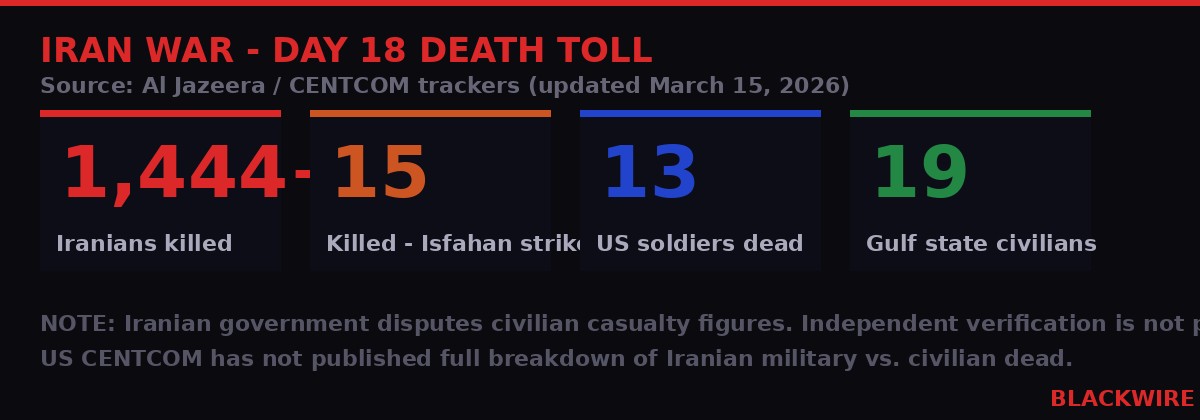
Source: Al Jazeera live tracker, CENTCOM press releases, Iranian state media (IRNA). Iranian government disputes civilian casualty classifications. Independent verification inside Iran is not possible.
Isfahan: The Factory That Won't Stop Burning
The strike on Isfahan on Sunday morning was the seventh confirmed hit on the city since the war began. Iranian state media IRNA reported that 15 people were killed at a factory in the western industrial district. The Israeli Defense Forces said in a statement that the facility was producing components for the Shahed-136 loitering munitions - the long-range kamikaze drones that Iran has been using against Gulf shipping and Israeli cities.
Isfahan is not just a military-industrial hub. It is a UNESCO world heritage city, home to the Naqsh-e Jahan Square - one of the largest public squares on earth, surrounded by 400-year-old mosques. Strikes in and around the city have drawn condemnation from European cultural institutions even as Western governments stay quiet on the war's conduct.
Photographs circulated on social media - geolocated to Isfahan's industrial district by open-source intelligence analysts - showed black smoke rising from a multi-story complex. A correspondent for IRNA described a "direct hit on a civilian-adjacent factory employing 200 workers." The IDF described the same building as "a components warehouse for drone manufacturing."
The truth - as is standard in this conflict - sits somewhere contested in the middle. Isfahan was confirmed by US intelligence, leaked to Reuters in early March, to be a dual-use manufacturing region. Civil factories pivot to military production, and military facilities subcontract civilian parts. The line between combatant infrastructure and civilian property is not just blurred in Isfahan; it may not exist.
"Those killed were assembly workers on the morning shift. No one I spoke to knew this place made anything for the military." - Unnamed relative speaking to IRNA, March 15, 2026
The IDF did not comment on civilian casualties. The US State Department, when asked at a Sunday briefing, said it was "not in a position to independently verify Iranian casualty claims." This has been the administration's standard response for 18 days.
Trump Rules Out Any Deal - And What That Actually Means
Trump's statement - "the US is not ready to make a deal with Iran" - arrived during an Oval Office appearance with visiting European officials, according to reporters on the pool. The phrasing was careful: not that there would never be a deal, but that the US was "not ready" for one now.
Diplomatic back-channels have been working in parallel with the bombs. Oman, which brokered the 2015 nuclear framework conversations, has been quietly signaling it is available to host talks. Qatar, which maintains relationships with both Tehran and Washington, has been more publicly active. Multiple reports from the region - including from AFP and Al Jazeera - indicated that a ceasefire proposal was circulating through Qatari intermediaries in the 72 hours before Trump's statement.
Trump's comment killed that track, at least publicly. The administration's stated war aim has shifted over 18 days from "degrading Iran's nuclear program" to what Defense Secretary Pete Hegseth has called "elimination of the threat" - language that many analysts interpret as regime change, though the White House has not officially confirmed that framing.
Iran's new interim leadership under Mojtaba Khamenei - the son of the deceased Supreme Leader Ali Khamenei, killed in the opening strikes of the war - has not publicly offered or accepted any deal terms. But sources quoted by multiple outlets suggest the new leadership is attempting to consolidate power while keeping the door open to negotiations if US pressure becomes existential.
The gap between the two positions is still vast. Iran wants a ceasefire that acknowledges its right to self-defense and does not require the dismantling of its missile program. The US wants full denuclearization and, according to background briefings cited by AP, some form of power transfer. These are not negotiating positions - they are competing endgames. One of them requires the other side to cease to exist as a political entity.
"Two weeks into war with Iran, Trump has been knocked back on his political heels." - AP analysis headline, published March 14, 2026
The FCC Move: America's Press Takes Fire
The most domestically significant development of Day 18 was not a bomb or a missile. It was a statement from the chair of the Federal Communications Commission, published Friday and dominating Sunday's news cycle: broadcasters that air content the administration considers "distortions" about the war with Iran risk losing their FCC broadcast licenses.
The statement was reported by Al Jazeera, the BBC, and multiple US outlets. It did not cite a specific broadcaster, specific report, or specific threshold for what constitutes a "distortion." It was a general warning - precisely the kind of warning that does not need to result in actual license revocations to be effective. The threat itself achieves the chilling effect.
The FCC regulates broadcast television and radio stations in the United States. It does not have jurisdiction over cable networks, streaming services, or digital publications - which is why outlets like CNN, MSNBC, Fox News, and newspapers are not technically subject to this threat. But local television affiliates, which carry national network feeds, are. So are major AM and FM radio stations across the country.
Press freedom organizations responded immediately. Reporters Without Borders issued a statement calling it a "weaponization of federal regulatory power against independent journalism." The Committee to Protect Journalists said the move "has no precedent in modern American history." First Amendment lawyers began circulating analyses arguing that any actual license revocation based on editorial content would face near-certain constitutional challenge.
The practical effect is harder to measure. Television news producers and assignment editors know that their employers depend on FCC licenses to operate. Whether or not the threat is legally enforceable, it lands in newsrooms where people have mortgages and careers and editors who report to executives who answer to boards. Self-censorship does not require a formal order. It just requires enough ambiguity about where the line is.
This is the third direct move against media during the Iran war. Earlier in the conflict, two Dubai journalists were arrested for filming Iranian strike footage. The Pentagon restricted embedded media access to combat operations in Week 1. The FCC statement is the first time the pressure has moved directly onto American soil and American broadcasters.
Hormuz: Trump Demands a Naval Coalition Nobody Has Joined
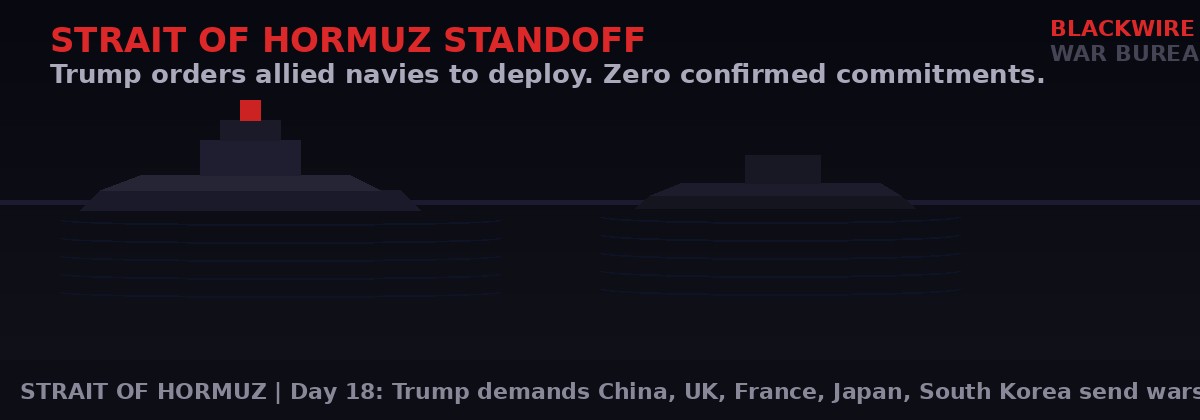
On Saturday, Trump made what was described by the BBC as an urgent appeal: he wants the UK, China, France, Japan, and South Korea to send warships to the Strait of Hormuz to help keep the critical shipping lane open. Iran's new interim leadership has declared the strait closed to "tankers and ships of enemies" during the conflict.
The Strait of Hormuz is not a large body of water. At its narrowest point, it is 21 nautical miles wide, with navigable shipping lanes of about 2 miles in each direction. Roughly 20 percent of the world's oil supply and 17 percent of global LNG passes through it in normal conditions. It is also the most heavily mined and missile-monitored waterway on earth, backed by Iranian coastal defense batteries on the eastern shore.
As of Sunday morning, no country has formally committed to the coalition Trump is demanding. The UK said through a government spokesperson that it is "discussing a range of options to protect shipping." China has made no public statement. Japan's government, which depends on Gulf oil for approximately 90 percent of its petroleum supply, is under intense domestic pressure to act - but also navigating a deeply complicated relationship with both Tehran and Washington.
Gulf Arab states - Saudi Arabia, the UAE, Kuwait, Bahrain, Oman - have been intercepting Iranian missiles and drones since the war began. Their militaries are integrated with US Central Command and have been actively defending their own territory. But none of them has formally committed a naval force to Hormuz escort duty. The liability calculus is brutal: sending ships into the strait under present conditions is not a deterrent exercise, it is a combat deployment.
"The US cannot keep Hormuz open alone with the current carrier posture. The math does not work. You need minesweepers, you need patrol vessels, you need intelligence sharing. That requires a coalition that actually shows up - not one that gets announced on social media." - Former US Navy admiral, cited in background briefing to AP, March 14, 2026
Oil prices have reflected the uncertainty. Brent crude has traded above $100 per barrel for nine consecutive days - the longest such streak since the 2008 financial crisis period. Insurance premiums for Gulf-transiting vessels have spiked so sharply that several shipping companies have suspended all Gulf operations regardless of available naval escort.
The Three-Front Reality: What's Actually Happening on the Ground
Day 18 - Timeline (March 15, 2026)
The war is now running across three distinct operational theaters. The air campaign against Iran continues at a pace that analysts estimate at 30-50 strikes per day, targeting military infrastructure, missile production, energy facilities, and leadership nodes. The IRGC's missile and drone program has been degraded but not destroyed - it continues to fire at Israel and Gulf targets daily, with diminishing but still dangerous accuracy.
The maritime front in Hormuz is the economic artery of the conflict. Every day the strait remains effectively closed to commercial traffic, the global economy absorbs another shock. Fuel costs in Europe, South Asia, and East Asia have risen between 20-35 percent since the war began. Jet fuel prices are rising sharply enough that multiple airlines have warned of summer fare increases.
The third front is newer and more diffuse: the information and political war inside the United States. The FCC threat is one piece of it. Congressional pressure on Trump's war powers is another - multiple Senate Democrats and a handful of Republicans have been pushing for a formal war powers authorization vote that Trump has so far refused. Two weeks in, with 13 American soldiers dead and the war's endpoint invisible, domestic politics are starting to intrude.
Pakistan-Afghanistan: The War Nobody's Watching
Buried beneath the Iran headlines, a second major conflict escalated on Friday. Pakistan struck an Afghan military base in Kandahar Province, according to Al Jazeera and AFP. Islamabad said it was responding to Taliban drone strikes on Pakistani civilian areas and military sites.
This is not a new conflict - Pakistan and Afghanistan have traded cross-border strikes for months. But the intensity has increased sharply. Pakistan's president publicly declared a "red line" had been crossed; the Taliban government in Kabul responded with defiance.
The Pakistan-Afghanistan escalation is directly linked to the Iran war, though the mechanics are indirect. US attention and military assets are committed in the Gulf. Regional intelligence-sharing arrangements have been strained. Iran has reportedly moved some support to Taliban factions as a pressure valve against Pakistan, a US-adjacent state. The Iranians deny this; US and Pakistani officials say the evidence is solid.
The world's most sophisticated news organizations have roughly two dozen correspondents covering the Iran war for every one covering the Pakistan-Afghanistan conflict. The ratio reflects priorities that may not match strategic reality. Pakistan is a nuclear-armed state. Its military is in a full combat posture on two borders simultaneously. The consequences of that conflict metastasizing are not smaller than the consequences of the Gulf war - they are just different in character.
The Press, the FCC, and the Historical Parallel
The FCC move deserves examination beyond the immediate headline. The US government has threatened broadcasters over war coverage before, but not in the manner now unfolding. During the Vietnam War, the Nixon administration pressured network executives through informal channels - meetings, calls, implicit leverage. The Reagan administration used the Fairness Doctrine as a theoretical cudgel. Neither administration issued a public regulatory threat to revoke licenses based on news content during an active military conflict.
What makes the current situation distinct is the explicit public announcement. The FCC chair did not merely lean on executives in private. The statement was published. That suggests one of two things: either the administration calculates the threat is legally sound and wants it on record, or the chilling effect is precisely the goal and a public statement achieves it more efficiently than private pressure ever could.
Constitutional scholars quoted by multiple outlets over the weekend noted that the FCC's authority over broadcast content is historically limited to indecency and technical compliance. The commission has no legal framework for evaluating war coverage as "distorted" in any judicially reviewable way. But regulatory bodies do not need to win in court to achieve their desired effect. They need only to make the legal battle expensive enough that broadcasters make editorial choices to avoid the fight.
NPR, PBS, ABC, NBC, and CBS News have not commented publicly on the FCC statement as of Sunday morning. That silence itself is informative. When a federal regulatory body with licensing power issues a warning to an industry, the industry's first instinct is not a press conference. It is a lawyer.
"This is how press freedom dies - not with a law, but with a letter. Not with a prohibition, but with a threat. The goal is not to ban coverage. The goal is to make editors unsure what is safe." - Reporters Without Borders statement, March 14, 2026
What Comes Next - The Week 3 Variables
Entering the third week of the conflict, four variables will determine the trajectory of the war and the political fallout in the United States.
The coalition question. If Trump fails to assemble even symbolic naval support from major allies in the next 72 hours, the Hormuz strategy collapses into a purely American commitment at a moment when Congress is beginning to ask pointed questions about costs and duration. The UK is close to confirming. China will not join any US-led coalition. Japan and South Korea are watching American domestic politics before committing to anything that could become a liability in their own elections.
The deal question. Trump's statement that the US is "not ready" for a deal was notable for what it did not say. It did not say "never." Back-channel contacts have not been terminated. The Qatari proposal reportedly involved a temporary humanitarian ceasefire and prisoner talks - not a formal end to hostilities. If Iran signals any flexibility on its missile program, the current "not ready" posture could shift faster than the public rhetoric suggests.
The American casualty threshold. Thirteen US soldiers dead in 18 days. The question every political analyst in Washington is calculating: what number triggers congressional action? The War Powers Resolution gives Congress a mechanism to force a drawdown vote. It has never been successfully used. But 13 dead is 13 families, 13 congressional districts, 13 stories that local affiliates are covering in ways the FCC cannot easily suppress.
The Isfahan precedent. Multiple strikes on a city of 2.2 million people, hitting what Iran calls civilian factories. European governments have stayed quiet. But they will not stay quiet indefinitely if the death toll in Iranian cities becomes undeniable and visually documented. The moment that changes - the moment a strike hits something that cannot be called dual-use even by the most charitable military analyst - the diplomatic position of US allies becomes untenable.
Sunday, March 15, 2026. Eighteen days in. The war is not escalating toward resolution. It is expanding laterally - into newsrooms, into coalition politics, into a second conflict that the world is barely watching, into a diplomatic vacuum where nobody is ready to make a deal but nobody has a plan to end the war without one.
This is what an open-ended conflict looks like when it enters its third week with no defined terminus. The bombs keep falling. The missiles keep flying. The press gets warned. And the coalition that was supposed to be managing this together is still arguing about whether to show up.
Get BLACKWIRE reports first.
Breaking news, investigations, and analysis - straight to your phone.
Join @blackwirenews on Telegram