165 Children Dead: How the Pentagon's Gutted Intel Office Killed the Minab School
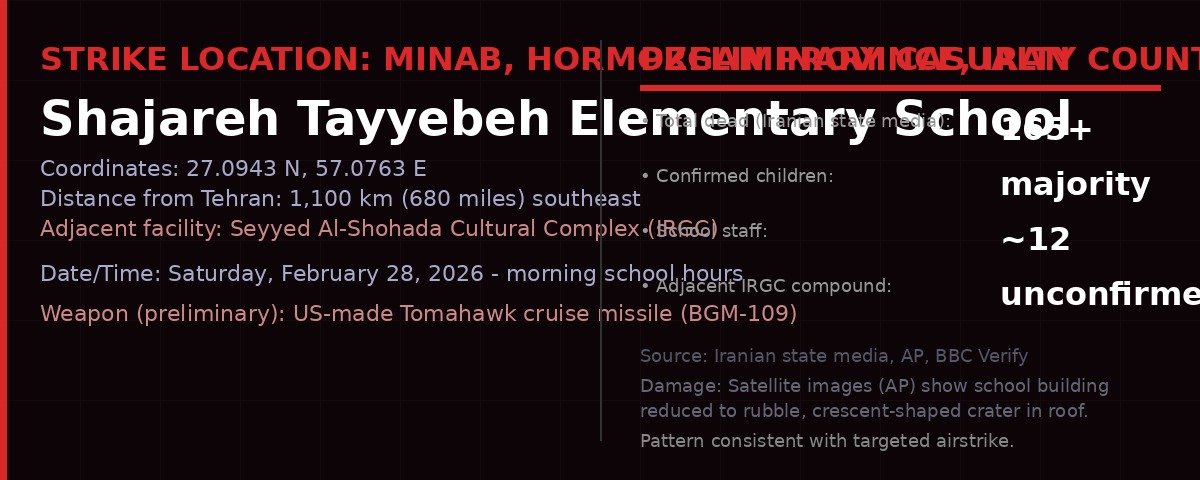
BLACKWIRE data graphic: Key facts about the Shajareh Tayyebeh Elementary strike, Minab, Iran, February 28, 2026. Sources: AP, BBC Verify, satellite analysis.
For two weeks, the United States government refused to confirm what a growing mountain of evidence already showed. On Wednesday, the New York Times first reported that a preliminary Pentagon investigation found the US military was almost certainly responsible for the strike. The Associated Press confirmed it hours later, citing two officials who spoke anonymously. The Defense Intelligence Agency had provided target coordinates based on data that was at least eight years old - coordinates that pointed to a Revolutionary Guard compound that had, by 2017, been separated from a functioning girls' school by nothing more than a new wall and a coat of paint.
The result: 165 people killed, the vast majority of them children. It stands as one of the highest civilian death tolls caused by US military action in two decades. And it happened because of a chain of institutional failures stretching from a DIA data management failure up through a Pentagon that had systematically dismantled the very offices designed to prevent exactly this kind of catastrophe.
SECTION ONE: SATURDAY MORNING AT SHAJAREH TAYYEBEH
Saturday is the first day of the Iranian school week. On the morning of February 28, 2026 - the same day US and Israeli forces launched the opening strikes of the operation against Iran - Shajareh Tayyebeh Elementary School in the port city of Minab was operating normally. Teachers were in classrooms. Girls ranging in age from roughly six to twelve were at their desks. The school had a website listing administrators, staff, and enrollment information. It was clearly marked as a school on every major mapping platform, including Google Maps and Iranian domestic apps.
Minab sits approximately 1,100 kilometers southeast of Tehran, in Hormozgan Province - a strategically critical region that straddles the approaches to the Strait of Hormuz. The school occupied a building that, according to satellite imagery reviewed by the Associated Press, was once part of a larger compound belonging to the Islamic Revolutionary Guard Corps (IRGC). Specifically, the compound housed elements of the 16th Assef Coastal Missile Group, a IRGC naval unit responsible for operations in the Strait of Hormuz. [AP]
Around 2017, visible changes appeared in satellite images of the property. A new wall was constructed, physically separating the school building from the IRGC compound. A watchtower on the school side was removed. The exterior walls of the school were repainted in vibrant murals - primarily blue and pink, a color scheme so intense it was later described by AP analysts as "visible from space." The school became, by every legal and observable standard, a civilian site.
None of this appears to have reached the Defense Intelligence Agency database that US Central Command used to target the strike.
"My assumption is that probably there were some activities recently there and they detected and tracked them, but they weren't aware or didn't have an up-to-date database that a girls' school was there and they bombed it."
- Farzin Nadimi, Senior Fellow, Washington Institute for Near East Policy
The strike killed over 165 people. Iranian state media reported most were children. Satellite photos taken in the days following the attack show the main school building reduced to rubble, with a crescent-shaped blast crater punched through what had been its roof. At least five buildings inside the adjacent IRGC compound were also struck, leaving craters and charred structural shells visible in the imagery. In a nearby cemetery, video verified by the AP showed dozens of fresh graves.
SECTION TWO: OUTDATED COORDINATES - THE INTELLIGENCE FAILURE
US Central Command relied on target coordinates provided by the Defense Intelligence Agency. According to a person familiar with the preliminary investigation findings who spoke to the Associated Press, those coordinates used outdated data. The DIA did not respond to an AP request for comment. [AP, March 12, 2026]
The mechanics of how this happens are not exotic. Military targeting packages are built from intelligence databases that accumulate over years, sometimes decades. A site designated as a military target in 2016 or 2017 can remain flagged in that database even if the physical reality on the ground has fundamentally changed - unless someone in the targeting chain specifically updates the record or runs a pre-strike validation check against current imagery. That check either did not happen or did not flag the discrepancy.
The failure is made more striking by how visible the changes were. The AP analysis noted that the school's civilian character could have been identified "from the air" using characteristics visible in satellite imagery available before the strikes. The blue-and-pink murals on the walls. The absence of military vehicles or equipment. The removal of the watchtower. The school's own digital footprint - its publicly accessible website with staff directories and enrollment information. The building was listed on commercial mapping services as an elementary school.
Senator Tim Kaine, in a briefing with journalists on Wednesday, cut to the core legal question: [AP]
"It's either we've changed our traditional targeting rules or we made a mistake. If we've changed our traditional targeting rules and we no longer provide the same level of protection for civilians, that would be tragic."
- Sen. Tim Kaine (D-VA)
International humanitarian law is unambiguous on this point. The proximity of a school to a valid military target does not make the school a military objective. Civilian structures retain their protected status unless they are actively being used for military purposes. Elise Baker, a senior staff lawyer at the Atlantic Council, told the AP: "The proximity of a school to a valid military target does not change its status as a civilian site." [AP]
Whether this was a targeting rules failure or an intelligence process failure - or both - matters enormously for legal accountability. But the institution built specifically to answer that question had been largely dismantled in the weeks before the war started.
SECTION THREE: THE DISMANTLED GUARDRAIL
BLACKWIRE graphic: The institutional timeline from civilian protection mandate to its dismantling.
In late 2022, Congress passed the National Defense Authorization Act with broad bipartisan support. Tucked inside the defense bill was a mandate directing the Pentagon to create a Civilian Protection Center of Excellence - a dedicated office tasked with "institutionalizing and advancing knowledge, practices, and tools for preventing, mitigating, and responding to civilian harm." [AP]
The measure formalized an initiative Defense Secretary Lloyd Austin had already launched earlier that year. The 36-step action plan Austin put in place was, in his own description at the time, "ambitious and necessary." By April 2023, the center had a full-time Army-appointed director and an initial core staff of 30 civilians. The 2024 Pentagon report on the program described it as moving toward full operational capacity.
Then came the new administration. Budget cuts, reorganization priorities, and what one former Pentagon official described as Hegseth's personal emphasis on "lethality over legality" systematically hollowed out the civilian harm mitigation infrastructure. The letter from more than 45 Democratic senators to Defense Secretary Pete Hegseth, sent Wednesday, listed specific cuts: staffing reductions at US Central Command - the command actually running the Iran air campaign - and the functional reduction of the Civilian Protection Center itself. [AP, Senate letter]
The senators wrote: "Under this administration, budgetary and personnel cuts at the Department have robbed military commands of crucial resources to prevent and respond to civilian casualties." They pressed Hegseth on whether the US bore culpability for the Minab strike and what pre-strike analysis of the school building had been conducted.
One former Pentagon official told the AP the Feb 28 strike was "a natural result" of those changes - that removing the people and processes whose explicit job was to catch exactly this kind of error made a catastrophic mistake not a possibility but an inevitability.
"If the US is found responsible, the military must do everything you can to eliminate those mistakes going forward. But you also can't undo it."
- Sen. Kevin Cramer (R-ND)
Even Republican senators are pushing for accountability. Cramer's statement is notable precisely because it comes from within the president's own party and from a senator not known for open defiance of the administration's defense posture. The scale of the civilian death toll is making bipartisan silence increasingly difficult to sustain.
SECTION FOUR: THE COVER-UP ATTEMPT AND THE POLITICAL FALLOUT
In the immediate aftermath of the February 28 strikes, President Donald Trump did not express uncertainty about what happened. He blamed Iran. [AP]
That framing held through the first week of the war. Iranian officials blamed the US and Israel. Neither country accepted responsibility. Defense Secretary Pete Hegseth, when asked directly at a Pentagon briefing, said: "All I can say is that we're investigating that. We, of course, never target civilian targets. But we're taking a look and investigating that." The statement simultaneously acknowledged an investigation was underway - which Pentagon protocol only triggers when investigators make an initial determination that US culpability is possible - while maintaining the fiction that intent was enough to settle the question.
By March 6, the weight of physical evidence had become overwhelming. AP published its satellite image analysis showing the school reduced to rubble. A US official acknowledged to the AP on condition of anonymity that the strike was "likely US." Video authenticated by AP and BBC Verify showed what munitions experts identified as a US-made Tomahawk cruise missile impacting near the school. [AP, BBC Verify]
On Wednesday, March 11, the New York Times first reported that a preliminary Pentagon investigation had concluded the US was responsible. AP confirmed the finding within hours. Trump's public position shifted from "Iran did it" to "I wasn't certain" to "I'll accept the results of the investigation." White House press secretary Karoline Leavitt told reporters the investigation was "still ongoing."
The Pentagon has blocked news photographers from Hegseth's briefings on the Iran war - a move documented by the AP this week that restricts visual accountability for military operations in ways that would have been politically untenable under previous administrations. [AP]
The political calculus is stark. Trump built his 2024 campaign in part on attacking "stupid wars" and promising to keep American troops out of foreign conflicts. The Minab school death toll now gives his domestic critics a concrete, catastrophic civilian casualty event to attach to the Iran war - one that happened on the first day of the operation and that a gutted institutional safeguard was designed to prevent.
SECTION FIVE: IRAN'S NEW SUPREME LEADER - THE SON INHERITS THE WAR
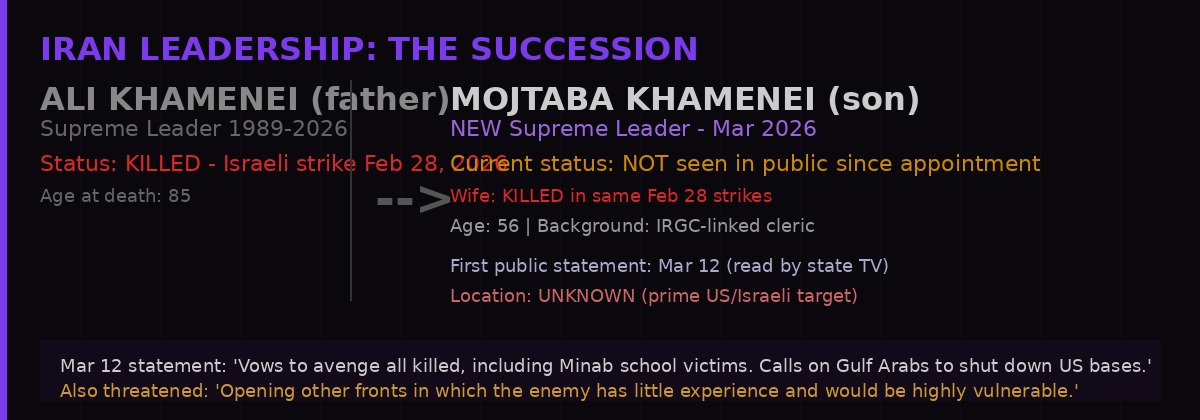
BLACKWIRE graphic: Iran's leadership transition - from Ali Khamenei to his son Mojtaba. Sources: AP, Reuters, BBC.
The Israeli strike that opened the war on February 28 also killed Supreme Leader Ayatollah Ali Khamenei, who had led the Islamic Republic since 1989. His son, Mojtaba Khamenei, was subsequently elevated to the position. He is 56 years old. His wife was killed in the same February 28 strikes. He has not appeared in public since his appointment. His location is unknown - making him the primary target for US and Israeli intelligence services. [AP]
On Thursday, March 12, Mojtaba Khamenei issued his first public statement. He did not deliver it himself. A presenter on Iranian state TV read the statement on air. The substance was unambiguous: the war continues. [AP, BBC]
The statement vowed to "avenge those killed in the war" - a list that explicitly included the Minab school victims. He called on Gulf Arab states to "shut down" US military bases in the region, telling them the protection Washington promised was "nothing more than a lie." He warned of "opening other fronts in which the enemy has little experience and would be highly vulnerable," without specifying what those fronts might be. Iranian officials have historically used similar language when referring to attacks on Jewish and Israeli targets internationally, cyberoperations, or activation of proxy networks outside the immediate theater.
Those close to the Iranian government describe Mojtaba Khamenei as even less compromising than his father - a cleric with deep ties to the Revolutionary Guard who has spent decades in his father's orbit as a political and ideological enforcer. His elevation represents a leadership transition that, rather than creating an opening for negotiation, has likely hardened Iran's posture. [Reuters, BBC]
The US and Israel have struck more than 6,000 targets since operations began, according to US Central Command. That includes more than 30 minelaying vessels destroyed. The strikes have killed significant portions of Iran's original leadership structure and degraded substantial elements of its ballistic missile program. They have not toppled the government. Iran is still fighting. And the new supreme leader's first words suggest the regime intends to keep fighting for as long as it takes to extract enough economic pain from the West to force a ceasefire on terms acceptable to Tehran.
SECTION SIX: HORMUZ IN FLAMES - 18 SHIPS, $100 OIL, AND THE GLOBAL CHOKEHOLD
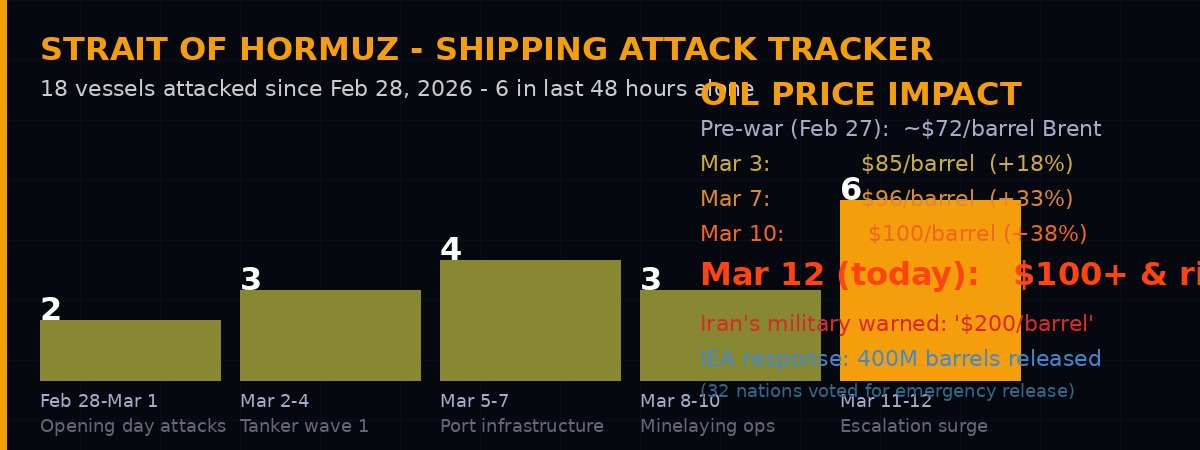
BLACKWIRE data graphic: Shipping attacks and oil price impact since the war began. Sources: BBC Verify, UKMTO, Vanguard maritime intelligence, MarineTraffic.
Iran's primary leverage instrument in this conflict is not its missile arsenal. It is a narrow strip of water 33 kilometers wide at its most restricted point: the Strait of Hormuz. Approximately 20% of the world's traded oil - roughly 20 million barrels per day - transits through this corridor between Iran's southern coast and the combined territories of Oman and the UAE. So does a significant share of global liquefied natural gas, along with helium, fertilizer precursors like urea, and manufactured goods flowing to and from the Gulf states. [BBC Verify]
Iran has effectively closed it. As of Thursday, March 12, 18 vessels have been attacked since the war began on February 28. Six of those attacks occurred in the last 48 hours alone. Ten of the struck vessels are oil tankers. Three crew members from the Thai-flagged Mayuree Naree are missing and believed trapped in the engine room after it was hit while transiting through the strait on Wednesday morning. One crew member died after the US-owned Safesea Vishnu was rammed by an unmanned explosive speedboat in Iraqi waters. Video authenticated by BBC Verify shows a massive explosion on the vessel as those on the attacking small boat can be heard celebrating. [BBC Verify, Indian authorities]
"In theory, Iran can keep threatening shipping indefinitely. Iranian forces are well practised in decoy, camouflage and subterfuge tactics, and many of their smaller weapons can be disguised in commercial vehicles, hidden in buildings and out of sight along Iran's long coastline."
- Nick Brown, Janes Defence Intelligence
MarineTraffic data shows only six vessels passed through the strait between Monday and Thursday. Many ships have disabled their onboard transponders, making tracking unreliable. Signal jamming is causing others to broadcast false position data. No ship insurer in the world wants to write a policy for a vessel entering the Gulf right now. [BBC Verify, Neil Quilliam, Chatham House]
Brent crude oil has risen 38% since the war began, pushing above $100 per barrel by Monday and remaining there. Iran's military spokesman Ebrahim Zolfaqari warned this week: "Get ready for the oil barrel to be at $200 because the oil price depends on the regional stability which you have destabilised." The International Energy Agency, responding to a unanimous vote by 32 member nations, announced an emergency release of 400 million barrels from strategic reserves to offset the effective closure of the shipping lane. [BBC, IEA announcement]
Trump pledged a military convoy escort for tankers transiting the strait "if necessary," but military analysts question whether this is operationally feasible at scale. Professor Michael Clarke of King's College London asked the blunt question no administration spokesman has answered: "Even if a convoy is 90% effective, which ship owners and crew unions are prepared to play Russian roulette in one of them?" [BBC]
US Central Command announced Thursday that American forces struck 16 minelaying ships in an operation this week. But Iran's small-unit naval doctrine - which relies on dispersed fast boats, shore-based mobile missiles, kamikaze drones, and small submarine units - does not lend itself to being defeated by destroying individual vessels. The weapons and crews are distributed across hundreds of kilometers of Iranian coastline, hidden in civilian infrastructure, ready to re-engage.
SECTION SEVEN: THE HUMAN RECKONING - DISPLACEMENT, CASUALTIES, AND ACCOUNTABILITY
The UN refugee agency UNHCR reported Thursday that up to 3.2 million people in Iran have been displaced by the ongoing war. Most have fled Tehran and other major urban centers toward northern Iran or rural areas - evacuating ahead of what they fear will be continued strikes on infrastructure and population centers. Around 800,000 people have been displaced in Lebanon, where Hezbollah continues to launch rocket salvos into northern Israel while Israeli forces mount continued air operations into Lebanese territory. [AP, UNHCR]
On Thursday, Hezbollah launched some 200 rockets at northern Israel. Israeli strikes on Tehran and Lebanon continued. Eleven people were killed in Lebanon in the latest Israeli wave. Air raid sirens and the sounds of interception - Iran's remaining air defense systems engaging incoming Israeli and American missiles - have become routine noise for the populations that remain in Tehran. [AP]
The displacement figure of 3.2 million inside Iran alone does not capture the full humanitarian picture. Hospitals in Hormozgan Province, already dealing with casualties from the February 28 opening strikes, are now treating victims from continued operations in the same region. The destruction of energy infrastructure across the Gulf - the BBC has verified 10 strikes on oil facilities in Bahrain, Oman, Saudi Arabia, the UAE, and Qatar since the war began - has disrupted power and water supply across an entire region. The civilian cost of the war is accelerating faster than most Western governments publicly anticipated when they supported or tolerated the opening operation.
The Minab school case is the focal point of that reckoning. It is the most documented single civilian casualty event of the conflict. It has the highest confirmed death toll of any US military strike in at least two decades. It happened on the first day of the war. And preliminary findings now suggest it was caused by a data management failure that a deliberately dismantled institutional safeguard was specifically designed to catch. [AP, NYT]
Iran's sports minister announced Thursday that the country cannot participate in the upcoming World Cup due to the ongoing US military attacks - a symbolic detail that nonetheless underscores how comprehensively the war has disrupted Iranian civil life. FIFA has not yet made a formal ruling on the matter. [AP]
Timeline of Key Events
WHAT COMES NEXT
The Minab investigation has no clean resolution ahead of it. If the Pentagon confirms US responsibility - which preliminary findings strongly indicate it will - the administration faces a legal and political exposure it cannot easily contain. International humanitarian law violations arising from civilian strikes are not extinguished by an apology or a procedural review. Advocacy groups, UN bodies, and allied governments that have been diplomatically quiet about the Iran operation are watching this case as the test of whether American targeting accountability means anything at all.
For the war itself, the Minab revelation changes the political environment in ways that could constrain the operation's continuation. Public support in the United States was already showing strain in AP-NORC polling. The revelation that 165 children died because the Pentagon's civilian protection infrastructure was gutted before the first strike landed gives the domestic opposition a concrete, human-scale argument against continued military operations.
Mojtaba Khamenei's choice to use the Minab children as his first public statement's centerpiece is not accidental. Iran's strategic interest is in making the school strike radioactive enough politically that it becomes a brake on the US operation. Whether that calculation succeeds depends entirely on how much political pain the Trump administration is willing to absorb - and how much the war's supporters in Washington believe they can outlast the pressure.
On the Strait of Hormuz, the economic mathematics are brutal and worsening. At $100 oil with 32 nations drawing on strategic reserves, the global economy is absorbing the shock. At $150 oil - a threshold analysts say is reachable within weeks if the blockade continues - the political sustainability of the campaign shifts dramatically. At $200, the number Iran's military spokesman invoked this week, it shifts terminally. The IEA's 400 million barrel release is a delay, not a solution. The reserves are finite. The Iranian coastline is not.
British forces in Iraq shot down two Iranian drones overnight Thursday. The geographic spread of the conflict continues to widen. The 3.2 million displaced Iranians represent a humanitarian crisis that will outlast whatever ceasefire eventually ends this war by years. And in a cemetery in Minab, 165 people - most of them children who were learning to read, doing math problems, and eating breakfast before the missile came down - are buried in rows of graves that were dug in a single afternoon.
The school walls were painted bright enough to see from space. The coordinates in the DIA database did not include the color.
Get BLACKWIRE reports first.
Breaking news, investigations, and analysis - straight to your phone.
Join @blackwirenews on TelegramSources: Associated Press (March 6, 12, 2026), New York Times (March 11, 2026), BBC Verify (March 12, 2026), BBC News, UKMTO maritime incident reports, Vanguard maritime intelligence, MarineTraffic vessel tracking data, Senate letter to Secretary Hegseth (March 11, 2026), International Energy Agency emergency release announcement, UNHCR displacement estimates, Atlantic Council legal analysis, Janes Defence Intelligence, King's College London, Chatham House, Washington Institute for Near East Policy. Satellite imagery: AP satellite analysis, commercially available imagery reviewed by AP and BBC Verify.