
Gulf energy infrastructure - the backbone of 20% of the world's traded oil - is now a battlefield. (Illustrative / Pexels)
The math was brutal before Thursday. Iran had already blocked the Strait of Hormuz, through which one fifth of the world's traded oil normally flows. Saudi Arabia had started pumping west, toward the Red Sea, looking for an alternate export route. Qatar had been hoping to restart LNG shipments once the shooting stopped. Refiners in Kuwait and Abu Dhabi were still operating, quietly serving as the region's backup processing capacity.
On Day 20, Iran hit all of it.
A drone struck the SAMREF refinery in Yanbu - Saudi Arabia's Red Sea port, the very facility Riyadh had been routing oil toward to bypass Hormuz. Iranian missiles hammered Qatar's Ras Laffan LNG terminal again, a facility that had only just absorbed strikes earlier in the month. Kuwait reported two refineries hit. Abu Dhabi said gas operations in the emirate were targeted in what local authorities described as the third attack in 72 hours.
Brent crude, the international oil benchmark, spiked to $119 per barrel in early trading before pulling back to around $110. That is still a 63% increase since the United States and Israel launched the war on February 28. European benchmark natural gas prices rose 17% in a single day and have doubled over the past month. (AP News, March 19, 2026)
This is no longer a war about degrading Iran's military. This is a war about who controls the global energy system.
What Triggered Thursday's Strike Wave

Industrial fires lit the Gulf sky across multiple countries on Thursday. Iran fired on four separate nations in a single day. (Illustrative / Pexels)
The immediate trigger was Israel's attack on South Pars - Iran's largest natural gas field, shared with Qatar across a submerged boundary in the Persian Gulf. The field provides roughly 80% of Iran's domestic natural gas, feeding its power grid, heating its cities, and supplying its industrial base. Israel struck Wednesday. By Thursday morning, Iran had drawn up a response list.
South Pars is not an export facility. Unlike Qatar's North Field - the same geological structure, just on Qatar's side of the border - Iran's portion feeds pipelines that run inland to Tehran and other major cities. Sanctions have prevented Iran from building the LNG export terminals it originally planned. (AP News / Columbia University Center on Global Energy Policy)
Iran is the world's fourth-largest natural gas consumer, trailing only the United States, China, and Russia. Striking South Pars did not immediately cut Iran's oil export revenue - that had already been decimated by the war. What it threatened was domestic heating, cooking, electricity generation, and industrial production. The attack struck at the part of Iran the bombs had not yet reached: the civilian interior.
Tehran calculated a response in kind. If Israel would hit what Iranians heat their homes with, Iran would hit what everyone else in the Gulf heats their economy with.
The Yanbu Strike: Closing the Red Sea Escape

Saudi Arabia had been rerouting tankers westward to the Red Sea to avoid the Hormuz blockade. The Yanbu refinery was the linchpin of that strategy. (Illustrative / Pexels)
The Yanbu strike is the one that matters most for global supply chains. Saudi Arabia controls the only pipeline network that can move crude oil from the Persian Gulf side of the Arabian Peninsula to the Red Sea - bypassing the Strait of Hormuz entirely. The East-West Pipeline, known as Petroline, has a capacity of roughly 5 million barrels per day. At the Red Sea end sits Yanbu, where the oil gets loaded and shipped north toward the Suez Canal and into global markets.
After Iran established its Hormuz blockade in the early days of the war, Riyadh had quietly ramped up Petroline flows. The assumption was that even if the Gulf was closed, Saudi oil could get out through the back door. It was the one card the Saudis could play without entering the war.
The SAMREF refinery in Yanbu - a joint venture between Saudi Aramco and Mobil - was struck by what Saudi authorities described as an Iranian drone. The facility suffered damage to processing units, though production volumes and extent of damage were not immediately disclosed. The strike sent an unambiguous message: Iran has been watching the Petroline strategy. There is no back door it will leave open. (AP News, Saudi Energy Ministry statement, March 19, 2026)
The Arab League Secretary-General Ahmed Aboul Gheit called the Iranian attack wave a "dangerous escalation." Saudi Foreign Minister Prince Faisal bin Farhan warned on Thursday that the Gulf's patience was "not unlimited" and that the kingdom retained "significant capabilities" to respond. It was the closest Riyadh has come to a direct military threat since the war began.
Ras Laffan, Again: Qatar's LNG Hub Takes a Second Blow

Qatar's Ras Laffan Industrial City is the world's single largest LNG export facility. It shut down on March 2 after the first Iranian strike. It was hit again Thursday. (Illustrative / Pexels)
Qatar supplies approximately 20% of the world's liquefied natural gas. Its Ras Laffan industrial complex - a purpose-built city of refineries, processing plants, and export terminals on the northeastern coast of the Qatari peninsula - handles almost all of it. Europe, Japan, South Korea, and India collectively depend on Ras Laffan for a significant portion of their heating and power generation.
The facility had already been shut down since March 2, when an earlier Iranian missile salvo hit key infrastructure. Qatar had been hoping to resume limited operations as damage assessments were completed. Thursday's strike delayed that timeline indefinitely.
Energy Intelligence, a data and analytics firm that tracks the LNG market, described the attack as "a grim warning for the LNG market." The firm said the strikes were "a dangerous escalation" with consequences likely to ripple through energy contracts in Asia and Europe for months, regardless of when the fighting stops. (AP News / Energy Intelligence, March 19, 2026)
European natural gas futures - already elevated because winter demand had kept storage levels below seasonal averages - surged 17% in a single session. The benchmark has now doubled since the war started. Utility companies in Germany, France, and the Netherlands began issuing contingency guidance to industrial customers about potential supply curtailments if the war extends past April.
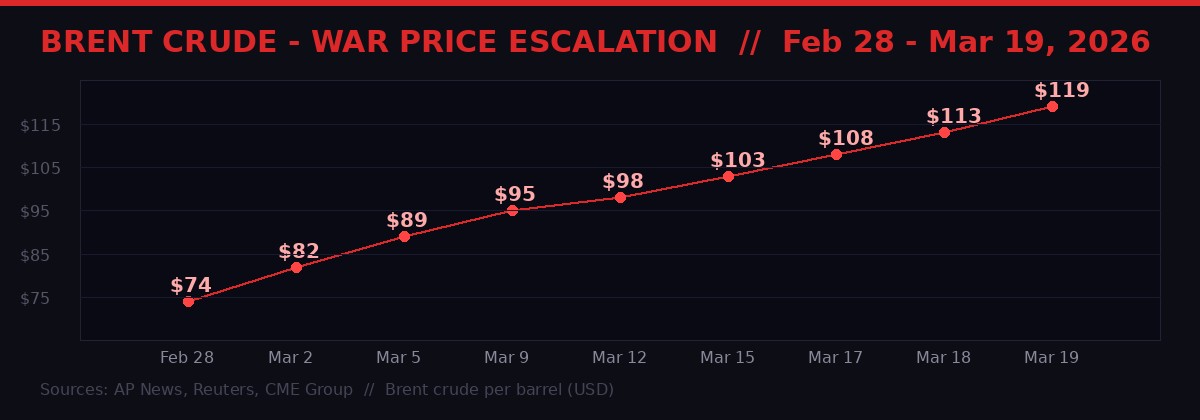
Brent crude price from war start through Day 20. Every major escalation added another leg up. (BLACKWIRE / Data: AP News, CME Group)
The Gulf States in a Diplomatic Bind

Gulf capitals are watching their infrastructure burn while trying to stay out of a war they did not start and cannot stop. (Illustrative / Pexels)
The Gulf Cooperation Council states - Saudi Arabia, Qatar, the UAE, Kuwait, Bahrain, and Oman - are in an impossible position. They did not support the US-Israeli military campaign. They were not consulted before the strikes began on February 28. Several of them host American military bases and have quietly coordinated on air defense, but none have committed forces to the fight.
That studied neutrality has not protected their infrastructure. Iran's position appears to be that there is no such thing as neutral ground when it comes to the energy war. Qatar hosts US Central Command's forward headquarters at Al Udeid Air Base - the operational nerve center for the entire campaign. The UAE has been a critical logistics hub. Saudi Arabia's airspace and bases have facilitated American operations in ways that have never been publicly acknowledged.
As of Thursday, Arab League foreign ministers and Muslim-majority country representatives meeting in Riyadh were trying to formulate a unified response. The meeting produced stern language but no clear action framework. Saudi Arabia's warning about "significant capabilities" was the sharpest statement yet from any Gulf state, but Riyadh has consistently stopped short of actual escalation.
The bind is structural. If the Gulf states enter the war, they validate Iran's argument that this is a regional Sunni-versus-Shia conflict wrapped in American power projection. If they stay out, their infrastructure continues to burn and their silence looks like complicity.
Meanwhile, a vessel was set ablaze off the coast of the United Arab Emirates and a second was damaged near Qatar's territorial waters - incidents that raise the specter of direct maritime confrontation. Iran's naval assets remain active in the Strait of Hormuz despite US air campaigns hunting Iranian patrol boats. (AP News, March 19, 2026)
Allies Refuse: Europe and Asia Watch from the Sideline

Trump demanded allied minesweepers and warships for the Strait of Hormuz. Europe replied with what one French analyst called "a global raspberry." (Illustrative / Pexels)
The United States is fighting this war alone. That fact became more visible on Thursday as Trump's demands for allied military support continued to produce a string of refusals.
Trump has framed his demands as calling in debts - decades of American security guarantees now requiring reciprocal military support in the Gulf. The response from European capitals has been consistent: this is not our war, and we were not consulted before it started.
"This is not Europe's war. We didn't start the war. We were not consulted." - Kaja Kallas, EU foreign policy chief, March 18, 2026
Britain, long considered Washington's most reliable military partner, has refused to send warships and initially refused to allow US bombers to attack Iran from British bases before partially relenting on strikes targeting Iran's ballistic missile program. Prime Minister Keir Starmer has said Britain "will not be drawn into the wider war" and demanded "a proper thought-through plan" - a diplomatic way of saying he sees no coherent endgame. (AP News, March 19, 2026)
Trump called Britain "the Rolls-Royce of allies" before expressing personal displeasure with Starmer's refusal. French President Emmanuel Macron said Paris envisions possible naval escorts in the Strait of Hormuz - but only after hostilities cease. Germany's Defense Minister Boris Pistorius was blunter: "Sending more warships to the region will certainly not contribute" to ending the conflict.
"My attitude is: We don't need anybody. We're the strongest nation in the world." - President Donald Trump, March 18, 2026
Retired US Army Lieutenant General Ben Hodges, former commanding general of US Army Europe, told AP that allies are "looking at the United States in a way that they never have before. And this is bad for the United States." He noted that European leaders who previously used flattery to manage Trump are "starting to realize that there's no benefit or value" in that approach.
China, which was also asked to help clear the Strait, has not responded to Trump's public calls. Beijing's silence on a conflict that disrupts its own oil supply routes is being read in Washington as a deliberate calculation - letting the US absorb the military and economic costs without offering anything in return.
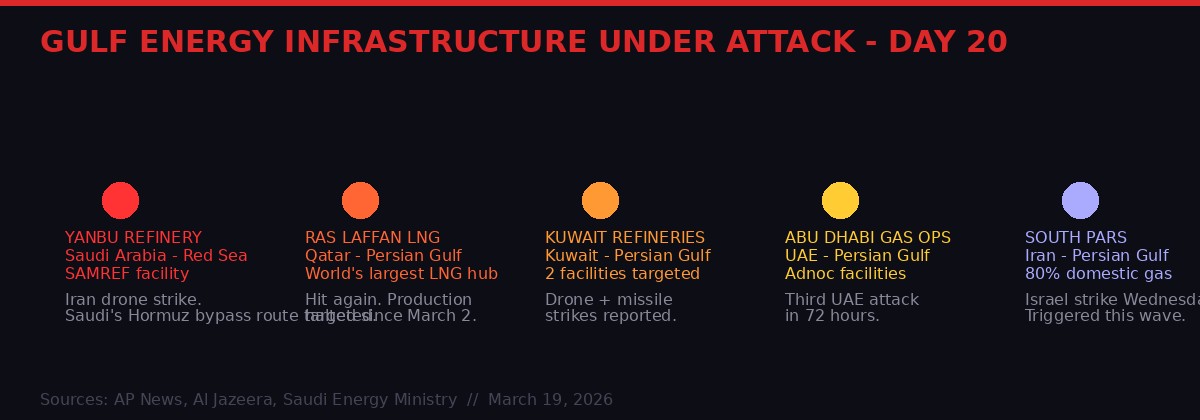
Four countries hit in a single day. Iran's Day 20 retaliation spread across the entire Gulf energy network. (BLACKWIRE / Sources: AP News, Al Jazeera)
$200 Billion, $39 Trillion, and a Congress That Wants Answers

The Pentagon sent a $200 billion supplemental war funding request to the White House. Congress was not briefed before the war started and is not inclined to write blank checks. (Illustrative / Pexels)
The Pentagon sent a $200 billion supplemental funding request to the White House on Thursday, according to a senior administration official who spoke to AP on condition of anonymity. Defense Secretary Pete Hegseth did not confirm the specific figure but declined to deny it.
"It takes money to kill bad guys." - Defense Secretary Pete Hegseth, Pentagon press conference, March 19, 2026
The number is staggering by any historical measure. It comes on top of an additional $150 billion the Defense Department already received through Trump's tax cuts and spending bill. Combined, that would be $350 billion in extraordinary defense spending above the base budget in a single fiscal year - more than the entire defense budgets of China, Russia, the UK, and Germany combined.
Congress has not authorized the war. The Trump administration has not formally submitted a War Powers Resolution notification that provides a legal basis for the operation beyond the 60-day clock already ticking. Most Democratic lawmakers are likely to oppose the request and demand a strategy document. Republican fiscal hawks, who supported the war in its initial weeks, are increasingly uneasy about uncapped spending on an operation with no defined exit conditions.
Representative Betty McCollum, ranking Democrat on the House Defense Appropriations subcommittee, was direct: "This is not going to be a rubber stamp for the president of the United States." She noted that Congress is still waiting for an accounting of where the original $150 billion has been spent. (AP News, March 19, 2026)
The national debt crossed $39 trillion on Wednesday - a milestone that underscores the accelerating fiscal trajectory. The White House's own economic adviser Kevin Hassett estimated the war has cost more than $12 billion in direct military expenditures so far, with that figure growing daily. The Peter G. Peterson Foundation warned the debt could hit $40 trillion before the fall congressional elections - a number that will feature in attack ads across competitive districts.
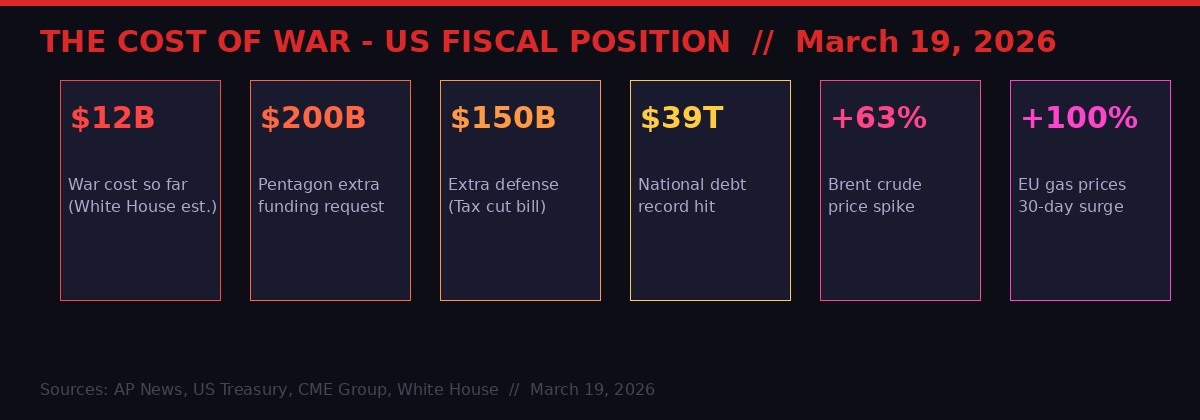
The financial architecture of the war, Day 20. The numbers compound with each escalation. (BLACKWIRE / Sources: AP News, US Treasury, CME Group)
Timeline: Twenty Days That Rewired Global Energy
What Comes Next: Escalation Ladder or Fragile Ceiling

The question on every energy trading desk: has Iran reached its tactical ceiling, or is there another escalation rung above $119 oil? (Illustrative / Pexels)
The key question after Day 20 is whether Thursday's strikes represent Iran's peak retaliation for South Pars, or the opening of a sustained campaign against Gulf energy infrastructure across multiple countries. The answer has implications that extend far beyond the immediate military situation.
Iran's strategic calculus appears to have shifted. For the first two weeks of the war, Iranian strikes concentrated on Israel and on US military assets in the Gulf - ships, air bases, the US Embassy complex in Oslo. The targeting of Gulf Arab energy infrastructure is a qualitative escalation. It brings Saudi Arabia, Qatar, Kuwait, and the UAE closer to the edge of direct involvement and risks converting the conflict from a US-Israeli-Iranian war into something larger and less bounded.
The US military, for its part, has been escalating inside Iran. General Dan Caine, Chairman of the Joint Chiefs, confirmed on Thursday that US forces are attacking deeper into Iranian territory - warplanes hunting Iranian patrol boats in the Strait, helicopters striking Iranian drones, and heavy bombers hitting underground weapons storage facilities. Hegseth's comment that senior IRGC and Basij leadership hold "temp jobs" telegraphed more leadership targeting in the pipeline. (AP News, March 19, 2026)
The $200 billion Pentagon request signals that the administration is preparing for a war measured in months, not weeks. But the absence of any defined political objective beyond "degrading Iran's capabilities" and the lack of allied support means there is no diplomatic track running parallel to the military campaign. Wars fought without a simultaneously developing diplomatic exit tend to last longer and cost more than initial estimates suggest.
For the global economy, the immediate variables are clear: oil above $100 per barrel causes inflation to accelerate; oil above $120 per barrel starts causing demand destruction and recession signals. Federal Reserve Chair Jerome Powell, who held rates steady on Wednesday, acknowledged that the war's energy impact complicates the Fed's calculations significantly. Traders are now betting on a near-5% chance the Fed hikes rates by year-end - a reversal of market expectations that had priced in multiple cuts just weeks ago. (AP News / CME Group data, March 19, 2026)
Iran has, in twenty days, demonstrated that it retains meaningful strike capability against targets across a wide geographic area despite severe attrition of its military command structure and weapons systems. Its drones and missiles are not precision weapons - the Bushehr nuclear plant was struck and suffered no damage, per IAEA - but they do not need to be precise to send oil prices through the floor of a ceiling that the global economy once considered permanent.
The exit routes from the Gulf - Hormuz, the Red Sea Petroline corridor, the Ras Laffan LNG terminal - are all compromised or under fire. Ships have been hit off the UAE and Qatar. The Saudi bypass is now a target. The Strait remains partially functional but contested. The world's single most consequential waterway for energy trade has become a combat zone, and as of Day 20, there is no timeline, no ceasefire framework, and no visible off-ramp that both sides would accept.
The lights in Tokyo, Frankfurt, and Mumbai that run on Qatari LNG will not flicker tomorrow. Energy storage buffers buy time. But every day this war runs, those buffers thin. And every day it runs, the bill - strategic, economic, human - compounds in ways that will outlast the fighting by decades.
Get BLACKWIRE reports first.
Breaking news, investigations, and analysis - straight to your phone.
Join @blackwirenews on Telegram