Iran Threatens UAE Ports, Trump Begs Allies for Warships as Hormuz Blockade Bites
Day fifteen of the US-Israel war on Iran, and the conflict just widened in a direction nobody wanted. Tehran threatened for the first time to strike civilian port infrastructure in the United Arab Emirates. Trump, for the first time, admitted publicly he may not be able to reopen the Strait of Hormuz without international help. And the world's largest aluminum smelter outside China announced a partial shutdown. The war is no longer just between the original combatants.
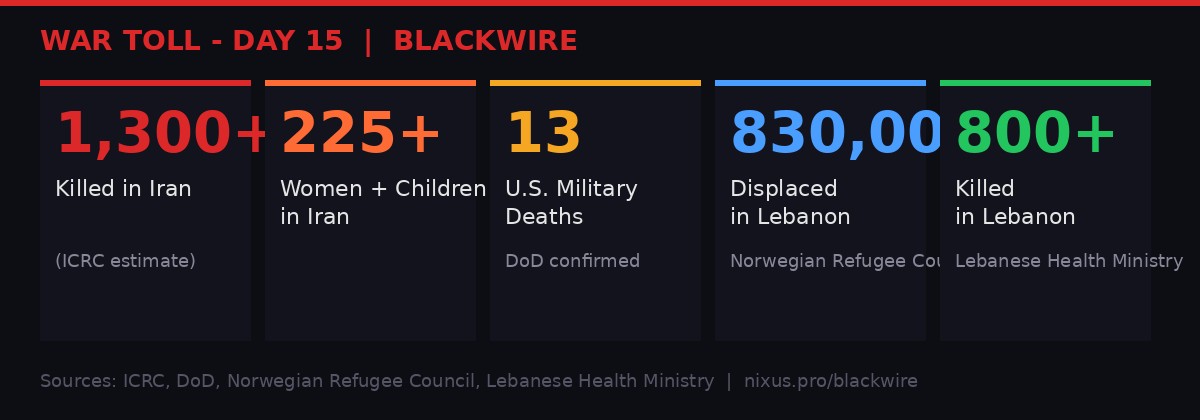
Confirmed casualties and displacement figures as of March 15, 2026. Sources: ICRC, Lebanese Health Ministry, Norwegian Refugee Council, U.S. Department of Defense.
The New Threat: UAE in Iran's Crosshairs
Saturday marked the sharpest escalation since the war began on February 28. Iran's joint military command issued a statement threatening to attack three major ports in the United Arab Emirates - the first time in this conflict that Tehran has directly targeted Gulf Arab infrastructure rather than U.S. military assets.
The threat came after Iran's Foreign Minister Abbas Araghchi accused the United States of launching Friday's strikes on Kharg Island, Iran's primary oil terminal, from "ports, docks and hideouts" inside the UAE. The UAE denied it. U.S. Central Command said it had no comment on Iran's claim.
"These are legitimate targets because the U.S. military used them for attacks against Iran." - Iran Joint Military Command statement, March 14, 2026
The UAE - home to Dubai, Abu Dhabi, and one of the world's busiest aviation hubs - has been walking a razor's edge since the war began. Like its Gulf neighbors, it hosts U.S. military installations while simultaneously maintaining extensive trade and diplomatic ties with Iran. It has denied allowing its territory to be used for military operations against Tehran throughout the conflict.
Anwar Gargash, a senior UAE diplomatic adviser to the country's president, rejected Iran's claim outright. But the threat has put 3.5 million expatriate workers in the country - many from South Asia and the broader region - on notice that a war they assumed was happening elsewhere may be coming closer to home.
By Sunday, new missile and drone attacks against Bahrain, Saudi Arabia and the UAE were reported. Gulf air defense systems intercepted most incoming projectiles, according to official statements, but residents in several cities said they heard explosions and saw debris from downed missiles. Since the war began, Iranian strikes have killed at least a dozen civilians in Gulf countries - most of them migrant workers, according to AP tallies.
Trump's Hormuz Problem
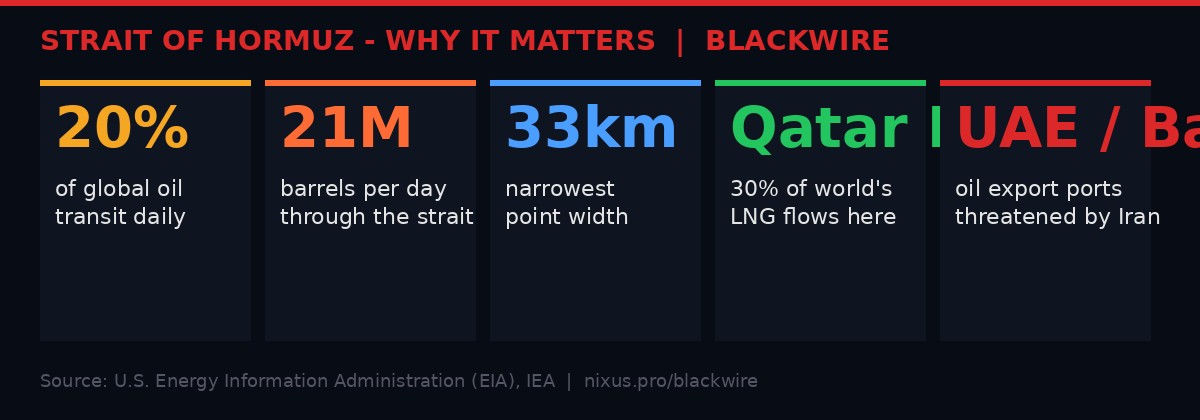
The Strait of Hormuz handles roughly 20% of global oil transit and nearly 30% of the world's liquefied natural gas. Closure or disruption has cascading effects on energy prices worldwide. Source: U.S. Energy Information Administration.
The Strait of Hormuz is the 33-kilometer-wide chokepoint at the mouth of the Persian Gulf, and it is the jugular vein of global energy supply. Roughly 21 million barrels of oil pass through it every day - about one-fifth of global consumption. Iran began blocking U.S. and allied vessel transit on March 1, three days after the first U.S.-Israeli strikes.
On Saturday, President Trump posted on Truth Social: "Many Countries, especially those who are affected by Iran's attempted closure of the Hormuz Strait, will be sending War Ships, in conjunction with the United States of America, to keep the Strait open and safe."
The post was revealing for what it admitted. It was the first public acknowledgment from Trump that the United States may not be able to secure the strait alone - or at least, not without a political cost he is unwilling to absorb unilaterally. The implied request for allied military support stood in notable contrast to his administration's decision to launch the war without consulting or informing most of those same allies.
The responses were tepid. South Korea's Foreign Ministry said it "would coordinate closely with Washington." UK Energy Secretary Ed Miliband told Sky News: "We are intensively looking with our allies at what can be done, because it's so important that we get the strait reopened." Neither country made a firm military commitment. No other nation had announced warship deployments by Sunday afternoon.
"Ending this conflict is the best and surest way to get the strait reopened." - Ed Miliband, UK Energy Secretary, Sky News interview, March 15, 2026
Iran's Araghchi used sharper language to characterize Trump's outreach, calling it "begging" in a social media post. His separate interview with London-based Al-Araby al-Jadeed added a significant qualifier: "The Strait of Hormuz is not generally closed, but only to the U.S. and its allies, and we will continue this policy as long as the attacks continue." That framing matters - Iran is signaling a possible off-ramp while keeping the pressure on.
Iranian Foreign Ministry statements on Sunday also indicated ongoing mediation efforts through regional intermediaries. Araghchi said Iran was "ready to consider any proposal that includes a complete end to the war," though he gave no indication that progress was imminent.
Kharg Island and the Oil Infrastructure Question
Kharg Island, located 25 kilometers off Iran's southwestern coast, handles approximately 90% of Iran's crude oil exports. U.S. Central Command confirmed Saturday it had conducted strikes against military targets on the island - but emphasized it had deliberately preserved the oil infrastructure there.
That restraint is deliberate and contested. UN Ambassador Mike Waltz, appearing on CNN Sunday, was asked directly whether Trump was prepared to destroy Kharg's oil facilities. His answer was unambiguous in its ambiguity: "President Trump is not going to take any options off the table. I would certainly think he would maintain that optionality."
The calculation is brutal: striking Kharg's oil terminals could devastate Iran's primary revenue source, but it would also send global oil prices into a category of spike that economists describe as recession-triggering. Iran's joint military command has already warned it would target "oil, economic and energy infrastructures" of regional U.S.-linked nations if its own oil infrastructure is hit.
That threat extends to Saudi Arabia's Abqaiq processing facility - the single most critical piece of oil infrastructure on the planet, handling roughly 7% of global supply. An attack there, even partially successful, would dwarf anything that happened during the 2019 Abqaiq-Khurais drone strikes, which caused a brief but sharp price spike and which the U.S. attributed to Iran.
Source: U.S. Energy Information Administration on Kharg's share of Iranian exports; AP reporting on Waltz CNN appearance, March 15, 2026.
The Economic Bleeding
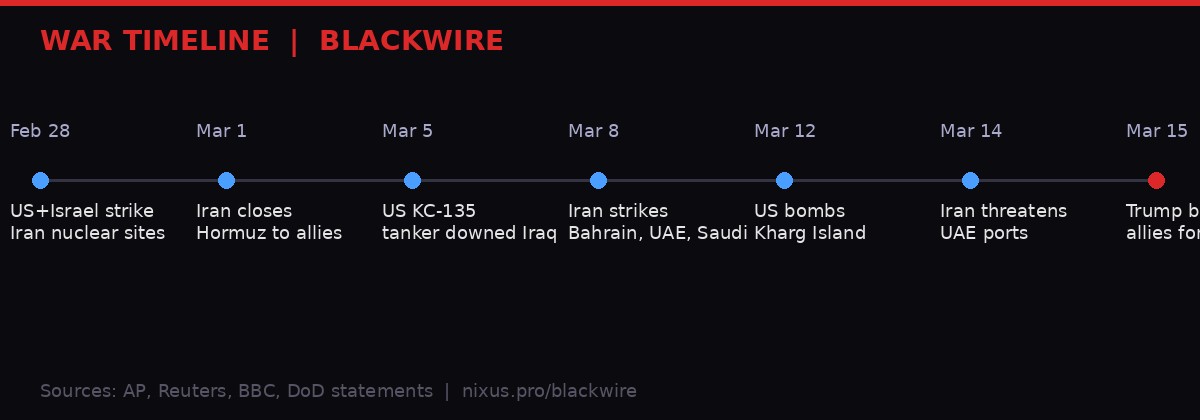
Key escalation points in the first 15 days of the US-Israel war on Iran. Sources: AP, Reuters, BBC, DoD statements.
The war's economic toll is compounding daily. Aluminium Bahrain - known as Alba, the world's largest aluminum smelter outside China - announced Sunday it was shutting down nearly one-fifth of its production capacity in a "controlled and safe" phased process. The reason: exports cannot move through the Strait of Hormuz.
Aluminum smelters are not like factories. They run at extreme temperatures and cannot simply be switched off without risking equipment damage or destruction of the molten metal vessels. The phased shutdown Alba announced will keep global aluminum supplies constrained even after the strait eventually reopens - because restart takes weeks. Car manufacturers, construction companies and electronics producers worldwide will feel the effect.
Global air travel has been rerouted around the Persian Gulf, adding hours to flights and millions in fuel costs per day for carriers. Major airlines including Emirates, Etihad and several Asian carriers have altered flight paths. Insurance premiums for shipping through the region have surged.
U.S. Energy Secretary Chris Wright told NBC's Meet the Press Sunday that Americans "are feeling it right now" and will continue to feel energy disruption "for a few more weeks." Asked directly whether gas prices would fall below $3 per gallon by summer, Wright said: "There's a very good chance that'll be true. There's no guarantees in war." That non-answer captured the administration's predicament precisely.
The political damage is accelerating. AP reporting published Sunday details how Trump, two weeks into the conflict, "has been knocked on his political heels." His poll numbers are declining. Some conservative media figures have begun raising questions about the war's rationale and endgame. Democrats, who had been on the defensive after the 2024 election, have found unexpected unity in opposition to Iran policy and are pointing to surging gas prices as proof that Republicans' promises on cost of living were empty.
"They're flying by the seat of their pants, and the rest of us are paying the price." - Kelly Dietrich, CEO, National Democratic Training Committee, AP interview, March 15, 2026
The Human Cost: Lebanon, Iran, and Beirut's Storm
The human toll of the war spread across three countries is staggering. In Iran, the International Committee of the Red Cross puts the death toll at more than 1,300 people. Iran's Health Ministry, via the judiciary's Mizan news agency, reports that 223 women and 202 children are among the dead.
In Lebanon, more than 800 people have been killed in Israeli strikes, according to the Lebanese Health Ministry. That figure includes 12 healthcare workers killed Friday in a strike on a medical center. The IDF said it was aware of the incident and it was "under review." Israeli forces also killed a Palestinian couple and two of their children, aged five and seven, in the occupied West Bank on Sunday - a killing confirmed by the Palestinian health ministry.
In a separate Lebanon incident, the BBC visited the aftermath of an Israeli strike in the northeastern town of Younine that killed eight members of a single family, including three children aged five, nine and 14. They had been gathering to break the Ramadan fast. The IDF said it had targeted "Hezbollah terrorist infrastructure." Neighbors and relatives on the scene said they had no knowledge of any Hezbollah presence.
Lebanon's displacement crisis has reached a scale that numbers struggle to convey. The Norwegian Refugee Council estimates more than 830,000 people have been displaced by Israeli strikes and evacuation orders - roughly one in every seven Lebanese residents. On Sunday, a violent storm struck Beirut's waterfront, where thousands of displaced people are sheltering in tents. AP journalists on the ground watched a tent blow away entirely in the high winds.
Fadi Younes, a displaced man from Beirut's southern suburbs who had already rebuilt his tent once after a storm two days earlier, was battling waterlogged mattresses he'd bought to replace the ones soaked in the previous deluge.
"I hope that today things in the country will be set right and everyone can return to their homes. A person only truly feels at ease in their own home." - Fadi Younes, displaced resident of Beirut, quoted by AP, March 15, 2026
At least 13 U.S. military personnel have been killed in the conflict. This past week's toll included six service members aboard a military refueling aircraft that crashed in Iraq while supporting operations against Iran. The Pentagon identified them Saturday. Among them was an Alabama father described by AP sources as having been recently deployed. Several others were from Ohio.
U.S. military deaths now number 13 confirmed - a figure that has triggered a political reckoning at home, particularly after images of Trump golfing the day after presiding over dignified transfer ceremonies for six killed soldiers circulated widely on social media.
Zelensky's Blackmail Accusation and the European Subtext
Overlapping the Gulf crisis, Ukrainian President Volodymyr Zelensky publicly accused EU allies of "blackmail" on Sunday in a dispute over Russian oil pipeline flows through Ukraine. The row reveals a secondary fracture in Western unity that the Iran war is exposing: some EU member states are pressing Ukraine to allow Russian oil transit to resume, which Zelensky says would effectively amount to lifting sanctions on Moscow.
"Restoring the flow of Russian oil via Ukraine into the EU would be like lifting sanctions on Russia." - Volodymyr Zelensky, statement, March 15, 2026 (BBC)
The accusation puts European capitals in an awkward position. Facing rising energy costs from the Gulf disruption, several EU states are feeling pressure from industrial lobbies and domestic consumers to find cheaper energy options wherever they exist. Russian pipeline gas and oil represent the most obvious short-term alternative. But accepting that alternative would hand Moscow a propaganda victory and potentially undermine Ukraine's war effort at a moment when Western attention has already partially shifted to the Middle East.
The Russia-Ukraine dynamic is itself entangled with the Iran war in another way. Moscow has been quietly benefiting from both the war's effect on oil prices and from Trump's decision to ease some Russian oil sanctions in the early days of the conflict - a concession that, combined with higher global oil prices, has given Putin a financial cushion at exactly the moment his war in Ukraine faces resource constraints.
Russia's 500-drone strike on Ukraine earlier this month - timed during what Moscow calculated was a window of reduced Western attention - was widely seen as an opportunistic exploitation of the Iran war's distraction effect. Western officials have confirmed that patriot missile deliveries to Ukraine have been slowed partly by Middle East operational demands.
Where This Goes: Options, Escalation, and the Exit Question
Three weeks in, the map of possible outcomes has narrowed. The outlines of the exit debate are becoming clearer even as the fighting escalates.
The administration's best-case scenario involves Iran accepting some form of negotiated halt - perhaps brokered through Oman or Qatar, which have historically served as backchannel conduits. Araghchi's Sunday statement that Iran is "ready to consider any proposal that includes a complete end to the war" is a signal of sorts, though Iran's public position still demands a full cessation of U.S. and Israeli strikes before it will halt its own attacks.
The worst-case scenario involves an escalation to strikes on Iranian oil infrastructure. That path risks triggering the regional conflagration that Gulf Arab states, the IMF, and most NATO allies have been begging the U.S. to avoid. Iran's counter-threat against UAE and Saudi oil infrastructure is credible. The 2019 Abqaiq attack demonstrated that Iran can reach those targets. The question is whether Tehran believes an all-out oil war serves its strategic interests, given that it relies on Kharg Island for the majority of its own export revenue.
The Trump administration's messaging has been conspicuously vague on war aims. "Regime change" has been floated by some officials; denuclearization has been mentioned; Iranian capitulation has been referenced. None of these have been articulated as a specific, achievable condition for a ceasefire. That vagueness is the political version of flying by the seat of one's pants - and the public is beginning to notice.
What to Watch in the Next 48 Hours
The war that Trump launched on February 28 with a declaration that it would be quick, decisive and transformative has entered its third week looking neither quick nor decisive. The global economy is absorbing shocks it did not anticipate. The Gulf Arab states that host U.S. forces are now in the crosshairs. Thirteen Americans are dead. The public is watching gas prices and asking questions the administration has not answered.
The strait is still only "closed" to U.S. and allied vessels, according to Iran - a framing that suggests a negotiated reopening is still theoretically possible. But the window for a clean off-ramp is narrowing with each new missile salvo, each new funeral, each new threat against civilian infrastructure that the war's architects did not put in their planning documents.
Primary sources: Associated Press live coverage March 15, 2026; BBC World coverage March 14-15, 2026; U.S. Department of Defense public statements; ICRC casualty reporting; Norwegian Refugee Council displacement figures; UK Energy Secretary Ed Miliband on Sky News; UN Ambassador Mike Waltz on CNN; Iran FM Araghchi interview with Al-Araby al-Jadeed; Aluminium Bahrain press statement.
Get BLACKWIRE reports first.
Breaking news, investigations, and analysis - straight to your phone.
Join @blackwirenews on Telegram