Sudan's Drone War Crosses the Border: 17 Dead in Chad, Retaliation Ordered
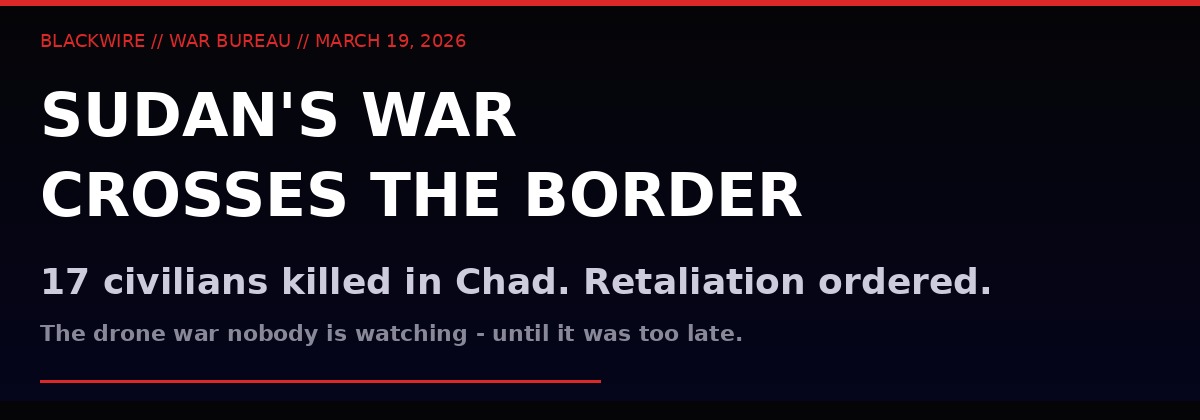
They came to mourn. A drone found them anyway. On Wednesday, March 19, 2026, a drone launched from Sudan killed at least 17 people gathered at a funeral ceremony in Tine - a Chadian border town separated from Sudan by nothing more than a dry riverbed. Children playing nearby were among the dead.
The attack - which both sides of Sudan's civil war deny carrying out - has pushed the world's most under-reported conflict into a new and dangerous phase. Chad's President Mahamat Idriss Deby convened an emergency security council meeting and issued a stark order: the military should "retaliate starting from tonight to any attack coming from Sudan."
The Sudan civil war has now been burning for 1,065 days. It has killed hundreds of thousands. It has displaced more than 12 million people - the largest displacement crisis on Earth. And until Wednesday, the international community had largely looked away.
A funeral in a desert border town may have changed that.
The Strike on Tine: What We Know
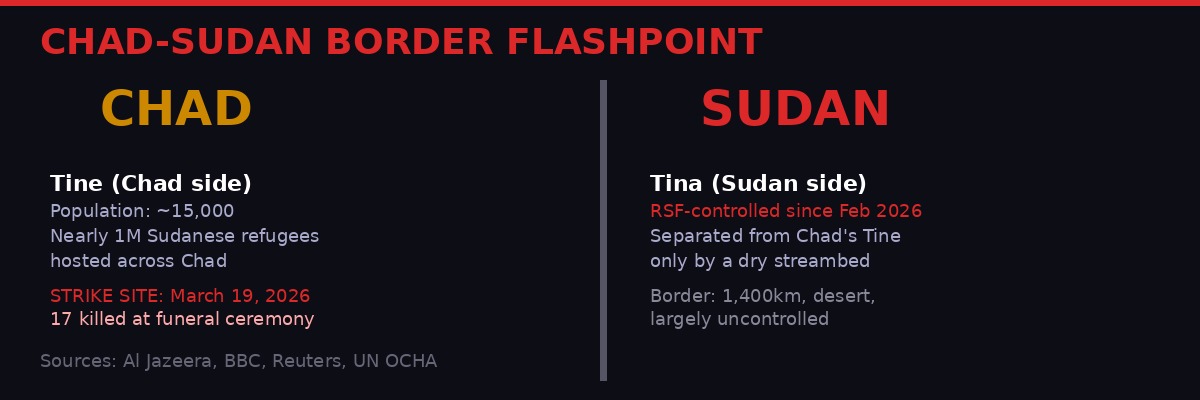
The drone hit during a funeral gathering on Wednesday evening. Local residents quoted by the Reuters news agency described two separate explosions. Mourners had assembled at a house in Tine for a Koranic reading ceremony - a standard element of Islamic funeral rites. Children playing nearby were also caught in the blasts.
The Chadian government spokesman confirmed a death toll of 17, describing the attack as "outrageous and a blatant aggression" against Chad's territorial integrity. Several more people were injured, though exact numbers were not immediately confirmed.
Local government sources told Reuters it was "not immediately clear" who was responsible. Both primary belligerents in the Sudan civil war - the Sudanese Armed Forces (SAF) and the Rapid Support Forces (RSF) paramilitary - denied involvement, each blaming the other.
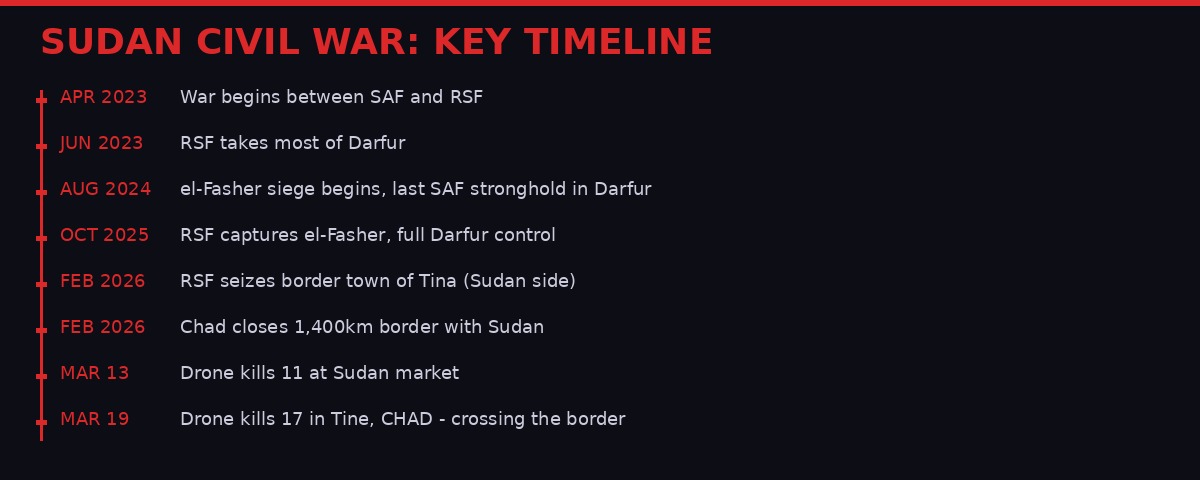
Chad's President Deby has ordered the military "on high alert" and announced a "total closure" of the 1,400km border with Sudan. Presidential statement confirms Chad is now prepared to conduct operations inside Sudanese territory "in strict compliance with international law."
The strike hit despite multiple prior warnings from Chad to the warring factions in Sudan, and despite the border closure that N'Djamena ordered last month after five Chadian soldiers were killed in cross-border clashes. The closure was supposed to prevent "any risk of the conflict spreading." It did not.
The town of Tine sits on the Chadian side of a border point that is, geographically speaking, almost inseparable from Tina - its Sudanese twin. The two towns are divided only by a dry streambed that is essentially a line on a map. In February 2026, the RSF seized control of Tina, placing its fighters within shouting distance of Chadian territory.
The Drone War Inside Sudan - Three Years of Aerial Slaughter
Drone warfare has been central to Sudan's conflict since its earliest days, but 2026 marked a sharp escalation in aerial attacks on civilian targets.
The Armed Conflict Location and Event Data Project (ACLED) recorded 198 drone strikes in Sudan in just the first two months of 2026. Of those, at least 52 caused civilian casualties. The total drone-related civilian death toll for that period alone: 478 people killed.
This is not collateral damage. The targets have included hospitals, markets, schools, refugee settlements, and - as of this week - a funeral gathering in a neighboring country.
Source: ACLED, Armed Conflict Location and Event Data Project, February 2026 report.
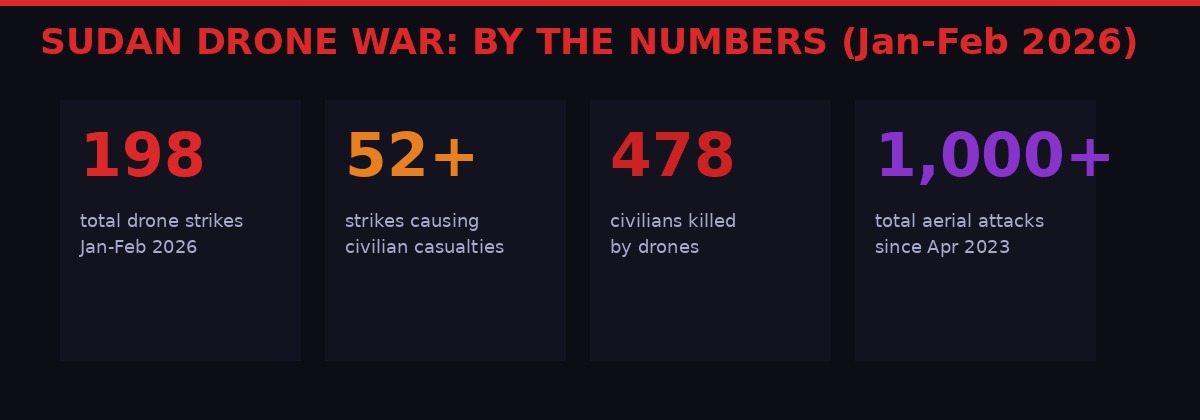
Since the war began in April 2023, ACLED has tracked more than 1,000 aerial attacks across Sudan. The trajectory is clear: the air war is getting more intense, more indiscriminate, and now, more geographically expansive.
Just six days before the Tine strike, on March 13, a drone attack on a market inside Sudan killed 11 people in a single strike. The attack followed a pattern seen across Darfur - drones hitting crowded public spaces with maximum civilian effect.
The Sudanese Armed Forces have received significant air power support. According to reporting by Al Jazeera, the SAF has been supplied with Iranian-made drones, as well as Turkish and Russian military support. The SAF also operates its own drone fleets built up over years of engagement with regional partners.
The RSF, which has no air force of its own, has relied on a different approach. Reports from the UN Panel of Experts and investigative outlets point to supply networks that have equipped the paramilitary with commercial and modified drones for surveillance and attack purposes.
The RSF's Supply Chain and the UAE Question
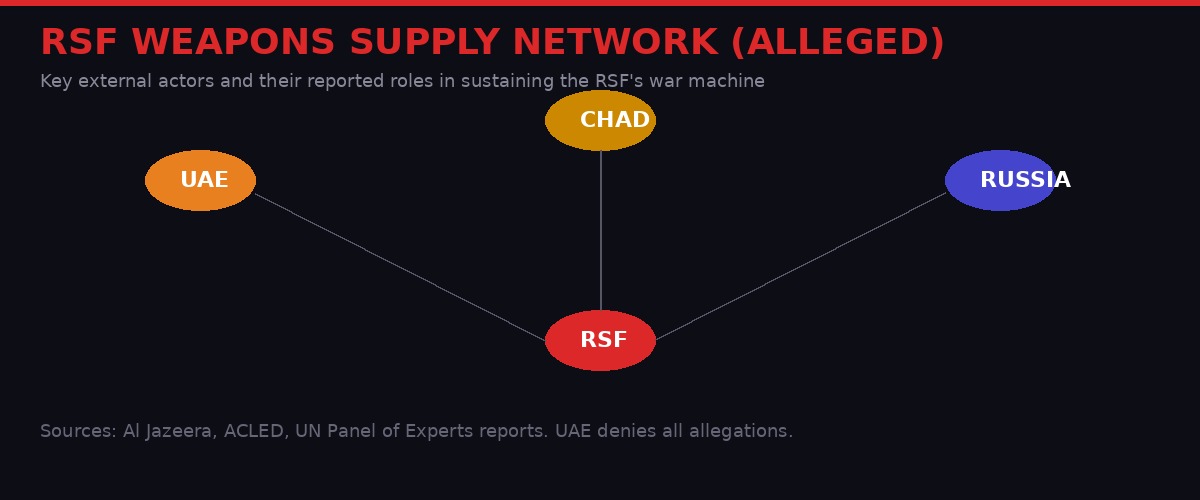
The Rapid Support Forces - an outgrowth of the Janjaweed militias that committed atrocities in Darfur during the early 2000s - have fought the Sudanese military to a bloody stalemate. Their ability to sustain that campaign requires external support, and the question of who provides it has become one of the war's most contested geopolitical issues.
Multiple reports from the UN, investigative journalists, and Western governments have pointed to the United Arab Emirates as a key backer of the RSF. The allegations include financial support, weapons transfers, and logistical facilitation through transit states including Chad. Abu Dhabi has categorically denied all such allegations.
Chad's role is equally contested. The Sudanese government has long accused N'Djamena of allowing weapons and fighters to reach the RSF through Chadian territory - accusations that Chad denies. The irony of Wednesday's drone strike is stark: if the RSF or its backers were using Chad as a transit corridor, they have now struck the very territory that hosts their supply lines.
Russia's support for the SAF adds another layer. The Sudanese Armed Forces' access to drone technology and training from Russian military personnel - documented in reporting by Bellingcat and others - has given the government air power that the RSF cannot match in scale. Yet both sides have now demonstrated the ability to cause mass civilian casualties from the air.
"The UN has accused the RSF of carrying out massacres with 'hallmarks of genocide' in Darfur. The last major city under SAF control in Darfur, el-Fasher, was seized by the RSF in October 2025." - Al Jazeera, reporting on RSF operations in western Sudan
The seizure of el-Fasher was a watershed moment. The city had been the last refuge for hundreds of thousands of displaced civilians in North Darfur. After its fall, the humanitarian situation in western Sudan deteriorated to levels that UN officials described as among the worst they had ever documented.
Displacement: The World's Largest Refugee Crisis Nobody Discusses
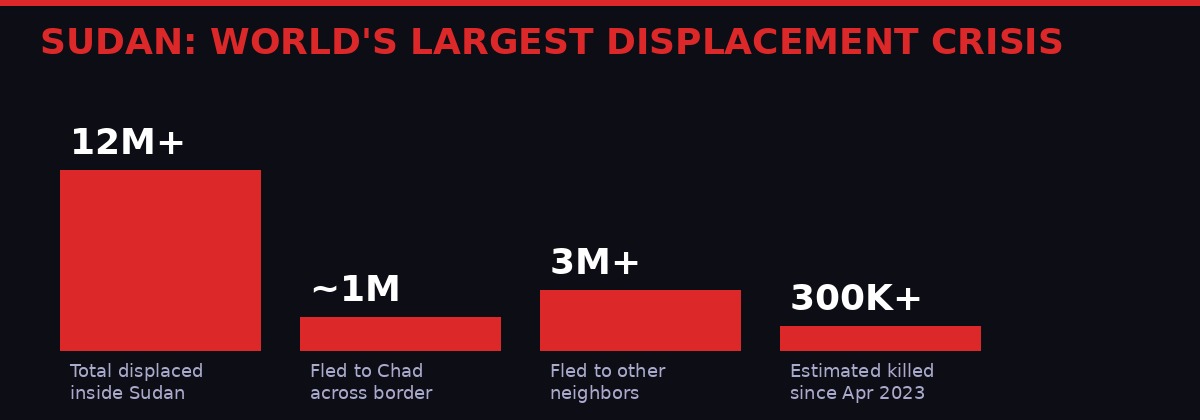
The numbers are staggering, and they have been staggering for long enough that the world has stopped noticing.
More than 12 million people have been displaced inside Sudan since April 2023 - that is roughly a quarter of the country's entire population forced from their homes. Nearly one million of them have fled across the border into Chad, joining a refugee population that Chad - one of the world's poorest countries - has been hosting for decades.
Chad already hosted significant Sudanese refugee populations from the Darfur conflict of the 2000s. The current war has overwhelmed whatever infrastructure existed. Towns in eastern Chad near the Sudanese border - including Tine - have swelled with people fleeing the RSF's advance through Darfur.
Sources: United Nations OCHA, UNHCR, Reuters, March 2026 figures.
The humanitarian agencies operating in the region operate under extreme constraint. Access to conflict zones inside Sudan is severely restricted. Funding has been chronically insufficient. Aid workers themselves have been targeted.
The estimated death toll from three years of war in Sudan exceeds 300,000, according to various estimates. Some analysts believe the true figure is significantly higher due to documentation gaps in conflict-affected areas where NGO access is limited or non-existent. The UN and international human rights organizations have documented mass atrocities - summary executions, sexual violence used as a weapon of war, and deliberate starvation of civilian populations.
"The death toll estimates range widely. What is not in dispute is that the scale of suffering in Sudan represents one of the worst humanitarian catastrophes since World War II - and it has received a fraction of the international attention given to other conflicts." - Analysis based on UN OCHA, ACLED, and Amnesty International reporting
Chad's Military Threat: A Third Country on the Brink
President Mahamat Idriss Deby - himself a military commander who came to power in 2021 following the death of his father, former President Idriss Deby, in battle against rebels - did not issue a diplomatic statement on Wednesday night. He convened the security council in military uniform and issued a military order.
The distinction matters. Chadian officials did not call for UN Security Council sessions or demand investigations. They placed their armed forces on high alert and said retaliation would begin "starting from tonight." Early Thursday morning, the government confirmed that Chad had "strengthened the posture of its defence and security forces" and was prepared to carry out operations inside Sudanese territory.
This raises immediate questions about what a Chad-Sudan confrontation would look like - and what it would mean for an already catastrophic conflict.
Chad's military - the Armee Nationale du Tchad - is a battle-hardened force with experience fighting insurgencies across the Sahel. N'Djamena has historically been one of the more capable military powers in Central Africa. But any direct engagement with forces inside Sudan - whether SAF or RSF - would fundamentally change the conflict's character.
If Chad strikes RSF positions in Sudan's Darfur region in retaliation, it risks deepening its entanglement in a war that has already cost it dearly. If it strikes SAF positions or assets believed responsible for the drone, it risks a direct confrontation with Sudan's national military - a state-versus-state conflict on a continent already straining under multiple active wars.
The border between Chad and Sudan is 1,400 kilometers long, runs through remote desert terrain, and is effectively uncontrolled. Chad closed it last month. The drone crossed it anyway.
Who Launched the Drone - and Does It Matter?
Both the RSF and the Sudanese Armed Forces have denied responsibility for the Tine strike. Local sources were unable to determine the origin in the immediate aftermath.
The denial itself is a feature of this war. Both sides have routinely denied attacks on civilian targets that credible evidence subsequently attributed to them. The UN has documented SAF airstrikes on civilian areas including hospitals and markets. It has documented RSF massacres and deliberate targeting of non-combatants in Darfur.
From a purely tactical standpoint, the RSF had stronger opportunity if not stronger motive. RSF fighters have controlled the Sudanese side of the Tine-Tina border crossing since February 2026. They are physically closest to where the strike landed. They also have motive: if the Sudanese government's accusation that Chad facilitates RSF supply routes is accurate, RSF leadership might actually prefer N'Djamena not to close that corridor - making an RSF strike on Chad somewhat counterintuitive. But irregular armed forces do not always act according to rational self-interest.
The SAF, for its part, has conducted drone operations across Darfur that have routinely crossed the lines between military and civilian targeting. A strike aimed at an RSF position or a suspected weapons route that drifted across the border - or was fired with insufficient precision - is not implausible given the documented history of SAF aerial operations.
The third possibility: the strike was deliberate cross-border targeting, intended to pressure Chad or send a message about the costs of its policies.
The investigation, if one happens, will take weeks. Chad's military response, based on Deby's statements, will come sooner.
The Broader Context: Africa's Invisible War in a World of Multiple Crises
Sudan has received perhaps one-tenth of the international media coverage of other active conflicts - despite being responsible for the world's largest displacement crisis and among its highest death tolls.
Part of this is geography. Part of it is the absence of the kind of proxy great-power dynamics that drive Western media coverage. The US, UK, and EU have issued statements and imposed sanctions. They have not committed the kind of political capital or resources that would create sustained attention.
The global news cycle in March 2026 is dominated by the Iran war - the US-Israeli bombing campaign that has now entered its 20th day, struck Gulf energy infrastructure, and triggered Iran's attacks on Qatari LNG facilities. Sudan competes for attention against that conflict, the war in Lebanon, the Ukraine ceasefire negotiations, and a dozen other flashpoints.
It loses that competition every day.
But the dynamics of neglected conflicts are well-documented: they fester, they spread, they draw in neighboring states, and they produce refugee crises that eventually arrive at the borders of countries that could have intervened earlier at far lower cost. Chad is already there. If Chad's military enters Sudan, other states may be next.
"Sudan's devastating war rages on as regional rivalries deepen." - Al Jazeera opinion, March 11, 2026
The countries surrounding Sudan are all under strain. Egypt has closed its borders to most Sudanese refugees. Libya, to the northwest, is itself a failed state hosting competing militias. The Central African Republic - to the southwest - is a war zone. Ethiopia, to the east, has its own unresolved internal conflicts. South Sudan, to the south, signed a peace deal that has not held.
There is no stable neighborhood for this war to remain contained within. Wednesday's drone strike on Chad was a demonstration of that reality - one that 17 people at a funeral paid for with their lives.
What Happens Next: Three Scenarios
The next 72 hours will be critical in determining whether this incident remains a horrifying data point in Sudan's war or becomes the trigger for regional escalation.
Scenario 1 - Contained retaliation: Chad conducts limited strikes on border positions believed linked to the drone, demonstrates military resolve domestically, and then returns to its policy of attempting to seal the border. Diplomatically, this is the most manageable outcome. Practically, it may prove difficult to execute in a way that satisfies Chadian public opinion without risking direct confrontation.
Scenario 2 - Sustained military engagement: Chad commits forces to sustained operations inside Sudanese territory, targeting RSF positions in Darfur. This would represent a fundamental change in the conflict - a third national military entering a war that has already killed hundreds of thousands. The humanitarian consequences for displaced civilians in eastern Darfur would be severe.
Scenario 3 - International intervention push: Chad uses the strike to internationalize the crisis - escalating at the UN Security Council, demanding sanctions, and building a coalition of African states pushing for intervention. The African Union has been slow on Sudan throughout the conflict. The Arab League's attention is currently consumed by the Iran war. The prospects for meaningful international response in the near term are limited.
What is certain is that Wednesday's drone strike has changed the terms of the conversation. For three years, Sudan's civil war has been treated as an internal conflict - horrific, but internally bounded. The strike on Tine, Chad is a line crossed. When drones from one country's civil war start killing mourners in another country, the word "internal" stops applying.
Get BLACKWIRE reports first.
Breaking news, investigations, and analysis - straight to your phone.
Join @blackwirenews on TelegramSources: Al Jazeera (reporting from N'Djamena and Khartoum); BBC News (Africa desk); Reuters (local sources in Tine); ACLED (Armed Conflict Location and Event Data Project); United Nations OCHA; UN Panel of Experts on Sudan; Chadian Presidency official statement; Chadian government spokesman statement; QatarEnergy (contextual reference). All quotes cited to original publications.