The 2018 agreement that stopped a war killing 400,000 people is fracturing along the same ethnic fault lines. Government airstrikes hit civilians. SPLA-IO forces advance on state capitals. 280,000 people have fled. The UN has issued a civil war warning nobody is listening to.
BLACKWIRE Field Intelligence | Africa Bureau
MARCH 17, 2026 | JUBA / JONGLEI STATE, SOUTH SUDAN
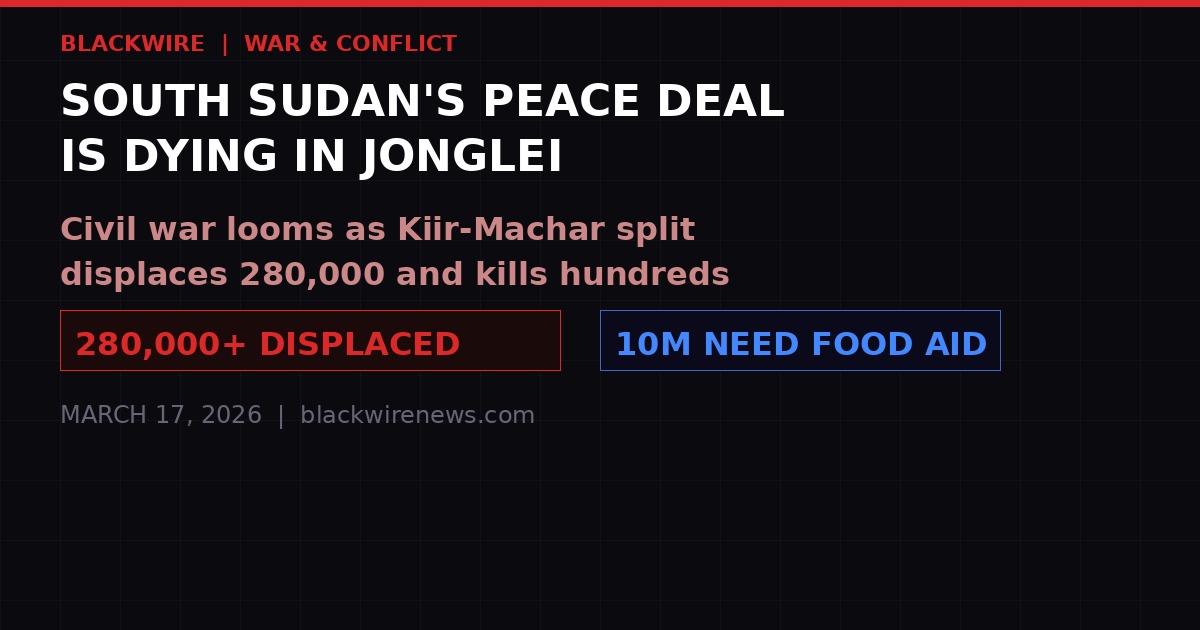
The 2018 Revitalized Peace Agreement is disintegrating in Jonglei state as both government forces and SPLA-IO fighters target civilians. [BLACKWIRE Graphic]
Nyawan Koang walked for two days carrying her five children. Behind her, the thatched roof where her parents had lived was burning. An air strike had found them in Ayod county, in Jonglei state. "Fire came from the sky and burned them," she told the BBC when she reached the dust-choked displacement camp at Duk.
She is one of more than 280,000 people who have fled Jonglei and neighboring states since fighting between government forces and opposition militia intensified at the start of 2026. [BBC, March 17, 2026] That number is rising daily.
South Sudan, the world's youngest nation, is doing what it has done repeatedly since independence in 2011: tearing itself apart along ethnic and political lines, with civilians absorbing the cost. What makes this moment different is that the mechanism meant to prevent exactly this - the 2018 Revitalized Agreement on the Resolution of the Conflict in South Sudan - is now the carcass around which the new fighting circles.
280,000+
Displaced by 2026 fighting
189
Civilian deaths in January alone (UN)
10M
South Sudanese needing food aid
The Fault Line: Kiir and Machar Again
Everything in South Sudan's politics runs through the relationship between President Salva Kiir and Riek Machar, his former deputy and perennial rival. Kiir is from the Dinka ethnic group, the country's largest. Machar leads the Nuer, the second-largest. When the two fell out in December 2013, it triggered a civil war that burned for five years and killed an estimated 400,000 people.
The 2018 Revitalized Agreement brought Machar back into a power-sharing government as First Vice-President. It never fully worked. Implementation stalled. The transitional security arrangements were never completed. The unified national army that was supposed to integrate government and opposition fighters remained a bureaucratic fiction. Both sides kept their armed units separate and loyal. [The Guardian, October 2025]
The breaking point came in mid-2025. The White Army - a Nuer civilian militia aligned with Machar's SPLA-IO - seized control of a government military base. Kiir used this as justification to move against Machar directly. He fired Machar as First Vice-President. He fired Machar's wife, Interior Minister Angelina Teny, along with other senior officials aligned with the opposition. And he had Machar placed under house arrest in Juba, where he has now been held for a year awaiting trial on charges of murder, treason, and crimes against humanity.
Machar denies all charges. His supporters argue the prosecution is politically motivated - a deliberate effort to eliminate a rival under the cover of legal process, destroying the power-sharing framework that was supposed to guarantee stability. [BBC Africa, March 2026]
"Civilians are bearing the brunt of a spike in indiscriminate attacks including aerial bombardments, deliberate killings, abductions and conflict-related sexual violence."
- Volker Turk, UN High Commissioner for Human Rights, 2026
What Is Happening in Jonglei Right Now
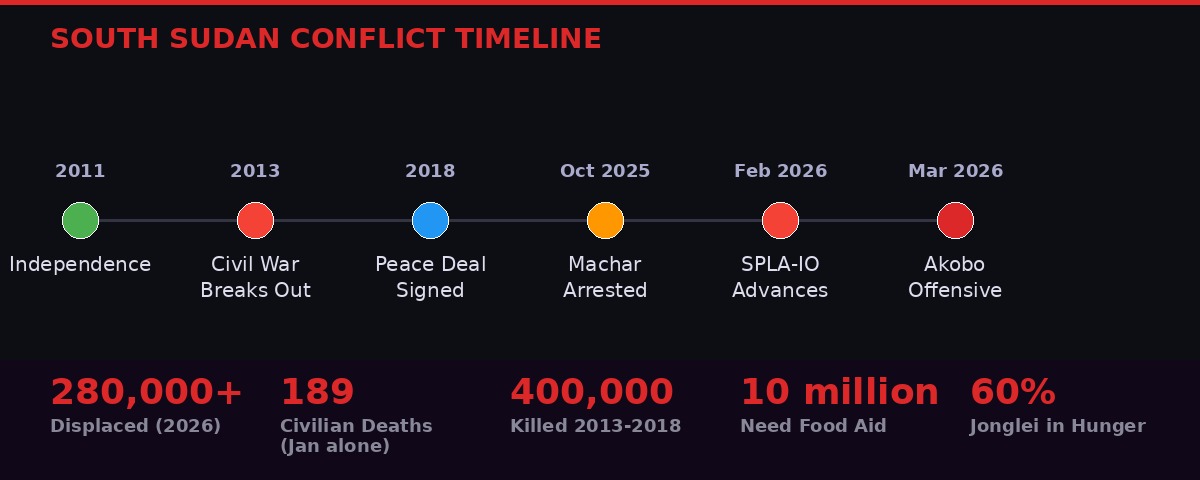
Conflict timeline from independence to the current 2026 escalation. [BLACKWIRE Infographic]
Jonglei state has historically been the sharpest edge of the Kiir-Machar conflict. It sits in the eastern part of the country, a vast, flat, flood-prone territory larger than many European nations but with almost no paved roads. The Nuer people make up a significant portion of its roughly two million residents. SPLA-IO has its strongest footholds here.
Since January 2026, SPLA-IO forces - supported by the White Army - have been advancing through Jonglei, seizing towns and villages, threatening Bor, the state capital. They have moved through Ayod county, through Uror county, pushing toward the strategic Akobo river town near the Ethiopian border.
The government response has been heavy. Military forces have been deployed in large numbers. Air strikes have hit positions in SPLA-IO-held territory. Earlier in March, the South Sudan People's Defense Forces (SSPDF) announced a "second-phase" offensive targeting Akobo county - one of the strongest SPLA-IO strongholds in the state. With that announcement came an order: aid agencies and some 50,000 civilians were told to leave the area immediately before the military operation began. [BBC, March 2026]
When government forces retook Ayod at the end of February, they found - or created - a massacre. By the army's own admission, soldiers from two platoons executed more than 20 civilians at close range. The victims included women and elderly residents. Army spokesman Major General Lul Ruai Koang told the BBC that the soldiers involved and their commanders were detained and face court martial. The admission of direct civilian killing by government forces is rare and significant. [BBC Africa, March 2026]
SPLA-IO and the White Army are not innocent in this. Both sides have torched villages and killed civilians as they advance or retreat. Eyewitness accounts collected by humanitarian workers describe burning homesteads, separated families, and killings that show no pattern suggesting they were even aimed at combatants. Neyasebit, 27, who fled Uror county for the displacement camp at Duk, lost two uncles, a brother-in-law, and a younger brother to air strikes. "They were just staying at home," she told BBC reporters. "Both sides" were responsible for the violence around her. [BBC Africa, March 2026]
The Anatomy of a Collapsing Peace Deal
To understand why the 2018 agreement is failing, it helps to understand what it actually required. The Revitalized Agreement was built on a fragile architecture: a transitional government of national unity in which Kiir and Machar shared power, a process to unify their separate armies into a single national force, cantonment of fighters in designated areas, elections to eventually replace transitional arrangements, and accountability mechanisms for war crimes.
None of these things happened at the pace or scale required. The unified army was never formed. Fighters were never genuinely cantoned - both sides kept armed units under effective command. Elections were delayed repeatedly, first to 2021, then to 2023, then indefinitely. Accountability mechanisms produced almost no consequences for commanders on either side responsible for atrocities during the first civil war.
The international community, distracted by other crises, allowed the slow erosion to continue. The Intergovernmental Authority on Development (IGAD), the regional body nominally overseeing implementation, issued statements but applied little genuine pressure. The UN Mission in South Sudan (UNMISS) documented violations but had no enforcement capacity. Western donors funded humanitarian operations while largely looking away from the political disintegration.
By the time Kiir moved against Machar in mid-2025, the peace framework was already hollow. Removing Machar from government did not break a functioning power-sharing arrangement - it was the final collapse of one that had been failing for years. [Guardian South Sudan, 2025]
400,000
People killed in South Sudan's 2013-2018 civil war. The country is now approaching the same conditions that triggered that conflict.
The Humanitarian Collapse
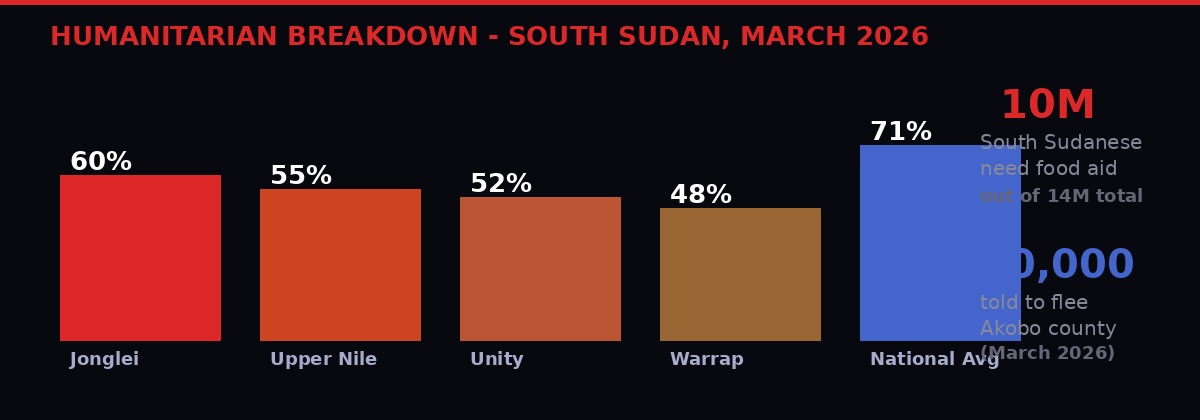
Food insecurity by region and key displacement statistics, South Sudan March 2026. [BLACKWIRE Infographic / WFP data]
South Sudan's humanitarian situation was already catastrophic before 2026. Now it is deteriorating toward something worse.
According to the World Food Programme, 10 million out of the country's approximately 14 million people require food assistance. In Jonglei state specifically, 60 percent of the roughly two million residents face food insecurity. That number was generated before the current fighting pushed 280,000 additional people out of their homes, disrupting planting seasons and collapsing what little informal food distribution existed in contested areas. [WFP, via BBC, March 2026]
Adham Affandy, WFP's acting country director for South Sudan, described the operating environment to BBC reporters in terms that suggest the aid system itself is close to breakdown. "South Sudan is one of the world's most complex environments to provide humanitarian assistance," he said. The country has approximately 400 kilometers of paved roads out of an estimated 20,000 kilometer road network - a statistic from a 2022 study that captures how inaccessible most of the country remains. During the rainy season, which lasts up to eight months per year, around 80 percent of South Sudan becomes unreachable by ground transport. That means aid delivery depends almost entirely on aircraft. Aircraft are expensive. Aircraft are also targets. [WFP / BBC, March 2026]
The humanitarian crisis is compounded by a regional one. South Sudan has absorbed more than one million refugees from Sudan since the RSF-SAF war erupted in Khartoum in April 2023. Those refugees arrived into a country already unable to feed its own population. They compete for the same depleted resources. The Sudanese war shows no signs of ending. The displacement pipeline continues. [UNHCR, 2025-2026]
Aid agencies that withdrew from Akobo and other conflict areas when fighting erupted in January are now trying to navigate military operations, active front lines, and the government's explicit instruction to civilians to evacuate areas targeted for offensive military action. That instruction itself constitutes a de facto acknowledgment that civilians in those areas will be in the line of fire. The International Committee of the Red Cross (ICRC) and several UN agencies have been forced to suspend operations repeatedly as fighting made access impossible.
"South Sudanese people are exhausted. They want peace."
- Adham Affandy, WFP Acting Country Director for South Sudan, March 2026
The Ethnic Logic of the Conflict
South Sudan's wars are political in origin and ethnic in execution. Understanding why requires looking at how the country was constructed.
When South Sudan split from Sudan in 2011, it did so as a country built almost entirely around the shared cause of liberation from Khartoum. That unifying purpose evaporated on independence day. What remained was a country with over 60 ethnic groups, no functional institutions, a government dominated by Dinka elites close to Kiir, an economy almost entirely dependent on oil revenue, and a political culture where authority derived from military power rather than democratic legitimacy.
The 2013 civil war began as an elite power struggle between Kiir and Machar but became an ethnic slaughter within days. Dinka soldiers affiliated with government forces massacred Nuer civilians in Juba. Nuer forces retaliated with killings of their own. By the time the violence spread across the country, it had acquired the logic of ethnic warfare: people were being killed because of what group they belonged to, not what political position they held. That dynamic has never fully gone away.
The current fighting follows the same pattern. Government forces advancing through Jonglei are predominantly Dinka. The SPLA-IO and White Army fighters they are fighting are predominantly Nuer. Civilians caught in the middle are identifiable by ethnicity to both sides. The UN's documentation of 189 civilian deaths in January 2026 alone reflects killings that were not incidental to military operations but, in many cases, appear to have been the purpose. [UN Human Rights Monitoring Mission, 2026]
Hoth Wan Kornyom, a community leader who fled Uror county for the Duk displacement site, described to BBC reporters how his brother was killed in gunfire, his house burned, and parents separated from children in the chaos of flight. He had organized the community's movement to the displacement camp. "We suffered a lot," he said. He did not identify the perpetrators beyond noting that the violence came from multiple directions. In South Sudan's current war, such ambiguity is itself a statement about how widespread the killing has become.
Who Is Watching - and What They Are Doing
The international response to South Sudan's deterioration has been a masterclass in institutional inadequacy.
IGAD held an emergency summit on South Sudan in early 2026, issuing a communique calling for restraint and renewed commitment to the peace agreement. The communique had no enforcement mechanism. The member states - Ethiopia, Kenya, Uganda, Djibouti, Eritrea, Somalia - are themselves variously distracted by their own political crises, economic pressures, or direct interest in South Sudan's stability for reasons that do not always align with civilian protection. Uganda has historically provided support to Kiir's government and has deployed forces in South Sudan in the past.
UNMISS, the UN peacekeeping mission with over 18,000 uniformed personnel deployed to South Sudan, operates under a mandate to protect civilians and support implementation of the peace agreement. Its record on both counts is mixed at best. The mission has been unable to prevent civilian massacres in areas where it does not have a physical presence, and its presence in contested areas in Jonglei is limited by the same access constraints that hamper aid agencies. The mission has issued documentation of violations but lacks either the mandate or the political backing from the Security Council to compel compliance from either side.
The United States, which has been the largest bilateral donor to South Sudan and played a key role in brokering the 2018 agreement, has been largely absent from active diplomatic engagement with Juba in 2026. The Trump administration's foreign policy priorities have been elsewhere - the Iran conflict, Ukraine, domestic political battles. State Department engagement with South Sudan has been sporadic and below the level of seniority required to move Kiir on Machar's status or force credible implementation of peace commitments. [Foreign Policy analysis, Q1 2026]
The African Union's Peace and Security Council has held consultations but has not escalated to the level of sanctions or formal condemnation of either party. The EU has continued humanitarian funding while issuing statements expressing concern. None of this changes the facts on the ground in Jonglei.
SITUATION ASSESSMENT
The conditions that triggered South Sudan's 2013-2018 civil war - elite political rupture along Kiir-Machar lines, ethnic mobilization, civilian targeting, aid access collapse, failed international mediation - are all present in March 2026. The question is not whether the peace deal is failing. It has failed. The question is whether the country descends into the full-scale war that killed 400,000 people, or finds some new arrangement before that happens.
Timeline: From Peace to the Brink
Jul 2011
Independence
South Sudan becomes the world's youngest nation after a referendum in which 99% of southern Sudanese voted to split from Khartoum. Kiir becomes president. Machar is vice-president. International community celebrates. The country has almost no institutions, no paved roads, no functioning civil service, and an economy entirely dependent on oil.
Dec 2013
Civil War Begins
A fight between presidential guards in Juba - Dinka forces loyal to Kiir versus Nuer forces loyal to Machar - erupts into a full-scale political and ethnic conflict within days. Nuer civilians are massacred in Juba. The war spreads to Jonglei, Upper Nile, and Unity states. Hundreds of thousands are killed over the following five years.
Sep 2018
Revitalized Peace Agreement
After multiple failed ceasefires, the Revitalized Agreement on the Resolution of the Conflict in South Sudan (R-ARCSS) is signed in Addis Ababa. Machar is to return as First Vice-President. A transitional government would govern until elections. Army integration, cantonment, and accountability mechanisms are mandated. None are ever fully implemented.
Feb 2020
Transitional Government Formed (Late)
The transitional unity government is finally formed after multiple missed deadlines. Machar returns to Juba as First Vice-President. The implementation of security arrangements - the critical mechanism for preventing renewed war - stalls almost immediately.
2023-2024
Peace Erodes
Elections are postponed indefinitely. The unified national army remains unformed. Inter-communal violence increases in Jonglei and the Equatorias. Sudan's civil war sends over a million refugees south across the border. Aid funding runs short. International attention shifts elsewhere. The transitional period extends with no political horizon.
Mid 2025
White Army Seizure and Machar's Arrest
The White Army seizes a government military base in Jonglei. Kiir fires Machar and his allies from the government, suspending the power-sharing framework. Machar is placed under house arrest in Juba, charged with murder, treason, and crimes against humanity. He denies all charges.
Jan 2026
SPLA-IO Advances Through Jonglei
SPLA-IO forces supported by the White Army begin advancing through Jonglei state, seizing towns and threatening Bor. The UN documents 189 civilian deaths in January alone. Aid agencies begin withdrawing from conflict areas. 280,000 people flee. The UN warns of possible return to full-blown civil war.
Feb 2026
Ayod Massacre
Government forces retake Ayod county. The army later admits that soldiers from two platoons executed more than 20 civilians - including women and elderly - at close range. Commanders and soldiers are detained pending court martial. Air strikes continue across Jonglei, hitting civilian areas.
Mar 2026
Second-Phase Offensive, Akobo
The SSPDF announces a "second-phase" military offensive targeting Akobo county - the SPLA-IO's strongest Jonglei stronghold. Aid agencies and 50,000 civilians are instructed to evacuate. Families like Nyawan Koang's walk for days to reach displacement camps. International response remains inadequate.
What Comes Next
The scenarios are not good. They range from bad to catastrophic.
The best-case scenario is a negotiated de-escalation - either IGAD or the African Union managing to broker a ceasefire in Jonglei, some form of political accommodation that keeps SPLA-IO fighters from pressing toward Bor, and some mechanism that addresses the status of Machar without either releasing him unconditionally or proceeding to a trial that will almost certainly be seen as politically driven. This scenario requires Kiir to make concessions he has shown no inclination to make and requires international mediators to apply pressure they have not applied in the past.
The middle scenario is a protracted low-intensity war - SPLA-IO holding Akobo and other Nuer-majority areas, government forces controlling Bor and Juba, with a front line running roughly through Jonglei and periodic offensives on both sides that periodically escalate. This scenario involves ongoing civilian casualties, continued displacement, aid access restrictions, and a humanitarian system stretched beyond its capacity. It is, in some ways, a continuation of what South Sudan has experienced since 2020 - just more intense and more visible.
The worst case is a return to the 2013-2018 model: full-scale ethnic civil war, mass atrocities, complete collapse of humanitarian access, potentially millions displaced internally and across borders. The neighboring countries are already under strain from Sudan's war. Ethiopia is managing its own post-Tigray fragilities. Uganda's ability to intervene in support of Kiir's government, as it did in 2013, is constrained by domestic political pressures. A collapse of South Sudan into full-scale war in 2026 would generate a regional humanitarian catastrophe with no equivalent international response capacity.
The UN's Volker Turk has already used language that suggests the high-end scenario is being taken seriously in Geneva. His reference to "aerial bombardments, deliberate killings, abductions and conflict-related sexual violence" against civilians is the language of a conflict that has already crossed into atrocity territory. The Security Council has not matched that language with action. [UN Human Rights, 2026]
The woman who walked two days through burning Jonglei with her five children is now in a displacement camp. Her parents are ash. She has no way to know what the political actors in Juba will decide, or whether the international community will finally apply enough pressure to change those decisions. She told the BBC what she saw. "Fire came from the sky and burned them." That is the state of South Sudan's peace in March 2026.
Get BLACKWIRE reports first.
Breaking news, investigations, and analysis - straight to your phone.