Pentagon Demands $200 Billion More. US Debt Crosses $39 Trillion. Every Major Ally Has Said No.
Three weeks into the Iran war, the financial reckoning has arrived: a war bill that Congress never voted to authorize, oil at $118 a barrel, central banks frozen between inflation and collapse, and an alliance network that is refusing to follow Washington anywhere near the Strait of Hormuz.

US carrier strike groups are now operating in a Gulf being contested on multiple fronts. (Pexels)
The Iran war entered its twentieth day on Thursday, and the price tag is now impossible to ignore. The Pentagon has formally asked the White House for $200 billion in supplemental war funding - a sum that would represent a 25% increase on top of the military's already-approved $800 billion annual budget. The US national debt simultaneously crossed $39 trillion for the first time in history. Oil hit $118 a barrel in London. Every major US ally has refused Trump's demands to send warships to the Strait of Hormuz. And the central banks of Europe, the United Kingdom, and the United States are all frozen, unable to cut rates because inflation is rising, unable to hike rates because economic pain is already spreading. (AP News, March 19, 2026)
This is not the story of a war going well. This is the story of a war whose costs are multiplying faster than its objectives are being achieved.
The $200 Billion Bill Nobody Voted For

The Pentagon is now the center of America's most expensive active military campaign in a generation. (Pexels)
The Pentagon sent a request to the White House this week for $200 billion in additional funds to continue military operations against Iran. The figure, first reported by the Washington Post and confirmed by a senior administration official speaking to AP on condition of anonymity, is staggering in its scale. It would need to go to Congress for approval - and Congress has not yet authorized the war itself.
Defense Secretary Pete Hegseth was asked directly about the number at a press briefing Thursday. He did not confirm the specific amount, saying only that it "could change." His justification for the ask was blunt to the point of being memorable: "It takes money to kill bad guys," he said.
"We're going back to Congress and our folks there to ensure that we're properly funded."
- Defense Secretary Pete Hegseth, March 19, 2026 (AP News)
The request is already generating serious resistance. Congress is controlled by Trump's Republican Party, but fiscal hawks within the caucus are deeply uncomfortable with a number this large. Democrats, who are largely opposed to the war, will almost certainly reject the ask in its current form. And the political math is complicated by the fact that Congress never formally voted to authorize this war in the first place - the Trump administration launched strikes on Iran on February 28 without seeking a congressional authorization for the use of military force.
For context: $200 billion is larger than the annual defense budgets of every US ally except the UK. It is more than twice what the US spent in its peak year of military operations in Afghanistan. White House economic adviser Kevin Hassett said on Sunday that the war had already cost more than $12 billion in its first three weeks - meaning the actual pace of spending is roughly $570 million per day. (AP News, March 19, 2026)
The request also piles on top of the $150 billion Congress already gave the Pentagon last year through the so-called "big beautiful bill" - Trump's tax cuts legislation that also included a substantial defense appropriation. The accumulated burden is now showing up in the national debt figures in real time.
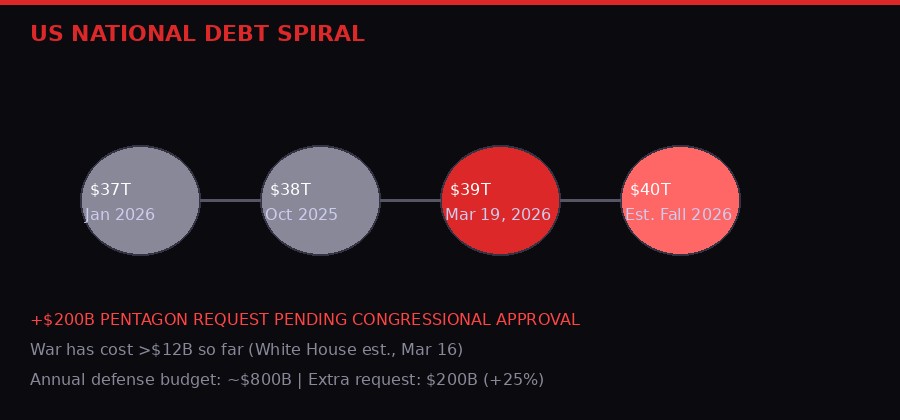
The US debt trajectory: from $37T in January to $39T today, with $40T projected before fall elections. (BLACKWIRE infographic)
$39 Trillion and Counting

Congress faces a war funding fight it never authorized. (Pexels)
The US national debt crossed $39 trillion on Wednesday, according to the Treasury Department's Fiscal Data website. The pace of accumulation is extraordinary even by the extraordinary standards of recent US fiscal history. The debt crossed $37 trillion in January 2026. It crossed $38 trillion five months before that. Now, just weeks into an unbudgeted military campaign, it has added another trillion. (AP News, March 19, 2026)
Michael Peterson, chair and CEO of the Peter G. Peterson Foundation - a nonprofit dedicated to long-term fiscal accountability - was direct about what the trajectory means:
"At the current growth rate, we will hit a staggering $40 trillion in national debt before this fall's elections. Borrowing trillion after trillion at this rapid pace with no plan in place is the definition of unsustainable."
- Michael Peterson, Peter G. Peterson Foundation
The White House, predictably, pushed back on that framing. Spokesman Kush Desai pointed to a decline in the federal deficit during Trump's first year back in office - down $41 billion from the prior year to $1.78 trillion - and attributed the improvement to higher individual tax revenue and reduced federal employment. The counterpoint, which Peterson and other economists are quick to make: a shrinking deficit still adds to the overall debt. And a $200 billion war supplement would add to both.
The longer-term effects of carrying $39 trillion in debt are well documented. The Government Accountability Office highlights higher borrowing costs for mortgages and car loans, lower wages resulting from reduced business investment, and the fiscal squeeze that forces tradeoffs between defense spending and domestic priorities like healthcare, infrastructure, and Social Security. None of those dynamics go away when the Iran war eventually ends.
What makes the current moment particularly complex is that rising debt is intersecting with rising energy prices. Every dollar-per-barrel increase in oil raises the import bill for the United States by hundreds of millions annually. With Brent crude up 64% since the war began, the macroeconomic drag is compounding rapidly. (AP News; Treasury Fiscal Data)
Oil at $118 - How the Gulf Became a Firing Range

Refineries across the Gulf are now active targets. The Ras Laffan facility suffered "extensive" damage. (Pexels)
The immediate trigger for Thursday's market spike was Iran's decision to escalate its attacks on Gulf Arab energy infrastructure - in direct retaliation for Israel's strike on South Pars, the Iranian portion of the world's largest natural gas field. South Pars supplies roughly 80% of Iran's domestic electricity, according to the International Energy Agency. Hitting it was a deliberate economic pressure play by Israel, designed to make life difficult for ordinary Iranians. Tehran's response has been to make life difficult for the entire global economy. (AP News, March 19, 2026)
The scale of Thursday's attacks was significant. Here is what was hit, country by country:
Qatar: The Ras Laffan LNG terminal - the largest liquefied natural gas export facility in the world - was struck by Iranian missiles. Firefighters extinguished a blaze at the site. QatarEnergy described the damage as "extensive." Production had already been halted at the facility following earlier strikes. The damage means Qatar's ability to supply global gas markets will be impaired even after the conflict ends.
Saudi Arabia: The SAMREF refinery in the Red Sea port city of Yanbu was hit. This is particularly painful because Saudi Arabia had specifically been rerouting oil westward through the Red Sea to bypass the Strait of Hormuz. Iran targeted that alternative route directly. Separately, six Iranian drones were intercepted over Riyadh and the Eastern Province. A damage assessment at the Yanbu facility is ongoing, with both the Saudi Defense Ministry and Shell involved.
Kuwait: Drone attacks struck both the Mina Al-Ahmadi and Mina Abdullah refineries - two of the largest in the Middle East - sparking fires at both sites. No injuries were reported.
UAE: Abu Dhabi authorities were forced to shut down operations at the Habshan gas facility and Bab oil field, calling the attacks a "dangerous escalation." A vessel was also set ablaze off the UAE coast.
Iran also directed waves of missiles at Israel, sending millions into shelters across the country. Building damage was reported but no mass casualties. (AP News, March 19, 2026)
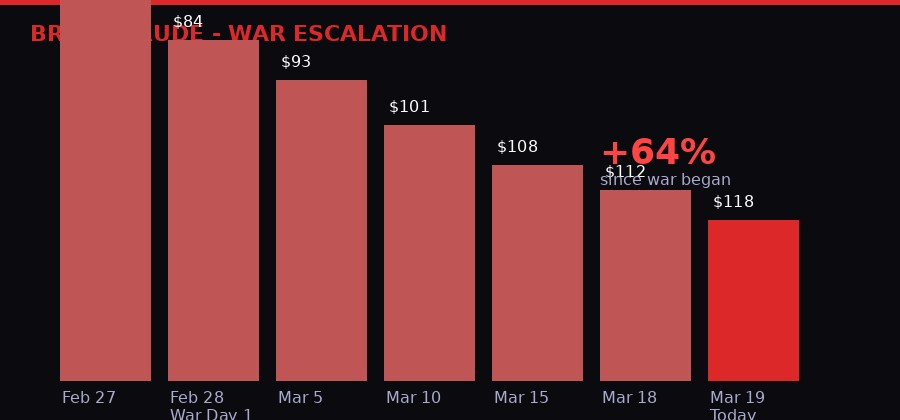
Oil is up 64% since February 28. Every refinery strike adds another dollar. (BLACKWIRE infographic)
Brent crude, the global benchmark, touched $118 per barrel on Thursday - a 64% increase from pre-war levels. The European natural gas benchmark rose 17% in a single day and has doubled over the past month. The Arab League's Secretary-General Ahmed Aboul Gheit called the attacks a "dangerous escalation." Qatar, Saudi Arabia, and the UAE issued formal condemnations.
Iran's President Masoud Pezeshkian warned after the South Pars strike of "uncontrollable consequences that could engulf the entire world." That was not an empty threat. The events of Thursday suggest the engulfing has begun.
Hegseth's Warning - and What It Actually Means

The Pentagon's public posture remains aggressive. The private funding request tells a different story. (Pexels)
Defense Secretary Pete Hegseth's press briefing on Thursday was notable for both what it said and what it implied. He stated that the US military "controls the fate" of Iran - a maximalist claim that has become standard rhetoric from senior administration officials. He warned that Iran "should not, going forward, target Arab allies" and that Tehran "created their own pain."
But Hegseth also made clear that the US is actively preparing for more leadership kills inside Iran's military command structure. His comment about senior IRGC and Basij commanders was pointed: "The last job anyone in the world wants right now, senior leader for the IRGC or Basij - temp jobs, all of them." Earlier this week, Israel killed the commander of Iran's Basij force.
The broader US operational picture is coming into clearer focus. General Dan Caine, the chairman of the Joint Chiefs of Staff, confirmed Thursday that US forces struck more than 90 targets on Kharg Island - Iran's primary oil export terminal, responsible for roughly 90% of the country's crude exports. The attack on Kharg represents a direct assault on Iran's primary source of hard currency. Combined with the strikes on South Pars, the US-Israeli campaign is systematically dismantling the revenue and energy infrastructure that keeps Iran's government functional. (AP News, March 19, 2026)
There are also nuclear dimensions to the conflict that the public record has only partially illuminated. AP reported this week that the Bushehr nuclear power plant complex was struck in recent days. The International Atomic Energy Agency said there were no injuries and no damage to the plant itself. Whether that is being fully verified by independent inspectors remains unclear given the fog of ongoing conflict.
The strategic objective appears to be pressure-driven regime change or capitulation - degrade Iran's missile capabilities, eliminate its nuclear program, kill its senior leadership, and wreck its economy until Tehran agrees to terms. The $200 billion ask signals that the US military believes this goal will take considerably longer and cost considerably more than the public has been told.
Allies Abandon the Coalition That Never Was

The transatlantic alliance has fractured over an Iran war that US allies were never consulted about. (Pexels)
Perhaps the most revealing dimension of the war's current state is the diplomatic isolation in which the United States now finds itself. Trump went to his closest partners and demanded warships for the Strait of Hormuz - essentially minesweepers and naval escorts to help manage the conflict he and Israel ignited. The response was a collective refusal the likes of which has rarely been seen in modern alliance history. (AP News, March 19, 2026)
The UK, which holds a unique position as America's closest bilateral partner, was the first and clearest "no." Prime Minister Keir Starmer - who had cultivated a relationship with Trump and secured an early trade deal with the administration - has drawn a hard line. "Britain will not be drawn into the wider war," Starmer said. He has declined to allow US bombers to use British bases for strikes on Iran's broader infrastructure, though he did accept their use for strikes on Iran's ballistic missile program. Trump singled out Britain's refusal with particular frustration, calling the UK "the Rolls-Royce of allies" and saying he was "not happy."
"This is not Europe's war. We didn't start the war. We were not consulted."
- EU Foreign Policy Chief Kaja Kallas, March 17, 2026
France's position is conditional rather than absolute. President Macron has said French naval escorts in the Strait of Hormuz would be possible - but only once the fighting has died down. He condemned Thursday's escalation as "reckless" and called for a truce and negotiations as Ramadan nears its end. Germany's position is cleaner: Defense Minister Boris Pistorius said flatly, "It is not our war; we did not start it. We want diplomatic solutions and a swift end to the conflict. Sending more warships to the region will certainly not contribute to that." (AP News, March 19, 2026)
"This is not our war; we did not start it."
- German Defense Minister Boris Pistorius, March 2026
China, which was also approached - Trump apparently asked Beijing to help open the Strait - is simply ignoring the request. No response has been issued.
The pattern here is significant. The United States launched a war without consulting its allies. It is now demanding their help to manage the consequences of that war. The allies, having been subjected to two years of tariff bullying, Greenland threats, and NATO payment ultimatums, have no goodwill left to spend. Retired Lieutenant General Ben Hodges, former commanding general of US Army Europe, put it plainly: "Allies are looking at the United States in a way they never have before. And this is bad for the United States."
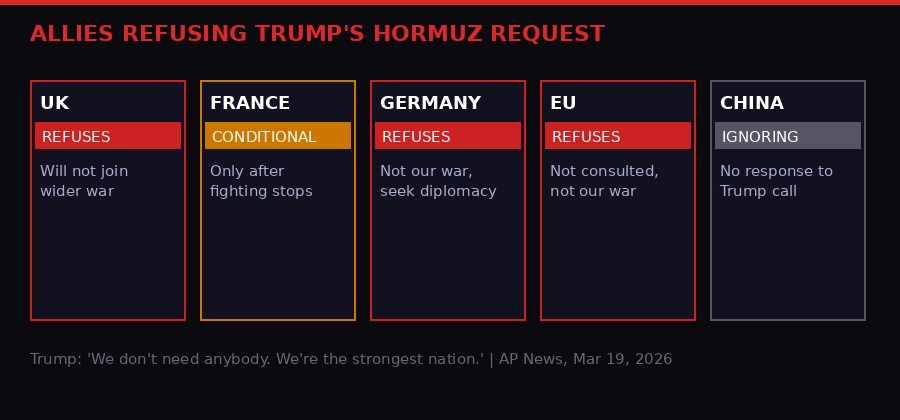
UK, France, Germany, EU, and China have all declined Trump's request for Hormuz support. (BLACKWIRE infographic)
Trump's response to this isolation has been characteristically dismissive. "My attitude is: We don't need anybody. We're the strongest nation in the world," he said Monday. Whether that attitude is sustainable as the $200 billion funding request heads toward a hostile Congress - and as US debt accelerates past $39 trillion - remains to be seen.
Central Banks on Hold - The Global Economy Caught in the Crossfire

Central banks in the US, UK, and EU are all holding rates as the war creates an impossible inflation-recession dilemma. (Pexels)
Three of the world's most powerful central banks convened this week. All three held rates. None of them knows what to do next. That paralysis is itself a signal of how deep the economic disruption has become.
The European Central Bank left its benchmark deposit rate unchanged at 2% on Thursday, explicitly citing the Iran war as a source of "significantly more uncertainty." The ECB statement flagged "upside risks for inflation" and "downside risks for economic growth" simultaneously - the textbook definition of stagflation risk. The bank said long-term inflation expectations remain "well anchored," but the hedge was clear: it would decide on future rate moves based on incoming data, because right now nobody can model what the data will look like. (AP News, March 19, 2026)
The Bank of England held its main rate at 3.75% on the same day, for the same reasons. The UK is watching its gas import costs surge in real time as Qatar - one of Britain's primary LNG suppliers - takes direct fire. The Ras Laffan damage means British energy security is now a casualty of a war its government explicitly refused to join.
The US Federal Reserve held rates on Wednesday. Chair Jerome Powell described the outlook as "increasingly uncertain" and signaled the Fed could stand pat for an extended period. That's the polite way of saying: we have no idea whether we're heading into an inflationary spiral or a demand-driven recession, because both forces are operating simultaneously.
The core tension for every central bank is the same: energy price spikes are inflationary, which argues for rate hikes. But an energy shock that crushes consumer spending and industrial output is recessionary, which argues for cuts. Doing both at once is impossible. So they're doing nothing - holding and watching as the war economy writes its own rules. (AP News; ECB press release; Federal Reserve statement, March 18, 2026)
The Asia picture adds another layer of severity. Japan relies on the Strait of Hormuz for 93% of its oil imports. A liter of gasoline in Japan has risen from 144 yen to 175 yen since the war began - a 21% jump in three weeks. Japan has released emergency reserves, but analysts are already invoking the oil shocks of the 1970s. South Korea, which imports 70% of its oil and 20% of its LNG from the Middle East, is lifting its national cap on coal-fired power generation and considering resuming Russian crude oil imports. India, Pakistan, and China represent most of the 90 vessels that have managed to transit the Strait since February 28. (AP News Asia energy report, March 19, 2026)
"The countries exposed to that supply disruption are not so much in Europe or in the Americas - they're actually really in the Asia region."
- Michael Williamson, UN Economic and Social Commission for Asia and the Pacific
Timeline: Twenty Days That Changed the World's Energy Map

In twenty days, the Iran conflict has reshaped global energy flows, alliance dynamics, and financial markets. (Pexels)
US and Israel launch coordinated strikes on Iran. Oil spikes from $72 to $84/barrel in 24 hours. Congress was not consulted. No AUMF was sought.
Iran begins targeting Israeli population centers. US strikes Kharg Island, Iran's primary oil export terminal. 90+ targets hit. Hormuz traffic falls sharply.
Oil crosses $100/barrel. Britain refuses US basing requests for most strike missions. EU foreign policy chief says Europe was "not consulted." US asks allies for Hormuz warships. Rejections begin.
Israel kills the Basij commander. Ras Laffan LNG facility struck for the first time. QatarEnergy halts production. European gas prices double over three weeks.
Bushehr nuclear complex struck. IAEA says no damage to reactor. US debt crosses $38 trillion. Pentagon war cost estimate: $12+ billion. Oil at $112.
Israel strikes South Pars gas field. Iran retaliates across Gulf: Ras Laffan, SAMREF refinery, Mina Al-Ahmadi, Mina Abdullah, Habshan gas facility, Bab field all hit. Brent crude: $118. US debt: $39 trillion. Pentagon war funding request: $200 billion. Every major ally: no.
What Comes Next - Three Scenarios

The path forward is constrained by energy, money, and an alliance network that has withdrawn its support. (Pexels)
The war's trajectory now depends on which of three broad paths the combatants end up taking. None of them is comfortable. All of them have serious tail risks for the global economy.
Scenario One - Continued Attrition: The US and Israel continue degrading Iranian military and energy infrastructure. Iran continues asymmetric retaliation against Gulf Arab targets, global shipping, and Israel. Oil stays above $100, potentially rising further if Hormuz transit falls significantly below current levels (only about 90 vessels have made it through since the war began). The war continues to cost roughly $570 million per day. Congress debates the $200 billion supplemental. Central banks stay frozen. Global growth slows. The conflict grinds toward some undefined endpoint.
Scenario Two - Arab Escalation: Saudi Arabia, Qatar, Kuwait, or the UAE - all of which have now been directly attacked by Iran - decide to escalate beyond defensive measures. This would dramatically complicate the US strategic picture and risk drawing Iran's Arab neighbors into a full regional war. Saudi Arabia has already begun treating the Yanbu refinery strike as a red line. If Riyadh hits back directly at Iranian territory, the geometry of the conflict changes entirely.
Scenario Three - Negotiated Exit: Ramadan, which ends in the coming days, has been cited by French President Macron as a potential window for ceasefire talks. Iran's President Pezeshkian has used language - "uncontrollable consequences" - that could be read as either a threat or an opening for negotiation depending on the audience. Trump has made contradictory statements: warning against more South Pars strikes while also telling Iran to stop targeting Gulf energy infrastructure or face total destruction of the field. Trump's actual bottom line remains opaque. That opacity has been strategic, but it has also prevented any clear off-ramp from forming.
What is clear is that the costs of the current trajectory are not sustainable in their present form. The Soufan Center, a New York-based think tank, noted after the South Pars strike that Israel's target selection "has heavily focused on the institutions, leaders and infrastructure" of Iran, and is now seeking "to inflict additional pressure on the regime by making the living conditions for civilians intolerable." That is a description of a coercive strategy that requires time - and time means money, blood, and a global economy absorbing shocks it did not budget for. (AP News, Soufan Center, March 19, 2026)
Day 20 ends with the Pentagon's $200 billion request sitting in a White House inbox, a US national debt counter flipping from $38 to $39 trillion, oil at $118 and climbing, the world's largest LNG terminal offline and damaged, and every major US ally at arm's length from a conflict they were neither consulted on nor asked to shape. The next twenty days will either begin to close this war - or accelerate its costs beyond anything currently modeled.
Get BLACKWIRE reports first.
Breaking news, investigations, and analysis - straight to your phone.
Join @blackwirenews on Telegram