KC-135 Down: Four American Aircrew Confirmed Dead as Iran War Enters Its Bloodiest Phase
The fourth U.S. aircraft to crash in 14 days of combat went down in western Iraq Thursday, killing four of its six crew. On Friday morning, Iran launched drone swarms at Saudi Arabia, Oman, and the UAE. Trump threatened catastrophic new retaliation. Eleven American troops are now dead - and the war has no end date.
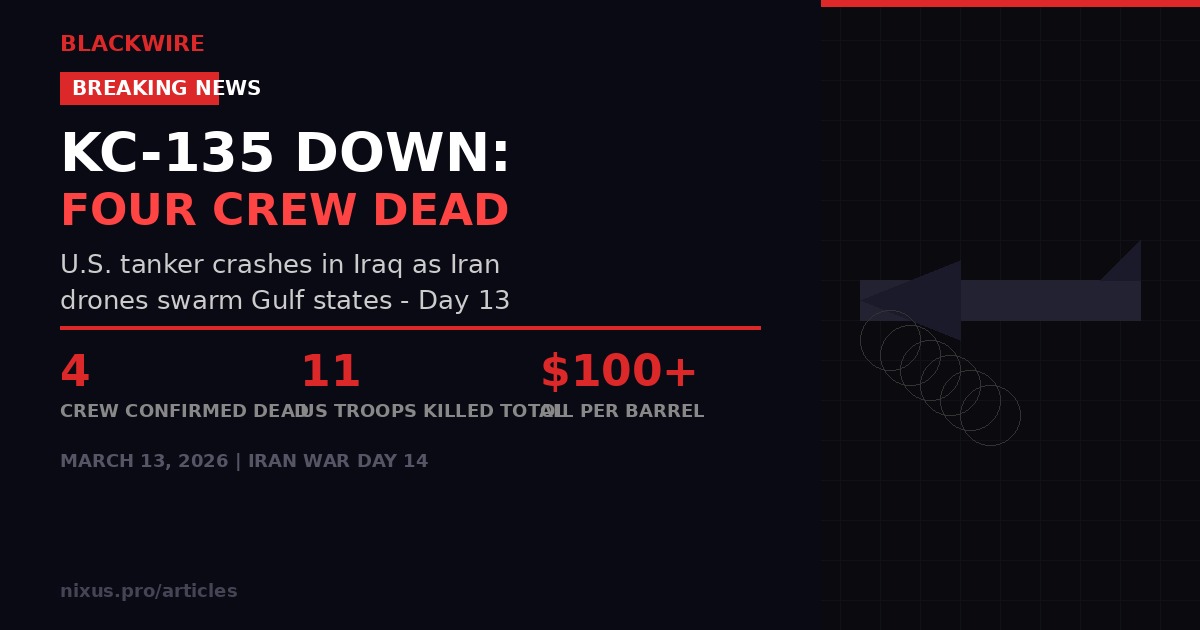
BLACKWIRE graphic. KC-135 refueling tanker downed in western Iraq, March 13, 2026. (BLACKWIRE / Visual Desk)
Four American service members are dead. A KC-135 Stratotanker - the aging backbone of U.S. aerial refueling operations - went down in western Iraq on Thursday, the military announced, in what U.S. Central Command bluntly described as "a loss." Search and rescue efforts were still underway for the remaining two crew as of Friday morning.
The crash was not caused by hostile fire or friendly fire, Central Command said. That explanation raises its own set of troubling questions. In the middle of an active war, a 60-year-old aircraft carrying at least six personnel simply fell from the sky. No enemy missile brought it down. The machine failed - or something went wrong between two aircraft operating in "friendly airspace," as the Pentagon's statement carefully phrased it.
It is the fourth U.S. aircraft publicly lost in 14 days of combat operations against Iran. It will not be the last. Defense Secretary Pete Hegseth said this week the conflict could last eight weeks - and he declined to promise it wouldn't go longer.
By Friday morning, the wider war had accelerated further. Iran's new Supreme Leader, Mojtaba Khamenei - son of the man killed on the first day of the conflict - issued threats against Gulf Arab nations hosting American bases. Iran then made good on those threats, launching nearly 50 drones at Saudi Arabia, striking the UAE's Dubai Financial Centre with debris, and killing two people in Oman. U.S. President Donald Trump responded on Truth Social with language that should alarm anyone tracking escalation: "Watch what happens to these deranged scumbags today."
The Iran war has entered its most dangerous and chaotic phase yet.
The Crash: What Went Wrong Over Western Iraq
U.S. Central Command's statement on the KC-135 crash was careful - and conspicuously brief. The command said the incident involved two aircraft operating in friendly airspace. One landed safely. The other, a KC-135 Stratotanker, went down in western Iraq and was declared "a loss."
A U.S. official speaking anonymously to the Associated Press confirmed the downed plane had at least five crew members aboard. A second official confirmed the other aircraft involved was also a KC-135. Israeli Ambassador to the United States Yechiel Leiter posted on X that the second tanker landed safely - in Israel, a detail that underscores the geographic sprawl of operations now being coordinated across Iraq, the Gulf, and the eastern Mediterranean.
By Friday, Central Command confirmed four of the six crew members had been found dead. Recovery efforts were continuing to locate the other two.
The military's statement that hostile fire was not involved still leaves multiple potential causes: mechanical failure, a mid-air collision, fuel system malfunction, or a catastrophic structural problem. The KC-135 fleet has a documented history of incidents tied to its age. The most deadly recent crash - a 2013 accident in Kyrgyzstan - was traced to a faulty rudder that caused the tail section to break apart mid-flight, killing all three crewmembers aboard.
Sources: Associated Press - KC-135 Crash Initial Report | U.S. Central Command Press Release
The Aircraft: America's 60-Year-Old War Workhorse
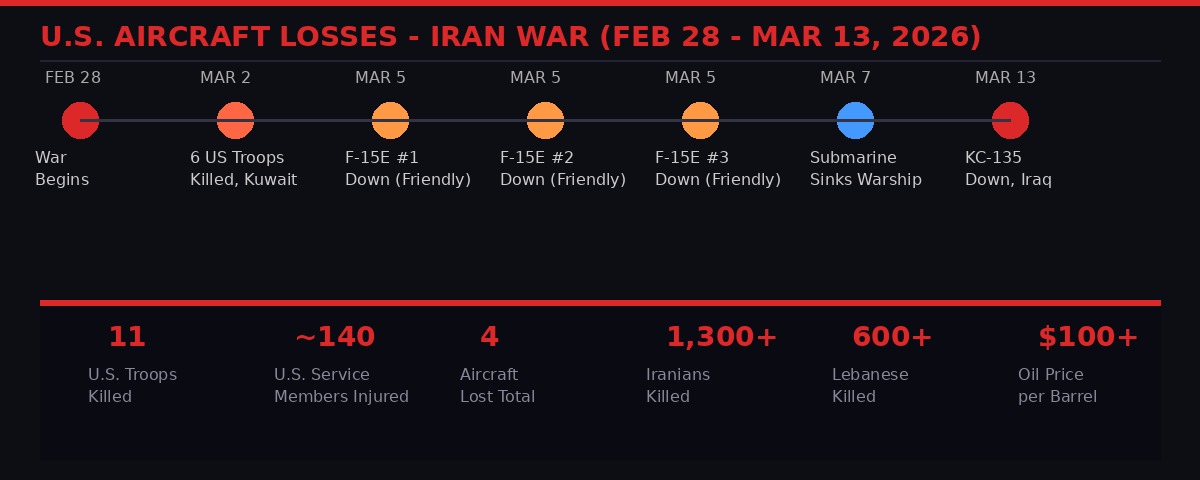
BLACKWIRE infographic: U.S. military losses in the Iran War, Feb 28 - Mar 13, 2026. (BLACKWIRE / Data Desk)
The KC-135 Stratotanker entered U.S. Air Force service in 1957, built on the same airframe as the Boeing 707 passenger jet. It has been refueling American combat aircraft for more than six decades - through Vietnam, the Gulf War, Iraq, Afghanistan, and now Iran. The Air Force had 376 of them as of last year: 151 on active duty, 163 in the Air National Guard, and 62 in the Air Force Reserve.
The aircraft is set to be phased out as the KC-46A Pegasus tanker enters full service - but that transition has moved slower than planned. The KC-135s still flying today are the same airframes produced in the late 1950s and early 1960s, kept operational through repeated upgrades. Every defense analyst who has looked at the fleet has flagged the same concern: these planes are old, and old planes fail in unexpected ways under high operational tempo.
A basic KC-135 carries three crew: a pilot, co-pilot, and boom operator - the specialist who lies face-down looking through a window in the plane's belly to guide the fuel boom into a receiving aircraft's port. In aeromedical evacuation missions, nurses and medical technicians are added to the crew. The fact that this plane carried at least six people suggests it was on a mission beyond standard refueling.
The tanker's role in this war has been essential. U.S. fighter jets and bombers pounding Iranian targets need mid-air refueling to extend their range across the distances involved - from bases in the Gulf, Saudi Arabia, and eastern Mediterranean, to target sets spread across Iran's interior. As the Pentagon's offensive has pushed deeper into Iranian territory, chasing dispersed military assets and hardened nuclear facilities, tanker operations have become the connective tissue holding the entire air campaign together.
"Refueling tankers could play an increasingly important role if the Iran war drags on, as U.S. aircraft may need to fly longer missions to pursue Iranian forces retreating deeper into the country," Yang Uk, a security expert at South Korea's Asan Institute for Policy Studies, told AP. Yang added that it would be "rare for a refueling tanker to be downed by enemy fire" - those aircraft typically operate well behind the front line of air combat. Which makes it even more significant when one goes down anyway.
Sources: Associated Press - KC-135 explainer | Congressional Research Service, U.S. Air Force tanker fleet data, 2025
A Pattern: Four Aircraft in Fourteen Days
The KC-135 is not a fluke. It is the fourth U.S. aircraft to go down since the war began on February 28th.
The most publicized previous losses came just last week, when three F-15E Strike Eagles were shot down by friendly Kuwaiti fire. All six crew members of those aircraft ejected safely and were recovered in stable condition - an outcome that seemed miraculous given the circumstances. The friendly fire incident immediately raised questions about the coordination between U.S. and allied air defense networks operating in the same crowded skies.
Four aircraft lost in 14 days represents a loss rate that, if sustained, will generate serious pressure on operational capacity. The Air Force does not have unlimited KC-135s, and it cannot replace F-15Es overnight. Hegseth's assertion that the U.S. has sufficient munitions and equipment for a "war of attrition" has not been tested against a sustained campaign of this intensity.
The Pentagon's own framing has shifted several times on how long this war will last. The initial signals suggested a sharp, targeted campaign of days or weeks. As of this week, Hegseth was saying "four weeks, six weeks, eight weeks, maybe three" - a range so broad it suggests the military genuinely does not know.
Sources: AP - F-15E Friendly Fire Incident | AP - Hegseth Pentagon Briefing
The New Supreme Leader and Iran's Widening Retaliation
When the U.S. and Israel launched the war on February 28th, one of the first things they did was kill Iran's Supreme Leader, Ayatollah Ali Khamenei. The Islamic Republic's political and military command structure was designed to survive its founder. It has survived this too - but in a form that may prove harder to deal with.
Mojtaba Khamenei, the son of the man killed on Day 1, has been named Supreme Leader. His first major public statement - delivered as the bombing continued - was a vow that Iran would "not refrain from avenging the blood" of the Iranians killed in the conflict. He warned Gulf Arab nations hosting U.S. military bases that the idea of American protection was "nothing more than a lie."
Within hours of that statement, Iran made it literal. On Friday morning, Iran launched nearly 50 drones at Saudi Arabia. Saudi air defenses shot them down. Simultaneously, Iran struck Bahrain, where sirens sounded as a precaution. In Oman, two drones crashed into an industrial area in the Sohar region, killing two people - a country that had been conspicuously neutral in the conflict suddenly absorbed Iranian ordnance. In the UAE's Dubai, debris from an intercepted strike damaged a building at the Dubai International Financial Centre - the economic heart of the Gulf's financial elite, home to hundreds of international banks and wealth management firms.
Iran's paramilitary Revolutionary Guard had warned earlier this week of "the complete destruction of the region's military and economic infrastructure." The DIFC strike - whether accidental via intercept debris or deliberate - was a message: no institution in the Gulf is beyond reach.
"Iran allegedly aspired to conduct a surprise attack using Unmanned Aerial Vehicles from an unidentified vessel off the coast of the United States homeland, specifically against unspecified targets in California." - FBI law enforcement bulletin, posted this week, cited by ABC News
The FBI bulletin about a potential Iranian drone attack launched from a vessel off the California coast was characterized as "unverified intelligence" by White House Press Secretary Karoline Leavitt. California Governor Gavin Newsom said there was no imminent threat. By Friday, Leavitt walked back further: "No such threat from Iran to our homeland exists, and it never did." But the fact that the FBI felt it necessary to warn local law enforcement departments speaks to how far Iranian retaliatory ambitions now extend - at least in the intelligence community's threat modeling.
Sources: AP - Iran Drone Swarms, Gulf States, March 13 | AP - California drone threat bulletin | AP - Mojtaba Khamenei, New Supreme Leader
Trump's Friday Morning Threat and the Escalation Loop
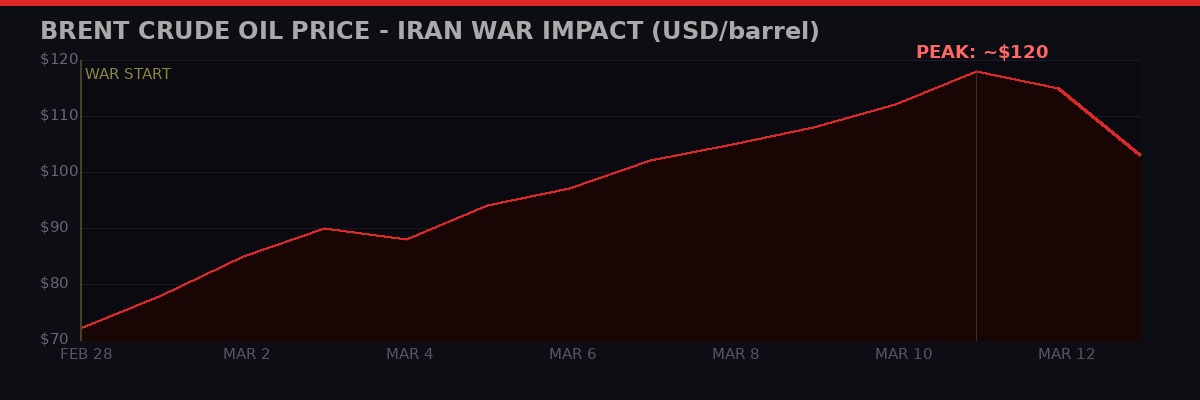
BLACKWIRE data chart: Brent crude oil pricing since the start of the Iran war, Feb 28 - Mar 13, 2026. (BLACKWIRE / Data Desk)
Donald Trump's Friday morning post on Truth Social was written with the cadence of a threat, not a briefing.
"Watch what happens to these deranged scumbags today. Iran's Navy is gone, their Air Force is no longer, missiles, drones and everything else are being decimated, and their leaders have been wiped from the face of the earth." - U.S. President Donald Trump, Truth Social, March 13, 2026
The boast is partly accurate and partly aspirational. Iran's navy has taken heavy losses - a warship was sunk in the Indian Ocean by a U.S. submarine torpedo earlier this week, with 87 bodies recovered. Iranian air launch capacity has been degraded. The country's supreme leader - the original one - is dead. But Iran's navy is not gone. Iran's air force still flew missions this week. And the new supreme leader is very much on the face of the earth, issuing war orders.
Trump also said in the same post that the U.S. is "totally destroying the terrorist regime of Iran, militarily, economically, and otherwise." That framing - regime destruction as a goal - is significant. It was how the war was originally framed when launched. But the exact objectives have, by the Pentagon's own admission, "repeatedly shifted." Hegseth declined at his briefing to define specific war aims beyond degrading Iran's military capability. Joint Chiefs Chairman Gen. Dan Caine refused to answer whether ground troops might be deployed in Iran.
White House Press Secretary Leavitt said ground troops were "not part of the plan for this operation at this time" - but added that the president's options remain on the table. That careful non-denial is the diplomatic equivalent of a loaded pause.
The Senate voted down a war powers resolution that would have required congressional authorization to continue operations. Fellow Republicans stood with Trump. The legal authority for an open-ended conflict in Iran is now settled - at least domestically. The strategic endgame is not.
Sources: AP - Senate Votes Down War Powers Resolution | AP - Trump on Regime Change
The Human Cost: Eleven Dead, Hundreds Wounded
Seven American service members were killed before Thursday's KC-135 crash. Now the count stands at eleven confirmed dead - with two more crew still unaccounted for in the Iraqi desert.
The first six American deaths came from a single Iranian drone that struck an operations center at a civilian port in Kuwait. They were Army Reserve soldiers from a logistics unit based in Iowa - not combat troops, not special operations. They were keeping supply lines moving: food, equipment, fuel. The drone hit them in what their families later described to reporters as a shipping-container-style building with no defenses.
The seventh American died after being wounded in the March 1 attack on Prince Sultan Air Base in Saudi Arabia. Trump attended the dignified transfer of the first six soldiers' remains at Dover Air Force Base. Vice President Vance and Secretary Hegseth saluted the seventh transfer case. There have been no public statements about the four KC-135 crew members yet recovered.
Beyond the dead: approximately 140 U.S. service members have been injured in 14 days of combat, eight severely. Hegseth and Trump have both publicly warned that more American casualties are inevitable before the war concludes. That is an unusual thing for wartime leadership to say - both because it is honest and because honesty about casualties rarely comes this early.
The death toll extends far beyond American forces. Iranian authorities have reported more than 1,300 killed in Iran as U.S. and Israeli strikes hit targets across the country - missile launchers, nuclear facilities, defense infrastructure, Basij command centers, IRGC buildings. In Lebanon, where Israel has been striking Hezbollah simultaneously, more than 600 people have been killed and nearly 800,000 displaced. In Israel, 12 people have died. Iran has fired on Bahrain, Kuwait, Saudi Arabia, the UAE, Oman, and Israel - a geographic spread of conflict that qualifies this as a regional war in the full sense of the term.
A French soldier stationed in northern Iraq was also killed in an attack on Friday, French President Emmanuel Macron confirmed. NATO members are now taking casualties at the periphery of a war they did not declare.
Sources: AP - American Soldiers Killed in Iran War | AP - Kuwait Drone Strike, Six Soldiers
Oil Above $100: The Energy War Behind the Shooting War
The price of Brent crude oil - the international benchmark - crossed $100 per barrel last week and has remained there. It touched $120 at its peak. On Friday morning it stood around $103, still roughly 40% higher than when the war started on February 28th.
The mechanism is straightforward: Iran controls the Strait of Hormuz, the narrow chokepoint through which approximately one-fifth of the world's oil passes from the Persian Gulf to the open seas. Iran has been attacking ships attempting to transit the strait since the conflict began. Commercial tankers have diverted, been damaged, or halted operations. The flow of Gulf oil to global markets has been disrupted in a way not seen since the 1973 Arab oil embargo.
The new Supreme Leader, Mojtaba Khamenei, explicitly said Iran would continue to block the waterway. That is not merely a military threat - it is a direct economic weapon aimed at every country that depends on Gulf oil imports. That includes Europe, India, Japan, South Korea, and China. It includes the United States' own oil market, even accounting for domestic shale production.
The Gulf Arab states - Saudi Arabia, UAE, Bahrain, Oman - are simultaneously being attacked by Iran and hosting the U.S. military forces prosecuting the war against Iran. They are targets of the retaliation they are enabling. Saudi Arabia shot down nearly 50 Iranian drones on Friday. Oman, which has historically positioned itself as a back-channel between Iran and the West, took drone strikes on its soil this week. The financial district of Dubai took debris damage from an intercept.
Global stock markets have been "hammered," as the AP reported, over concerns that sustained oil disruption could drag the world economy into recession. The U.S. has tapped the Strategic Petroleum Reserve in response. Trump has pivoted from boasting about low gas prices - a key campaign and early-term talking point - to talking about "oil being a weapon of war." It is an about-face that signals even the White House did not fully price in this particular consequence.
Sources: AP - Trump's Oil Price About-Face | AP - Strait of Hormuz under attack | AP - Global Markets on Iran War
What the Next 48 Hours Could Bring
Trump's Friday morning post said "watch what happens today." That is either preparation for a genuine escalation - new strike packages, a naval action, an attempt to physically clear the Strait of Hormuz - or it is theatrical intimidation. Given the pace of this war so far, assuming it is merely theater is a bet with poor odds.
The military options on the table include several that have not yet been publicly confirmed: direct targeting of Iranian oil infrastructure, strikes on the Natanz nuclear facility's deeper underground centrifuge halls, naval operations to force open the Strait of Hormuz, and - if Caine's non-denial about ground troops means anything - potential special operations activity inside Iran.
Iran's strategy has been to make the war expensive - in blood, in dollars, in allied stability - for the United States and Israel rather than trying to win a symmetric conflict. Swarms of cheap drones aimed at Gulf financial infrastructure are designed to impose economic cost, not military defeat. That approach has logic: Iran cannot match U.S. air power. But it can raise the price of victory until it becomes politically unsustainable.
Hegseth said the U.S. has the munitions for a war of attrition. He may be right. The question is whether America's Gulf partners - Saudi Arabia, UAE, Bahrain, Kuwait - can sustain the political and physical cost of hosting the war while absorbing Iran's drone swarms. Dubai just took a hit at the center of its financial district. The Gulf's economic model depends on stability and the perception of safety. That perception is deteriorating.
Meanwhile, Lebanon is burning. More than 600 dead, 800,000 displaced, and Israeli airstrikes continuing daily. Turkey intercepted a ballistic missile launched from Iran before it entered Turkish airspace - a NATO member's air defense activated against an Iranian missile. Qatar evacuated residents near the U.S. Embassy in Doha as a precaution. The geography of the conflict is metastasizing.
Four aircraft down. Eleven American troops dead. Fourteen days in. No exit date. The war that Trump launched on February 28th is not the short, sharp campaign the optimistic case assumed. It is the grinding, widening kind - the kind that shapes decades, not just news cycles. The KC-135 that went down in western Iraq on Thursday, with four crew now confirmed dead and two still missing, is a data point in a trajectory that is moving in one direction.
Upward.
All reporting sourced from Associated Press wire dispatches, U.S. Central Command press releases, Pentagon briefings, and official statements. Sources cited inline throughout.
Get BLACKWIRE reports first.
Breaking news, investigations, and analysis - straight to your phone.
Join @blackwirenews on Telegram