The War Tax Nobody Voted For
From a Detroit gas station to a Bangladesh kitchen that stopped cooking hot food, ordinary people across three continents are picking up the tab for a war they didn't start and can't stop. This is what $100 oil actually means when you're not a hedge fund manager.
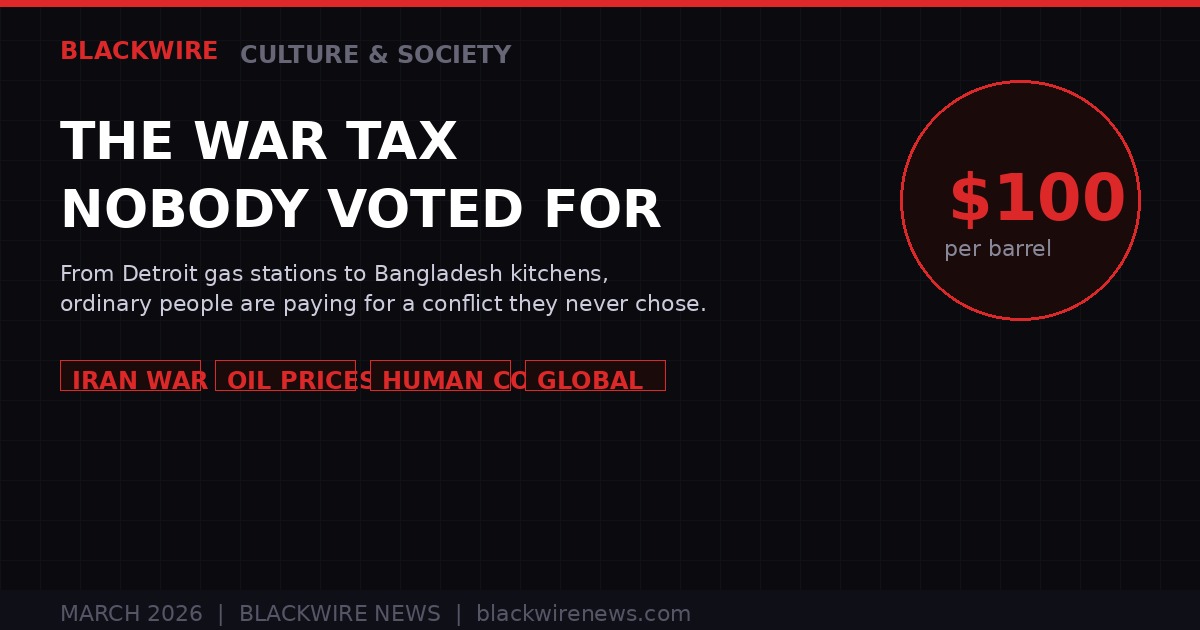
The Iran conflict has pushed Brent crude above $100 per barrel for the first time since Russia's Ukraine invasion. BLACKWIRE / EMBER
Victor Rodriguez stood at a gas pump on a rainy afternoon in Detroit and watched the numbers climb. He drives an F-250 diesel. The fill-up totaled $110. "Ridiculous," he said, to no one in particular.
Rodriguez supports "getting rid of this thug" - his words for Iran's Ayatollah Ali Khamenei, who was killed in the US-Israel military operation now entering its third week. But the cost was getting too high. He had already detoured off the freeway hunting for cheaper diesel, finding $4.19 per gallon instead of the $5.00 posted at stations back home in Romeo, an exurb about 30 minutes north of Detroit. [Guardian]
In the same story, half a world away: kitchens across India are quietly pulling hot food off menus. Not because they've run out of ingredients. Because they can't afford to heat them. Cooking gas, dependent on Middle Eastern supply chains, is suddenly scarce. [Guardian]
Two people. Two continents. One war nobody asked them about.
The Waterway That Runs the World
To understand why a Detroit father is choosing between filling his tank and feeding his kids, you need to understand a thin strip of water between Iran and the Arabian Peninsula. The Strait of Hormuz is 33 kilometers wide at its narrowest point. Through it flows roughly one-fifth of the world's oil supply. Every barrel that heats a home in South Korea, every liter that powers a delivery truck in Bangladesh, every gallon that goes into Victor Rodriguez's F-250 - a significant portion passes through that narrow neck of the Persian Gulf.
As of March 16, the Strait has been effectively shut for almost two weeks. Iran's Revolutionary Guards declared they would not allow "one litre of oil" to be exported from the Middle East while US and Israeli strikes continued. Several merchant ships have been attacked in and around the waterway. Insurance companies have pulled coverage for routes through the region. [Guardian]
The result: Brent crude crossed $100 per barrel last week for the first time since Russia's invasion of Ukraine four years ago. By Sunday it reached $104.98, up 1.8% in a single morning's trading. Oil company shares hit all-time highs. [Guardian]
"The longer the strait remains closed, the more likely that these stocks will be exhausted, and prices will continue to rise, leading to a major global economic crisis. The only solution is to reopen the strait and enable navigation to resume." - Yousef Alshammari, President, London College of Energy Economics
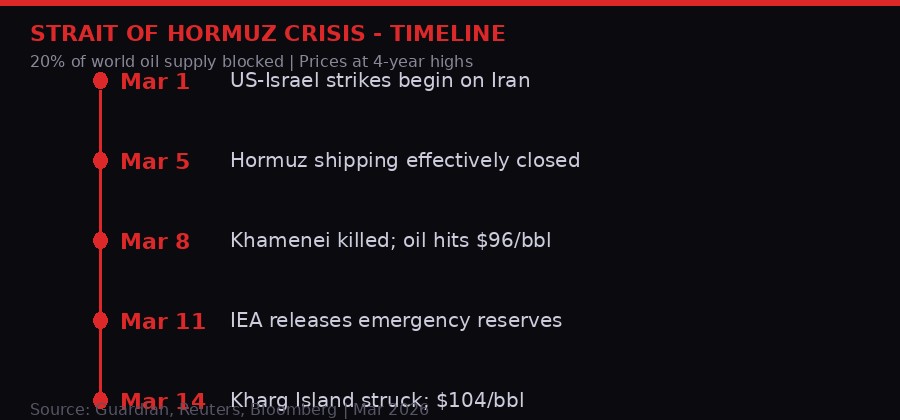
Three weeks of conflict have closed one of the world's most vital waterways. Prices climbed with every strike. Source: Guardian, Reuters, Bloomberg.
Detroit: Where the Price Is Political
Michigan voted for Donald Trump twice. His promise - "drill baby drill," low energy costs, economic revival - helped him win this state in 2024, including the swing precincts of Macomb County that political scientists have spent a decade dissecting. Now those same voters are paying 60 cents more per gallon than they did a week ago, and the math is getting personal.
Kevin Dass, an underemployed father of two, said it bluntly to the Guardian at a station on Eight Mile Road: "I don't give a shit about Iran. I don't want to pay higher gas." He's considering driving less. Metro Detroit's public transit is sparse. He doesn't have great options. [Guardian]
Del Carey, filling up her SUV in Madison Heights in Macomb County, said the war is "unnecessary." She lives in Warren, one of the counties that political scientists call America's bellwether - it flipped and re-flipped and flipped again, tracking the national mood with uncanny precision. She is not yet making financial cuts, but if prices hold, dining out goes first.
Trump has attempted to wave this away. "I think they'll go lower than they were before," he told NBC News. "There's so much oil, gas - there's so much out there. But you know, it's being clogged up a little bit. It'll be unclogged very soon." [NBC]
The people paying $4.30 per gallon near downtown Detroit are not finding this reassuring. The average US fuel price hit $3.70 per gallon on Sunday, according to AAA - up 62 cents from a month ago. That is not a rounding error. That is a meaningful chunk out of a working family's monthly budget.
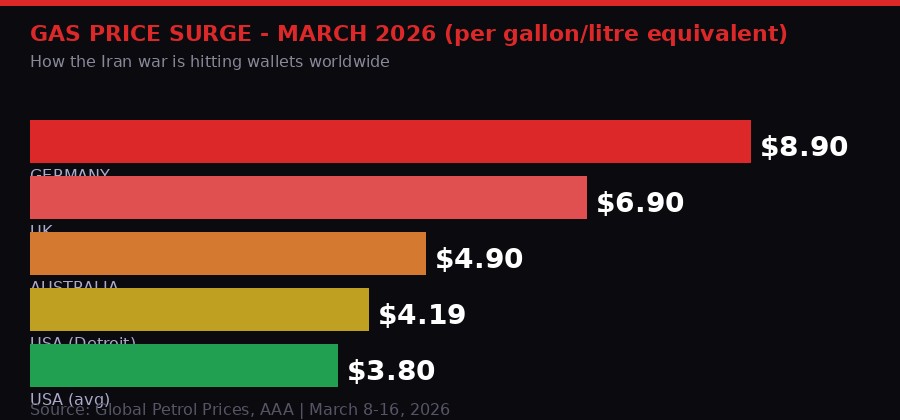
How the Iran war's supply shock is hitting wallets across countries. Americans still pay less than Europe, but the jump is steeper and faster. Source: Global Petrol Prices, AAA.
Asia: Where It Hits Harder
America's pain is real. But in the Global South, the same price shock lands on people with far less cushion to absorb it.
Asia is the world's top crude-importing region. In 2025, the continent relied on the Middle East for 59% of its crude imports, according to shipping analytics firm Kpler. Now that spigot has been effectively turned off. [Guardian]
The downstream effects are already visible in daily life. In Bangladesh, cooking fuel rationing has begun. In India, Reuters reported that restaurants and households are pulling hot food from menus because cooking gas is either unavailable or suddenly unaffordable. The disruption cascades from a supply chain that runs through refineries and ports and tankers into individual kitchens. One LPG cylinder too expensive to refill means a family eating cold food. It means a street food vendor going dark. It means a small restaurant shuttering.
South Korea's president Lee Jae Myung announced the country's first cap on domestic fuel prices in nearly three decades - a market intervention so extreme it hasn't been used since the 1990s. Thailand's oil fuel fund is spending tens of millions of dollars every single day to artificially suppress prices, essentially running a permanent subsidy to prevent social unrest. Japan, one of the more prepared economies, is releasing 80 million barrels from emergency stockpiles - roughly 45 days of supply. [Guardian]
China, which has the world's largest onshore crude stockpiles, has reportedly been receiving Iranian oil shipments in defiance of the broader blockade. India ramped up Russian crude imports after the US quietly granted New Delhi a sanctions waiver. These are the geopolitical workarounds available to major powers. They are not available to Bangladesh or Sri Lanka.
"The situation is certainly very worrying. Even when ship operators feel confident again to send tankers through the strait, oil producers will need time to bring supply up to its pre-crisis levels." - Yousef Alshammari, London College of Energy Economics, speaking to the Guardian
The Strike That Spooked the World
On Saturday, March 14, US forces struck Kharg Island. This is not just any piece of Iranian real estate. Kharg is a five-mile-long coral island in the Persian Gulf, 27 miles from the Iranian mainland, and it handles approximately 90% of Iran's oil exports. Hitting Kharg was a significant escalation from the first two weeks of the conflict, during which the island had largely been left untouched. [Guardian]
Trump announced the strike on social media, saying he had avoided hitting oil and energy infrastructure "for reasons of decency" and that only military targets were struck. He told NBC News that US forces might hit the site "a few more times just for fun." Markets did not find this reassuring. Brent crude spiked. Insurance rates for Gulf shipping routes, already at extraordinary levels, climbed further.
Iranian Foreign Minister Abbas Araghchi called the strikes on fuel depots "ecocide." The language is charged - and calculated. Framing the destruction as environmental crime rather than military action is a messaging strategy, an attempt to shift the moral ledger, to put environmental catastrophe on the international agenda alongside the humanitarian one.
Trump has since stepped up pressure on allies to help patrol the strait, publicly calling out France, Japan, South Korea, the UK, and even China to join a "team effort." The responses have been decidedly cool. South Korea said it was "exploring various measures from multiple angles." The UK is drawing up plans for minesweeping drones - the minimum possible gesture - amid concerns that complying more fully with Trump's demands could escalate rather than resolve the crisis. [Guardian]
Britain: When Solidarity Runs Out of Gas Too
Energy prices are not the only thing measuring public stress right now. In Britain, a separate but related story has been unfolding quietly in charity sector data - and it tells you something uncomfortable about how societies fracture under sustained economic pressure.
The Charities Aid Foundation released its annual report this week, and the numbers are stark. Public donations to UK charities fell by more than £1.4 billion last year. Only half of Britons gave to charity in 2025, down from 61% a decade ago. Total donations collapsed from £15.4 billion to £14 billion. An estimated 6 million fewer people gave to charity compared with 2016. [Guardian]
These are not just numbers. They represent a measurable erosion of social solidarity - the quiet infrastructure of a society that theoretically looks after its own. Food banks now receive more donations than arts, education, or homelessness charities combined. Britain's giving culture has contracted to the most immediate, most visible form of need: hunger, here, now, in my town.
"Charities can no longer depend solely on habitual generosity or goodwill from the public. Giving is no longer a habit in this country." - Mark Greer, Managing Director, Charities Aid Foundation
Nearly half of non-donors in 2025 said they couldn't afford to give - up from 44% the previous year. This includes people earning over £125,000 a year who cited lack of affordability. That figure is worth sitting with. The cost of living crisis has been so psychologically corrosive that even people who are objectively comfortable are feeling too squeezed to give. Or telling themselves that story.
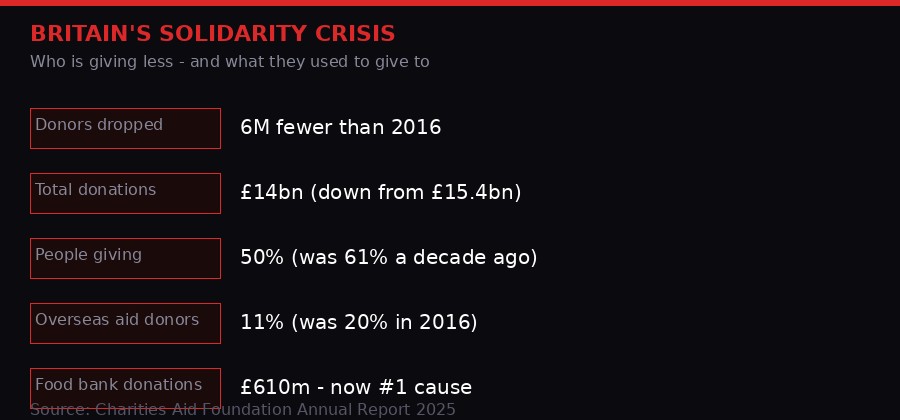
Six million fewer Britons gave to charity in 2025 compared to 2016. The sector is contracting around the most immediate need: food banks. Source: Charities Aid Foundation.
Peter Grant, a philanthropy expert at Bayes Business School, points to something beyond affordability: "culture war" attacks on charities - RNLI, the National Trust - have undermined their legitimacy in some quarters. When rightwing politicians turn charity into a political football, the collateral damage is real, and it falls on the people those organizations serve. [Guardian]
The Generation That Can't Get Started
While the oil shock dominates global headlines, another slow-motion crisis has been accumulating in the UK's labor statistics - one that arrived this week with numbers the government could no longer ignore.
The Health Foundation published analysis showing a 70% surge over the past decade in the share of young people aged 16 to 24 who are not in education, employment, or training - the government's "NEET" designation - and who report a work-limiting health condition. In the three months to December 2025, there were 957,000 young people in this category. Of those who cited health problems, more than two-thirds pointed to mental health issues and autism. [Guardian]
The statistic that Work and Pensions Secretary Pat McFadden plans to cite in a speech Monday: a person under 25 on universal credit is now less likely to get a job than someone over 55 on the same benefit. That is a reversal of generational norms so complete it barely seems possible. Youth is supposed to be an advantage in the labor market. For this cohort, it is not.
Forty-six percent of NEET young people now report being sick or disabled - up from 26% a decade ago. The Health Foundation's Sam Atwell notes: "More Neet young people are reporting health problems, potentially putting this generation at even greater risk of harm to their future opportunities."
The government is responding with a £2.5 billion youth employment package - grants for employers, apprenticeship incentives, an expanded guarantee for 18 to 24 year-olds. Whether financial incentives adequately address what is fundamentally a health crisis is a question the policy doesn't fully answer. [Guardian]
What is clear: an entire cohort of young people arrived in the labor market during or after a pandemic, during a cost-of-living crisis, during a period of profound social anxiety. They are not lazy. They are unwell. The collective stress of the past five years has left measurable physiological damage - anxiety, depression, autism diagnoses that went uncaught in chaotic pandemic-era schools. The bill for that is now showing up in the employment statistics.
The Algebra of Ordinary Life
Pull back from the headlines and you see a pattern forming across all of these stories. They are not separate news items. They are expressions of the same underlying pressure - the accumulated weight of cascading crises on people who have very limited ability to absorb another shock.
Victor Rodriguez in Detroit doesn't care about the Strait of Hormuz. He cares about the $110 it costs to fill his truck. Del Carey in Macomb County doesn't have a position on Iranian foreign policy. She has a position on whether she can still afford to eat out once a week. The anonymous family in Bangladesh pulling cold food off the menu didn't vote for this war, didn't support it, didn't even hear about the strategic calculus that led to it. They just know that the gas cylinder they usually refill once a month is now either unavailable or costs twice what it used to.
The British grandmother who used to put a tenner in the Macmillan envelope once a month isn't doing it anymore. Not because she stopped caring about cancer patients. Because her heating bill went up and her fixed income didn't, and something had to give. The young man who can't work and can't explain why - not laziness, not attitude, but a nervous system that emerged from the pandemic years running on threat response - isn't a statistic. He's someone's son.
This is what war costs. Not just the lives lost in theater. Not just the ships burning in the Persian Gulf. The cost runs through every economy on earth, and it concentrates in the households with the least margin to absorb it. The price of oil is never just the price of oil. It is the price of everything - food, heat, transport, the functioning of supply chains that deliver the goods that make daily life livable.
And right now, that price is being paid by people who had no vote on the matter.
"Nothing is worth higher gas prices, obviously." - Victor Rodriguez, Detroit, filling his F-250 at $4.19/gallon
What Comes Next
The International Energy Agency has authorized its largest ever release of emergency oil reserves - hundreds of millions of barrels across member states - to soothe markets while the Strait remains blocked. Japan is releasing 80 million barrels. The US Strategic Petroleum Reserve is being tapped. These are tools designed to bridge a short disruption. They are not tools for a sustained war. [Guardian]
Trump wants allies to help escort tankers through the Strait. Most are reluctant. Sending warships into an active conflict zone is not a minor commitment, and the political risk of escalation - of a navy vessel being struck by an Iranian mine, of a provocation that turns a regional war into something broader - is real. European governments are watching their own gas prices, their own political pressures, their own public patience. France just had local elections this weekend. The National Rally performed strongly. The Le Pen-aligned right runs on cost-of-living anger. High energy prices are Le Pen's best campaign posters. [Guardian]
China has quietly positioned itself well - drawing down on Iranian oil, sitting out of the US-led coalition, watching its rivals exhaust themselves. India has secured a Russian crude waiver from the US, a geopolitical favor that reflects just how much Washington needs New Delhi to stay neutral and stable. The developing world navigates as it can.
Yousef Alshammari's analysis is simple: until the Strait reopens and tankers can move again, prices will not fall. Even when the conflict ends - if it ends - restoring supply chains takes time. Pipeline capacity, refinery throughput, tanker scheduling: these are not things that switch back on overnight. The price spike we are living through now could have a long tail.
Kevin Dass in Detroit is thinking about driving less. The family in Bangladesh is eating cold food. The charity in Swansea is watching donation envelopes arrive empty. The 22-year-old NEET in Birmingham is somewhere the statistics don't fully reach - a person, not a data point, trying to find a foothold in a labor market that seems to have shifted under him while he wasn't looking.
The war tax is real. It is regressive - it falls hardest on those least able to pay. And unlike a budget line, nobody voted for it.
Get BLACKWIRE reports first.
Breaking news, investigations, and analysis - straight to your phone.
Join @blackwirenews on Telegram