Cuba's Quiet Rage Explodes: Inside the Blackout Revolt That Rattled Havana
Protesters in Moron ransacked a Communist Party building as Cuba's energy catastrophe collapses daily life. Fifteen-hour blackouts, empty pharmacies, schools shut, rubbish piling in the heat. This was not a riot - it was people who had run out of patience, not hope.

Cuba's streets. When the lights go out for fifteen hours, the darkness is not just physical. // Pexels
The fire started small. Just chairs dragged from a reception area and piled in the middle of the street in front of the Communist Party building in Moron, a mid-sized city in Cuba's Ciego de Avila province. By the time the footage circulated on social media overnight into Saturday, March 14, rocks were smashing through windows. People were shouting "Libertad" - freedom - into a warm night that had no electricity and therefore no light.
Five people were arrested. Cuba's Interior Ministry confirmed what state-run newspaper Invasor already described: a demonstration that began peacefully before escalating into "acts of vandalism." Cuba's president Miguel Diaz-Canel, who has been watching this tinder dry for months, went on X to say the protesters' complaints were "legitimate" but violence would not be tolerated. Then he blamed the United States.
He was not entirely wrong. But he was not entirely honest either.
Cuba in March 2026 is a country in the middle of an energy catastrophe so severe that it has begun eating the institutions that hold the society together. Hospitals running on generators that run out of fuel. Schools canceling classes because classrooms hit 37 degrees with no fans. Rubbish rotting uncollected. Public buses not running. And at the center of it all: rolling blackouts that in Havana last up to fifteen hours per day - and in some provinces, more.
What happened in Moron was not a revolution. It was a pressure valve blowing. And the pressure has been building for a very long time.
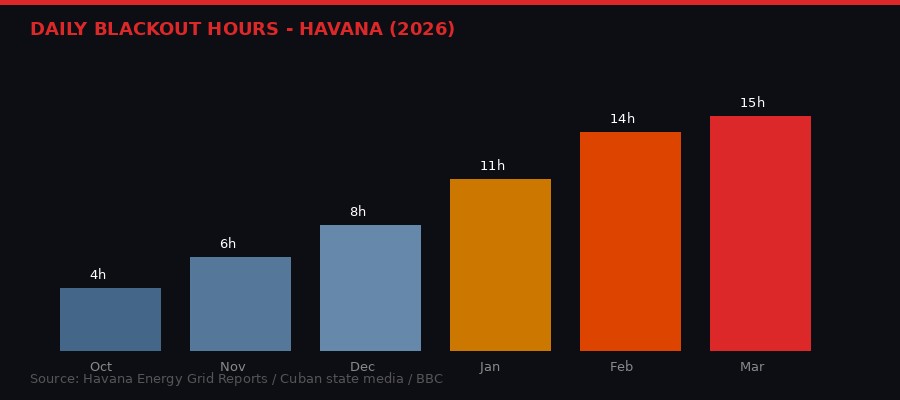
Daily blackout hours in Havana have escalated dramatically across late 2025 and into 2026. Source: Havana Energy Grid reports / BBC / Cuban state media.
When the Lights Go Out: The Anatomy of a Collapse
To understand why Cubans are burning furniture in front of Communist offices, you have to understand what their daily life looks like now. Not the government's version. The actual version.
Cuba's electricity grid runs primarily on imported fuel. That fuel came largely from Venezuela - roughly half of the island's energy needs - through an arrangement built over decades between Havana and Caracas. When US President Donald Trump moved to choke off Venezuelan oil shipments after detaining Venezuelan President Nicolas Maduro in January 2026, and threatened tariffs on any country selling oil to Cuba, the grid began to buckle. (Source: BBC, Reuters)
The US trade embargo on Cuba has been in place for six decades. But the accumulated pressure of the past year has brought it close to collapse. Venezuela's oil lifeline, frayed since Maduro's fall, was effectively severed. Cuba's domestic oil production cannot make up the difference. The grid is running on fumes - sometimes literally.
What fifteen hours of daily blackouts actually means: no refrigeration, which means food spoils faster in a country where food is already scarce. No fans or air conditioning, which in a tropical climate means genuine health risk for the elderly, infants, and people with respiratory conditions. No water pumping in buildings that rely on electric pumps - which means hauling water by hand from communal points. Charging a mobile phone becomes a logistical undertaking, requiring queuing at points where power happens to be available. Internet - Cuba's already restricted internet - becomes effectively inaccessible.
Medical care is compromised. According to Cuban doctors who have spoken to human rights groups, the situation in emergency wards has become critical. Generators exist but fuel runs short. Operations have been delayed. Dialysis machines have run on borrowed time.
Education has been disrupted across the country. Schools in Havana have sent students home repeatedly because classrooms are too hot to function when there is no power for ventilation. Teachers are delivering lessons in the early morning - the small window before the midday heat becomes dangerous - and canceling the rest.
Pharmacies are empty of basic medicines. Soap and hygiene products are scarce. Cooking gas is rationed and increasingly unavailable. The average Cuban shopping basket has not been this bare since the "Special Period" of the 1990s, when the Soviet Union collapsed and Cuba's economy contracted catastrophically.
This is the context for a man throwing a chair through a party office window. He was not ideologically motivated. He was tired.
The History of Silence - and Why It Broke
Public protest in Cuba is, by law and by enforcement, extremely uncommon. The 2019 constitution grants citizens the right to demonstrate, but the law that would define what that right actually means has been stalled in the legislature for years. In practice, Cubans who protest publicly face arrest, social pressure, job loss, and in some cases imprisonment. The July 2021 protests - the largest in decades - were met with mass arrests, long sentences, and a sustained crackdown that sent a message across the island: the cost of dissent is high.
Which makes what happened in Moron significant not because of its scale - it was small, five people arrested, a few broken windows - but because of its context. Cuba's culture of enforced public compliance, reinforced by surveillance, neighborhood committees, and genuine fear, means that even a small act of visible public rage against the party carries weight far beyond its size.
"The national spirit and patriotism of the Iranian women's national football team defeated the enemy's plans" - that kind of language reveals the playbook. Cuba's government is now describing the Moron protesters through the same lens: foreign interference, psychological operations, traitors. It is the reflex of a system that cannot admit internal failure. - Analysis, BLACKWIRE Culture Desk
The Moron protest was not organized by a political opposition. Cuban civil society, as an independent force, has been systematically dismantled over the past five years. Independent journalists have been jailed. Human rights activists have been exiled or imprisoned. The protest movements that emerged after 2021 have been largely crushed or scattered into the diaspora.
What remained was ordinary people. In Moron, footage shows a crowd that does not look like a political demonstration. It looks like neighbors who had gathered and could not leave quietly when the familiar impulse to just go home and endure was finally, after months and years, not enough.
The week before, students at the University of Havana - Cuba's oldest and most prestigious institution - had gathered to protest the disruption to their education caused by the blackouts. That protest was quieter, more structured, more obviously within the bounds of what the system might tolerate. The state media barely mentioned it.
Moron was different. Moron crossed a line.
The Geopolitics Behind the Gas Burner
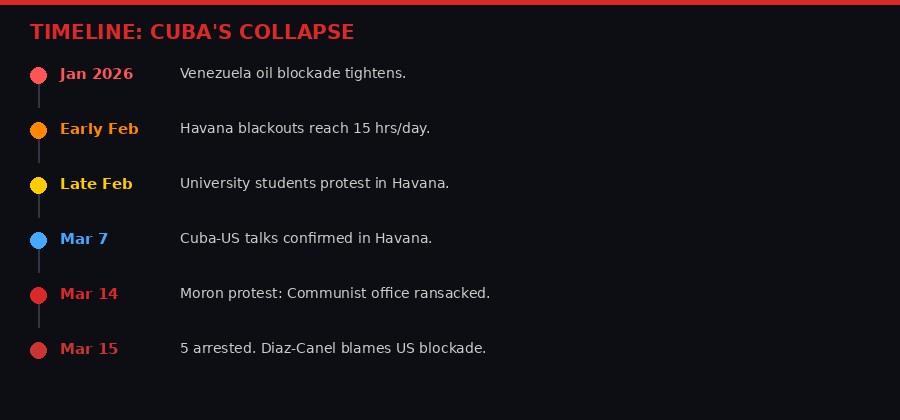
The timeline of Cuba's collapse. The blockade tightened. The lights went out. Then the streets caught fire.
The Havana government had some diplomatic news to offer on March 14 - the same day the Moron protests erupted. After months of standoff, Cuba confirmed that talks with the United States were underway "to seek solutions through dialogue." The announcement was made public hours before footage of the ransacked Communist office began circulating.
The timing is either ironic or illustrative. Cuba's leadership understands that the energy crisis has reached a point where the society may not hold without external relief. The US talks represent a pragmatic calculation: survival requires some engagement with the power that is, functionally, squeezing the island. (Source: BBC, March 14, 2026)
But Trump's objectives are not humanitarian. He said Monday that Cuba was in "deep trouble" and threatened a "friendly takeover." He positioned Cuba as "next" following Venezuela - the next domino in a Latin American reshaping where the US reclaims spheres of influence through economic pressure and regime change. From Washington's perspective, the suffering of ordinary Cubans is a feature of the strategy, not a bug.
That is a brutal calculation that the people of Moron are paying for with their daily lives. And there is no simple moral clarity available here. The Cuban government has for decades used the US embargo as cover for its own failures - mismanagement, ideological rigidity, suppression of the economic reforms that might have built resilience. The revolution that promised liberation delivered, in many ways, a different kind of imprisonment. Economic stagnation. Political stagnation. A gerontocracy that shuffled power between old men while the infrastructure crumbled.
The collapse of the Soviet Union in 1991 forced Cuba into its "Special Period" - years of extraordinary hardship that the government survived by legalizing the dollar, opening to limited tourism, and making pragmatic if painful adjustments. The system survived. But the adjustments never went far enough. Cuba remained dependent, first on the USSR, then on Venezuela, for the energy that kept the lights on. When Caracas fell, Havana had no backup plan.
Now the lights are out. And the people can see, in the darkness, how hollow the promises were.
Diaspora Dispatch: The View From Hialeah, From Madrid, From Toronto
The Cuban diaspora - scattered across Miami, Madrid, Mexico City, Toronto, and dozens of other cities - has been watching the crisis with a particular kind of grief. For many, the people on the streets in Moron are their cousins, their parents, their grandparents.
Social media has become the main communication channel between Cuban exiles and the island. WhatsApp groups carry video footage that Cuban state media will never broadcast. Messages move back and forth: "Papi, do you have power today?" "Mami, the pharmacy has nothing again." "Are you okay?"
In Hialeah, Florida - the Cuban American heartland - reaction to the Moron footage was raw. Second and third generation Cuban Americans who have lived in the US their entire lives watched the footage with the specific recognition of something their grandparents warned them about: the moment when the long Cuban patience, the cultural tendency toward quiet endurance built into generations of survival under authoritarianism, finally gives way.
Ana Perez, a 34-year-old Cuban American nurse in Miami whose grandmother left Havana in 1969, described watching the footage on her phone. "My abuela always said the day would come when people couldn't take it anymore. She said Cubans are patient but they're not stupid. When you can't feed your kids, when your medicine isn't there, when your kids can't go to school - at some point it stops being about politics and starts being about survival."
In Madrid, where a large Cuban diaspora community has formed over the past decade as emigration has surged, activists who left Cuba post-2021 have been amplifying footage from Moron and organizing solidarity calls. Human rights organizations including Amnesty International and Cubalex have called for the release of the five arrested and documented reports of additional detentions not yet confirmed by the interior ministry.
The diaspora is not unified. Older exiles who fled the revolution in the 1960s and 1970s have a different political relationship with Cuba than those who left in 2021 or 2022 fleeing crackdowns. Some want regime change; others just want the people inside to have enough to eat. What unites them is the knowledge that the people in Moron are not political operatives or foreign-funded agitators. They are the same people who have endured everything else. They just ran out of room to endure.
Diaz-Canel's Impossible Position
Cuba's president posted on X in the hours after the Moron protest. It was, by the standards of authoritarian governments responding to unrest, a relatively measured statement. He acknowledged the blackouts had caused "distress." He said the protesters' complaints were "legitimate." He blamed the US blockade. He warned that "violence and vandalism that threatens citizen tranquility" would not be tolerated.
"The prolonged blackouts have understandably caused distress. But violence and vandalism that threatens citizen tranquility will not be tolerated." - Miguel Diaz-Canel, President of Cuba, via X, March 14, 2026
What the statement reveals is the bind Diaz-Canel is in. He cannot ignore the crisis - it is physically impossible to ignore when fifteen hours of daily darkness are a lived reality for millions of people. He cannot fix it quickly - the energy infrastructure problem is structural and requires either a new oil supply or massive infrastructure investment Cuba cannot fund. He cannot open the political space enough to allow genuine dissent without risking the controlled collapse of the system he leads. And he cannot admit what is plainly true: that the Cuban government's decisions over decades contributed to the vulnerability that makes the US blockade so devastating.
The opening of talks with Washington is a signal that the math has changed. Survival requires engagement. The government that has built its identity on resistance to the imperial north is now, quietly, talking to that north in hopes of some relief. It is a profound ideological contortion - one that the hardliners inside the party will not easily accept.
Meanwhile, Cuba's foreign minister confirmed Tuesday that Cuba is open to discussions about its future - carefully chosen words that could mean almost anything, and almost certainly mean nothing that resembles the political opening that would actually address the roots of the crisis.
The five people arrested in Moron are the most visible manifestation of the government's response: order will be maintained. But order and stability are not the same thing. Order can be enforced. Stability requires a society that believes, at some basic level, that tomorrow has a chance of being better than today.
In Cuba right now, tomorrow looks like another fifteen-hour blackout.
The Things That Break When the Power Goes Out
There is a version of this story that focuses on the geopolitics - the Trump administration's strategy, Venezuela's collapse, the US-Cuba talks, the great-power competition playing out in the Caribbean. That version is accurate but incomplete.
The complete version includes: the dialysis patient who missed three sessions because the clinic had no fuel. The infant who developed heat exhaustion because the apartment had no ventilation. The teacher who is delivering curriculum by candlelight because the school cannot function. The mother who walks three kilometers to a water collection point because the pump in her building has been down for two weeks. The university student whose final exams have been postponed twice because the exam halls are too hot.
These are not statistics. They are the texture of daily life for eleven million people caught between a government that cannot provide and a geopolitical struggle that does not particularly care about them as individuals.
Cuba's last great confrontation with catastrophe - the Special Period of the 1990s - produced extraordinary cultural responses. Cuban musicians, artists, and writers made work in the darkness, during the blackouts, that captured the specific texture of survival. The so-called "alumbrones" - moments of sudden electrical power - became a cultural event. Cubans joked, because what else do you do. They found ways to be human in inhuman conditions.
That resilience is real and it is extraordinary. It is also not a solution. And there is a cruelty in romanticizing Cuban resilience - in turning the extraordinary human capacity to endure into a substitute for the material conditions that human beings actually need to live with dignity.
The people in Moron were not romanticizing anything. They were just done.
What Comes Next: Three Possible Trajectories
Cuba in March 2026 stands at a genuine inflection point. The energy crisis is not resolving on its own. The US-Cuba talks are at an embryonic stage with no timeline and no guarantees. And the social pressure inside the island continues to build.
The first trajectory is managed deterioration. The government maintains order through selective arrests and deterrence, the talks with Washington produce some limited relief - perhaps a partial easing of restrictions on fuel purchases - and the crisis stabilizes at a severe but survivable level. Cubans continue to leave in large numbers. The diaspora grows. The island ages and depletes. Change comes slowly, from attrition.
The second trajectory is escalation. More protests, more crackdowns, more international attention. The Cuban government doubles down on the external enemy narrative. The US uses the instability as justification for increased pressure. The death spiral accelerates. This trajectory ends badly for ordinary Cubans regardless of which side "wins."
The third trajectory - the one almost nobody in power is actively pursuing - is negotiated transition. A genuine political opening in Cuba, paired with genuine economic relief from the United States, creating conditions where the country can begin to rebuild its energy infrastructure, diversify its economy, and give its eleven million people something that looks like a future. This trajectory requires political will in both Havana and Washington that does not currently appear to exist.
The people who ransacked the Moron Communist office were not trying to chart any of these trajectories. They were expressing something simpler and more urgent: we cannot continue like this. Someone has to hear us. Something has to change.
Five people are now in Cuban custody for saying that out loud. The international community, busy with wars in the Middle East and geopolitical competition elsewhere, has barely noticed.
In Havana, the lights will go out again tonight for fifteen hours. In Moron, the Communist Party building will get new windows. The electricity grid will keep failing. And somewhere in the island's eleven million stories, someone will decide that silence is no longer enough - or will decide that nothing is worth the risk of speaking.
Both decisions are rational. Both are human. And neither changes the fundamental arithmetic of a country that is running out of time to fix what is broken before the people run out of patience to wait for it to be fixed.
Get BLACKWIRE reports first.
Breaking news, investigations, and analysis - straight to your phone.
Join @blackwirenews on Telegram