Tehran Blast on Quds Day, Six Americans Dead, Oil Hits $100: Iran War Day 14
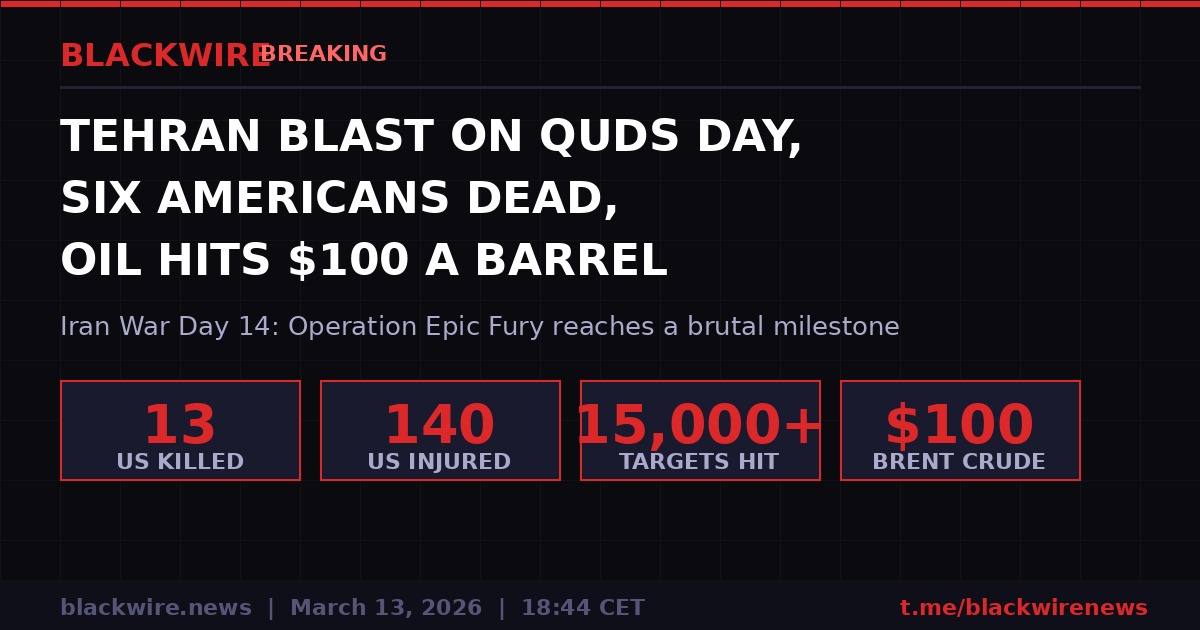
Day 14 scoreboard: 13 U.S. service members dead, oil at $100 a barrel, Hormuz effectively closed. BLACKWIRE / Generated graphic.
An explosion tore through a packed Tehran square while Iran's judiciary chief was giving a live television interview. Six U.S. airmen died in a fuel tanker crash in Iraq. Brent crude crossed $100 a barrel for the first time since the war started. Two weeks into Operation Epic Fury, nothing is slowing down.
The blast struck Ferdowsi Square in central Tehran on Friday during the annual Quds Day rally, a state-organized event where thousands of Iranians gather to chant "death to Israel" and "death to America" in support of Palestinians. Israel had issued a warning hours before via a Farsi-language X account, telling people to clear the area. Almost no one in Iran could see that warning. Tehran has nearly completely shut down the internet since the war began on February 28. [AP, March 13]
The explosion did not produce reported casualties, but the symbolism cut deep. Gholamhossein Mohseni Ejei, Iran's hardline judiciary chief, was mid-sentence in a live state television broadcast when the blast struck. His bodyguards moved in. He raised his fist and said Iran "under this rain and missiles will never withdraw." [AP, March 13]
The same day, the U.S. military confirmed that all six crew members of a KC-135 refueling aircraft had been killed when the plane crashed in western Iraq. The death toll for Operation Epic Fury climbed to at least 13 American service members. Roughly 140 others have been wounded, eight of them severely. [U.S. Central Command press release, March 13]
Brent crude oil, the global benchmark, hit $100 a barrel Thursday and was holding there Friday. It was trading at $72 a barrel when the war started. That 40 percent jump in two weeks is now bleeding directly into American wallets - the national average for a gallon of gasoline has risen from $2.30 in February to $3.60, according to AAA. [AP / AAA, March 13]
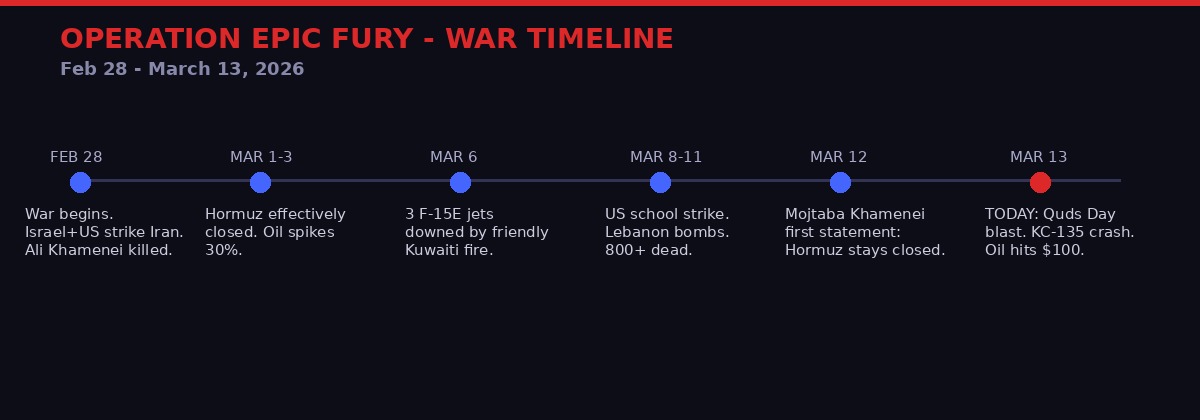
Operation Epic Fury timeline: from the opening salvo that killed Supreme Leader Ali Khamenei to today's Quds Day blast. BLACKWIRE infographic.
The Quds Day Strike: Israel Fires Into a Live Broadcast
Quds Day - the last Friday of Ramadan - is one of the Iranian regime's most choreographed annual performances. Thousands of Iranians fill city squares, holding Palestinian flags, burning Israeli and American flags, chanting slogans that play on a loop in state media. Senior officials appear. It signals unity and defiance.
This year, that defiance played out in real time under Israeli bombardment.
Israel's military had posted a warning to its Farsi-language X account before the rally, telling people to evacuate the Ferdowsi Square area. The catch: Iran has shut down internet access almost entirely since the war began. The warning was visible to virtually no one inside Iran. [AP, March 13]
Footage from the scene showed large crowds still gathered when the blast occurred. Smoke rose over Ferdowsi Square. People could be heard chanting "God is greatest" as they scattered. Israel later posted a follow-up message on X, noting that the head of Iran's judiciary was present at the rally and criticizing Tehran for restricting internet access so severely that their evacuation warnings couldn't reach the public. [AP, March 13]
Iran's judiciary chief, Mohseni Ejei, was completing a live interview for state television when the strike landed. His security detail moved in around him. He responded with defiance - fist raised, vowing the Islamic Republic would not retreat. The image of a senior Iranian official continuing a live broadcast through an explosion will circulate for days.
There were no immediate reports of casualties from the Ferdowsi blast. But the strike carries a message that goes beyond the physical damage: Israel is willing to hit the geographic and symbolic center of Iran's capital, during one of its most public annual events, with senior officials on site. The restraint of earlier weeks is eroding fast.
Israel said separately on Friday that its air force had struck more than 200 targets in Iran in the last 24 hours, targeting missile launchers, air defense systems, and weapons production facilities. [Israeli military statement, via AP, March 13]
Six Americans Dead: The KC-135 Crash and the Growing Toll
The KC-135 Stratotanker that went down in western Iraq Thursday was not shot down. U.S. Central Command said the cause remains under investigation and was "not due to hostile or friendly fire." A second KC-135 was involved in the incident; that aircraft landed safely in Israel. [U.S. CENTCOM press release, March 13]
The KC-135 is a Boeing 707-era aircraft that has been refueling U.S. combat jets for more than six decades. It is the backbone of American aerial operations across the Middle East - without tankers, strike aircraft can't reach Iran and return. The Air Force had 376 KC-135s as of last year, a mix of active-duty, National Guard, and Reserve units. The planes are aging, and the transition to the next-generation KC-46A Pegasus has moved slower than planned. [Congressional Research Service, AP]
Gen. Dan Caine, Chairman of the Joint Chiefs, confirmed the crash at a Pentagon briefing Friday morning - before the six deaths had been officially announced. Defense Secretary Pete Hegseth called the crew "heroes."
"War is hell. War is chaos. And as we saw yesterday with the tragic crash of our KC-135 tanker, bad things can happen. American heroes, all of them." - Defense Secretary Pete Hegseth, Pentagon briefing, March 13, 2026
The KC-135 is the fourth U.S. military aircraft to crash publicly since Operation Epic Fury began. Last week, three F-15E Strike Eagle fighters were mistakenly downed by friendly Kuwaiti fire. All six crew members of those jets ejected safely. [AP, March 6]
The cumulative U.S. toll now stands at 13 killed and approximately 140 wounded, with eight in serious condition. That figure places Operation Epic Fury among the most costly short-term American military engagements since Iraq and Afghanistan. The war is two weeks old.
Security analyst Yang Uk of South Korea's Asan Institute for Policy Studies noted it would be unusual for a tanker to be taken down by enemy fire, as refueling aircraft operate well behind front-line combat zones. The circumstances of this specific crash remain unclear, pending investigation. What is not unclear: the United States is losing personnel at a rate that will become politically significant quickly. [AP, March 13]
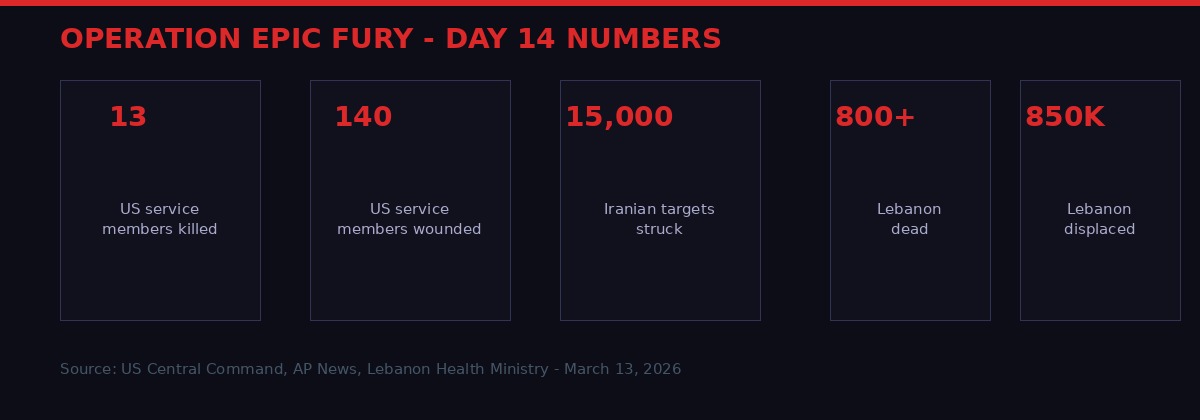
By the numbers: Day 14 of Operation Epic Fury. US killed, wounded, targets struck, Lebanon dead and displaced. BLACKWIRE infographic.
Hormuz Closed, Oil at $100: The Global Energy Crisis Nobody Planned For
About 20 million barrels of oil pass through the Strait of Hormuz every day under normal conditions. That represents roughly one-fifth of all oil traded globally. Since the war began, most tankers are avoiding the strait. Iran has effectively closed it, using a combination of mines, drone threats, and small boat harassment. [AP, March 13]
The consequences are visible in every gas station price board across the United States and Europe. Brent crude, which was at $72 a barrel when Israel and the U.S. launched the war on February 28, crossed $100 a barrel Thursday. The 40 percent increase in 14 days is the sharpest war-driven oil price spike since the 1973 Arab oil embargo. [AP / Oxford Economics, March 13]
For American consumers: the national average price of gasoline was $2.30 a gallon during Trump's State of the Union address in late February, a figure he used as evidence of his economic success. That number has climbed to $3.60 a gallon, according to AAA data published Friday - a jump of more than 50 percent in under three weeks. [AAA, AP, March 13]
"The swings in Brent crude oil prices over the past several days are eye-catching and odds are volatility will remain because of the absence of a timeline for when the conflict will deescalate and when the Strait of Hormuz, which is effectively closed, will see traffic begin to recover." - Oxford Economics analysts, Wednesday March 11, 2026
Goldman Sachs issued a forecast Thursday: higher oil prices will push inflation up, slow economic growth, and increase unemployment by year's end. The bank's analysis lands at a delicate political moment for the Trump administration. November midterm elections are eight months away. High energy prices have historically punished the party in power. [Goldman Sachs, via AP, March 13]
Trump's public messaging has shifted noticeably. In February's State of the Union, he boasted about $2.30 gas. By Thursday, he was posting on Truth Social: "The United States is the largest Oil Producer in the World, by far, so when oil prices go up, we make a lot of money." [AP, March 13]
The pivot isn't going unnoticed. Trump's Energy Secretary announced new measures this week aimed at releasing strategic petroleum reserves and opening Russian oil to non-sanctioned markets - an attempt to inject supply while Hormuz remains closed. These steps have not meaningfully moved prices. The Hormuz closure is not a supply disruption that can be patched with reserve releases. It is a physical blockade of the world's most critical oil passage, and it will remain in place as long as Iran's new supreme leader wants it there.
Hegseth, asked directly about the Hormuz problem Friday, offered a three-word reassurance: "Don't need to worry." The market is not listening.
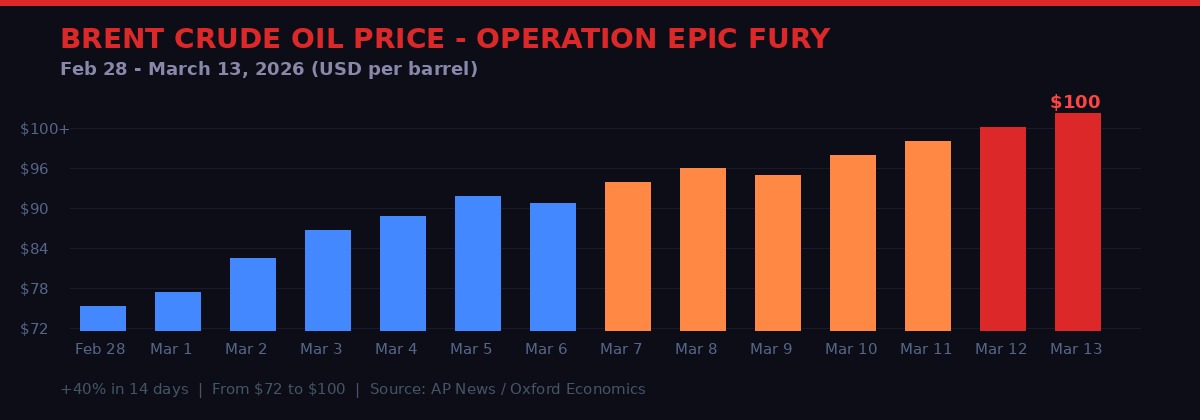
Brent crude price during Operation Epic Fury: from $72 at war start (Feb 28) to $100 on Day 14 (March 13). BLACKWIRE data chart. Sources: AP, Oxford Economics.
New Supreme Leader: Mojtaba Khamenei's First Words
When Israel and the United States launched Operation Epic Fury on February 28, one of their first targets was Iran's Supreme Leader Ayatollah Ali Khamenei. He was killed in that opening strike - a decapitation blow at the top of Iran's power structure that U.S. and Israeli planners apparently calculated would fracture the regime's will to fight. It did not. [AP]
Ayatollah Mojtaba Khamenei, Ali's son, assumed leadership. He has not appeared on camera since the war began. Israel's military assesses he was wounded in the same opening strike that killed his father. Hegseth told reporters Friday that Mojtaba Khamenei "is wounded and likely disfigured," though he provided no evidence and declined to elaborate. [AP, March 13]
On Thursday, Mojtaba Khamenei issued his first public statement. It was read aloud by a news anchor - not delivered by the new supreme leader in person. He did not specify his location or his physical condition. [AP, March 12]
The statement contained no room for interpretation:
"The lever of closing the Strait of Hormuz must certainly continue to be used as well. Studies have also been conducted on opening other fronts in which the enemy has little experience and would be highly vulnerable. Their activation will take place, if the wartime situation continues and in accordance with considerations of expediency." - Ayatollah Mojtaba Khamenei, first public statement, March 12, 2026
The reference to "other fronts" was notable and underreported. It suggests Iran is actively planning escalation beyond the current theater - potentially cyberattacks on critical infrastructure, proxy activations in new geographies, or economic warfare targeting shipping lanes beyond Hormuz. AP reported separately Friday that Iran-linked hackers are targeting U.S. systems and allied networks, raising the risk of cyberattack escalation. [AP, March 13]
On his father's death: "I had the honor of seeing his body after his martyrdom. What I saw was a mountain of steadfastness, and I was told that the fist of his intact hand had been clenched." He pledged that the blood of every Iranian killed in the conflict would be avenged. He singled out a U.S. strike on the Shajareh-Tayyebeh school in Minab - believed to have killed children - as carrying "special status" in Iran's accounting of grievances. [AP, March 12]
He also warned Iran's Gulf neighbors directly: "These countries must clarify their position regarding those who have attacked our beloved homeland and killed members of our people. I recommend that they shut down those bases as soon as possible." The message was aimed at Gulf states hosting U.S. forces, including Kuwait, Bahrain, and Qatar. [AP, March 12]
Lebanon in Ruins: Over 100 Children Dead
Lebanon did not start this war. It is paying for it anyway.
Israel's campaign against Iran-backed Hezbollah has been running parallel to the strikes on Iran itself since day one of Operation Epic Fury. The scope of the Lebanese front has grown steadily. As of Friday, Lebanon's Health Ministry reported at least 800 people killed and 850,000 displaced. More than 100 of the dead are children. [Lebanon Health Ministry, AP live updates, March 13]
On Friday, at least eight people were killed in an Israeli strike on Sidon, Lebanon's southern coastal city. Nine others were wounded. Rescuers were still searching rubble when the Health Ministry updated its numbers. [Lebanon Health Ministry, March 13]
The humanitarian situation in Lebanon is deteriorating faster than international organizations can respond. The UNHCR and World Food Programme have described access corridors as dangerously constrained. 850,000 displaced people in a country of roughly 5 million is the equivalent of displacing 55 million Americans - proportionally, one of the largest displacement crises in recent Middle Eastern history.
Israel has shown no indication of pausing its Hezbollah campaign. Officials in Tel Aviv have framed Lebanon as a necessary second front: as long as Hezbollah retains its arsenal and command structure, they argue, any ceasefire with Iran is reversible. The United Nations Security Council has passed no binding resolution. The United States holds veto power and has not supported any resolution that would constrain Israeli operations.
Iran's continued missile and drone attacks on Israel and Gulf states show that the Hezbollah pressure has not compelled any strategic retreat on Tehran's part either. Both sides are absorbing punishment at a rate that would have been inconceivable three weeks ago. Neither side is showing the signs of collapse that the war's architects may have anticipated.
Regional Spillover: Missiles Over Turkey, Drones Into Oman
The war's footprint is expanding beyond its declared theaters.
On Friday, the USS Oscar Austin - a U.S. Navy guided missile destroyer - shot down an Iranian ballistic missile over Turkey. It was the third such interception over NATO territory in two weeks. Residents in Adana, Turkey's southern city that hosts Incirlik Air Base, reported a loud explosion and heard base sirens. U.S. forces at Incirlik have been supporting air operations against Iran. [U.S. official speaking anonymously to AP, March 13]
Iran's missiles reaching NATO territory - even if intercepted - represents a significant expansion of the conflict's geography. Turkey, a NATO member, has not formally joined Operation Epic Fury. The repeated missile threats over its soil are creating pressure on Ankara that has not yet found a public political expression.
In Oman, two people were killed when Iranian drones crashed in the Sohar region. Oman has historically served as a backchannel between Iran and Western governments. Its exposure to Iranian drone spillover is a sign of how thoroughly Iran is prioritizing regional pressure over diplomatic optionality. [Oman News Agency, March 13]
Iran's attacks on oil and other infrastructure across Gulf states continued Friday, targeting energy facilities and storage depots. The attacks have not produced a catastrophic disruption to Gulf state energy infrastructure - yet. But they are raising insurance costs, disrupting maintenance schedules, and signaling that no facility in the region is fully safe.
The building in Dubai's financial district that appeared partially damaged Friday - caused by falling debris from a successful missile interception, according to UAE authorities - was a visible demonstration of the conflict's blast radius. The world's most heavily traded financial hub is taking physical damage from a war being fought hundreds of miles away. [AP Photo/Altaf Qadri caption, March 13]
Allies Breaking Ranks: Germany Demands an Exit Plan
The cracks in the Western coalition backing Operation Epic Fury are becoming harder to paper over.
German Chancellor Friedrich Merz spoke alongside the prime ministers of Norway and Canada at military exercises in Norway on Friday. His message was direct: he wants a "convincing plan" for how to end the war. It was not a call for ceasefire - but it was not a ringing endorsement of indefinite military escalation either. [AP, March 13]
Germany is particularly exposed to the oil price shock. Unlike the United States, Germany does not produce significant quantities of domestic oil. European economies running on $100 Brent crude face inflation that U.S. policymakers can partially offset through domestic production gains. German industrial competitiveness is already under pressure from post-Ukraine energy costs. Another sustained oil spike threatens to tip a fragile economy into recession.
Norway's prime minister, appearing alongside Merz, leads a country that is a major oil producer and NATO member. Norway has benefited financially from higher oil prices while simultaneously hosting NATO military exercises. The optics of that position have become complicated.
Canada's prime minister has his own pressure: Canadian consumers are paying more at the pump, and the political calendar - Canada faces its own electoral tests in the coming months - makes an open-ended oil price war difficult to sustain publicly.
Trump, asked about ending the war, was characteristically opaque:
"When I feel it in my bones." - President Donald Trump, Fox News interview, March 13, 2026
There is no public indication that Trump's bones are feeling anything other than continued military pressure. The administration has not proposed a ceasefire framework, has not engaged Iran through any acknowledged diplomatic back-channel, and has publicly rejected any UN Security Council resolution that would constrain Israeli or American operations.
The military objective - forcing Iran's capitulation or regime change - has not been achieved. The secondary objective - keeping the Strait of Hormuz functional - has not been achieved. The economic cost is accelerating. The political clock, with November midterms eight months away, has started ticking.
Day 14 - Key Events Timeline
What Comes Next: Escalation Paths and Endgame Scenarios
The new Khamenei's reference to "other fronts" that "the enemy has little experience with" is the most important phrase in any statement issued this week. It could mean several things, and none of them are good for stabilization.
The most likely near-term escalation: intensified cyberattacks. Iran's cyber apparatus - including groups assessed by U.S. intelligence to be state-affiliated - has been quiet since the war began in terms of destructive operations. AP reported Friday that these groups are now "taking aim at US and other targets." A serious cyber strike on critical infrastructure in the U.S., Europe, or Gulf states could trigger a response that expands the conflict's scope dramatically. [AP, March 13]
The secondary path: proxy activation in geographies where the U.S. has thin presence and poor intelligence coverage. Iran maintains relationships with militias from Iraq to Yemen to West Africa. Some of these have been dormant. A deliberate activation - particularly in Iraq, where U.S. troops are stationed and where the KC-135 just went down - would present U.S. commanders with a multi-front crisis they are not resourced to handle simultaneously.
The Hormuz question is the central variable. Every day the strait remains closed, the economic cost to the global system mounts. The question is not whether pressure will eventually force resolution - it will. The question is who breaks first. Iran is paying an enormous military price. The United States is paying an escalating economic price. Both leaderships are signaling they will not back down. That is the definition of a war that outlasts its original plan.
Goldman Sachs's forecast - higher inflation, slower growth, rising unemployment by year's end - is a political prediction as much as an economic one. If that forecast proves correct, the November midterms will not be a referendum on Operation Epic Fury's success. They will be a referendum on whether the American public was willing to pay $4 gas to pursue regime change in Tehran.
Neither side has achieved its stated objectives. Iran has not expelled U.S. forces from the region. The United States has not collapsed Iran's will to fight. The new supreme leader is wounded, possibly disfigured, and running a government from an undisclosed location - and he is still closing the Strait of Hormuz.
Day 14 is the halfway point to a month. At the current pace of U.S. casualties, economic disruption, and regional spillover, day 30 will look nothing like today. The only question is in which direction.
Get BLACKWIRE reports first.
Breaking news, investigations, and analysis - straight to your phone.
Join @blackwirenews on Telegram