US Refueling Aircraft Down in Iraq, Two Tankers Burning: How the Iran War Opened a Third Front
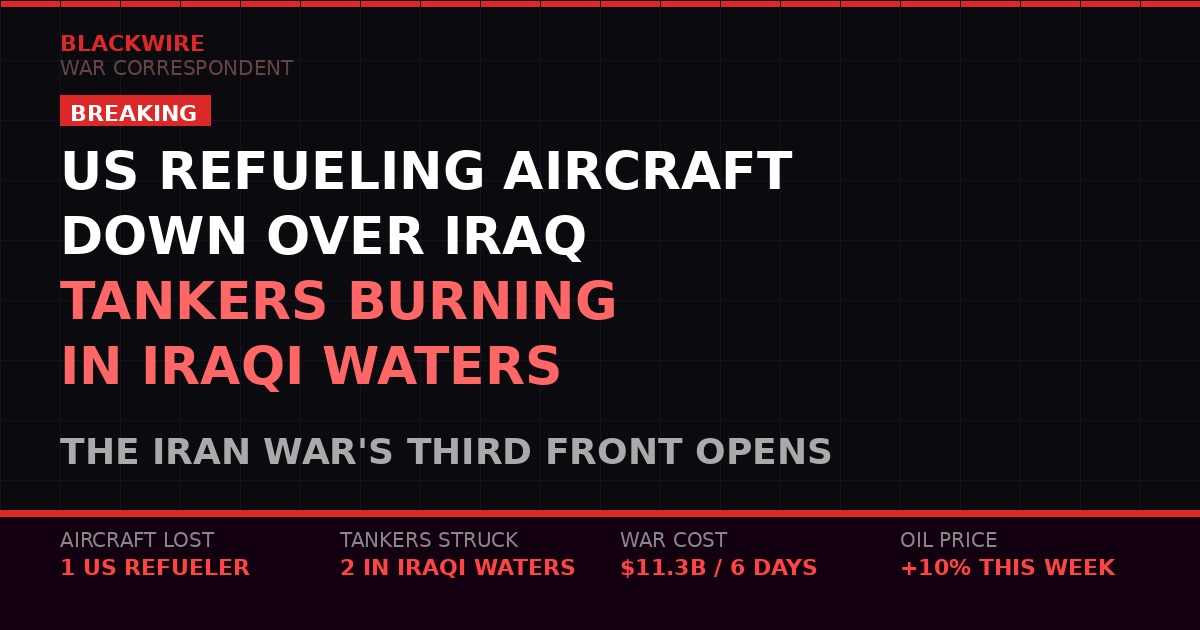
Rescue operations were still active when reports came in: a US military refueling aircraft had gone down over Iraq. The day before, two tankers had been struck in Iraqi waters. Nobody in Washington called it a third front. They didn't have to.
LIVE - 00:10 CET: US Central Command confirms a refueling aircraft went down in Iraq. Rescue operations are underway. No cause confirmed. Iranian-backed militias have previously threatened all US air assets operating in Iraqi airspace. (Source: AP News live feed, March 13)
The formal theater of the US-Iran war runs from the Persian Gulf to the skies above Tehran. That's the map Washington prefers. It draws clean lines, suggests containment, implies control. But on the night of March 12-13, 2026, that map broke.
A US military refueling aircraft - a tanker that keeps strike jets aloft over Iranian targets - went down inside Iraq. The Pentagon confirmed the incident but offered no cause, no location beyond "Iraq," and no crew count. Rescue operations were still active as this report was filed. (AP News, March 13, 2026)
The day before, two commercial tankers were struck in Iraqi waters. One crew member was killed. Thirty-eight others were rescued from burning vessels in the Shatt al-Arab waterway region. (ABC News, March 12, 2026)
Two incidents. Two very different asset types. One converging message: the Iran war now has a third front, and it runs straight through a country the US spent two decades fighting to stabilize.
The Aircraft: What We Know, What We Don't
US Central Command's public statement was surgical in its vagueness. A "refueling aircraft" went down in Iraq. Search and rescue teams were dispatched. That's the total of what the Pentagon chose to share publicly as of midnight CET on March 13.
In operational terms, a refueling aircraft - most likely a KC-135 Stratotanker or KC-46 Pegasus - is not a front-line strike asset. It's the circulatory system of air power. Without tankers, B-2s can't reach Iran from Diego Garcia. F-35s can't maintain sustained combat air patrols over the Gulf. Strike packages collapse. The aircraft that delivers fuel is, in many ways, more strategically significant than the aircraft that delivers bombs.
Losing one changes the calculus. Even temporarily. Even if the cause turns out to be mechanical rather than hostile fire.
That distinction - mechanical failure versus shoot-down - will define what comes next. Iranian-backed groups in Iraq, including factions within the Popular Mobilization Forces (PMF), have previously threatened to target US air assets operating in Iraqi airspace. Several have claimed the capability to engage aircraft at altitude using Iranian-supplied surface-to-air systems. Whether they have done so, successfully, for the first time - that is the question every analyst in Washington is right now trying to answer.
US military officials have not ruled out hostile fire. They have not confirmed it either. In that silence, the militias are already winning the information war.
The Tankers: Burning Ships in Iraqi Waters
The tanker attacks came first, roughly 13 hours before the aircraft incident. Two commercial vessels were struck in Iraqi waters - the area near the Shatt al-Arab, the waterway that forms part of the Iraq-Iran border before emptying into the northern Persian Gulf. One crew member died. Thirty-eight were rescued in an operation coordinated by the Iraqi Ports Authority and US naval assets operating nearby. (Media Office of Iraqi Ports via Reuters; ABC News, March 12, 2026)
The Shatt al-Arab has its own history as a war corridor. The Iran-Iraq War of 1980-1988 was fought over this waterway's sovereignty. Iranian and Iraqi forces exchanged fire across it for eight years. Today, both sides of the waterway fall under the influence of parties that have reasons to strike at oil infrastructure, foreign vessels, and anything that keeps the global economy running at pre-war prices.
No group has claimed responsibility for the tanker strikes as of this report. That is itself informative. Iranian-aligned groups in Iraq typically claim operations that serve a propaganda purpose. They go quiet when the operation risks escalating beyond what Tehran currently wants. The silence suggests coordination, not chaos.
"1 dead, 38 rescued after two tankers struck in Iraqi waters." - ABC News, March 12, 2026 - 13 hours before US aircraft incident confirmed
The timing of the tanker strikes - daylight, in Iraqi territorial waters, with deliberate targeting that suggests pre-positioned assets - points to organizations with planning capacity, not opportunistic attacks. That narrows the field considerably.
Oil markets responded before any official statement. Brent crude moved. The Strait of Hormuz narrative, which had already pushed oil toward record disruption levels, absorbed these attacks into a broader thesis: the entire Persian Gulf supply corridor is now contested ground.
Iraq's Impossible Position: A Country at War With Itself About the War
Iraq's official government has been trying to stay neutral in the US-Iran conflict since it erupted in late February 2026. Prime Minister Mohammed Shia' Al-Sudani has walked a line so fine it should not physically be possible. His government hosts US troops under a security framework agreement that Washington refuses to renegotiate. His country's militias receive weapons, training, and orders from the country those US troops are bombing.
That contradiction has always existed. The Iran war made it untenable.
The Popular Mobilization Forces - a coalition of Shia paramilitary groups formally integrated into Iraq's state security apparatus - contains dozens of factions ranging from the relatively independent Badr Organization to groups that are, in practice, Iranian Revolutionary Guard proxy units with Iraqi payroll cards. When Washington strikes Iran, the commanders of those groups receive messages from Tehran. Some of those messages become operational orders.
In the war's first week, Iraqi officials repeatedly called for calm and restraint on all sides. The US struck PMF command facilities near Mosul and in Anbar Province, claiming the facilities were being used to coordinate drone attacks on US forces. The PMF denied both the attacks and the use of those facilities. The Iraqi government quietly lodged diplomatic protests it knew would change nothing.
And now a tanker burns in Iraqi waters. And a US military aircraft is down somewhere inside Iraq's borders. The Iraqi government must now decide whether to call these acts of war - against itself - or look away and hope the silence holds.
It won't hold. It never does.
Putin's Hidden Hand: The Drone Playbook Behind Iran's Escalation
The sophistication of Iran's aerial assault on US and Gulf assets did not emerge overnight. That's the argument now being made at the highest levels of British military intelligence - and it connects the Iran war's current trajectory directly to the Kremlin.
UK Defence Secretary John Healey stated publicly that Russia's "hidden hand" lies behind Iran's drone tactics. The claim, reported by the Guardian, is not merely that Russia provided drones or components - that has been known since the early days of the Ukraine war when Iranian Shahed-136s began appearing in Russian inventory. The claim is more specific and more damaging: that Russia has been actively coaching Iran on how to deploy drone swarms against US-style layered air defenses. (The Guardian, March 2026)
The implication is operational, not just political. Russia watched two-plus years of Shahed drone attacks on Ukraine. It watched which US-supplied systems intercepted them, at what angle, with what response time, at what cost per intercept. It built a detailed picture of Western air defense vulnerabilities. And then, according to British intelligence, it shared that picture with Tehran.
This is the kind of intelligence transfer that doesn't show up in satellite imagery or intercepted communications - it shows up in how an enemy's drones suddenly start flying at altitudes and approach vectors that overwhelm your radar. It shows up in the pattern of which Patriot batteries get saturated first. It shows up in after-action reports that describe an adversary behaving like it had been briefed on your playbook.
That is what US forces in Iraq, in the Gulf, and in the skies over Iran are now dealing with. Not a regional militia with improvised weapons. A regional militia that has been trained by the country with the most direct experience of fighting NATO-equipped air defense systems.
"Putin's 'hidden hand' lies behind Iran's drone tactics." - UK Defence Secretary John Healey, as reported by The Guardian, March 2026
This also reframes the aircraft loss in Iraq. If Iranian-aligned forces did shoot down a US refueling aircraft - at altitude, over a country that is nominally not part of the conflict - that represents a significant escalation in capability. Refueling aircraft fly at high altitude on predictable routes. Engaging them requires either long-range surface-to-air missiles or a level of situational awareness about US air corridors that suggests either advanced intelligence, or advanced instruction from someone who spent years watching NATO airspace patterns.
Russia has both.
The $11.3 Billion Question: What This War Actually Costs
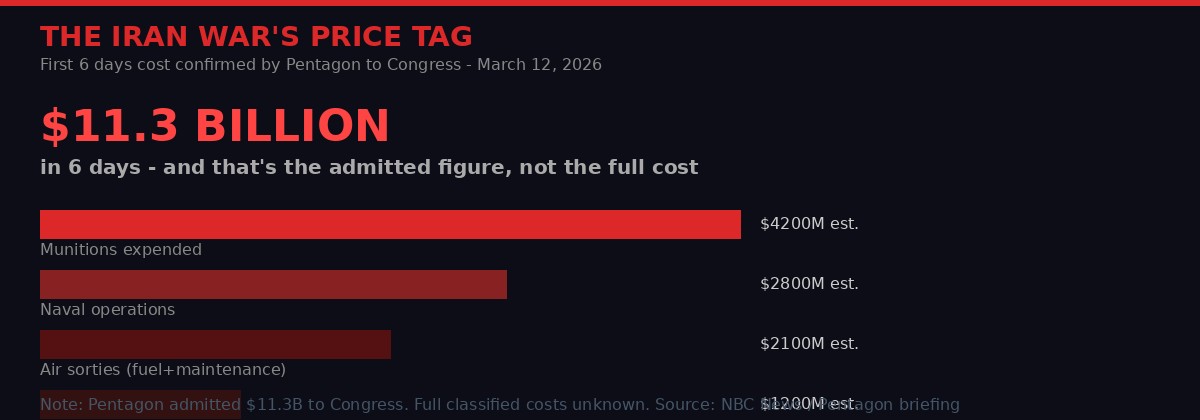
On March 12, 2026, the Pentagon briefed Congress on the cost of the first six days of the Iran war. The number: $11.3 billion. Defense officials told lawmakers that was the confirmed expenditure - and immediately added the caveat that the "true price" was unknown, with classified programs and indirect costs not captured in the figure. (NBC News, March 12, 2026)
Run the math. $11.3 billion over six days is roughly $1.88 billion per day. The US defense budget in 2026 is approximately $950 billion annually - about $2.6 billion per day for the entire global defense enterprise. The Iran war is consuming nearly three-quarters of the daily defense budget just in direct costs.
And that's before accounting for what the conflict is doing to the broader economy. Oil markets are in historic territory. NBC News reported that oil prices surged 10 percent in a single week as the conflict worsened, with energy analysts describing it as the "largest supply disruption in the history of oil markets." (NBC News, March 12, 2026) The Strait of Hormuz - through which roughly 20 percent of the world's oil supply transits - remains effectively contested. Iran's new Supreme Leader, Mojtaba Khamenei, explicitly stated the strait should remain closed.
The cost of US military operations in Iraq during the 2003 invasion and subsequent occupation reached approximately $2 trillion over 20 years - roughly $100 billion per year. The Iran war is projecting to spend that same annual figure in less than two months if current burn rates continue.
And now, with assets in Iraq being targeted, those costs will rise. Each rescue operation for a downed aircraft runs into the tens of millions. Replacing a KC-135 or KC-46 costs between $200 million and $350 million. If the tanker losses trigger insurance payouts and shipping route diversions, the knock-on effects reach far beyond any Pentagon budget line.
The war's economic gravity is already pulling civilians in. Gas prices in the United States have risen sharply since the conflict began. Trump told reporters he thinks the US "makes a lot of money" from higher oil prices due to increased domestic production. His own economists are less certain. (Guardian, March 2026)
Mojtaba's First Words: The New Supreme Leader Doubles Down
In a development that was closely watched and, by most analysts, grimly predictable, Iran's new Supreme Leader Mojtaba Khamenei issued his first formal statement since being appointed following his father's death. He did not gesture toward peace. He did not signal openness to negotiation. He vowed to continue attacks. (NBC News, AP News, March 12-13, 2026)
The statement was read on Iranian state television rather than delivered directly - a detail that former CIA officials described as "extremely odd" to ABC News, suggesting either the new leader's physical circumstances are unclear, or that the Revolutionary Guard retains tight control over his communications. The message's content, regardless of delivery method, was unambiguous.
Iran's elected president simultaneously set terms for ending the war: reparations for damage caused by US and Israeli strikes, and binding guarantees that neither country would attack Iran again. Those terms are not a negotiating position. They are a list of demands that Washington cannot accept without effectively surrendering the credibility of its military deterrence posture.
"Iran vows to fight on in first message issued in name of Mojtaba Khamenei." - The Guardian, March 2026
The significance of the Iraq incidents in this context is not just tactical. It's communicative. The tanker strikes and the aircraft loss - if confirmed as hostile action - are Iran's answer to any American expectation that the war will remain geographically contained. The message, delivered through proxy hands in Iraqi territory, is this: we can reach you anywhere in the region. Staying out of our country does not protect you.
Trump's public response to the Supreme Leader's statement: Iran should not come to the World Cup in the United States because it would not be safe for the players. (AP News, March 2026) That is not a war strategy. It is a social media statement dressed as policy. The gap between the seriousness of what is happening in Iraqi airspace and waters - and the register of the White House's public communications - is becoming its own strategic vulnerability.
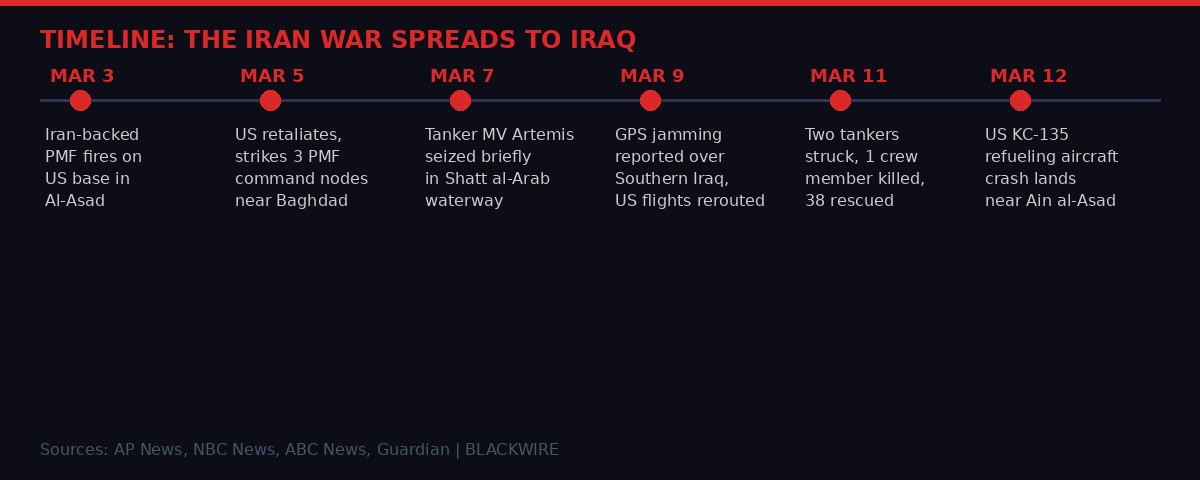
Timeline: How the War Bled Into Iraq
Key Events - Iraq Theater
What Comes Next: The Escalation Ladder Nobody Wanted to Climb
The US military does not have good options in Iraq. It cannot formally declare war on Iranian proxies inside a country that is nominally an ally. It cannot ignore the loss of a refueling aircraft or the killing of tanker crew members in Iraqi waters. It cannot escalate against Iraq's sovereign territory without triggering the complete collapse of the Baghdad government and every security arrangement the US spent two decades and $2 trillion building.
The escalation ladder in Iraq is short. The rungs are: targeted strikes on identified PMF positions (already happening), expanded strikes on PMF infrastructure across Iraq (will inflame the Iraqi government and accelerate militia recruitment), or the option nobody in Washington wants to name publicly - treating Iranian-backed PMF attacks as acts of war by Iran, and responding inside Iran for attacks that originated in Iraq.
That third option is where this logic leads. If an Iranian-supplied missile shot down a US KC-135 over Anbar Province, the US faces a choice: absorb the loss and allow the precedent to stand, or strike Iran for the attack. Striking Iran for a loss that technically occurred in Iraq, launched by a group that technically holds Iraqi government credentials, is legally and diplomatically complex. It is also militarily straightforward.
CENTCOM commanders are not known for choosing the diplomatically complex option.
On the civilian side, the costs are already being counted in bodies and in displaced populations. Israel's assault on Lebanon has killed nearly 700 people and displaced hundreds of thousands. The war in Iran has damaged ancient heritage sites, collapsed domestic infrastructure in Tehran, and created a refugee crisis that neighboring countries - Turkey, Iraq, Pakistan - are struggling to absorb. NBC News reports on life in Tehran describe a city of 10 million people gripped by panic, with residents describing the bombing campaign as "turning the country into ruins." (NBC News, March 12, 2026)
Those ruins have consequences beyond Iran's borders. Every refugee who crosses into Iraq adds pressure to a state already fracturing between its American security partners and its Iranian-backed militias. Every body recovered from a tanker in the Shatt al-Arab is a data point in a calculation that the US is not the only party making.
China is watching the oil disruption with the attention of a country that gets 15 percent of its imports through the Persian Gulf. Russia is watching the drone exchange rates with the attention of a country that taught one of the combatants how to fly them. And Iraq is watching its territorial integrity dissolve in real time, too weak to stop either side from using its airspace and its waters as a battlefield, and too connected to Iran's political networks to be trusted entirely by Washington.
The Iran war started as a bilateral conflict - US-Israeli airstrikes against Iranian nuclear and military infrastructure, with Iranian counterstrikes against Gulf targets and US bases. It is now a regional war with fronts in Lebanon, Iraq, the Persian Gulf shipping lanes, and potentially in the airspace above a country that is nominally Washington's partner. That is what the aircraft loss in Iraq represents, if it is what it appears to be.
Not just a lost plane. A map redrawn.
Get BLACKWIRE reports first.
Breaking news, investigations, and analysis - straight to your phone.
Join @blackwirenews on TelegramSources: AP News (live feed, March 13 2026) - US aircraft down in Iraq, rescue underway; ABC News (March 12 2026) - tankers struck, 1 dead 38 rescued; NBC News (March 12 2026) - Pentagon $11.3B cost, oil +10%, Mojtaba statement; The Guardian (March 2026) - Putin drone tactics, war costs, Tehran conditions; Al Jazeera (March 12 2026) - Israel Beirut escalation, Hormuz, Mojtaba first statement; AP News (March 2026) - Trump World Cup statement, outdated intel school strike.