
The math of the Iran War is getting brutal fast. In nineteen days of fighting, the United States and Israel have launched hundreds of airstrikes, killed Iran's supreme leader and much of its military command, and dropped 5,000-pound bombs on underground weapons storage facilities. The Pentagon is now requesting an additional $200 billion in emergency funding - a senior administration official confirmed Thursday - sending the war's projected cost past any conflict since the peak years of Iraq and Afghanistan combined.
Meanwhile, the weapon Iran still controls is the one that hurts everywhere at once: energy. On Thursday, Iranian missile and drone strikes hit Qatar's Ras Laffan LNG terminal, a Saudi refinery in the Red Sea port of Yanbu, two refineries in Kuwait, and gas operations in Abu Dhabi. Two vessels were struck near the UAE and Qatar coastlines. A barrel of Brent crude briefly touched $119 - up more than 60 percent since the war began February 28. European natural gas rose 17 percent in a single session and has doubled in a month.
The Strait of Hormuz, through which a fifth of the world's traded oil normally passes, remains effectively choked. Iran has sunk or damaged ships, threatened passage, and used the strait's bottleneck as leverage since the opening salvo. Only around 90 vessels - mostly flagged to India, Pakistan, and China - have transited the strait since the war began, according to AP News. For the rest of the global economy, the impact is a slow-motion catastrophe that is now accelerating.
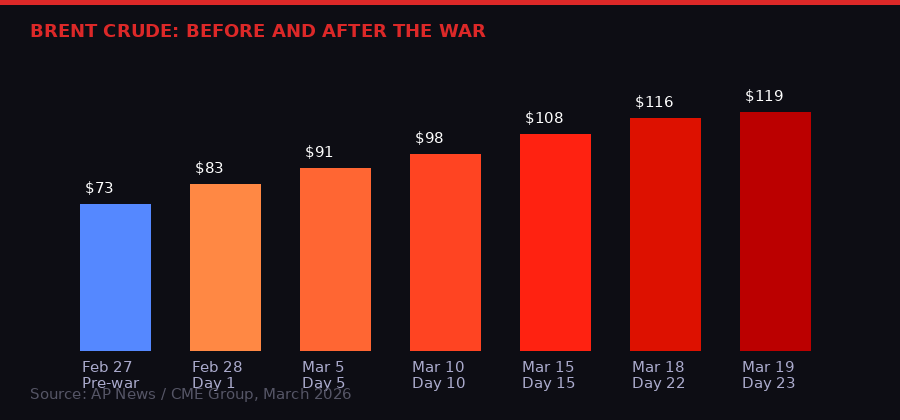
Brent crude price progression: from $73 before the war to $119 at the peak on March 19, 2026. (BLACKWIRE / AP News / CME Group)
The Pentagon's $200 Billion Ask

US naval forces have been central to the Iran War effort. The Pentagon is now requesting emergency supplemental funding. (Pexels)
The number that landed in Washington Thursday - $200 billion in additional funding requested by the Pentagon - is staggering by any historical measure. The Department of Defense sent the emergency supplemental request to the White House, a senior administration official confirmed to AP News, speaking on condition of anonymity to discuss internal budget deliberations.
For context: the entire first year of the Iraq War in 2003 cost approximately $53 billion. The peak year of US spending in Afghanistan was around $120 billion. The Iran War is now projected to eclipse both - within its first month.
Defense Secretary Pete Hegseth, speaking to reporters Thursday, gave no indication of any move toward scaling back. He said the US military "controls the fate" of Iran and that Tehran "should not, going forward, target Arab allies, Arab countries." He implied additional senior Iranian leaders would be targeted, referring specifically to the Islamic Revolutionary Guard Corps and the Basij internal security force - whose leader was killed by Israel earlier this week.
"The last job anyone in the world wants right now: senior leader for the IRGC or Basij. Temp jobs, all of them." - Defense Secretary Pete Hegseth, March 19, 2026
General Dan Caine, chairman of the Joint Chiefs of Staff, outlined Thursday that US forces are now dropping 5,000-pound bombs on underground weapons storage facilities, hunting Iranian naval vessels in the Strait of Hormuz with warplanes, and using helicopters to intercept Iranian drone swarms. Israel, separately, announced it struck Iranian targets in the Caspian Sea for the first time - hitting ships, a shipyard, and a command center, according to Israeli military spokesman Lt. Col. Nadav Shoshani.
Trump on Monday said the war is "a very small price to pay" and predicted oil prices "will drop like a rock" once fighting ends. Neither assertion has been supported by market pricing or independent analyst assessments. With no diplomatic track visible and the Pentagon seeking $200 billion more, the "small price" is only growing.
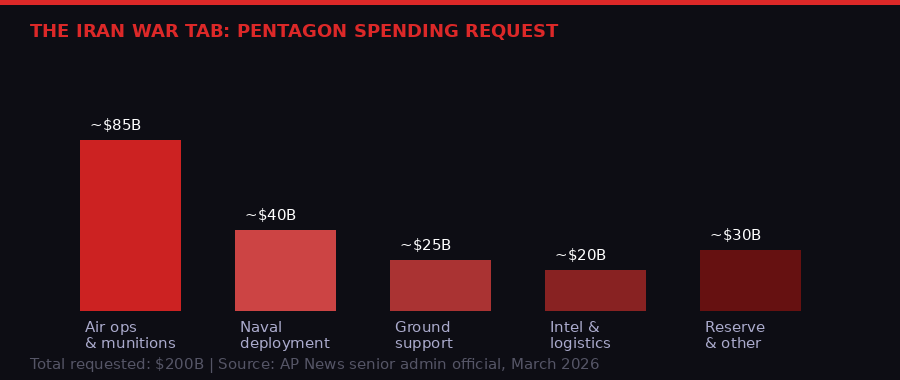
Estimated Pentagon spending allocation across the Iran War's primary operational categories. (BLACKWIRE / AP News)
South Pars: The Strike That Triggered the Escalation Cascade

South Pars - the world's largest gas field - sits beneath the Persian Gulf, shared between Iran and Qatar. Israel's strike on the Iranian side triggered Thursday's Gulf-wide energy attacks. (Pexels)
Thursday's blitz on Gulf energy infrastructure was Iran's direct answer to Israel hitting South Pars - Iran's section of the world's largest natural gas field, which it shares with Qatar under the name North Field. The field lies beneath the Persian Gulf. Iran's side supplies roughly 80 percent of the country's domestic natural gas, used for electricity generation, household heating, and cooking, according to the International Energy Agency.
Israel's attack on South Pars was not aimed at Iran's export revenue but at its domestic survivability. The Soufan Center, a New York-based security research organization, said in a research note: "Israel's target selection in this war has heavily focused on institutions, leaders and infrastructure. It now seeks to inflict additional pressure on the regime by making the living conditions for civilians intolerable."
Iran's retaliation was swift and calibrated to inflict maximum economic pain on its Gulf Arab neighbors. Qatar - which exports roughly a fifth of the world's LNG from its Ras Laffan facility - had already shut the terminal after an earlier attack. Thursday's strike hit Ras Laffan again, causing what Qatari authorities described as extensive damage. Saudi Arabia confirmed its SAMREF refinery in Yanbu - the Red Sea port it had been using as an alternative export route around the Strait of Hormuz - was struck. Kuwait reported two of its refineries targeted. Abu Dhabi confirmed gas operations hit.
Arab League Secretary-General Ahmed Aboul Gheit called the strikes a "dangerous escalation." Qatar, Saudi Arabia, Kuwait, and the UAE all denounced Iran. But all four, as non-participants in the US-Israeli military campaign, are in an impossible position: absorbing the economic damage of a war they didn't start and can't stop.
"Qatar and Iran both tap the same underground reserves. Qatar invested billions developing it as an LNG export business. Iran's attack on what is effectively shared infrastructure is an act that damages both sides." - Andres Cala, geopolitical analyst, Montel News / AP
The Global Market Rout: From Tokyo to Frankfurt

Markets worldwide are selling off as Iran's energy war intensifies. Japan and South Korea logged the steepest single-day losses. (Pexels)
The market damage on Thursday was global and severe. Japan's Nikkei fell 3.4 percent. South Korea's KOSPI dropped 2.7 percent. Germany's DAX fell 2.8 percent. The UK's FTSE shed 2.3 percent. On Wall Street, where US companies are less directly exposed to Gulf energy, losses were more contained - but still meaningful. The S&P 500 fell 0.7 percent, on track for its fourth consecutive losing week - the longest such streak in a year.
Brent crude briefly topped $119 per barrel before pulling back to $110.90, still a 3.2 percent rise on the day. US benchmark West Texas Intermediate added 2.2 percent to $98.40. European benchmark natural gas prices rose 17 percent on Thursday alone and have doubled in the past month, according to AP News.
The bond market told an equally alarming story. Traders at CME Group are now pricing an 8 percent chance the Federal Reserve hikes its main interest rate by year-end - a complete reversal from a month ago, when markets were pricing a 74 percent probability of two or more cuts in 2026. The 10-year Treasury yield rose to 4.28 percent, up from 3.97 percent before the war started. The two-year yield hit its highest level since the summer.
The Federal Reserve held rates steady at its meeting Wednesday - no surprise there. But Chair Jerome Powell's comments were interpreted by traders as closing the door further on cuts this year. The risk: if oil keeps rising and feeds through to broader inflation, the Fed's room to maneuver shrinks dramatically. A stagflationary trap - high inflation, weak growth - is what kept economists awake through the 1970s energy shocks. The comparisons are already being made openly.
"The biggest short-term losers of the war will be US consumers of oil and gas, as energy prices rise. It turns out fossil fuels have their own supply risks, and the administration has no answers." - Tyson Slocum, energy director, Public Citizen
The Bank of Japan, the European Central Bank, and the Bank of England all held their own rates steady Thursday. None are willing to cut into an energy-driven inflation shock. The synchronization of central bank paralysis across three continents is itself a signal: rate setters globally are watching the same war and making the same calculation - wait, hold, and hope the fighting stops before the inflation data forces a response.
Asia on the Edge: Emergency Reserves and Queue Lines

Asia depends on the Strait of Hormuz for the majority of its energy imports. The war has triggered emergency stockpile releases from Japan to India. (Pexels)
The region hit hardest by the Hormuz blockage is Asia. Countries across East and Southeast Asia rely on the strait for the majority of their oil imports - far more so than Europe or North America. "The countries exposed to that supply disruption are not so much in Europe, or in the Americas, they're actually really in the Asia region," said Michael Williamson of the UN Economic and Social Commission for Asia and the Pacific.
Japan is the most exposed major economy. The country relies on the Hormuz route for approximately 93 percent of its oil imports. Fuel prices have already climbed: a liter of regular gasoline hit 175 yen ($1.09) Thursday, up from around 144 yen ($0.91) a month ago. Tokyo has released 15 days of private-sector oil stockpiles and tapped a month's worth from national reserves. Japan had roughly 250 days of total reserves as of year-end, according to AP News - enough to absorb a short war. A long one is a different calculation.
Public concern in Japan is mounting. Analysts are invoking the 1973 oil shock - the last time Middle East upheaval sent fuel prices into a spiral that triggered shortages and long queues. Calls are growing to accelerate wind and solar deployment; Japan's renewable lag behind peer economies has gone from an abstract criticism to an urgent vulnerability.
South Korea imports approximately 70 percent of its oil and 20 percent of its LNG from the Middle East. Queues have formed at cheaper gas stations. Delivery workers, truckers, and greenhouse farmers report surging operating costs. The government has lifted a national cap on coal-fired power generation, is planning to boost nuclear output, and is considering resuming Russian crude oil and naphtha imports - a set of moves that would have been politically unthinkable before the war.
China, despite being the largest buyer of Gulf oil by volume, is relatively better insulated - for now. Ample strategic reserves, plus a growing share of renewables accounting for roughly 30 percent of its power mix, have cushioned the immediate impact. But Chinese consumers are already paying: airlines are doubling ticket prices on popular international routes, citing surging jet fuel costs, according to local media reports cited by AP.
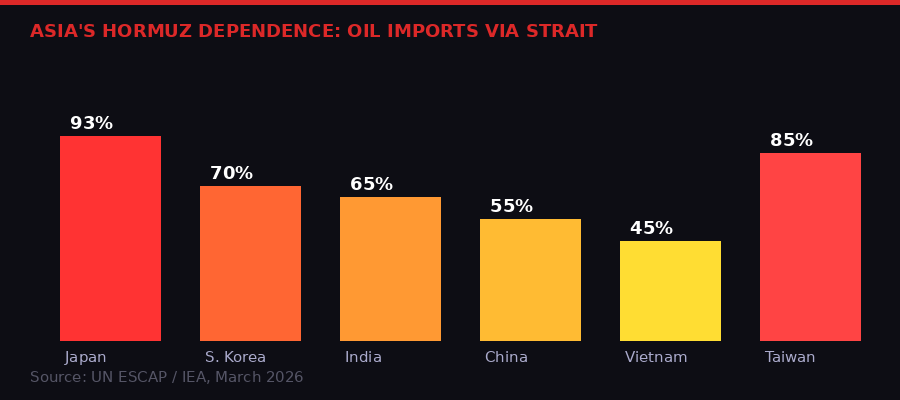
Percentage of oil imports flowing through the Strait of Hormuz for major Asian economies. (BLACKWIRE / UN ESCAP / IEA)
India, Vietnam, and Taiwan face similar pressures. Ramnath Iyer of the US-based Institute for Energy Economics and Financial Analysis warned Asia to prepare for "cascading impacts into all economic activities" - supply chains, food prices, transport, manufacturing. It is not a distant risk. It is arriving now.
The Fossil Fuel Trap: Trump's Energy Policy in Wartime

Trump's "Drill baby drill" energy policy has left the US with fewer alternative energy buffers as Gulf supply shocks bite. (Pexels)
There is a particular irony embedded in the energy crisis: the man who launched the war against Iran spent his first year back in office dismantling the alternative energy buffers that might have blunted its impact on American consumers.
Trump campaigned on "energy dominance" - a policy centered on maximizing fossil fuel production and rolling back renewable energy mandates. His administration blocked offshore wind development, gutted clean energy tax credits, and repeatedly urged Americans to "drill we must." The strategy assumed cheap oil from expanded US production would keep prices low regardless of global events.
The Iran War has tested that assumption and found it wanting. National average gasoline hit $3.84 per gallon Wednesday according to AAA - up from the "below $3" Trump boasted about during his State of the Union address last month. Peter Gleick, climate scientist and co-founder of the Pacific Institute, told AP: "The biggest short-term losers of the war will be US consumers of oil and gas, as energy prices rise."
Tyson Slocum of Public Citizen framed it bluntly: "It turns out fossil fuels have their own supply risks, and the administration has no answers. Now we are seeing higher gas prices, and nobody knows where it's going."
The midterm elections are in November. Affordability is the top voter concern, according to polling. Gas at $4 a gallon by summer - a scenario energy analysts consider realistic if the war continues - would be a devastating political backdrop for a Republican president seeking to hold Congress.
Trump's stated fix is rhetorical: once the war ends, prices "will drop like a rock." That may be true. But the war shows no signs of ending, every major allied nation has refused to send forces, and Iran - despite losing its supreme leader and senior military command - continues to inflict damage through the one instrument that survives leadership decapitation: infrastructure attacks on a region the world depends on for energy.
Iran's Playbook: Pain Without Surrender

Iran's drone and missile campaign targets energy infrastructure across the Gulf, executing a strategy designed to outlast US political will. (Pexels)
Iran's military capabilities have been, by any objective measure, severely degraded. The US and Israel killed Supreme Leader Ayatollah Ali Khamenei in the opening salvo. Multiple top IRGC generals, the Basij force chief, and much of the senior military command have been killed in subsequent strikes. The country's nuclear program has been substantially dismantled. Its conventional air force is largely destroyed.
And yet Iran keeps firing.
The Islamic Republic, now led by Mojtaba Khamenei - the son of the killed supreme leader - has fallen back on a strategy its analysts had long telegraphed: cause maximum regional and economic disruption to erode the political will of the United States, its allies, and Gulf Arab neighbors who depend on the energy Iran is now destroying.
"Iran is upping the costs for this US military campaign and regionalizing it from the get-go, as they promised they would if America restarts the war again with Iran." - Ellie Geranmayeh, deputy director, Middle East and North Africa program, European Council on Foreign Relations
The Soufan Center's assessment is that Iran's missile and drone capabilities - built specifically for this scenario - remain meaningful despite losses. Thousands of drones and ballistic missiles have been fired at Israel, US military bases, Gulf energy facilities, and even over Iran's borders with Turkey and Azerbaijan. The country maintains stockpiles and production capacity that, while degraded, have not been eliminated.
In Israel, more than a half-dozen waves of Iranian attacks Thursday sent millions to bomb shelters. Iranian fire caused damage to buildings. The electricity grid in northern Israel sustained damage after the latest barrage - Energy Minister Eli Cohen said crews were working to restore power to affected areas. Israeli media showed black smoke rising from an oil refinery in Haifa.
The Bushehr nuclear power plant complex was among Iranian energy facilities struck recently - but the International Atomic Energy Agency confirmed no damage and no injuries to the plant itself. Whether that constraint holds as the war escalates is an open question neither the US nor Israel has publicly answered.
The Diplomatic Void: No Exit, No Plan, No Allies

The diplomatic track remains empty. No major allied nation has agreed to join the US-Israeli war effort, and no framework for talks exists. (Pexels)
The Pentagon is seeking $200 billion more. Oil is at $119. Asia is burning through emergency reserves. Markets are pricing in rate hikes. And there is no diplomatic track.
Every major US ally has refused to join the campaign. Britain has flatly refused to be drawn into the war. France says it might consider naval escorts in the Strait of Hormuz once fighting dies down - not before. Germany's Defense Minister Boris Pistorius said Thursday: "It is not our war; we did not start it. We want diplomatic solutions and a swift end to the conflict. Sending more warships to the region will certainly not contribute to that." EU foreign policy chief Kaja Kallas said Tuesday: "This is not Europe's war. We didn't start the war. We were not consulted."
China, asked by Trump to help keep the strait open, is ignoring the call. China has the largest stake by volume in continued Hormuz transit - its own economy is bleeding from the closure - but Beijing has calculated that being drawn into a US-led military operation serves no Chinese interest.
Retired Lt. Gen. Ben Hodges, former commanding general of US Army Europe, summarized the allied dimension starkly: "They're looking at the United States in a way that they never have before. And this is bad for the United States."
Iran's leadership, meanwhile, has stated its terms with equal clarity. Iran's president, responding to a demand for unconditional surrender, said: "They should take that dream to their grave." The war began February 28 following the collapse of US-Iranian nuclear talks. Nineteen days later, there are no talks, no ceasefire framework, no back-channel signals that either Washington or Tehran is ready to stop.
The Trump administration has articulated four war objectives: destroy Iran's missile capabilities, eliminate its navy, prevent it from obtaining nuclear weapons, and end its support for armed regional proxies. All four remain unresolved. Iran's missile capacity is degraded but operational. Its naval presence in the Hormuz has been targeted but not eliminated. Its nuclear program has been damaged. Its proxy networks are disrupted but not dismantled.
With each passing day, the $200 billion request grows more comprehensible and the exit harder to see. The Iran War is now an economic event as much as a military one - and the global economy has no emergency reserves for a war without an end date.
Timeline: The Iran War's Economic Escalation
Get BLACKWIRE reports first.
Breaking news, investigations, and analysis - straight to your phone.
Join @blackwirenews on Telegram