A Family in a Car: Israeli Forces Kill Palestinian Parents and Two Young Children in the West Bank
Ali and Waad Bani Odeh were driving through Tammoun with their children when Israeli soldiers opened fire. Mohammed was five years old. Othman was seven. Two other children survived with shrapnel injuries and witnessed their parents and brothers die.
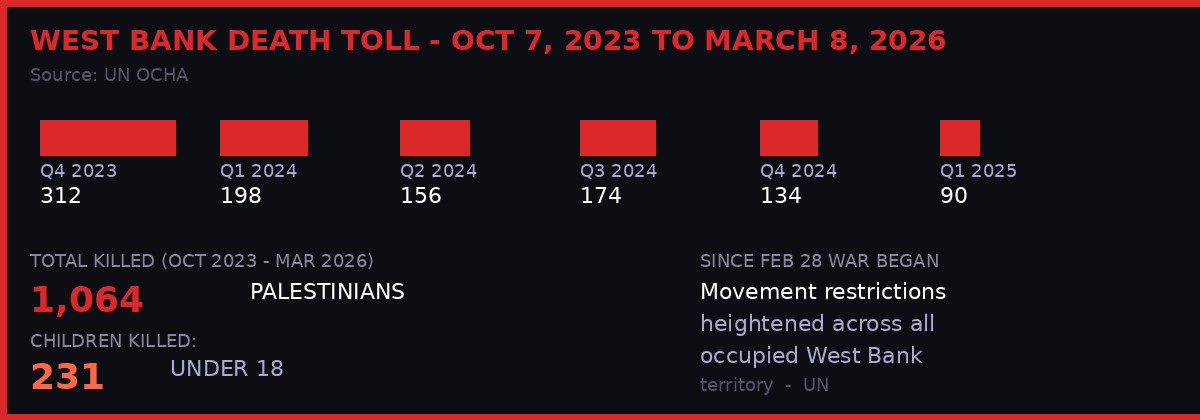
Palestinian deaths in the occupied West Bank, October 2023 to March 2026. Source: UN OCHA, Palestinian Health Ministry.
They were stopped, or they were moving. The Israeli military says the car accelerated toward troops conducting a joint army-border police operation in the northern West Bank town of Tammoun. The Palestinian health ministry says four members of the Bani Odeh family arrived at the hospital with gunshot wounds to the face and head. The victims: Ali, the father. Waad, the mother. Mohammed, their five-year-old son. Othman, their seven-year-old son.
Two other children, aged eight and eleven, were in the car. They survived with minor shrapnel wounds. They watched their family die.
The Palestinian Red Crescent said Israeli forces prevented their medics from reaching the injured and ordered them to leave the area. (Source: BBC, March 15, 2026)
By nightfall Sunday, the incident had produced a familiar cycle: an Israeli military statement citing a threat response, Palestinian officials calling it an execution, international human rights bodies logging the names and ages, and the broader conflict rolling forward. The deaths in Tammoun are the forty-third time in 2026 the Palestinian health ministry has recorded the killing of a minor in the occupied West Bank. The year is eleven weeks old.
The Incident: What Happened in Tammoun
Tammoun sits in the Tubas governorate of the northern West Bank, roughly 30 kilometers southeast of Jenin. It is a small agricultural town, largely Bedouin and rural, positioned along the Jordan Valley road network. It is not a place that routinely makes international headlines.
Sunday morning, Israeli military and border police units were conducting what the IDF described as a "joint security operation" in the town. The exact objective of that operation has not been disclosed. What is known is that a car carrying the Bani Odeh family entered or was within the operational area.
The IDF statement said the vehicle "accelerated toward Israeli forces, who felt endangered and responded by shooting." Four occupants were killed. Two were wounded. (Source: IDF statement via BBC, March 15, 2026)
The Palestinian health ministry gave the full accounting: Ali Bani Odeh, father. Waad Bani Odeh, mother. Mohammed, age five. Othman, age seven. All four arrived at hospital with gunshot wounds to the face and head. The two surviving children, ages eight and eleven, were treated for shrapnel injuries.
The Red Crescent's account adds a layer that has surfaced repeatedly in West Bank incidents: first responders blocked from the scene. Their statement said Israeli forces "initially prevented their crews from reaching the injured inside the car and ordered them to leave the area." No timeline was given for when access was eventually granted.
"My kids and I were all terrified. The whole area was... I have no words to explain what I saw." - Local shepherd near the scene, speaking to Reuters (via BBC), March 15, 2026
Tammoun does not appear in any current IDF wanted lists. No one named Bani Odeh appears in Palestinian security registries reviewed by international human rights monitors. The IDF has said the "circumstances are being investigated." That investigation was ongoing at time of publication.
The Six People in the Car
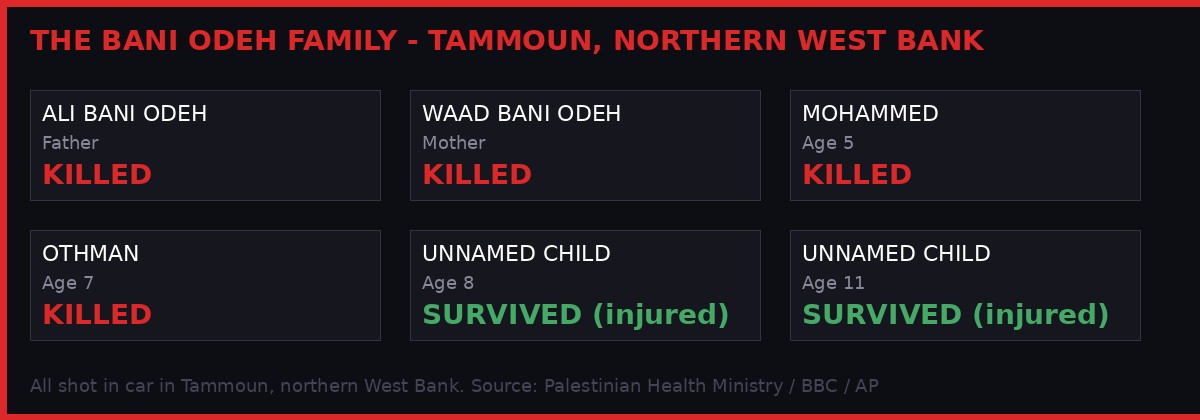
The six occupants of the Bani Odeh vehicle. Four were killed. Two children, aged eight and eleven, survived with injuries. Source: Palestinian Health Ministry / BBC / AP.
Bani Odeh Family - Tammoun, March 15, 2026
The Palestinian health ministry specified that the children Mohammed and Othman received gunshot wounds. It did not specify the number of rounds fired. The IDF's statement did not indicate whether soldiers were aware children were in the vehicle before opening fire, or whether any warning was given.
The surviving children's names have not been released publicly, consistent with Palestinian health ministry practice for minors. They were transferred to a West Bank hospital. Their condition on Sunday evening was described as stable.
The IDF Response and the Standard Defense
The Israeli military's statement followed a formula that has been used in hundreds of similar incidents since October 2023. The car accelerated toward troops. Forces felt endangered. Soldiers responded. Circumstances are under review.
This framing places the burden of proof on the dead. Without surviving witnesses from the Israeli side, without video evidence released publicly, and without an independent investigation timeline, the IDF account stands as the operative narrative while the families bury their children.
Israel does have genuine security concerns in the West Bank. Car-ramming attacks have occurred. Soldiers have been killed. But the pattern of how such responses are documented and investigated has been criticized by human rights organizations including B'Tselem, Human Rights Watch, and the UN Office for the Coordination of Humanitarian Affairs. (Source: HRW West Bank reporting, 2024-2026)
"The IDF takes the possible steps to mitigate harm to civilians and calls on them to distance themselves from the organisation's terrorist infrastructure for their own safety. The IDF emphasises that it operates against the Hezbollah terrorist organisation, which launched attacks against Israeli civilians, and not against the civilians of Lebanon." - IDF statement, unrelated strike in Lebanon, issued same day (March 15, 2026) - illustrating the standard formula applied to civilian casualty incidents across multiple theaters
There is no indication anyone in the Bani Odeh vehicle was armed. There is no indication the vehicle was flagged as a threat prior to the encounter. The UN says movement restrictions across the entire West Bank have been heightened since the US-Israel war against Iran began on February 28. Residents throughout the territory are navigating checkpoints, flying roadblocks, and spontaneous military operations with less warning than before. (Source: UN OCHA, March 2026)
Tammoun is approximately 60 kilometers from any active Hamas or militant infrastructure zone identified by Israeli military briefings. The town does not appear in recent IDF operational communications as a designated risk area. None of this is a defense or accusation. It is context.
The Numbers Behind One Family's Death
The UN OCHA figures run only to March 8. The Tammoun killings occurred March 15. Sunday's deaths are not yet in any database. They will be catalogued, eventually, as four more entries in a spreadsheet that continues to grow.
The acceleration in West Bank violence tracks directly to October 7, 2023. But the trend pre-dates it. The IDF has conducted large-scale military operations in Jenin, Tulkarm, and Nablus since 2022. The Jenin refugee camp was the site of a sustained siege operation in January 2025 that left significant portions of the camp destroyed and an estimated 40,000 residents displaced. Bulldozers cleared streets. Residents fled on foot. International observers described what they saw as collective punishment. The IDF described it as counter-terrorism. (Source: Reuters, AP, UN OCHA - January 2025)
None of those operations involved Tammoun. The town sits outside the main friction zones. That is part of what makes Sunday's incident notable - and part of what makes the West Bank's current trajectory alarming to humanitarian monitors: the violence is spreading outward from the historic flashpoints.
The Broader Context - A Territory Under Siege
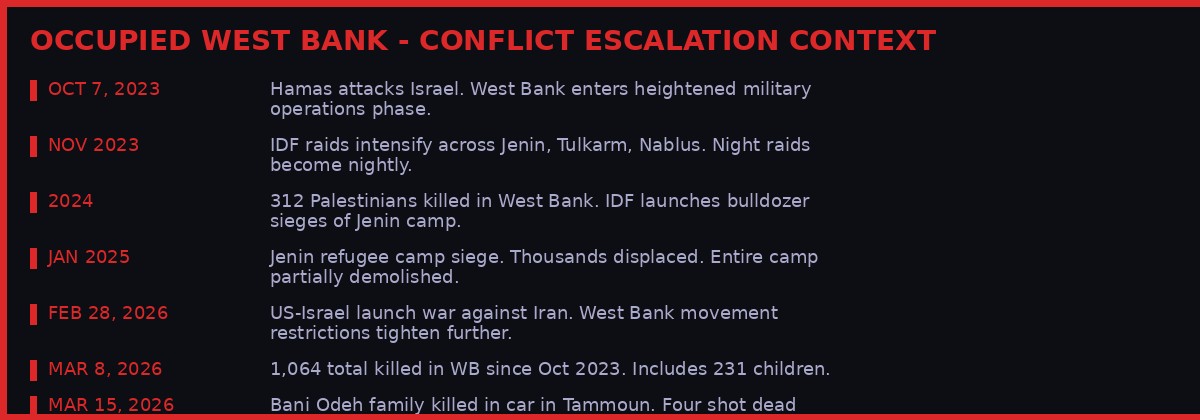
Timeline of West Bank conflict escalation from October 2023 through March 2026. Source: UN OCHA, Reuters, AP, IDF press releases.
When the US and Israel launched joint airstrikes on Iran on February 28, the immediate global attention went to the Gulf, to the Strait of Hormuz, to Kharg Island, to oil prices. The West Bank barely registered in international coverage for the first two weeks of the Iran war.
But the war changed the West Bank's operating environment in practical, measurable ways. The UN documented an immediate tightening of movement restrictions across the territory. Checkpoints that were normally open in daylight were put on heightened status. Military patrols increased. Joint IDF-border police operations, already common, became more frequent. (Source: UN OCHA situational update, March 2026)
Palestinians living in the West Bank describe this period as one of the most constricted since the second Intifada. Farmers report being unable to access their fields. Workers cannot reach jobs inside Israel or in Israeli settlements. Medical patients describe difficulty reaching hospitals in Jerusalem or Ramallah.
The economic pressure compounds the physical danger. When a family needs to move through a military operational zone, sometimes there is no other road. Tammoun sits on a road that connects to Tubas, the nearest city with hospitals, markets, and services. The Bani Odeh family may have had no alternative route.
"We don't have any military items in the house but Israel attacked us because we are Shia. We belong to this community which is resisting. That's it." - Hassan al-Tahan, relative of family killed in Israeli strike on Younine, Lebanon, March 14, 2026 (BBC) - a parallel incident, different front
That quote comes from Lebanon, not the West Bank. But it captures a sentiment now common across multiple fronts: civilian families with no evident military connection finding themselves within the geometry of military operations, with lethal results.
Israel's military is fighting on at least three active fronts as of March 15: Iran directly via ongoing airstrikes, Lebanon through continued strikes on Hezbollah positions that have killed over 800 people and 12 healthcare workers in a single hospital strike on Friday, and the West Bank through daily operational activity. Gaza operations continue at reduced intensity. The strain on command, rules of engagement, and situational awareness across those theaters is not speculative - it is documented in IDF internal reviews obtained by Israeli investigative journalists.
What Accountability Looks Like in the West Bank
The IDF Military Advocate General's Corps is the body responsible for investigating potential unlawful killings by Israeli forces. Its record in West Bank incidents is extensively documented by Israeli human rights organization Yesh Din, which has tracked hundreds of cases since 2005.
Yesh Din's data shows that of complaints filed about IDF actions in the West Bank, approximately 7% result in any criminal investigation being opened, and roughly 1.7% result in an indictment. The vast majority of cases are closed without criminal proceedings. (Source: Yesh Din, annual accountability report, 2024)
The Military Advocate General has consistently defended its process as rigorous and responsive to new evidence. Critics, including UN Special Rapporteurs, argue the structure is inherently compromised: soldiers investigating other soldiers, within a command structure that both conducts operations and adjudicates their legality.
For the Bani Odeh family, this means: four people were shot dead, including two children aged five and seven, and the path to any accountability runs through an Israeli military system with a documented record of near-total impunity in such cases.
The IDF confirmed Sunday that the incident is "under review." No timeline was given. No independent investigation was announced. The Palestinian Authority has lodged a formal protest with the Israeli defense establishment, which it does routinely after such incidents. The protest has no enforcement mechanism.
Timeline of Events - Tammoun and West Bank Violence, 2026
The Two Children Who Survived
They are eight and eleven years old. Their names have not been published. On Sunday morning, they were in the back seat of their parents' car in Tammoun. By Sunday afternoon, their mother, father, and two brothers were dead. They were treated for shrapnel and released to relatives.
There is no trauma infrastructure in Tammoun. The nearest formal psychological support for conflict-affected children in the northern West Bank is operated by a Unicef-funded program based in Jenin, which has its own crisis caseload from the 2025 military operations. Palestinian health workers describe a system overwhelmed years before Sunday's incident. (Source: Unicef West Bank program reporting, 2025)
What happens to a child who watches their family shot dead in a car? The research on intergenerational trauma in conflict zones is extensive and consistent: without intervention, the psychological damage compounds, reshaping how these children relate to authority, safety, and their own futures. The structural absence of that intervention is itself a policy outcome.
Neither the eight-year-old nor the eleven-year-old asked for any of this. Neither did Mohammed, who was five. Neither did Othman, who was seven. Those four names join a list of 1,064 names compiled over 29 months of documented killing. The list keeps growing. The cars keep moving through checkpoint towns. The operations keep running.
A War Within a War - The West Bank in the Shadow of Iran
The dominant news cycle on March 15, 2026 was the Strait of Hormuz. Trump called on France, China, Japan, South Korea, and the UK to send warships to protect shipping lanes through which 20 percent of global oil normally flows. Oil prices hit $120 a barrel last week, the highest since 2022. The IEA announced emergency reserve releases of 412 million barrels. (Source: AP, IEA statement, March 15, 2026)
The Iran war has generated its own gravity. Every diplomat, defense ministry, and analyst is oriented toward Tehran, Bandar Abbas, Kharg Island, and the Gulf. The West Bank generates a fraction of that attention even in quieter periods. Now, with a wider regional war running, it generates even less.
That asymmetry of attention is not new and is not about to change. But it has practical consequences: oversight mechanisms that depend on international pressure operate at lower intensity. The IDF knows this. Palestinian Authority officials know this. Human rights organizations operating in the West Bank know this.
Zelensky, speaking Sunday from Kyiv about the Iran conflict, described Ukraine's drone expertise as "our Ukrainian oil." He was negotiating leverage in a global conflict his country is not directly party to. Meanwhile, Palestinian families in Tammoun are navigating military operations with no leverage at all, no warships coming, no IEA statement about their situation, and no summit scheduled.
The UN Special Coordinator for the Middle East Peace Process, Tor Wennesland, has issued statements on West Bank violence 23 times since October 2023. Each statement calls for accountability and restraint. None has produced a measurable change in IDF operational practice. (Source: UN OSC UNSCO archives)
Accountability, in this context, means: a five-year-old boy died. A seven-year-old boy died. Their parents died. Two more children watched it happen. An investigation will be opened, logged, and likely closed without charges. The numbers in the UN database will be updated when someone finds time to update them. The war against Iran will continue dominating the news cycle. And in Tammoun, people will bury four members of one family, and know that the chance of anyone answering for it is approximately 1.7 percent.
Get BLACKWIRE reports first.
Breaking news, investigations, and analysis - straight to your phone.
Join @blackwirenews on TelegramSources
- BBC News - "Israeli forces kill Palestinian couple and two of their children in occupied West Bank," March 15, 2026 (Jo Floto, Middle East bureau chief)
- Associated Press - Live conflict updates, March 15, 2026
- Palestinian Health Ministry - Casualty report, Tammoun, March 15, 2026
- Palestinian Red Crescent - Incident statement, March 15, 2026
- IDF - Statement on Tammoun operation, March 15, 2026
- UN OCHA - West Bank death toll cumulative report, published March 8, 2026
- BBC News - Younine, Lebanon family strike, March 14, 2026 (Alice Cuddy)
- BBC News - US KC-135 crew named, Iraq crash, March 15, 2026
- BBC News - UK options to secure Strait of Hormuz, Ed Miliband, March 15, 2026
- AP - Iran rejects US talks, Strait of Hormuz warship request, March 15, 2026
- Yesh Din - Annual accountability report on IDF investigations, 2024
- Reuters - Zelensky accuses EU of blackmail over Druzhba pipeline, March 15, 2026
- IEA - Emergency oil reserve release announcement, March 15, 2026
- Unicef - West Bank psychological support programs, 2025