South Pars Bombed, Five Gulf Energy Sites Named as Next Targets: The War Starts Eating the Region's Infrastructure
Israel struck the world's largest gasfield. Iran responded by naming five specific Gulf energy installations - in Saudi Arabia, the UAE, and Qatar - as targets to be hit "in the coming hours." Three Iranian leaders have been killed in 48 hours. NATO is rushing Patriot batteries to Turkey. Day 23 of the US-Israel war on Iran looks less like a campaign with a clear endpoint and more like a region-wide industrial demolition.
GHOST / BLACKWIRE WAR BUREAU - March 18, 2026, 16:15 CET - Sources: Al Jazeera, Tasnim News Agency, Iranian Ministry of Petroleum, Qatar MFA, Turkish Ministry of National Defence

Gulf energy infrastructure has become a primary target in the Iran war. Refineries and gasfields previously considered untouchable are now explicitly in the crosshairs. (Pexels)
Live Threat
Iran's semiofficial Tasnim news agency published a statement on March 18 naming five specific Gulf energy facilities as targets for strikes "in the coming hours." The targeted sites span three US-allied Gulf states. This article covers events through 16:00 CET / 15:00 UTC on March 18, 2026.
The Strike on South Pars: What Happened

Iran's South Pars gasfield, world's largest, shares its reservoir with Qatar's North Field. An Israeli strike on March 18 ignited fires across the offshore facility. (Pexels)
The South Pars gasfield sits in the shallow waters of the Persian Gulf off the coast of Iran's Bushehr province. It is the single largest natural gas reservoir on the planet, holding an estimated 51 trillion cubic meters of recoverable reserves - roughly eight percent of the world's entire proven gas supply. It is also the financial spine of the Iranian economy, and it shares its geology directly with Qatar's North Field.
On the morning of March 18, Israeli aircraft struck multiple facilities associated with the field. Iranian state media reported that a number of installations were damaged and a fire broke out, though Tehran said the blaze was "under control" and no casualties were immediately confirmed. Al Jazeera / Iranian state media
Israel did not immediately claim the strike publicly, but Israeli media, citing unnamed sources, attributed it to the Israeli Air Force. The pattern has been consistent throughout this war: Israeli strikes on Iranian energy infrastructure have proceeded without formal acknowledgment, maintaining a veneer of deniability while the physical and market consequences speak for themselves.
The significance of the target was not lost on Qatar. South Pars and Qatar's North Field are the same geological formation - the largest single hydrocarbon reservoir in history, divided by a maritime boundary. Qatar's Ministry of Foreign Affairs spokesman Majed al-Ansari condemned the attack within hours.
"Targeting energy infrastructure constitutes a threat to global energy security, as well as to the peoples of the region and its environment. We reiterate, as we have repeatedly emphasized, the necessity of avoiding the targeting of vital facilities." - Majed al-Ansari, Qatar Ministry of Foreign Affairs spokesman, March 18, 2026
Al-Ansari called the attack "a dangerous and irresponsible step amid the current military escalation." The language was careful - Qatar cannot afford to explicitly condemn Israel while US forces operate from its Al Udeid Air Base - but the condemnation was unambiguous. Hitting South Pars is not just hitting Iran. It is hitting the geological foundation of Qatar's entire $200 billion economy.
Iran's Ministry of Petroleum confirmed the damage in a statement distributed through Tasnim news agency, noting that gas output from affected facilities had been disrupted but framing the situation as manageable. The claim was consistent with Tehran's messaging throughout this war: absorb the blow, project resilience, and retaliate in kind.
Iran's Response: Five Targets Named, None Hypothetical
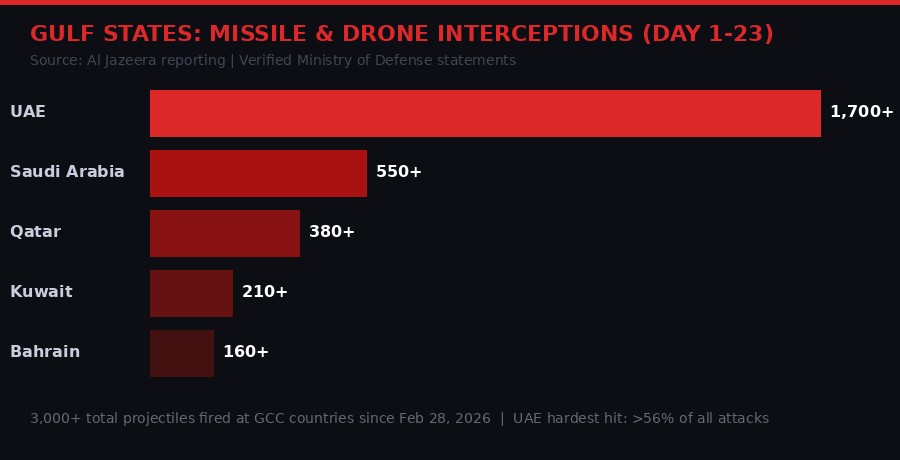
3,000+ missiles and drones have been fired at GCC states since the war began on February 28. The UAE has absorbed more than half of all attacks. Data compiled from verified Ministry of Defense statements. (BLACKWIRE / Al Jazeera)
The Iranian response to the South Pars strike was not metaphorical. A statement shared through Tasnim - Iran's semiofficial but well-connected news agency - named five facilities across three Gulf states as targets to be struck "in the coming hours." The list was specific, not rhetorical.
These are not symbolic targets. SAMREF and Jubail are core to Saudi Arabia's export economy. Al Hosn is central to the UAE's domestic energy supply. Ras Laffan is where the bulk of Qatar's liquefied natural gas - already massively disrupted - is processed and loaded onto tankers. Hitting any one of these would ripple through global energy markets for months. Hitting all five simultaneously would constitute a strategic catastrophe for the global energy supply chain.
The threat came hours after Qatar itself had condemned the South Pars attack. Iran's message was clear: the Gulf states sheltering US forces and staying silent as Iran absorbs strikes are not neutral parties. They are complicit, and they are exposed.
Al Jazeera's Zein Basravi, reporting from Dubai, framed the Gulf states' position with precision: "No matter how many voices try to call for a negotiated solution, unless there is an end to the targeting and fighting by both sides, there is really no room for a discussion on how to move forward." Al Jazeera
Saudi Arabia hosted an emergency meeting of Arab and Muslim-majority country foreign ministers in Riyadh on Wednesday. The agenda was already urgent before the South Pars strike. After it, the meeting became something closer to a crisis summit, with attendees trying to determine whether they were looking at an escalation toward catastrophic infrastructure war or a final warning before ceasefire talks.
Three Leaders in 48 Hours: Israel's Decapitation Campaign Accelerates
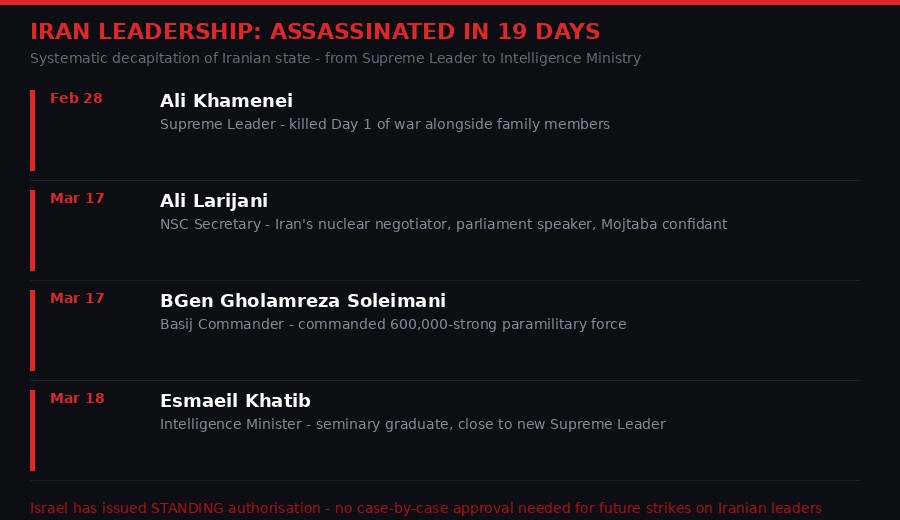
Israel has systematically eliminated Iran's top tier of leadership since February 28. Four senior figures - including Supreme Leader Ali Khamenei - have been killed in 19 days. Israel has now issued standing authorisation for future strikes without case-by-case approval. (BLACKWIRE)
The same day Israel struck South Pars, Israeli Defense Minister Israel Katz claimed another kill: Esmaeil Khatib, Iran's intelligence minister. Tehran had not confirmed the death as of Wednesday afternoon, but Israeli officials were confident enough to publish the claim and move on. Al Jazeera
If confirmed, it would be the third senior Iranian official killed in two days. The sequence is worth laying out in full:
Iran Leadership Eliminated - 19 Days
The pattern is deliberate and methodical. Israel has not been striking at random. It has been working through a target list of senior officials who represent either operational capacity - military commanders, intelligence chiefs - or political legitimacy and succession.
More significantly, Israeli Defense Minister Katz announced on Wednesday that he and Prime Minister Benjamin Netanyahu had given the Israeli military standing authorization to kill other senior Iranian officials in its sights without case-by-case approval. This is not a one-off campaign. This is a standing kill order against the Iranian state leadership. Al Jazeera
Al Jazeera analyst Marwan Bishara offered a blunt assessment of what this represents:
"In wars, you don't start by killing political leaders, including elected leaders. That programme of assassination is gangster, it's terrorism, it's not the norm of war." - Marwan Bishara, Al Jazeera Senior Political Analyst
Iran's foreign minister Abbas Araghchi pushed back against the intended effect - that killing leaders would destabilize the system:
"I do not know why the Americans and the Israelis still have not understood this point: The Islamic Republic of Iran has a strong political structure with established political, economic, and social institutions. The presence or absence of a single individual does not affect this structure." - Abbas Araghchi, Iranian Foreign Minister, Al Jazeera interview, March 18, 2026
The argument has some basis. Iran survived the assassination of Khamenei himself on Day 1 and continued fighting. The state has not collapsed. But the question is not whether Iran collapses - it is whether the cumulative loss of experienced operational and political leaders degrades the regime's ability to fight effectively, negotiate intelligently, or project coherent strategy over months of sustained conflict.
Hormuz: Iran Wins the Negotiation War Even as It Loses the Airspace

The Strait of Hormuz - 33km wide at its narrowest - carries 20 percent of global crude and LNG. Iran has emerged as the de facto gatekeeper, granting passage to India, Pakistan, Turkey and China while blocking US-allied commercial vessels. (Pexels)
While Israel methodically dismantles Iran's leadership tier, and CENTCOM pounds antiship missile sites along the Iranian coast with 5,000-pound bunker-busting munitions, the strategic picture at the Strait of Hormuz tells a different story. CENTCOM statement, March 18, 2026
Iran is losing in the air. US and Israeli air power have degraded an estimated majority of Iran's ballistic missile capabilities, according to statements attributed to senior US defense officials. Iran cannot project airpower. Its nuclear program has been largely destroyed. Its top tier of military and political leadership has been systematically eliminated.
But at Hormuz, Iran is winning the strategic game. Not through military victory, but through geography and the arithmetic of risk.
Traffic through the strait remains 97 percent below average, according to Windward maritime intelligence. Windward.ai, March 17, 2026 Crude oil has stayed above $100 per barrel - more than 20 percent higher than pre-war levels. LNG prices are up more than 40 percent. The world's emergency reserves are being drawn down at historic rates.
Trump called on allied navies to help open the strait. The response was humiliating. Japan has no plans to send warships. Australia ruled it out. The UK refused to be drawn into the wider war. Germany said plainly: "This is not our war."
Instead, countries are cutting deals with Iran directly. India negotiated safe passage for two LNG tankers through phone calls between Prime Minister Modi and Iranian President Pezeshkian. Ships from Pakistan, Turkey, and China have also transited. The Financial Times reported Italy and France quietly reached out for similar arrangements, though Italian authorities denied it. Al Jazeera / Financial Times reporting
Andreas Krieg, associate professor in Security Studies at King's College London, put it plainly:
"Iran has effectively proven that it dictates the terms of passage through the strait. They have now shown they are the gatekeeper of this important chokepoint. This will elevate the status of Iran in the geography of the Gulf. This will be the new reality for the foreseeable future." - Andreas Krieg, King's College London, Al Jazeera
Tehran is using the leverage deliberately. Iranian officials have framed Hormuz not just as a wartime measure but as a long-term bargaining chip - a tool to extract compensation, sanctions relief, and economic concessions after the conflict ends. Hamidreza Azizi, German Institute for International and Security Affairs, via Al Jazeera
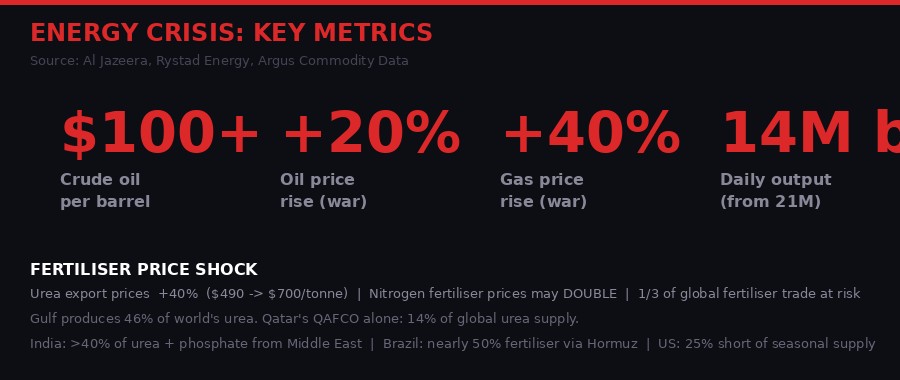
Key energy metrics from the 23-day war. Oil above $100. Gas up 40%. Gulf oil output has dropped from 21 million to 14 million barrels per day. Fertiliser prices surging toward double. (BLACKWIRE / Rystad Energy / Argus)
NATO Rushes Patriot to Turkey, Ukraine Deploys 201 Drone Experts to the Gulf

NATO has now deployed multiple Patriot batteries to Turkey following three separate Iranian ballistic missile interceptions since March 4. The alliance is reinforcing Incirlik Air Base in southern Turkey as the conflict's blast radius keeps widening. (Pexels)
The war is pulling in actors who would rather stay out. Turkey has now intercepted three Iranian ballistic missiles in its territory or airspace since March 4 - on March 4, March 9, and March 13. Iran denies firing at Turkey, suggesting instead that Israel may be staging false-flag attacks to drag Ankara into the conflict. Turkish Foreign Minister Hakan Fidan said the government is "discussing the discrepancy between their statements and the reality" with Tehran. Turkish Ministry of National Defence, March 18, 2026
NATO's response has been to reinforce. On Wednesday, Turkey's Ministry of National Defence announced at a briefing at Incirlik Air Base that the alliance is deploying an additional PAC-3 Patriot surface-to-air missile battery to the base in southern Adana. Earlier this month, a second Patriot battery was deployed to Malatya's Kurecik airbase, which houses a NATO early-warning radar manned by US troops for detecting Iranian missile launches. Turkish Ministry of National Defence
This is not a precautionary measure. This is NATO quietly expanding its missile defense footprint in one of the world's most contested airspaces. Incirlik already hosts personnel from the US, Qatar, Spain, and Poland. The addition of another Patriot battery puts more NATO hardware and personnel directly in the path of a conflict the alliance officially refuses to join.
Ukraine's involvement adds another dimension. President Volodymyr Zelenskyy confirmed on March 18 that 201 Ukrainian military experts have deployed to Gulf countries to help counter Iranian drone attacks. Zelenskyy called Russia and Iran "brothers in hatred" and claimed that Iran's drones targeting Gulf states contain Russian components - the same drone technology Ukraine has been fighting on its own front lines for three years. Al Jazeera, March 18, 2026
The Ukrainian deployment is significant beyond the numbers. It represents the first direct physical extension of the Ukraine war into the Middle East theater. Kyiv is sharing hard-won institutional knowledge about drone interception, electronic warfare, and counter-UAV tactics developed under live-fire conditions. For the Gulf states, that expertise is exactly what they need. For Russia and Iran, it signals that their technological partnership now faces a multi-theater response.
War Status - Day 23 Key Figures
The Food Bomb No One Is Talking About

The Hormuz closure is not just an energy crisis. It is cutting off 46 percent of global urea supply - the world's primary fertiliser. The disruption falls in the middle of the Northern Hemisphere planting season. (Pexels)
The energy numbers dominate the headlines. But buried beneath the oil price data is a slower-moving catastrophe that will outlast any ceasefire: the global fertiliser supply chain is breaking down.
Nearly half of the world's traded urea - the most widely used agricultural fertiliser - comes from Gulf countries and transits through the Strait of Hormuz. That waterway is now effectively closed. Al Jazeera / Signal Group data
The effects are already compounding. Qatar's state energy firm QatarEnergy shut down what is the world's largest urea plant after attacks on its LNG facilities cut the natural gas supply needed to run the plant. India has cut output at three of its own urea plants due to LNG shortages. Bangladesh has shuttered four of its five fertiliser factories. The US is running 25 percent short of fertiliser supply for this time of year. Al Jazeera analysis, March 18, 2026
The timing is the worst possible. The disruption falls in the middle of spring planting season in the Northern Hemisphere - the period running from mid-February to early May when commercial farmers apply fertiliser for the year's primary crop cycle. There is no making up for missed fertiliser applications mid-season.
The price data tells the story. Urea export prices have surged 40 percent since the war began - from around $490 to over $700 per metric tonne as of mid-March, according to Argus commodity pricing. Argus Media Morningstar analyst Seth Goldstein has projected that nitrogen fertiliser prices could roughly double from current levels, with phosphate prices rising by approximately 50 percent. Reuters
Analysis by commodity data firm Kpler estimates that up to one-third of global fertiliser trade could be disrupted if Hormuz remains effectively closed. The cascade from fertiliser to food prices to food security in import-dependent countries follows predictably. India - which sources more than 40 percent of its urea and phosphate fertilisers from the Middle East - is particularly exposed. Brazil, which depends on imports for nearly all of its fertiliser and routes roughly half through Hormuz, faces severe disruptions to its soybean and corn production. Kpler analysis, Al Jazeera
Qatar Fertiliser Company - QAFCO - supplies 14 percent of the world's urea by itself. It is currently offline. The numbers that result from sustained closure are not just expensive - they are famine-scale in vulnerable food-importing countries that depend on Gulf urea for basic crop production.
What Comes Next: Diplomatic Dead Ends and Escalation Loops

Saudi Arabia hosted an emergency summit of Arab and Muslim-majority foreign ministers in Riyadh on March 18 - the same day Iran threatened to strike Gulf energy facilities. The meeting's urgency was overtaken by events before it began. (Pexels)
The trajectory of this war on Day 23 does not suggest proximity to resolution. Every escalatory move produces a counter-escalation. Israel kills Iranian leaders; Iran fires more missiles and names new targets. The US bombs Hormuz coastline missile sites; Iran allows permission-based transit for non-US-allied ships while keeping commercial traffic locked out for everyone else. The Gulf states absorb missile and drone attacks while hosting US bases and trying to stay diplomatically neutral - and failing at both.
The Riyadh summit of Arab and Muslim-majority foreign ministers was already convening on Wednesday when the South Pars attack and the five-target threat dropped simultaneously. Saudi Arabia is in the bizarre position of hosting a ceasefire-oriented diplomatic gathering while one of its own major industrial complexes - SAMREF - is explicitly named as a target to be hit "in the coming hours." The gap between the diplomatic register and the operational reality is absolute.
There are structural obstacles to any ceasefire. Iran is demanding the end of US-Israeli strikes and meaningful concessions before it discusses Hormuz. The US is applying maximum pressure with no public off-ramp offered. Israel has issued standing kill orders against Iranian leadership. Gulf states cannot publicly oppose the US while dependent on its security umbrella, but they are privately in crisis.
The "permission-based transit" Iran is operating at Hormuz - quietly allowing Indian, Pakistani, Turkish, and Chinese ships through while blocking others - is not goodwill. It is strategic economics. Tehran is proving it can selectively enforce the blockade, punishing states aligned with Washington while rewarding those who keep diplomatic lines open. This buys Iran time, revenue, and international legitimacy even as its military capacity is ground down.
Trump's amphibious ships carrying thousands of Marines are already moving toward the Middle East. Some analysts believe the US may attempt to seize Kharg Island - the tiny landmass in the northern Gulf through which 90 percent of Iranian crude oil exports flow. US airstrikes have already hit what it described as military sites on the island. But Andreas Krieg at King's College was blunt about the limits of such an operation: seizing Kharg does not force Iran to open Hormuz. Iran controls the northern shore of the strait from the mainland, and it can sustain antiship missile attacks from positions no island seizure would touch.
The war is approaching its fourth week with no visible diplomatic mechanism for ending it, expanding energy and food consequences that will outlast the conflict by months or years, and an escalation ladder - from leadership assassinations to infrastructure strikes to explicit Gulf-facility targeting - that has not yet found a ceiling.
March 18, 2026 - Key Events Timeline
There is no end in sight on Day 23. Iran is battered, its leadership systematically targeted, its military capacity eroded, its economy under severe strain. It has also demonstrated that it can hold Hormuz effectively against the world's most powerful navy, name specific Gulf targets with apparent credibility, and sustain missile and drone pressure on Gulf states indefinitely.
The US and Israel have demonstrated overwhelming airpower dominance, killed multiple senior Iranian figures, and methodically dismantled nuclear infrastructure. They have not opened Hormuz. They have not forced a ceasefire. They have not secured Gulf state alignment beyond passive hosting of existing bases.
Both sides are winning some dimensions of this war. Both sides are losing others. And the region's energy and agricultural infrastructure - the physical foundation of the global economy - is being consumed either way.
Get BLACKWIRE reports first.
Breaking news, investigations, and analysis - straight to your phone.
Join @blackwirenews on Telegram