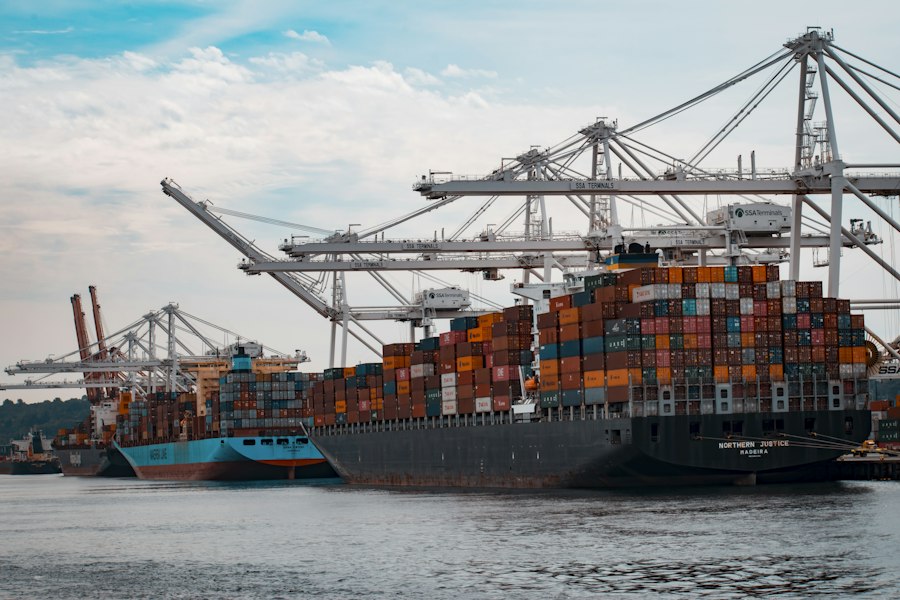
Oil tankers continue to navigate through selective corridors in the Strait of Hormuz. Iran has effectively created a two-tier transit system favoring its own exports and allies. (Illustrative)
When the Iran war began on February 28, the immediate assumption in Washington was binary: either the Strait of Hormuz stays open, or it closes. Three weeks in, the reality is far more complex - and far more strategically dangerous for the United States.
About 90 ships have crossed the strait since the war began, according to Lloyd's List Intelligence, a maritime data firm that has been tracking every movement through the critical chokepoint. That number sounds alarming given that roughly 100 to 135 vessels transited daily before Operation Epic Fury. But buried in the data is a finding that reshapes the entire strategic picture: more than one-fifth of those 90 vessels are Iran-affiliated "dark" tankers, evading Western sanctions and oversight. Iran is not just surviving the war's economic pressure - it is profiting from the chaos it created.
Meanwhile, satellite images released this week for the first time give the public a genuine look at the physical destruction rippling across the Middle East. Ships are burning in Iranian ports. American military infrastructure in Bahrain is cratered. A French naval base in Abu Dhabi is partially demolished. Dubai's airport has a fuel fire that turned the sky black. And a port in Oman has been on fire for more than a week.
The destruction is real. But the strategic picture is more complicated than the smoke suggests.
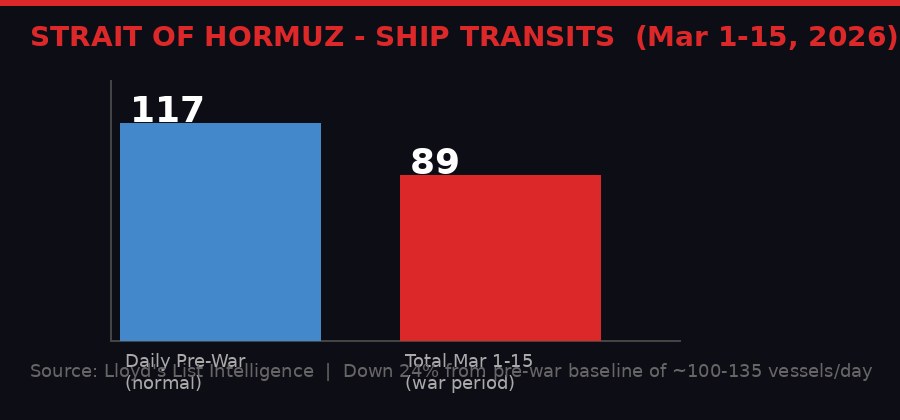
Ship transits through the Strait of Hormuz have fallen roughly 24% from pre-war baseline. But of those still crossing, a significant portion are Iranian-affiliated dark tankers. Source: Lloyd's List Intelligence.
The Dark Fleet Is Still Moving
Iran has been running a so-called "dark" fleet of tankers for years - vessels that disable their transponders, falsify their flags, and move Iranian crude oil in defiance of Western sanctions. Under normal conditions, this fleet operated as an open secret, tolerated because shutting it down would require a level of naval enforcement no one was willing to sustain.
Now, with the war active, the dark fleet has become a strategic weapon. Iran has effectively created what analysts are calling a "selective strait" - one that is dangerous for Western-linked vessels while remaining navigable for its own ships and allied buyers.
"Iran has effectively created a safe corridor with some ships passing close to the Iranian coast." - Richard Meade, Editor-in-Chief, Lloyd's List
The math is striking. Iran has exported well above 16 million barrels of oil since the beginning of March, according to trade data and analytics platform Kpler. China is the largest buyer. Chinese-affiliated vessels have also been passing through the strait, taking advantage of Beijing's closer ties with Tehran.
Some vessels near the strait were found to have declared themselves as China-linked or with all-Chinese crew to reduce the risk of being attacked, based on ship tracking data from MarineTraffic. Analysts believe they were effectively using China's political relationship with Iran as a shield.
This is not a closed strait. It is a politically managed one. And Washington finds itself locked out of the management structure it assumed it controlled.
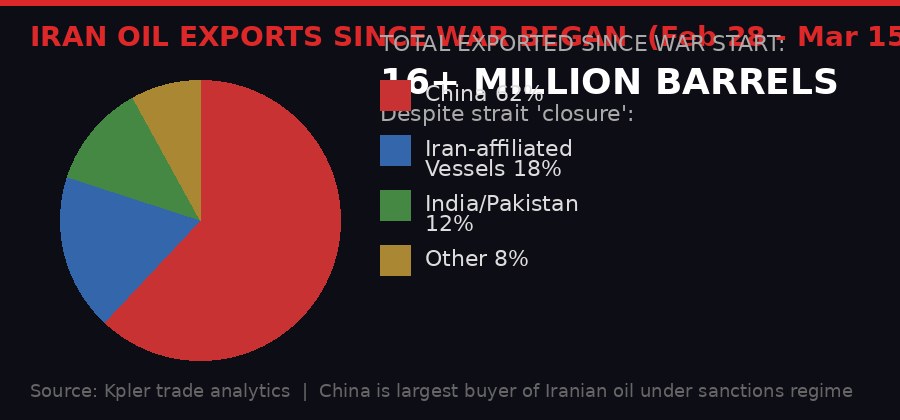
Iran has exported over 16 million barrels since war began February 28. China is the dominant buyer. Source: Kpler trade analytics.
What the Satellite Photos Actually Show
For three weeks, information about physical damage from the war has been tightly controlled. Military briefings have been scrubbed of specific casualty data. Iran's information blackout has been near-total. The U.S. has announced strikes but rarely confirmed the specific toll.
Planet Labs PBC, a San Francisco-based satellite imaging company, placed a two-week delay on its imagery after the war began, citing concerns that real-time satellite photos could be used by "adversarial actors" to assess damage and redirect fire. That delay has now expired for the earliest images, and what they show is significant.
In Bandar Abbas - home to Iran's major military port next to the Strait of Hormuz - images taken March 2 show multiple ships ablaze. The U.S. military's Central Command says it has sunk or damaged more than 100 Iranian vessels since the start of the war, and the satellite images appear to confirm catastrophic losses at Iran's most strategic naval installation.
In Bahrain, where the U.S. Navy's 5th Fleet is headquartered, a March 1 image shows a major building destroyed and two radomes - the geodesic domes covering radar antennas - eliminated by Iranian missile and drone fire. Iran has repeatedly claimed to have struck the base. Online videos had already shown incoming fire. The satellite images confirm the base took real, substantial damage.
At France's Camp de la Paix naval base in Abu Dhabi - in the UAE, not a country at war - satellite images from March 3 show damage to two large hangar-like buildings. The strike hit close to the Zayed Cultural District, near the Louvre Abu Dhabi. A French military base in a civilian cultural hub took direct fire in week one of the war.
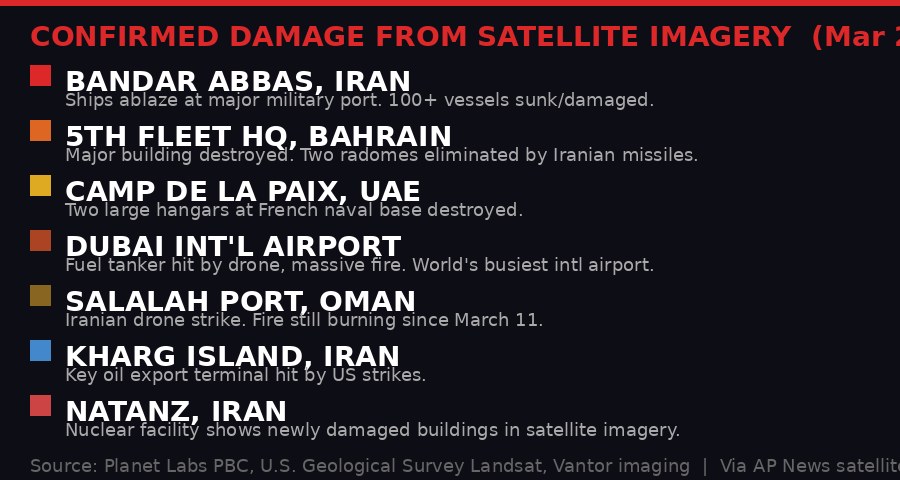
Satellite imagery from Planet Labs PBC, U.S. Geological Survey, and Vantor confirms damage at seven major locations across the Middle East. Source: AP News satellite analysis, March 2026.
In Dubai, U.S. Geological Survey Landsat imagery from Monday March 16 captured a fire at Dubai International Airport after an Iranian drone struck a fuel tanker. Dubai International is the world's busiest airport for international travel. A noxious black plume was visible from space. Flights were disrupted across a hub that handles over 80 million passengers annually.
In Oman - a country that has historically served as a neutral mediator between the United States and Iran - Oman's southern port in Salalah appears to have been struck by Iranian drones on March 11. Tehran has denied responsibility. The fire appeared to still be burning on March 16, five days later.
The damage extends inside Iran as well. At the Revolutionary Guard's headquarters in northern Tehran, satellite photos from Vantor show several buildings demolished. A capsized ship sits in the waters of Konarak Naval Base on Iran's southern coast. At the Isfahan Optics Industries plant - under international sanctions for suspected nuclear connections - strikes are confirmed. The main police headquarters in Tehran had multiple buildings flattened.
And in Natanz, satellite imagery released Monday shows newly damaged buildings at Iran's primary nuclear enrichment facility. Israel has indicated it will attack nuclear sites. That attack appears to have begun.
2,000 Targets: The Most Intense US Bombing Campaign in a Decade
U.S. Central Command says it has hit more than 2,000 targets in Iran since the war began. According to Airwars, an independent group that tracks global conflicts, this is a far heavier bombing campaign than any American operation in the Middle East in more than a decade - surpassing even the most intense periods of the ISIS campaign in Iraq and Syria.
The targets span the full architecture of Iranian state power. The Islamic Republic's leadership has been decimated. Supreme Leader Ayatollah Ali Khamenei was killed in the opening barrage on February 28. Since then, the defense minister has been killed. The head of the Revolutionary Guard has been killed. Khamenei's top security adviser has been killed. On Tuesday, Ali Larijani - the man widely believed to be running Iran's government through the crisis - was killed in an Israeli strike. His son Morteza was killed in the same strike. Earlier this week, Intelligence Minister Esmail Khatib was also eliminated.
"It is a more significant blow than anyone expected might happen in such a short time." - Armed Conflict Location and Event Data (ACLED), independent conflict monitoring group
Iran's missile infrastructure has been hammered. A suspected missile site deep in mountains near Isfahan was struck. Another site outside Kermanshah is documented in satellite photos with roads pockmarked by craters. At the Garmdarah missile site on Tehran's outskirts, several buildings are heavily damaged. CENTCOM says it has degraded Iran's missile launch capabilities significantly - though a senior Western official told AP that Iran likely retains several days' worth of ballistic missiles if it maintains its current firing rate.
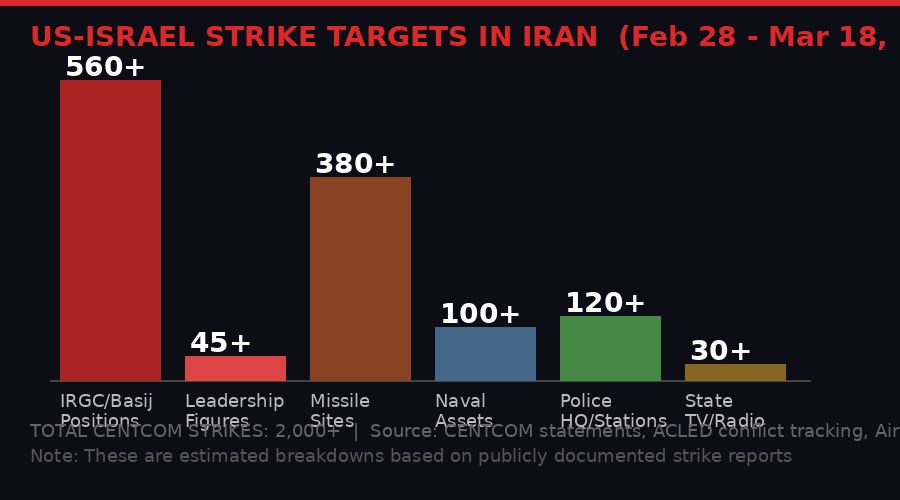
Over 2,000 targets struck by US and Israeli forces since Feb 28. IRGC and Basij positions represent the largest category. Source: CENTCOM statements, ACLED, Airwars tracking.
Iran's state TV broadcaster IRIB has been hit multiple times but continues to broadcast. Its main headquarters in northern Tehran shows damage. A separate station was struck Sunday, collapsing an antenna and heavily damaging the Gandhi Hospital across the street.
Despite 2,000 strikes and the deaths of most of its senior leadership, Iran has not collapsed. The emergency leadership team, whoever comprises it at this point, still appears to have what ACLED calls "the ability for domestic coercion." Missiles and drones keep launching. The dark fleet keeps moving. The selective strait keeps functioning.
China's Strategic Silence: The Real Winner of Operation Epic Fury
Trump asked China for help reopening the Strait of Hormuz. China said no.
The Chinese Foreign Ministry gave what analysts described as a "nonanswer" when asked whether Beijing would send ships to help secure the strait. It repeated its standing call for "parties to immediately stop military operations" and "prevent regional turmoil from further impacting the global economy." This was diplomatic language for: we will not help you fix the problem you created.
The Trump-Xi summit, originally scheduled for March 31 in Beijing, has been postponed. Trump claimed on Tuesday that the Chinese "were fine" with the delay and insisted he had "a very good working relationship with China." The claim rang hollow against the backdrop of Beijing's refusal to help at the strait and China's emerging role as Iran's primary economic lifeline.
"President Trump's request to delay his long-awaited summit with President Xi underscores how significantly he underestimated the fallout from Operation Epic Fury. A show of U.S. force that was meant to intimidate Beijing has instead served to puncture the illusion of U.S. omnipotence: Unable to reopen the Strait of Hormuz alone, Washington now needs its principal strategic competitor to help it manage a crisis of its own making." - Ali Wyne, Senior Research Adviser, International Crisis Group
China's position is not accidental. Iran-China trade has continued under the dark fleet system throughout the war. China is the primary beneficiary of discounted Iranian crude. Beijing has delivered humanitarian aid to Iran, specifically condemning the U.S.-Israeli strike on the Shajarah Tayyebeh elementary school in Minab that killed more than 165 people, mostly children. Chinese diplomats have been positioning Beijing as the peacemaker while Washington takes the blame for war.
The military pivot away from Asia is also a gift to Beijing that it did not have to ask for. The U.S. has transferred significant assets from the Indo-Pacific to the Middle East, including rapid-response Marine units and anti-missile defense systems. Every week the war continues is another week in which China gains relative position against U.S. deterrence in Taiwan Strait scenarios.
Zack Cooper, a senior fellow at the American Enterprise Institute who studies U.S.-Asia strategy, was blunt: "I believe that China is happy to delay the visit and reap the benefits as the United States once again gets bogged down in the Middle East. I think most Chinese experts and officials believe that the United States is undermining itself, so they just need to get out of the way."
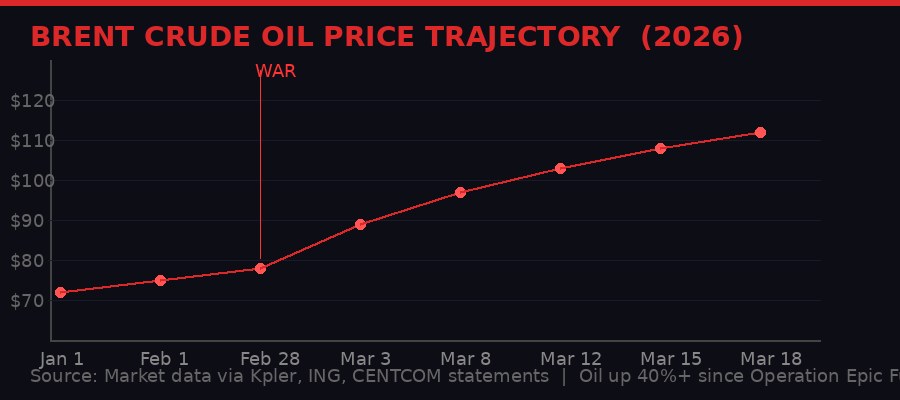
Brent crude has risen more than 40% since Operation Epic Fury began February 28, surpassing $100 a barrel. The oil market is pricing in prolonged disruption at the world's most critical chokepoint. Source: Kpler, ING Research.
The Intelligence Revolt: Kent's Resignation and What It Means
Joe Kent - director of the National Counterterrorism Center, former Green Beret, a man Trump once praised for having "hunted down terrorists and criminals his entire adult life" - resigned on Tuesday. His letter was not diplomatic.
"Iran posed no imminent threat to our nation," Kent wrote in a statement posted on social media, "and it is clear that we started this war due to pressure from Israel and its powerful American lobby."
This is extraordinary. Kent was confirmed to his post in a 52-44 Senate vote. He is a decorated veteran with connections to Trump's right flank, not a career bureaucrat or a liberal holdout. His resignation is not a protest from the left. It is a break from within the MAGA intelligence apparatus.
Trump responded by calling Kent "weak on security" and saying he never thought much of him anyway - a reversal of his previous lavish praise. Director of National Intelligence Tulsi Gabbard declined to state her own views, writing only that Trump had made the call and she supports it.
Kent's departure comes as Gabbard, CIA Director John Ratcliffe, and FBI Director Kash Patel are all scheduled to testify before Congress this week about threats facing the United States. The hearing will be dominated by questions about the Iran war and the revelation that outdated intelligence led to the U.S. firing a missile that hit the Shajarah Tayyebeh elementary school in Minab, killing more than 165 people.
Senate Intelligence Committee ranking Democrat Mark Warner said Kent is correct on this specific issue even though he disagrees with Kent's broader record: "There was no credible evidence of an imminent threat from Iran that would justify rushing the United States into another war of choice in the Middle East."
House Speaker Mike Johnson pushed back at a press conference, claiming Iran was "very close to nuclear enrichment capability" and that without action "we would have mass casualties of Americans." But the intelligence establishment Kent represented - the entity actually tasked with assessing those threats - has now produced a senior official willing to publicly call the war unjustified. That's not a political dispute. That's a fundamental fracture in the justification architecture of the conflict.
KEY FIGURES KILLED SINCE FEB 28
- Ayatollah Ali Khamenei - Supreme Leader (Feb 28, opening strikes)
- Mohammad Bagheri - Defense Minister (March, early week)
- Hossein Salami - IRGC Commander-in-Chief (March, early week)
- Khamenei's top security adviser (early March)
- Ali Mousavi - Senior IRGC figure (mid-March)
- Ali Larijani - De facto acting head of government (March 17-18)
- Morteza Larijani - Son of Ali Larijani, killed in same strike
- Esmail Khatib - Intelligence Minister (March 18, confirmed by Israel)
How Iran Is Surviving: The Underground Government
After 19 days of what CENTCOM calls the most intensive U.S. bombing campaign in a decade, Iran still has a functioning government. It is not the government anyone recognizes from before February 28, but it exists, it commands, and it fires.
Understanding how requires understanding the structure of the Islamic Republic. Iran's system was never built around a single leader. Khamenei's power was real, but it was embedded in multiple parallel institutions - the Supreme National Security Council, the Islamic Revolutionary Guard Corps, the Assembly of Experts, the Guardian Council, the intelligence ministry. These institutions do not share clean hierarchies. They overlap, compete, and in crisis conditions, operate semi-autonomously.
The killing of Ali Larijani removes the most prominent individual believed to be coordinating the surviving leadership. But Larijani himself was not running a government in the normal sense - he was coordinating a dispersed emergency network, with leaders underground, in undisclosed locations, communicating through channels that have proven difficult to intercept or trace.
The IRGC presents the most persistent problem for U.S. planners. Its structure is intentionally redundant. Command authority devolves down the chain when senior figures are eliminated. Individual garrison commanders have standing orders and pre-authorized strike packages. The continued firing of Khorramshahr-4 multi-warhead missiles into Israel and missiles into Gulf Arab infrastructure suggests those pre-authorized packages are still being executed, even without central coordination.
ACLED notes that the emergency leadership team still appears to have "the ability for domestic coercion" - meaning internal security forces, the Basij, and local police units are still functioning well enough to prevent the kind of mass uprising that might accelerate regime collapse. Protests have emerged in some cities, but they have been suppressed.
Iran's strategy appears designed around time. Not winning the war in a conventional sense, but outlasting the political will of an adversary whose own intelligence community is now openly questioning the war's rationale.
Timeline: How We Got to a "Selective Strait"
What Comes Next: The Endgame Nobody Can See
There are three plausible trajectories from here, and none of them look like the quick victory the White House appears to have planned for.
The first is regime collapse. The decapitation strategy - killing Iran's senior leadership layer by layer - could eventually trigger the kind of internal fracture that produces either a military coup or a genuine popular uprising. The Basij and IRGC have their own internal tensions, and the strain of absorbing leadership losses at this scale is genuinely unprecedented. But this trajectory requires more time than the current political environment in Washington may allow.
The second is stalemate at a high cost. Iran keeps the selective strait functioning. Oil prices stay above $100 and begin transmitting into U.S. inflation data. Trump's tariffs, already hitting American manufacturers harder than they're hitting China according to recent AP analysis, compound the economic pressure. The Federal Reserve, which was planning rate cuts before the war, finds itself trapped between a slowing economy and re-ignited inflation. Congressional approval for the war erodes. This is the slow bleed.
The third is escalation beyond current parameters. Iran hits a target that changes the political calculus - a civilian airliner, a water desalination plant serving Gulf cities, a strike that kills large numbers of American troops. Or Israel attacks Natanz in a way that produces a radiological incident. The war becomes something no one planned for and no one controls.
The satellite images released this week put physical reality to a war that has been abstracted in briefing slides and press releases. Ships are actually burning. Buildings that held military command structures are actually collapsed. A fuel fire at the world's busiest airport for international travel actually turned the sky black. These images now exist in the public record.
And yet, 16 million barrels of Iranian oil are moving. Dark tankers are threading corridors close to the Iranian coast. India and Pakistan secured their passage through diplomacy, not force. China is watching, waiting, and profiting.
Trump asked allies for warships to reopen the strait. Most said no. He asked China. China declined. The strait is not closed. It is selective. And the selection criteria are not Washington's to set.
That is the Hormuz paradox. The United States has launched its most intensive bombing campaign in a decade. It has destroyed most of Iran's visible senior leadership. It has sunk over 100 Iranian vessels. And it still does not control the strait.
Sources: AP News (Jon Gambrell, Washington bureau, Cairo bureau); Lloyd's List Intelligence; Kpler trade analytics; ACLED (Armed Conflict Location and Event Data); Airwars conflict tracking; Planet Labs PBC satellite imagery; U.S. Geological Survey Landsat data; International Crisis Group; American Enterprise Institute; U.S. Central Command statements; Senate Intelligence Committee statements.
Get BLACKWIRE reports first.
Breaking news, investigations, and analysis - straight to your phone.
Join @blackwirenews on Telegram