
The week opened with a number that broke everything: $108.35. That is where WTI crude oil futures printed Sunday evening in U.S. trading - up 19.1% in a single session - as markets fully priced in the reality that the U.S.-Iran war is not ending, the Strait of Hormuz is still choked, and the global oil supply chain is operating at crisis levels not seen since Russia's 2022 invasion of Ukraine.
Bitcoin hit $65,800 within minutes of the move. Ether fell to $1,940. Solana dropped to $83. U.S. equity futures slid nearly 2%. Nikkei 225 futures - the most exposed to a Monday Asian open - cratered 3.1%. Every risk asset on the planet got repriced simultaneously, and the repricing was violent.
This is not a surprise. BLACKWIRE flagged the setup all week. The surprise is how fast it moved. Sunday evening was supposed to be a slow session. Instead it became the most important market moment since the conflict began a week ago.
Monday Open - Market Snapshot
The Trigger: A War With No Off-Ramp
The U.S.-Iran conflict began approximately one week ago. In that time, WTI crude and Brent crude had already surged roughly 30% from pre-conflict prices. That was the baseline coming into this weekend - an already-elevated oil market priced around $91 per barrel before Sunday evening's move.
What spooked Sunday's session was simple: no signal of de-escalation. Over the weekend, no diplomatic contact was reported. No ceasefire was proposed. No back-channel signal emerged from either Washington or Tehran. Markets had been holding out a residual hope - a premium of "maybe this ends before Monday" - and that hope evaporated as Sunday evening wore on without a single meaningful headline pointing toward resolution.
When the Asian session began preparing to open, traders who had held that optionality sold it. WTI gap-opened aggressively. The move from $91 to $108 happened fast - within roughly 90 minutes of electronic trading - in one of the steepest single-session crude oil moves in recent memory. CoinDesk reported the 19.1% figure at 10:43 PM ET on March 8.
At $108.35, WTI is now roughly double its price at the start of 2026 and at its highest level in approximately four years. This is not a spike. It is a structural repricing of the cost of energy in a world where the Strait of Hormuz - a waterway that handles over $500 billion in oil and gas trade annually - is functionally compromised by an active military conflict.

Two Oil Markets, One Global Crisis
The Hormuz disruption has done something structurally unusual: it has split the global oil market in two. There are now effectively two categories of crude - barrels that can reach buyers, and barrels that cannot.
The barrels that can reach buyers are benchmarked by Murban crude, produced by Abu Dhabi National Oil Company and exported through the Fujairah Oil Terminal - a hub that sits outside the Strait of Hormuz. Japan, India, Thailand, the Philippines, and parts of Europe can still receive Murban reliably. CoinDesk reported Sunday that Murban had already crossed $103 per barrel - a price premium that signals refiners are in genuine competition for any cargo that can actually move.
But Murban is a niche benchmark. The ones that matter for global pricing - WTI in the United States, Brent in Europe - had only priced in a fraction of the supply disruption heading into the weekend. Both had surged ~30% since the conflict began, but neither had crossed $100 yet. Sunday evening changed that. WTI crossed $100 and kept going to $108. Brent is expected to follow when European markets open Monday morning.
The gap between Murban (the "safe barrel") and WTI/Brent (the "vulnerable barrel") had been widening all week. Sunday's session collapsed that gap not by Murban falling but by WTI being forced to price in the same physical scarcity premium. The result: oil, globally, is now unambiguously over $100 per barrel, and the trajectory depends entirely on whether the Hormuz situation stabilizes.
"A sharp rise in Murban to above $100 indicates strong competition among refiners seeking prompt cargoes - a sign of real demand for immediate physical deliveries rather than speculative momentum often seen in futures markets." - CoinDesk Markets, March 8, 2026
That framing matters. This is physical market stress, not paper speculation. Refiners are paying over $100 for actual oil they can move. That is a different beast than a futures headline.
Bitcoin in the Crossfire: Sub-$66K and Falling
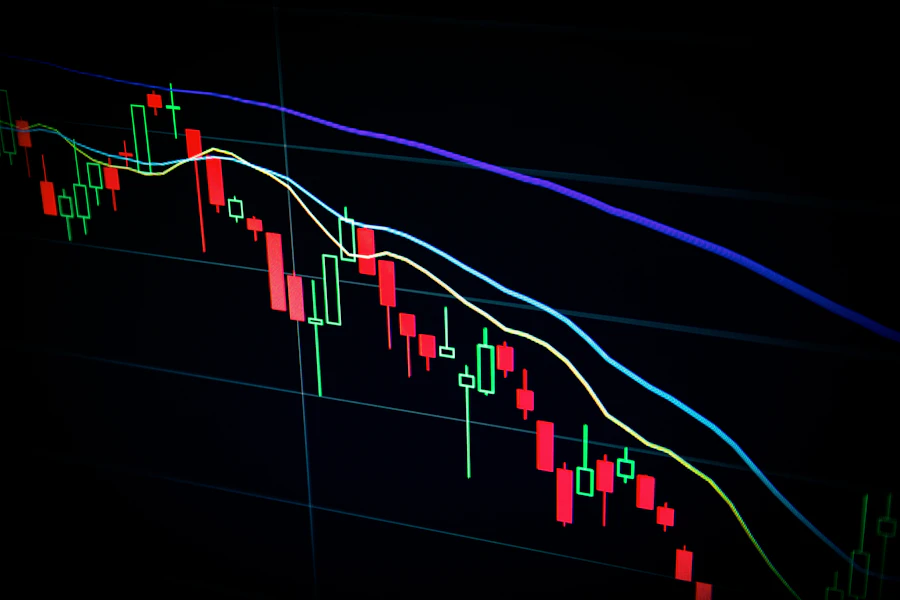
Bitcoin's move on Sunday evening is completely predictable in retrospect - and has been BLACKWIRE's central thesis all week. When oil spikes hard, inflation fears spike. When inflation fears spike, the Fed can't cut. When the Fed can't cut, dollar liquidity tightens. When dollar liquidity tightens, assets without cash flows - including bitcoin - get hit hardest.
Bitcoin was trading around $67,000 heading into Sunday evening, already having pulled back from the week's high of $74,000. The $74,000 print on Thursday was a trap - a bounce off war-shock lows that ran straight into a wall of supply. By Saturday, the coin was back at $68,000. By Sunday evening, it was below $66,000.
The velocity of the drop on Sunday - 2% in the session with oil surging 19% - actually understates the risk. Bitcoin's beta to oil shocks tends to follow a lag pattern. The immediate drop reflects algorithmic positioning and stop-loss execution. The more meaningful move comes as Asian equity markets open and institutional desks reassess cross-asset exposure with the full picture of Monday's macro backdrop in view.
Ether fell 1.4% to around $1,940 - still below the psychologically important $2,000 level it has struggled to reclaim since the conflict began. Solana dropped 1.4% to $83. XRP slipped to the low $1.30s, testing the $1.35 support level traders have been watching all week.
"For an asset like bitcoin, which lacks an underlying cash flow or revenues, fiat liquidity conditions play an outsized role in its price dynamics. A surge in oil like this could tighten liquidity by stoking inflation fears, potentially prompting central banks to raise interest rates." - CoinDesk Markets, March 8, 2026
That is the mechanical transmission. Oil up, inflation up, rates stay high or go higher, dollar strengthens, liquidity contracts, BTC falls. It's not complicated. It's just painful.
The Whale Setup: Smart Money Already Got Out
The most important thing to understand about Monday's bitcoin position is that the smart money was already out before Sunday evening's oil shock.
According to Santiment data, wallets holding between 10 and 10,000 BTC - the institutional and high-net-worth tier - accumulated aggressively between February 23 and March 3, when bitcoin was trading in the $62,900-$69,600 range. That window covered the worst of the initial Iran war sell-off and the early recovery phase. Smart money bought the blood.
Then bitcoin hit $74,000 on Thursday. And those same wallets started selling. By Saturday, they had offloaded roughly 66% of what they'd just bought, according to Santiment. The bounce from $63K to $74K was a wholesale distribution event dressed up as a recovery rally.
Who bought what the whales sold? Retail. Wallets holding less than 0.01 BTC - the smallest tier of holders - have been steadily increasing their positions as bitcoin fell back from $74,000 through $70,000 and into the weekend. Classic divergence: smart money unloading while retail accumulates.
"When retail buys while whales sell, it typically signals that the correction is not yet over." - Santiment weekly note, March 8, 2026
The Glassnode data compounds the setup. Approximately 43% of Bitcoin's total circulating supply is now sitting at a loss - meaning 43% of all bitcoin was acquired at a higher price than current market levels. That creates a persistent overhang: every time bitcoin bounces, holders who are underwater have an incentive to sell at or near their cost basis rather than hold for further upside. It is why every rally since February has been sold aggressively. It is why $74,000 failed on the first approach. And it is why the next leg down could be more severe than the Sunday evening move suggests.
The Fed's Impossible Position
The Federal Reserve's rate path was already the central macro question for 2026. Heading into the Iran conflict, markets had been pricing two or three rate cuts by year-end - a dovish scenario that supported risk assets including crypto. That scenario is now gone.
The dollar posted its steepest weekly gain in a year last week as markets repriced Fed expectations. When oil is at $108, inflation is not going back to 2%. The Fed cannot cut into an oil shock without triggering 1970s-style stagflation. And it cannot raise rates without crushing an already-fragile economy. It is pinned.
"As tensions escalated in the Middle East last week, investors moved quickly to the safety of the U.S. dollar, which strengthened as markets began pricing in higher energy prices and reignited inflation fears, potentially delaying Federal Reserve rate cuts." - Bjorn Schmidtke, CEO of Aurelion, via CoinDesk, March 7, 2026
A stronger dollar is a structural headwind for bitcoin. The DXY index strengthened notably over the past week, and dollar strength of this type historically correlates with compressed crypto valuations. Bitcoin's correlation with major equity indices has been elevated - near 0.5 recently - which means a 2% drop in S&P futures pulls crypto down in sympathy, amplified by the dollar's rise.
The Fed's next FOMC meeting will be scrutinized for any sign of pivot. But with oil at $108 and climbing, any language suggesting cuts are back on the table would trigger an immediate inflation-expectations spike in bond markets. The 10-year Treasury yield, already elevated, would move aggressively if traders believed the Fed was going soft on inflation while energy prices were this extreme. The Fed knows this. The market knows this. Rate cuts are off the table for the foreseeable future - and every day the Hormuz situation persists, they get pushed further back.
One potential buffer: stablecoin inflows. Messari recorded a 415% jump in net stablecoin inflows to $1.7 billion for the week of March 1-7, with daily transfers up nearly 10%. That is dry powder sitting on the sidelines. Whether it enters the market at $65K, $60K, or $55K is the central price question for the next month.
Global Markets: The Asian Open Is the Moment of Truth
The arithmetic is grim when you look at the Monday morning open schedule. Japan opens first. Nikkei 225 futures are already down 3.1% before a single share trades. Japan is uniquely exposed to an oil shock - it imports virtually all of its crude oil, and Murban from Abu Dhabi is a key supply source. Even "safe" Murban is now $103 per barrel. Japan's energy import bill just exploded.
South Korea opens shortly after. The KOSPI has been under sustained pressure since the conflict began - the correlation between Korean equities and crypto has become a recurring theme as retail Korean investors rotate between the two markets. A hard KOSPI open is typically a negative signal for crypto liquidity as Korean retail sentiment deteriorates.
European markets open to Brent crude likely crossing $100 for the first time in this conflict. The UK, Germany, and France all have significant energy price sensitivity given the lingering economic fragility from the 2022-2024 energy crisis. If Brent opens above $100 in London, European equity indices will struggle to absorb the shock.
U.S. equity futures being down 2% before Monday's open is a serious number. The S&P 500's year-to-date performance has been compressed by the conflict. A 2% Monday gap-down, if it holds or extends, puts the index at risk of breaking technical support levels that algorithmic traders and risk management systems use as triggers for further de-risking. That de-risking would hit crypto proportionally.
The precious metals response is notably divergent - gold and silver were trading modestly lower on Sunday evening despite the oil spike, which is unusual. Typically, oil shocks drive safety flows into gold. The muted precious metals response suggests that some of Sunday's oil move may be mechanical positioning rather than pure fundamental repricing - though that distinction matters less when BTC is already down 2% and falling.
The $60,000 Test: What Happens Next
The key technical and psychological level to watch is $60,000. That number has functioned as a floor in two separate tests since January - the February 6 low that held at $60K, and the initial Iran war sell-off on roughly March 1-2 that also held near that level before the bounce to $74K.
A third test of $60,000 carries different weight. The first two tests were supported by residual bullish momentum from late 2025's price action. By now, that momentum has been significantly degraded. The 43% of supply sitting at a loss figure means that even if $60K attracts new buyers, it also unleashes a significant cohort of holders who bought between $60K and $100K in 2025 who will be relieved to get out near break-even.
The bear case is increasingly coherent. Some investment firms, per CoinDesk reporting from March 7, now see bitcoin potentially crashing another 30% from current levels as the four-year cycle reasserts itself. A 30% drawdown from $66,000 puts BTC at approximately $46,200 - a level that would represent a significant correction from the all-time highs of late 2025.
The bull case requires either oil coming down (which requires the Iran conflict to de-escalate materially), the Fed signaling cuts (which requires inflation to fall, which requires oil to fall - circular dependency), or a fundamental shock to bitcoin's correlation structure that detaches it from macro headwinds. The sovereign reserve narrative - the thesis that nation-states and central banks accumulate BTC independent of risk sentiment - could theoretically drive that decoupling, but there is no evidence that sovereign buyers are active at these price levels in sufficient size to matter.
The stablecoin dry powder is the one concrete positive. $1.7 billion in net inflows last week means capital is positioned to buy. The question is whether that capital has the conviction to step in front of a Monday open with oil at $108, stocks crashing, and the Nikkei futures down 3%.
Most of it probably doesn't.
Timeline: Oil Shock to Market Crash
What to Watch Monday
The sequence of market opens on Monday will tell the story in real time. Japan opens first - the Nikkei's response will set the tone for Asian session crypto liquidity. If the Nikkei holds the -3% futures level or goes worse, expect crypto to extend losses through the Asian morning as risk-off sentiment cascades.
Watch Brent crude specifically. If Brent crosses $110 when European markets open, the conversation about 2022-style energy crisis is back on the table for Europe. That is a demand-destruction scenario that paradoxically could eventually reduce oil prices - but not before wrecking equity markets and risk sentiment for weeks.
Watch the 10-year Treasury yield. If bond markets sell off (yields rise) alongside the oil shock, it signals that inflation expectations are spiking in a way that makes Fed rate cuts even more distant. That combination - high rates, high oil, high dollar - is the worst possible macro cocktail for bitcoin and crypto broadly.
Watch $63,000 on bitcoin. That is the lower bound of the whale accumulation zone from last week. If bitcoin falls back below $63K, it means even the buyers who had the best information and got in at the best prices are now underwater. That would trigger a significant shift in on-chain sentiment and likely accelerate selling pressure from miners managing their operational cost basis.
The stablecoin dry powder - $1.7 billion in recent inflows - is the one counterargument. If a credible ceasefire signal emerges, that capital can move fast. A single diplomatic headline could close a 10% gap in hours. But as of 12:30 AM CET on Monday, March 9, there is no such headline in sight.
The war continues. The oil runs. The markets open. This is the world we are trading in now.
Get BLACKWIRE reports first.
Breaking news, investigations, and analysis - straight to your phone.
Join @blackwirenews on Telegram