TABLE OF CONTENTS
Why Weekends Are Different Chapter 1: Friday Market Setup Analysis Chapter 2: Weekend Liquidity Patterns Chapter 3: Key Support & Resistance Levels Chapter 4: Risk Management for Thin Hours Chapter 5: Alt Season Preparation Chapter 6: Monday Gap Trading Setups The Cheat SheetWeekends Will Eat Your Portfolio
Most traders lose money on weekends. Not because the market is harder to read, but because they trade weekends like weekdays. Same position sizes. Same leverage. Same assumptions about liquidity that simply don't hold when institutional desks go home.
Here's what changes between Friday 20:00 UTC and Monday 08:00 UTC:
Those numbers aren't scare tactics. They're the playing field. Once you understand the terrain, you can use it.
This guide covers everything: the Friday preparation ritual, the liquidity dead zones to avoid, exact support/resistance levels for this weekend, how to size positions when the order book is paper-thin, how to position for alt season rotation, and the Monday gap trade that has filled 77% of the time since 2023.
Bookmark it. Print the cheat sheet at the bottom. Reference it every Friday.
Chapter 1: Friday Market Setup Analysis
Your weekend trading success is determined on Friday. Not Saturday, not Sunday. Friday.
Between 16:00-20:00 UTC on Friday, three things happen simultaneously: CME Bitcoin futures close (creating the gap), institutional traders flatten positions, and retail traders stop paying attention. This 4-hour window is where you do your homework.

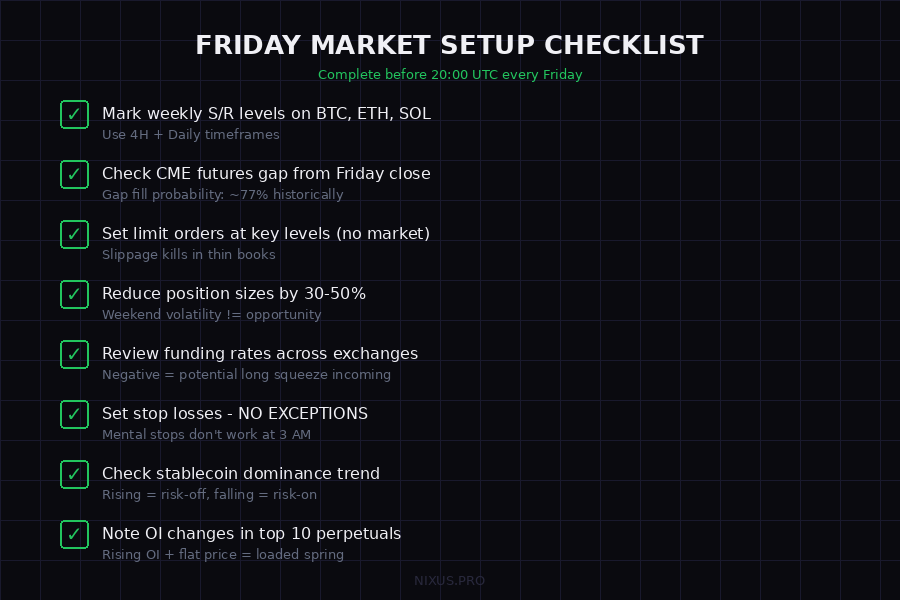
The Friday Prep Ritual
This isn't optional. It's the difference between traders who survive weekends and traders who wake up liquidated.
Step 1: Mark Your Levels
Pull up the 4-hour and daily charts for BTC, ETH, and SOL. Identify:
- Weekly open and close levels - price tends to revert to these
- Previous week's high and low - these become weekend magnets
- Volume profile POC (Point of Control) - where the most trading happened
- Any unfilled daily FVGs (Fair Value Gaps) - weekend moves love to fill these
Don't mark 47 levels. Mark 3-4 per asset. If you can't see clear levels, there aren't clear levels, and you shouldn't trade that asset this weekend.
Step 2: Record the CME Close
When CME Bitcoin futures close at 21:00 UTC Friday (16:00 EST), write down the exact closing price. This becomes your gap reference for Monday.
Step 3: Funding Rate Snapshot
Before the weekend begins, record funding rates on the top 10 perpetual contracts. This tells you how the market is positioned:
- Highly positive funding (>0.05%) - Market is overleveraged long. Weekend dumps hit harder.
- Neutral funding (0.01-0.03%) - Balanced. Normal weekend behavior expected.
- Negative funding (<0%) - Shorts are paying longs. Potential squeeze setup brewing.
Step 4: Stablecoin Dominance Check
USDT + USDC dominance is the best real-time fear gauge in crypto. If stablecoin dominance is rising into the weekend, money is flowing out of risk assets. If it's falling, capital is rotating into tokens.
As of this writing (March 2026), stablecoin market cap sits at $198B - an all-time high. Fresh capital is parked and ready. The question is whether it deploys this weekend or waits for confirmation.
Chapter 2: Weekend Liquidity Patterns
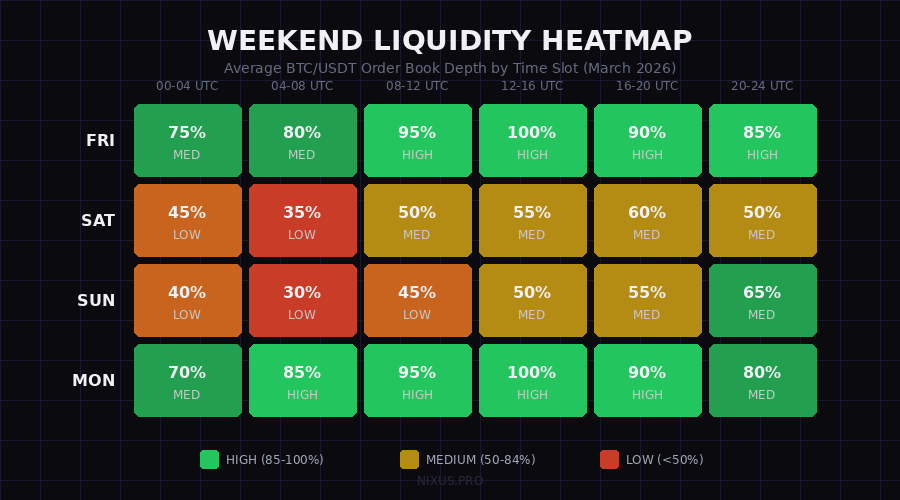
Liquidity doesn't disappear evenly over the weekend. It follows a predictable pattern that most traders completely ignore.
The Dead Zone: Saturday 04:00-08:00 UTC
This is the thinnest liquidity window of the entire week. US is asleep (23:00-03:00 EST). Europe is asleep. Asia hasn't fully spun up for the weekend. Order books on major exchanges show 35-40% of normal depth.
What this means practically:
- A $5M market sell that moves BTC 0.1% on Tuesday will move it 0.3% on Saturday at 05:00 UTC
- Cascading liquidations accelerate 2-3x faster because there's less book to absorb them
- Wicks are longer, fakes are more common, and stop hunts are cheaper to execute
The Recovery: Sunday 16:00-20:00 UTC
As Sunday evening approaches (European time), liquidity begins rebuilding. Asian markets prepare for Monday, institutional OTC desks start quoting again, and order books fill back toward normal depth.
This is actually one of the best entry windows of the week. Liquidity is improving but price hasn't yet reacted to the CME reopen. If you have conviction on a direction, Sunday 16:00-20:00 UTC is your moment.
Weekend Volume Distribution
Average BTC spot volume by day (last 90 days):
| Day | Avg Volume | vs. Weekday | Notes |
|---|---|---|---|
| Monday | $38.2B | +12% | CME gap + institutional return |
| Tuesday | $34.1B | Baseline | Normal trading day |
| Wednesday | $35.8B | +5% | Mid-week positioning |
| Thursday | $33.4B | -2% | Pre-weekend caution starts |
| Friday | $31.7B | -7% | Institutions flatten |
| Saturday | $19.8B | -42% | Thin. Dangerous. |
| Sunday | $22.1B | -35% | Recovery begins evening |
That's not a small difference. Saturday volume is less than half of Monday's. Every trade you take on Saturday is swimming in shallower water.
Chapter 3: Key Support & Resistance Levels
Here are the exact levels to watch this weekend across the three assets that matter most.
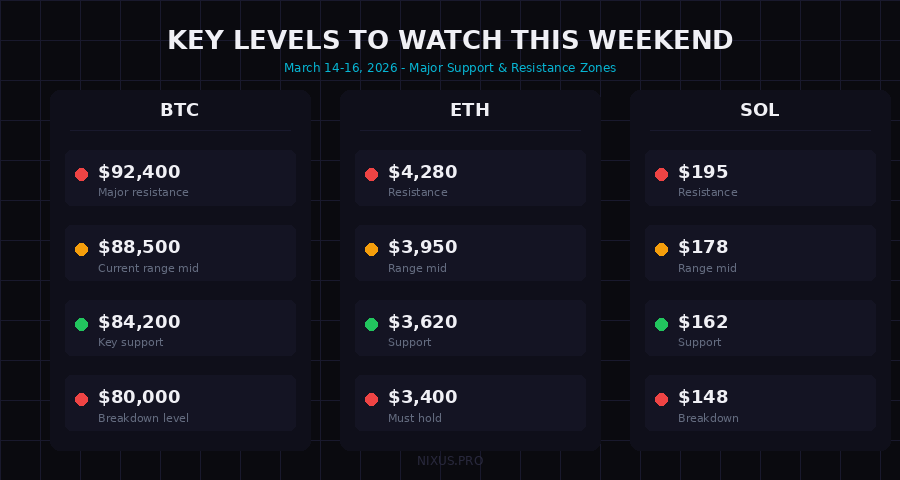
BTC/USDT - The Anchor
Bitcoin sets the tone for everything. If BTC holds its range this weekend, alts breathe. If BTC breaks down, everything follows.
- $92,400 - Major resistance. Weekly level rejection zone. Need a daily close above for continuation.
- $88,500 - Current range midpoint. The "fair value" based on volume profile. Price gravitates here during low-volume periods.
- $84,200 - Key support. Previous breakout level now acting as support. First buy zone for weekend dips.
- $80,000 - Breakdown trigger. If this level fails on weekend volume, expect a cascade to $76K. This is where you step away, not step in.
ETH/USDT - The Alt Leader
Ethereum leads the alt market. If ETH/BTC ratio holds or rises this weekend, it's the earliest signal of capital rotation toward alts.
- $4,280 - Resistance zone with heavy sell-side liquidity clustered above
- $3,950 - Range equilibrium. Base case for flat weekend
- $3,620 - Support. Previous accumulation zone with strong buyer interest
- $3,400 - Must-hold level. Below this, ETH structure breaks bearish for the weekly
SOL/USDT - The Momentum Play
Solana moves faster and harder than BTC or ETH on weekends because its order book is thinner. Both a risk and an opportunity.
- $195 - Resistance. Psychological round number with sell walls
- $178 - Range midpoint. Expected weekend chop zone
- $162 - Support. Strong buyer zone from previous weekly open
- $148 - Breakdown. Below here, SOL enters bear territory on the daily
Chapter 4: Risk Management for Thin Trading Hours
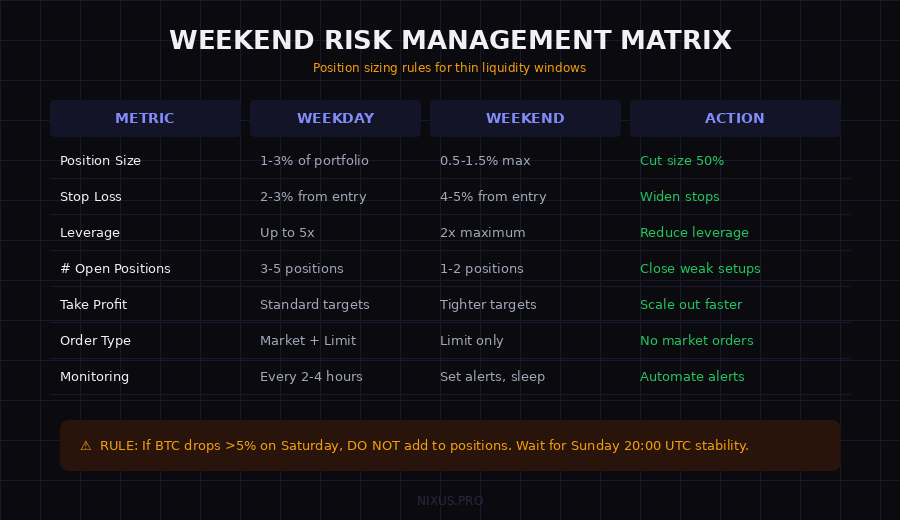
This is the chapter that saves your account. Everything else in this guide is edge. This is survival.
The 50% Rule
Whatever your normal position size is, cut it in half on weekends. If you normally risk 2% per trade, risk 1%. If you normally run 3 positions, run 1-2.
This isn't conservative trading. It's correct trading. When order book depth drops 45%, your effective risk per dollar deployed nearly doubles. Halving your size brings your actual risk back to weekday levels.
Stop Losses: Non-Negotiable
On weekdays, some experienced traders use mental stops. They watch the chart and exit manually when their level breaks.
On weekends? Set hard stops on the exchange. Price can move 5% in 90 seconds at 04:00 UTC Saturday. You will not be awake. You will not be watching. Your stop loss is your insurance policy, and you don't negotiate with insurance.
Leverage Limits
Maximum 2x leverage on weekends. Ideally 1x (spot only).
Here's the math: A 3% move against you with 5x leverage = 15% portfolio hit. On a weekday with normal liquidity, a 3% move takes hours. On Saturday at 05:00 UTC, it can happen in minutes. With 2x leverage, that same 3% move is a manageable 6% - uncomfortable but survivable.
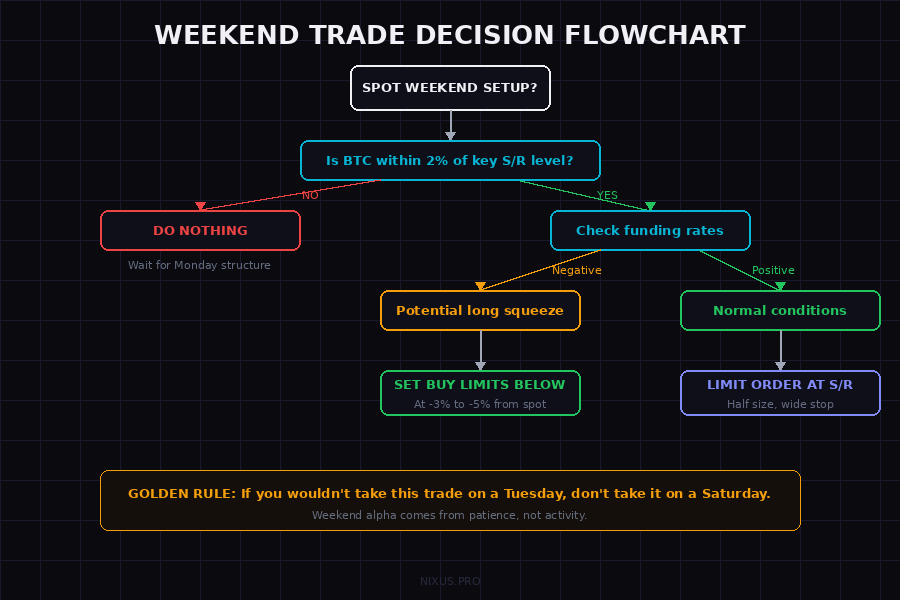
The "Would I Take This on Tuesday?" Test
Before entering any weekend trade, ask yourself: would I take this exact setup on a Tuesday? Same entry, same size, same conviction.
If the answer is no - if you're only trading because you're bored, or because you saw a tweet, or because the chart "looks like it's about to move" - close the app. The best weekend trade is often no trade.
Alert-Based Trading
The optimal weekend trading approach isn't sitting at your desk for 48 hours. It's this:
- Set your levels on Friday (Chapter 1)
- Place limit orders at those levels with stops
- Set price alerts at 1% above resistance and 1% below support
- Go live your life
- If an alert fires, check the setup. If it still makes sense, adjust your orders.
- If no alerts fire, congratulations - you preserved capital by doing nothing.
The traders who survive weekends are the ones who automate their strategy Friday night and only intervene when conditions change. Screen-watching a thin Saturday market is how you overtrade yourself into red.
Chapter 5: Alt Season Preparation Strategies
Alt season doesn't start with altcoins pumping. It starts weeks earlier with a specific sequence of signals that most traders only recognize in hindsight.
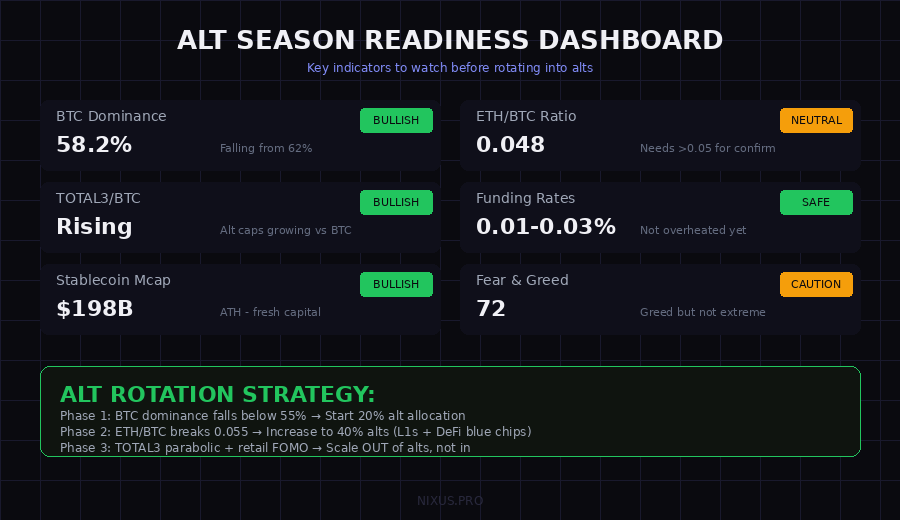
As of mid-March 2026, several of those signals are flashing. Here's what to watch and how to position.

The Alt Season Sequence
Every alt season in crypto history has followed roughly the same pattern:
- BTC rallies alone - Dominance rises above 60%. Alts bleed in BTC terms.
- BTC consolidates - Dominance plateaus. BTC goes sideways for 2-4 weeks.
- ETH catches up - ETH/BTC ratio starts climbing. This is your early warning.
- Large caps follow - SOL, AVAX, LINK start outperforming BTC.
- Mid caps explode - The "actual" alt season. 5-20x moves in quality mid caps.
- Junk pumps - Everything with a ticker goes up. This is the TOP, not the beginning.
Right now, we're between stages 2 and 3. BTC dominance has fallen from 62% to 58.2% over the past three weeks. ETH/BTC is at 0.048, approaching the critical 0.05 level. These aren't predictions - they're observable data points.
Weekend Alt Positioning
Weekends are actually ideal for building alt positions, for one counterintuitive reason: retail panic sells alts on weekend dips while institutional accumulation resumes Monday.
The playbook:
- If BTC dips to support on Saturday: place limit orders on your target alts at -8% to -12% from Friday's close. These get filled on the panic wicks that thin liquidity creates.
- If BTC holds flat all weekend: do nothing. Wait for the weekly close to confirm the range.
- If BTC breaks resistance: this is your signal to start the alt rotation. Begin with ETH and SOL (most liquid), then rotate into your conviction mid-caps over the following week.
Which Alts to Watch
Don't spray capital across 30 tokens. In the early stages of alt season rotation, focus on:
- Layer 1s (ETH, SOL, AVAX, SUI) - These move first after BTC and have the deepest liquidity for safer weekend positioning
- DeFi blue chips (AAVE, UNI, LINK) - Revenue-generating protocols that institutional capital targets
- AI/Compute tokens - The 2026 narrative leader. Look at tokens with actual compute revenue, not just "AI" in the name
Save the micro-caps for weekdays when you can exit quickly if needed. Weekend liquidity on small tokens is essentially zero.
Chapter 6: Monday Gap Trading Setups
The CME gap trade is the single most backtestable, repeatable setup in crypto. Here's how to execute it.

What Is the CME Gap?
CME Bitcoin futures trade Monday-Friday. When they close Friday evening, spot BTC keeps trading all weekend. Any price difference between Friday's CME close and Sunday's CME open creates a "gap" on the CME chart.
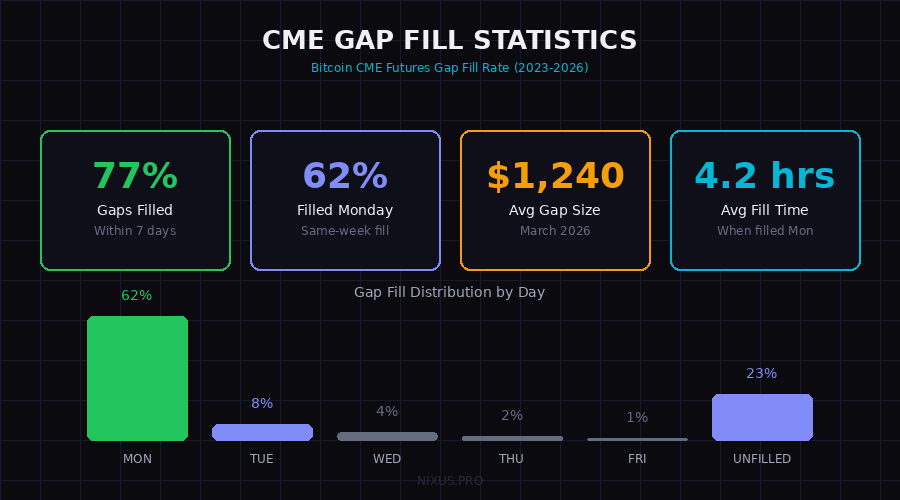
The market has filled 77% of these gaps since 2023. 62% fill on Monday itself. This is not an edge that's debatable - it's statistically verified across hundreds of occurrences.
Gap Up Scenario
If BTC spot price on Sunday night is above Friday's CME close:
- The CME opens with a gap up
- To "fill" the gap, price needs to come back down to Friday's close level
- Trade: Short entry near Sunday's spot price, target at Friday CME close, stop above the weekend high
- Sizing: 0.5-1% risk. This is a statistical trade, not a conviction trade
Gap Down Scenario
If BTC spot price on Sunday night is below Friday's CME close:
- The CME opens with a gap down
- To fill, price needs to rally back to Friday's close level
- Trade: Long entry near Sunday's spot price, target at Friday CME close, stop below the weekend low
- Sizing: Same 0.5-1% risk
When NOT to Trade the Gap
- Gap is less than $500 - Not worth the slippage and risk for a small target
- Major macro event Monday - FOMC, CPI, or other catalysts override gap dynamics
- Weekend move was >8% - Momentum can overwhelm gap fill mechanics
- BTC just hit a major new ATH - New territory means old patterns break
Execution Timing
CME reopens at 23:00 UTC Sunday (18:00 EST). The first two hours (23:00-01:00 UTC) see the highest volatility as the gap is created and traders react.
Two approaches:
- Aggressive: Enter at CME open. Higher risk, full gap capture potential.
- Conservative: Wait 1-2 hours for the gap direction to confirm. Enter on the first retracement. Smaller target but higher probability.
March 2026 Context
This month, CME gaps have averaged $1,240 in size. The last four gaps all filled within 24 hours. Given current volatility and the $84K-$92K range, this weekend's gap is likely to be in the $800-$1,500 range - tradeable on even a small account with proper sizing.
The Weekend Trading Cheat Sheet
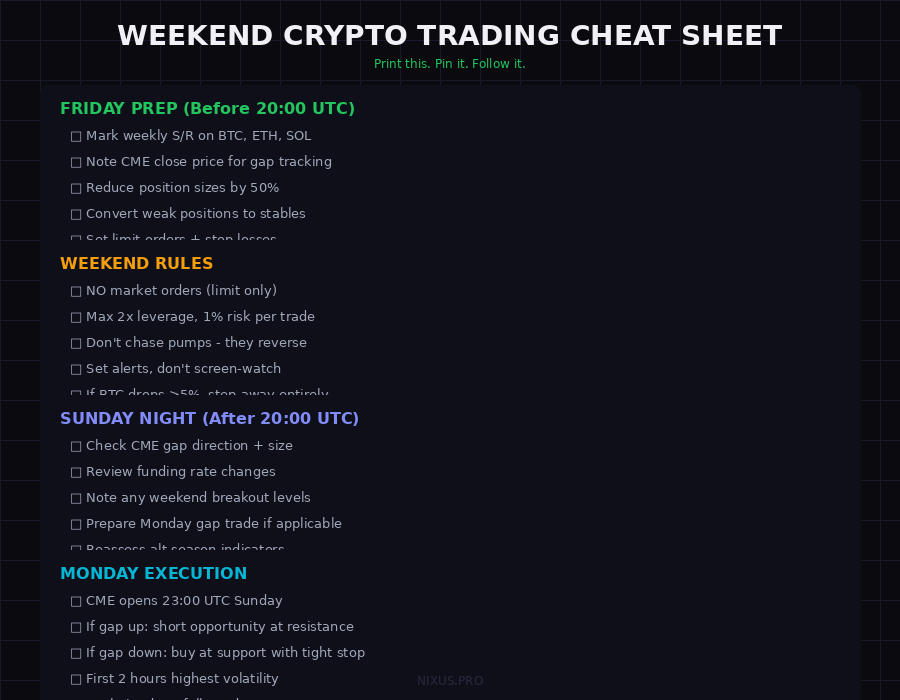
Everything above distilled into one printable reference. Save this image.
The One-Line Summary for Each Day
Final Thoughts
Weekend crypto trading isn't about finding alpha in chaos. It's about understanding that the market changes character when the institutional players leave, and adjusting your behavior accordingly.
The traders who blow up on weekends are the ones trading the same way they do on Wednesday. Full leverage. Market orders. Five open positions. Mental stops they'll "definitely check later."
The traders who profit from weekends are the ones who:
- Prepare on Friday
- Use limit orders exclusively
- Cut position sizes in half
- Trade the CME gap with disciplined sizing
- Treat patience as a strategy, not a weakness
The market will be here Monday. Your capital might not be, if you don't respect the weekend.
Trade the plan. Not the boredom.