Wearing Black Is Terrorism Now: The Prairieland Verdict That Changed American Protest
Eight people went to a protest wearing black. A federal jury decided that was enough to convict them of terrorism. Not the shooting - another person did that. Not the property damage - that charge stood separately. Just the clothes. The act of dressing in dark colors to protect your identity from government cameras is now, legally speaking, material support for terrorism in the United States of America.
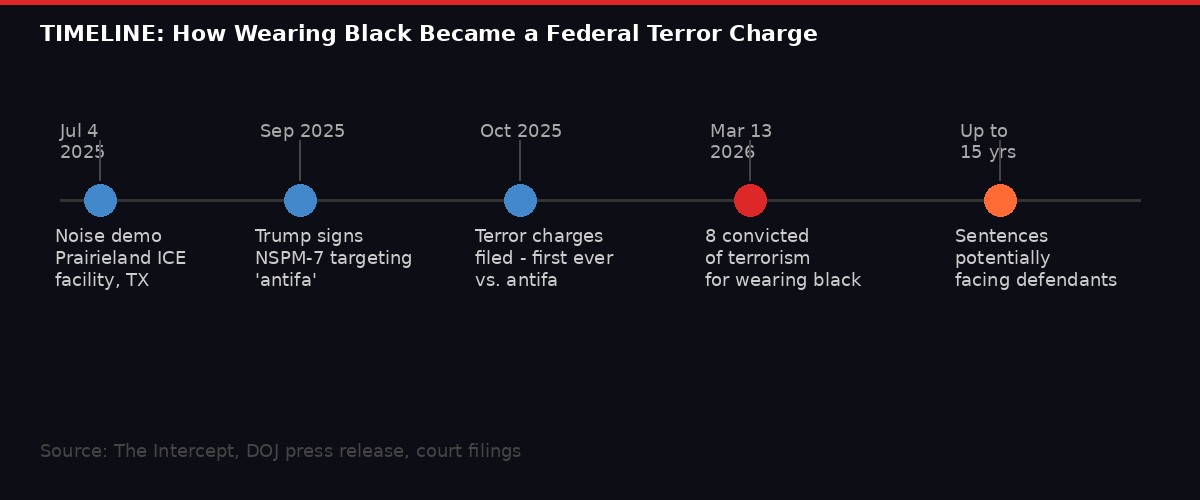
The verdicts in the Prairieland case dropped on March 13, 2026, inside a packed Fort Worth courtroom. Eight of nine defendants were found guilty of material support for terrorism charges, setting a precedent that civil liberties lawyers called the most dangerous expansion of terror law applied to domestic protest in American history. Attorney General Pamela Bondi celebrated immediately. President Trump's Department of Justice issued a press release.
The people convicted include a married couple who ran a community book club, a woman whose crime was transporting a box of pamphlets, and six others whose primary documented contribution to the "terror cell" was wearing dark clothing at a nighttime demonstration outside an Immigration and Customs Enforcement detention facility. They face up to 15 years in federal prison each.
What happened at Prairieland on July 4, 2025 was messy. One person, Benjamin Song, brought an AR-15 with a modified trigger and shot a police officer in the neck. Song was convicted of that. That part of the verdict is straightforward. What isn't straightforward - what has set off alarm bells from the ACLU to First Amendment scholars - is what happened to the other seven people convicted alongside him on terrorism counts: people who did not fire weapons, did not participate in violence, and whose only documented crime was wearing black bloc clothing to a protest.
What Actually Happened at Prairieland
The Prairieland Detention Center sits on the outskirts of Alvarado, Texas, about 30 miles south of Fort Worth. It houses ICE detainees - people awaiting immigration proceedings, some of them held for months or years without criminal convictions. On the afternoon of July 4, 2025, a peaceful daytime demonstration took place outside the facility. Later that night, a smaller group assembled for what organizers described as a noise demonstration - a common protest tactic where crowds gather to make enough noise that detainees inside can hear solidarity from the outside.
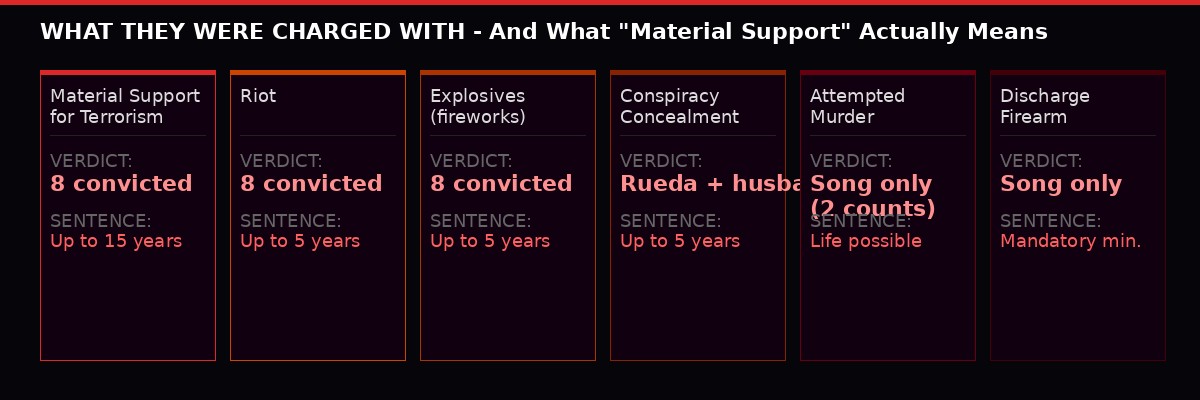
Things escalated. According to court testimony, some demonstrators shot fireworks and spray-painted cars in the parking lot. One protester, Benjamin Song, had brought an AR-15. During the chaos, Song fired his weapon and struck a police officer in the neck. The officer survived.
The government's response went far beyond arresting Song. In the days following the demonstration, federal agents conducted raids across the Dallas-Fort Worth area, seizing printing presses, zines, pamphlets, and - in one case that became nationally infamous - a box of leftist literature that a defendant had moved while his partner was being arrested. Eighteen people were ultimately charged. Most faced not just riot or weapons charges, but terrorism.
The specific charge - "material support for terrorism" - is a statute usually applied to people who fund or recruit for foreign terror organizations like ISIS or Al-Qaeda. It had never before been successfully used against alleged members of a domestic leftist group in the United States. That changed on March 13, 2026.
"They're here asking you guys to put protesters in prison as terrorists. That's not happened before. And you are literally the only people in the world who can stop it." - Defense attorney Blake Burns, closing arguments, Fort Worth Federal Court, March 12, 2026
The Government's Theory: Your Outfit Is a Weapon
To understand why this case matters beyond Texas, you have to understand what prosecutors actually argued in court. The government's theory of "material support" rested almost entirely on what the defendants wore and what communication apps they used.
Assistant U.S. Attorney Shawn Smith told the jury during closing arguments that wearing all-black clothing - a practice known as "black bloc" in protest culture - was itself a form of material support for terrorism. The argument: black clothing makes protesters harder to identify individually, therefore anyone wearing black was providing "cover" for others to commit crimes. "Providing your body as camouflage for others to do the enumerated acts is providing support," Smith said. "It's impossible to tell who is doing what. That's the point."
The government also cited defendants' use of Signal, the encrypted messaging app, as evidence of terrorist intent. This, despite the fact that their own expert witness acknowledged he also uses Signal. Millions of people use Signal - journalists, lawyers, domestic abuse survivors, business executives. The app is recommended by cybersecurity professionals worldwide as basic digital hygiene.
Then came the zines. Federal agents raided multiple homes and seized printed pamphlets, anarchist literature, and radical political tracts. Prosecutors displayed these materials to jurors as evidence of ideological commitment to terrorism. The government brought in Kyle Shideler of the Center for Security Policy - a far-right think tank - to serve as an "expert" on antifa. Shideler, who once focused his research on the Muslim Brotherhood before pivoting to "black identity extremists" and then leftist groups, helped write the government's definition of "antifa" that appeared in the indictment.
In perhaps the most surreal moment of the trial, prosecutors introduced a seven-year-old film essay about feminist horror cinema as evidence of terroristic intent. The essay - a review of the movies "Hereditary" and "Midsommar" written in 2019 by author Sophie Lewis - was found printed in zine format in a box belonging to one defendant. Lewis, who had nothing to do with Prairieland, later wrote that prosecutors had used her "analysis of feminism's relationship to horror cinema as 'evidence of ideologically driven intent.'"
"The prosecution treated it as a given that antifascist, anti-government, left-wing sentiment was itself evidence of criminal conspiracy." - Natasha Lennard, The Intercept, March 17, 2026
The People Behind the Charge
The human cost of this case has a specific shape. It is not abstract. It has names.
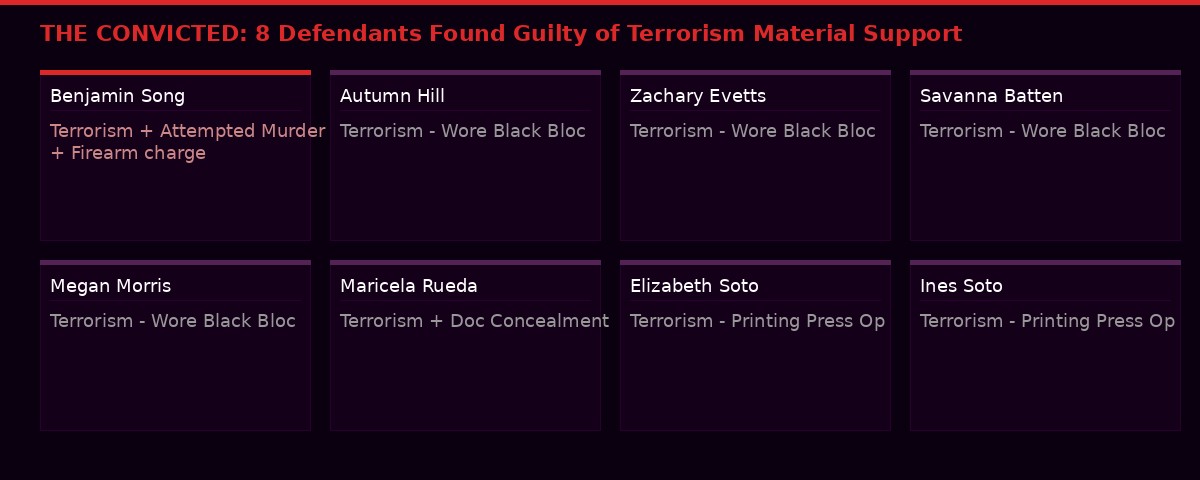
Elizabeth and Ines Soto are a married couple who operated a printing press and co-ran the Emma Goldman Book Club, a reading group named after the early 20th-century anarchist writer and activist. Prosecutors described the book club as "camouflage" for antifa recruitment. The Sotos' crime, beyond wearing black at the protest, included operating a printing press that produced radical literature. The press was seized during a raid. During the trial, prosecutors spent more than half an hour scrolling through a Twitter account allegedly linked to the Sotos, playing rap lyrics for the jury and presenting decade-old retweets as evidence of a terroristic mindset.
Daniel Sanchez Estrada - Maricela Rueda's husband - was not even at the protest. His charge was transporting a box of pamphlets after his wife's arrest. He was convicted of conspiracy to conceal documents and faces up to 20 years in prison for moving a box of reading material.
Autumn Hill, Zachary Evetts, Savanna Batten, and Megan Morris were convicted of material support for terrorism because they attended the demonstration in dark clothing. That is the totality of their documented participation in the "antifa cell." None fired weapons. None were found to have organized the protest. They wore black. They are now federally convicted terrorists.
The support group for the defendants issued a statement after the verdict: "Everything about this trial from beginning to end has proven what we have said all along: this is a sham trial, built on political persecution and ideological attacks coming from the top."
A member of the support group told The Intercept: "Most people looking at this case are still stuck on the shooting aspect, but the jury decided the shooting was beside the point. The verdict is that a normal noise demo deserves to be called terrorism and people should spend potentially the rest of their lives in prison. The implications of this are obvious."
A Pattern Three Administrations in the Making
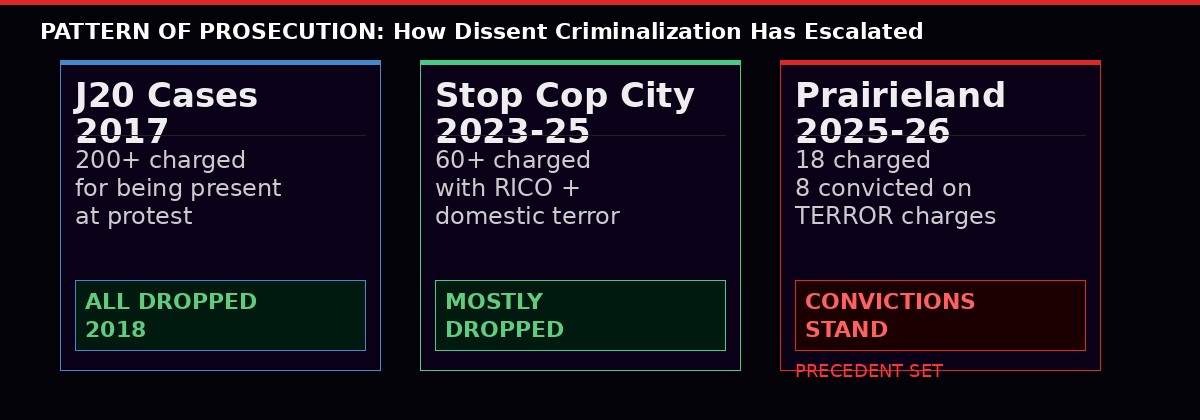
The Prairieland convictions did not emerge from nowhere. They are the product of a decade-long effort to apply terrorism law to left-wing protest movements, an effort that failed repeatedly in court until now.
In January 2017, over 200 people were arrested during Inauguration Day protests in Washington, D.C. The "J20" defendants were charged with felony riot and conspiracy. Prosecutors used the same collective guilt theory: you were present, you wore black, therefore you are responsible for any violence that occurred. The cases collapsed. All charges were either dropped or resulted in acquittals. Prosecutors engaged in misconduct. The government was humiliated.
In Atlanta, dozens of activists opposing the construction of a police training facility known as "Cop City" were charged with domestic terrorism and RICO racketeering. Many of those cases fell apart as well. Juries and judges proved unwilling to equate political activism with organized crime, even when violence occurred at the margins of protest movements.
What changed at Prairieland? Several things. Trump's National Security Presidential Memorandum 7, signed in September 2025, specifically directed federal law enforcement to target "antifa" and similar groups as domestic terrorist organizations. The memo - which one of the Prairieland defense attorneys told the news outlet NOTUS would not have existed without that executive order - created the legal and bureaucratic infrastructure for the prosecution.
Additionally, the Trump administration had years to learn from its predecessors' courtroom failures. The Prairieland prosecution was refined, strategic, and - crucially - took place in conservative north Texas before a jury less inclined to be skeptical of government terrorism claims. The venue mattered. The moment mattered. The precedent they established will outlast both.
"If that can be sold to juries as the work of an organized terrorist cell, deserving of decades in prison, then Trump's fantasy of rounding up and imprisoning leftists en masse becomes a reality." - Natasha Lennard, The Intercept
What the Evidence Actually Was
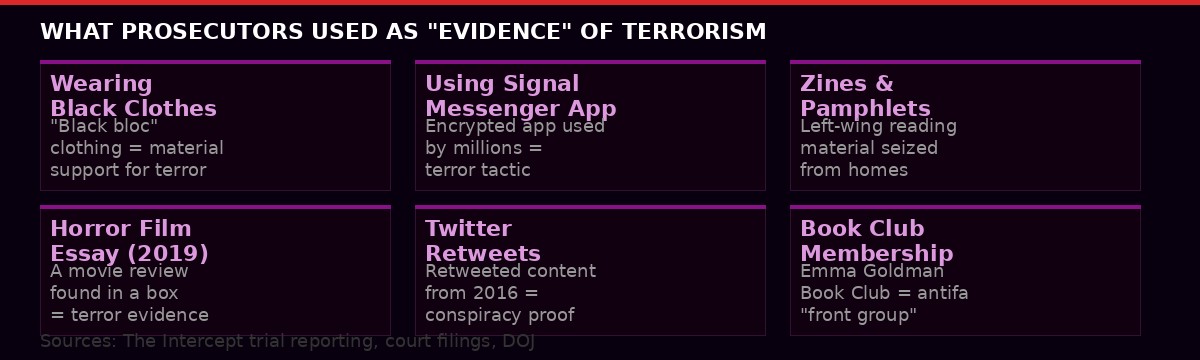
Set aside the legal arguments for a moment and look at the evidence catalog prosecutors assembled to prove eight people were terrorists. It is worth laying out in full because, once you read it, the weight of what happened in that Fort Worth courtroom becomes very clear.
Prosecutors presented: dark clothing worn to a nighttime protest. The use of Signal, an app recommended by governments including the U.S. State Department for secure communications. A collection of anarchist and leftist zines found during home raids. A 2019 horror film essay by a scholar with no connection to the defendants. Anti-government internet memes. A video of an unidentified street fight from an unknown location and time that happened to feature the Flatbush Zombies on the soundtrack. Tweets that were retweeted, not even authored, by defendants years before the protest. Membership in a book club.
None of the eight convicted on terrorism charges were found to have fired weapons. None were proven to have planned the protest specifically to provide cover for an attack on law enforcement. None were shown to have known Song would bring a modified AR-15. What they were shown to have done is attend a political demonstration in dark clothes while holding left-wing political views that the government found threatening.
The government's own expert witness, Kyle Shideler, acknowledged under cross-examination that he himself uses Signal. He could not definitively establish whether the Sotos had even posted the video the prosecution played for the jury - prosecutors admitted they were unable to confirm its origin.
For the book club, Assistant U.S. Attorney Smith told jurors: "Emma Goldman Book Club. It sounds very innocuous. It's camouflage for what it is." What it was: a group of people reading political philosophy in Dallas-Fort Worth. Named for a woman who died in 1940.
The First Amendment Is Not a Shield Anymore
Prosecutors, to their credit in purely technical terms, acknowledged that all the materials they introduced were constitutionally protected. The zines were protected speech. The tweets were protected speech. The book club was protected association. The dark clothing was protected expression. They said all of this out loud in court and then argued it anyway, as context proving ideological commitment to terrorism.
This is the mechanism by which the First Amendment has been effectively suspended for left-wing political organizing. You are allowed to hold these views. You are allowed to print these pamphlets. You are allowed to wear this clothing. But if you do all of these things and then attend a protest where a third party commits violence, all of those protected activities become evidence of your terrorist intent. The exercise of constitutional rights becomes the noose.
Defense attorneys saw this clearly. Blake Burns, representing Elizabeth Soto, pointed out during his closing argument that federal agents had seized a printing press during their raid - and never presented it to the jury. "The government hated the pamphlets and zines it published," Burns said, and kept the press locked away as a result. That press, used to produce political literature, was treated as inherently suspect. Not for what it produced specifically, but for the political direction of its production.
The implications extend well beyond anarchists and anti-ICE activists. The material support statute, once applied successfully to domestic protest in this way, becomes a tool that can be aimed at any political movement that holds confrontational demonstrations during which violence occurs. That includes anti-abortion protesters who have at times blocked clinics by force. It includes January 6 participants who overwhelmed police. Legal scholars have noted, with some grim irony, that the precedent cuts in all directions - though history suggests it is most likely to be aimed leftward.
"Antifa is a domestic terrorist organization that has been allowed to flourish in Democrat-led cities - not under President Trump. Today's verdict on terrorism charges will not be the last as the Trump administration systematically dismantles Antifa." - Attorney General Pamela Bondi, statement after the verdict, March 13, 2026
What Comes Next: Sentencing, Appeals, and Spread
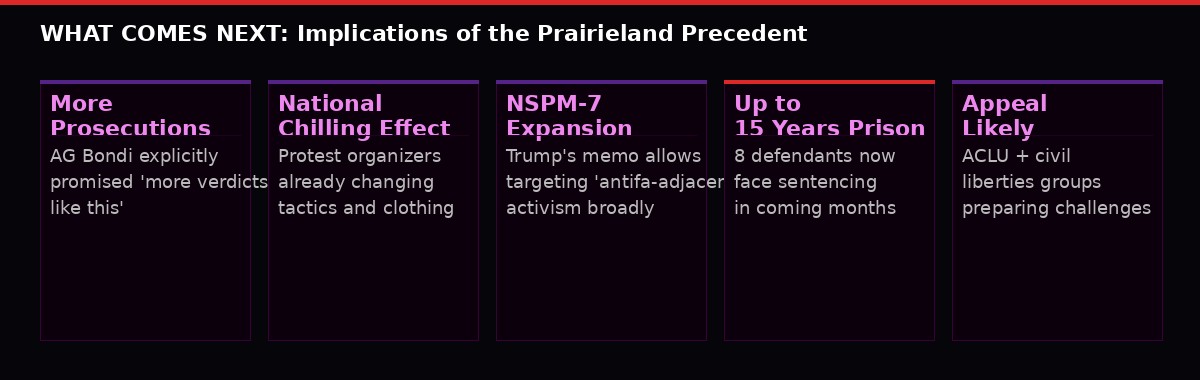
Bondi's statement was not a warning. It was a promise. Since the verdict, civil liberties organizations including the ACLU have publicly stated they are preparing to challenge the convictions on appeal. The American Civil Liberties Union called the verdict "a deeply troubling precedent that strikes at the heart of First Amendment protections" in a statement issued the same day. Legal challenges are expected to focus on the collective guilt theory and the introduction of protected speech as evidence of criminal intent.
Appeals, however, move slowly. The eight convicted defendants will face sentencing in the coming months. On the material support counts alone, each faces up to 15 years. Benjamin Song, convicted of attempted murder, attempted manslaughter, and additional terrorism charges, faces the prospect of life in prison. The sentencing hearings will likely take place before any appellate review begins in earnest.
Meanwhile, the chilling effect - that legal term for how prosecution and threat of prosecution suppresses protected activity - has already begun. Protest organizers across the country have reported, in the days since the verdict, a shift in how their communities are thinking about demonstrations. Discussions in activist circles about what to wear, whether to use Signal, what reading material to keep in your home. The prosecution does not need to win every case if the act of prosecution itself makes people afraid to exercise their rights.
The movement infrastructure is responding. The Prairieland defendants' support group, the DFW Support Committee, has continued organizing. Mutual aid networks have activated fundraising for legal costs. Some protest organizers have begun consulting with lawyers before demonstrations in ways that would have seemed extraordinary before this verdict. The geography of dissent is already shifting.
There is also the question of other pending cases. The Trump DOJ has used NSPM-7 and the antifa designation to investigate activist groups in multiple cities. The Prairieland template - identify a loose-knit local leftist scene, wait for or create circumstances involving violence at the margins, charge the entire ecosystem with terrorism using ideology as evidence - is now proven in court. The defendants' support group member put it plainly: "The DOJ is going to try this again."
Joe Kent, the intelligence official and Trump ally whose resignation from his position was reported by The Intercept on March 20, cited in part the administration's approach to civil liberties as a factor in his decision to leave. His departure has galvanized some discussion of "conscientious objection" to the war footing of domestic law enforcement, though whether it translates to institutional resistance remains to be seen.
The Sotos' Printing Press
Let's end where Blake Burns ended in his closing argument: the printing press.
Elizabeth and Ines Soto ran a small printing press in the Dallas-Fort Worth area. They used it to produce zines - those handmade, photocopied, self-published documents that have been a vehicle for political, artistic, and cultural expression since the 1970s punk movement. The zine tradition predates the internet. It was how communities shared ideas before algorithms could curate them, how movements spread arguments before social media could amplify or silence them. It is, almost definitionally, the most protected form of political expression under the First Amendment.
Federal agents seized that press during their raids. They never entered it into evidence. The jury never saw it. But it sat in federal custody throughout the trial, and it is presumably still there today.
What was on that press? Political essays. Anarchist philosophy. Anti-ICE literature. A horror film review. The kind of material you might find in any left-wing infoshop in any American city, the kind of material that has circulated at protests and book fairs and punk shows for decades without legal consequence.
The press is now in the possession of a government that has just successfully argued that producing and distributing such material, while also wearing dark clothes and knowing people who commit crimes, constitutes material support for terrorism. The press is not evidence. It is a warning. It sits locked in federal storage and it says: we know what you printed, and we're watching.
For the eight people now federally convicted of terrorism - for Autumn Hill, Zachary Evetts, Savanna Batten, Megan Morris, Elizabeth and Ines Soto, Maricela Rueda, and Benjamin Song - the cost of being present at an American political demonstration on the Fourth of July has turned out to be potentially the rest of their lives.
The government's theory requires you to believe that wearing black makes you an accessory to any violence committed near you by anyone else who also happened to be wearing black. If that theory holds on appeal, the act of political protest in the United States - already surveilled, already chilled, already legally treacherous - will have changed in a way that cannot easily be walked back.
The jury convicted in Fort Worth. The precedent now belongs to everyone.
Key Facts: Prairieland Terrorism Convictions
- Date of protest: July 4, 2025, outside Prairieland Detention Center, Alvarado, Texas
- Date of convictions: March 13, 2026
- Defendants convicted on terrorism charges: 8 of 9 on trial
- First ever: Material support for terrorism charges successfully used against alleged antifa members in the United States
- Key legal theory: Wearing black bloc clothing = providing material support to terrorism
- Maximum sentence: Up to 15 years on material support charges alone
- Legal authority cited: Trump's NSPM-7 (Sept. 2025), designating antifa as a "major terrorist organization"
- Expert witness: Kyle Shideler of the Center for Security Policy (far-right think tank), who helped write the government's definition of "antifa"
- Sources: The Intercept (trial reporting by Matt Sledge, analysis by Natasha Lennard), DOJ press release, court filings, DFW Support Committee statements
Get BLACKWIRE reports first.
Breaking news, investigations, and analysis - straight to your phone.
Join @blackwirenews on Telegram