
The World Anti-Doping Agency is preparing to vote on a rule change that could block US President Donald Trump, Vice President JD Vance, and hundreds of members of Congress from attending the 2028 Los Angeles Olympics and possibly the 2026 FIFA World Cup - events the United States is set to host on its own soil.
The proposal is on the agenda for WADA's executive committee meeting on Tuesday, March 17. The Associated Press learned of the agenda item through correspondence obtained between WADA and European officials involved in the agency's decision-making. Two others with knowledge of the agenda confirmed the proposal's existence - they were not authorized to speak publicly.
This is not theater. It is the most direct escalation in a years-long war between the US government and the Swiss anti-doping watchdog, a fight that began with 23 Chinese swimmers, morphed into a bipartisan funding blockade, and has now landed on the doorstep of the most consequential sporting events in American history.
What the Rule Would Actually Do
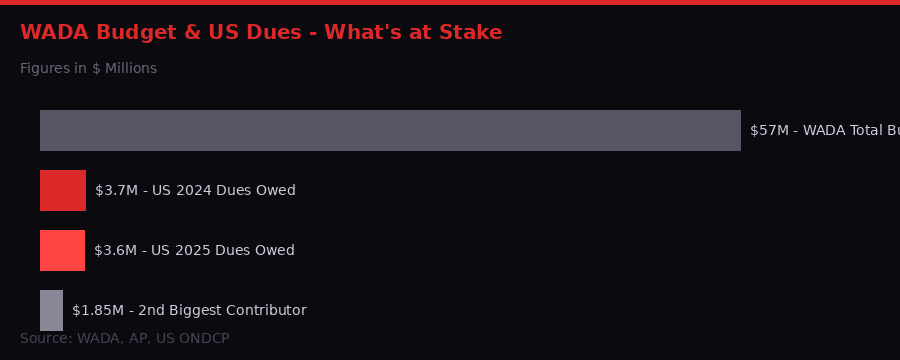
The proposed rule, according to a draft reviewed by the Associated Press, creates a three-tiered sanction system for countries that fail to pay their annual WADA dues by January 31 of the following year. The United States has not paid since 2023. Its accumulated unpaid dues now total approximately $7.3 million - $3.7 million from 2024 and $3.6 million from the year prior.
At the most extreme tier of sanctions, "government representatives" would be "excluded from participation in major events such as World Championships and Olympic and Paralympic Games." That language, if enacted, would apply directly to Trump, Vance, and members of the US Congress who have recently voted to approve hundreds of millions of dollars in security funding and logistics support for both the World Cup and the LA Games.
WADA's legal logic is that countries which don't pay their membership fees lose the privileges that come with membership - including the right to send government officials to events sanctioned by the international sports system WADA oversees. The rule would not prevent American athletes from competing. It would prevent their government from showing up to watch.
"In spite of WADA's increasing threats, we continue to stand firm in our demand for accountability and transparency from WADA to ensure fair competition in sport." - Sara Carter, Director, US Office of National Drug Control Policy (ONDCP)
WADA spokesman James Fitzgerald sought to defuse the story, saying "there is nothing new here" and noting that discussions about withholding funding have been ongoing since 2020. He also suggested that even if passed, the rule might not apply retroactively to events already scheduled - though he offered contradictory signals when pressed for clarification by the AP.
The Chinese Swimmer Scandal That Started It All

To understand why this fight has lasted five years and is now threatening the world's two biggest sporting events, you have to go back to the pool at the Tokyo Olympics in 2021.
Before the games, 23 Chinese swimmers tested positive for trimetazidine - a heart medication banned in sport for its endurance-enhancing properties. WADA accepted the Chinese anti-doping agency's explanation that the positives resulted from contamination at a hotel where the athletes were staying. All 23 were cleared. None were sanctioned. Several went on to win medals in Tokyo.
The decision was kept secret for three years. When German public broadcaster ARD and the Associated Press exposed the case in April 2024 through a leaked document, the story detonated across the global sports community. Critics called it the most significant doping cover-up in Olympic history. Chinese officials denied wrongdoing. WADA maintained its handling was proper.
For the United States Congress - already suspicious of WADA's governance - the revelation was the last straw. A bipartisan coalition that cut across every political division converged on a single conclusion: WADA could not be trusted, and it would not receive another dollar of American taxpayer money until it submitted to an independent audit.
"While WADA claims that their motivations are innocent, it appears this investigation's intent is to intimidate and suppress whistleblowers. If these allegations are accurate, WADA is not defending clean sport but is continuing to defend a cover-up." - Joint letter from Sen. Marsha Blackburn, Sen. Chris Van Hollen, Rep. John Moolenaar, and Rep. Raja Krishnamoorthi to WADA President Witold Banka
The US also objected to WADA's "Operation Puncture" - an internal investigation the agency launched to identify who leaked the Chinese swimmers' documents to the press. American lawmakers characterized this as an attempt to intimidate whistleblowers. WADA denied it was chasing leakers, saying it was merely investigating how the disclosure happened and why.
The argument split the organizations apart. WADA's statutes require that countries withholding dues lose their seat on the executive committee. The United States lost its seat. With no seat, the US had no vote. With no vote, it had no leverage inside the institution - which is exactly why the conflict has now escalated to the level of threatening the president's attendance at a domestic event.
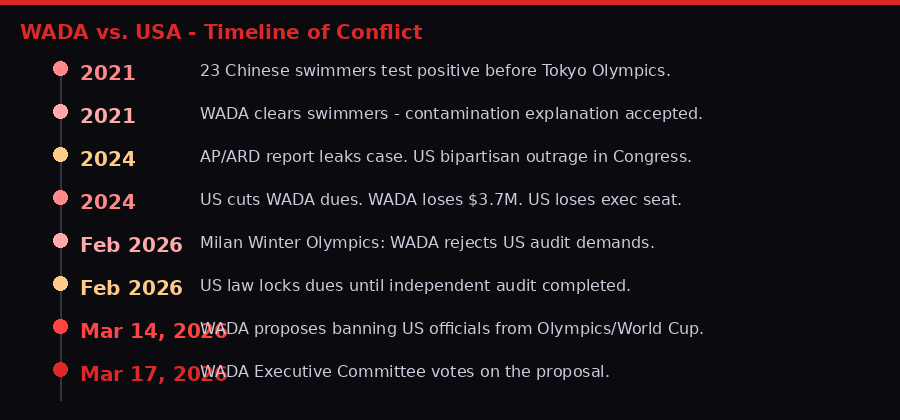
Five Years of Conflict - The Full Timeline
Why WADA Might Have a Point - And Why It Doesn't Matter
WADA's position is not frivolous. The agency operates on a budget of approximately $57 million. The United States is the single largest contributor, responsible for roughly $3.7 million per year - more than any other government on Earth. When the biggest funder stops paying, the institution feels it. Other governments resent covering the gap. The precedent is corrosive: if America can simply refuse to pay and face no consequences, what stops others?
The agency also has a reasonable legal case for its own governance. WADA does submit to audits - internal ones, plus oversight from the Swiss authorities under which it is incorporated. Banka's argument that the organization's existing accountability structures are "good enough" is at least coherent, even if critics find it unconvincing.
WADA's defense of its position:
Agency President Witold Banka said at the Milan-Cortina Winter Olympics in February 2026 that WADA "is financially very stable" and that the US dues dispute, while regrettable, does not threaten the agency's operations. He called WADA "one of the most audited organizations in the world" and said external conditions on payment undermined the unconditional nature of membership contributions.
But the practical enforceability of any ban is the problem. And critics on both sides of the Atlantic have been blunt about it.
"I have never heard of a $50-million-budget Swiss foundation being able to enforce a rule to, for example, prevent the United States president from going anywhere. And the next question you have to ask is: How are you going to enforce it? Are they going to post a red notice from Interpol? It's ludicrous." - Rahul Gupta, former US Drug Czar and former WADA Executive Committee Member
Gupta's predecessor in the Biden administration led the successful effort to kill the same proposal when it first came up in 2024. At that time, the United States still had its seat on the executive committee. It was able to lobby directly and effectively. Now, with no seat, the US has no formal voice in the room when the vote happens Tuesday. It can issue statements, threaten consequences, and call the rule ludicrous - but it cannot vote no.
The Stakes: What's Actually at Risk
The 2026 FIFA World Cup kicks off this summer in the United States - in New York, Los Angeles, Dallas, Atlanta, San Francisco, Boston, Seattle, Miami, Kansas City, Philadelphia, and Houston. It is the largest sporting event in American history by attendance. The tournament will draw an estimated five billion television viewers globally and generate billions in economic activity.
Congress has already voted to approve hundreds of millions of dollars in federal security funding specifically for World Cup operations. American law enforcement agencies are coordinating multi-agency security plans. The host cities have committed infrastructure investments. And yet, under the proposed WADA rule, Trump and the entire executive branch would be barred from attending - from the stadiums their government is paying to secure.
The 2028 Los Angeles Olympics compound the absurdity. The LA Games represent a flagship moment for American soft power, scheduled for August 2028 in a city that was chosen as host under the explicit assumption that the United States government would be a full and engaged partner. Los Angeles's bid was premised on federal support. The Olympic Village and venue infrastructure involve significant public investment.
WADA's Fitzgerald appeared to walk back the World Cup threat in follow-up correspondence with the AP, suggesting the rule could not apply retroactively to events already scheduled and noting the foundation board doesn't meet until November. But the language in the draft proposal makes no mention of retroactivity limits. The hedging appears to be tactical rather than legal.
"They should be really careful to go up against the United States Congress. It's never a good idea to go up against a bipartisan Congress where both sides of the aisle definitely want this to happen." - Rahul Gupta, Former Director, US Office of National Drug Control Policy
The Doping Cover-Up That Won't Stay Buried
Behind the financial dispute sits a deeper crisis of trust in international sports governance - and it centers on China.
The 23 swimmers who tested positive in 2021 included some of China's most decorated Olympians. Zhang Yufei, who went on to win two gold medals and two silvers in Tokyo, was among those who tested positive. So were multiple members of the Chinese relay team that broke the world record.
WADA's acceptance of the contamination explanation was not, in itself, unprecedented. Hotels have been established sources of contamination in doping cases before. But critics noted that the level of trimetazidine found in the samples was inconsistent with casual contamination, that the simultaneous positive tests across 23 athletes from the same program strained credulity, and that the investigation appeared to move with unusual speed to closure.
More damaging was the secrecy. WADA's rules theoretically require it to publicly report doping cases. The Chinese cases were not reported. They were buried in internal files until a source - whose identity WADA is still trying to discover through "Operation Puncture" - handed the documents to journalists.
The US Department of Justice opened its own investigation into the Chinese swimmers case in 2024. That investigation remains active. WADA officials have reportedly been reluctant to travel to the United States for fear of being subpoenaed.
The 23 Chinese swimmers - key facts:
All 23 tested positive for trimetazidine, a cardiac drug that improves oxygen efficiency and is banned in competition for its performance-enhancing properties. The Chinese anti-doping agency accepted a contamination explanation from a Beijing hotel. WADA accepted that explanation without requiring further investigation. No athlete was sanctioned. Several won Olympic medals. The case remained secret from 2021 until it was leaked to journalists in 2024.
WADA's own commissioned report, authored by an independent Swiss lawyer, concluded that WADA's decision not to appeal the contamination ruling was "reasonable." American critics called the report a whitewash and pointed out that the investigator was appointed by the agency whose conduct was under review - a structural conflict that made independent conclusions impossible.
Tuesday's Vote - What Happens Next
WADA's executive committee meets on Tuesday, March 17. The committee does not include a US representative - the US lost its seat when dues were withheld. The vote, if it happens as scheduled, will be conducted without American participation.
Three outcomes are possible. First, the proposal passes as written, creating the three-tiered sanction regime and immediately escalating the crisis. Second, the proposal is tabled pending further deliberation by the foundation board in November, giving both sides time to negotiate. Third, the proposal is rejected by a committee majority unwilling to take the confrontation this far.
Gene Sykes, president of the US Olympic and Paralympic Committee and a member of the International Olympic Committee, said in February that he had been working toward a resolution.
"All of us around the Olympic Movement are trying to work together to come to a resolution of the dispute between WADA and USADA, and we've made good progress on that." - Gene Sykes, US Olympic and Paralympic Committee President
But "good progress" has not produced payment. And WADA's decision to put the sanction proposal on the agenda - with a vote scheduled just three days after the story broke publicly - suggests the agency is not waiting for private diplomacy to bear fruit.
The US ONDCP, under Sara Carter, has been consistent and inflexible: no payment without an audit. WADA has been equally consistent: payment is unconditional. Tuesday will reveal whether either side blinks.
The Bigger Picture - Sports as Geopolitical Weapon
The WADA dispute sits inside a broader pattern of international institutions being pulled into great-power competition and domestic political conflicts. The fight is not really about anti-doping governance. It is about China, about who controls international institutions, and about whether the United States will accept the rules of organizations it funds when those organizations make decisions the US doesn't like.
WADA was created in 1999 as a response to the Tour de France doping scandal, designed to be a genuinely independent body outside the control of any single government or sports federation. That independence - its core selling point - is now its greatest vulnerability. When the largest funder decides the organization is not acting in good faith, independence becomes a standoff.
The bipartisan nature of the US position is significant. In an era when Republicans and Democrats agree on almost nothing, the demand for WADA accountability has unified Marsha Blackburn and Chris Van Hollen, John Moolenaar and Raja Krishnamoorthi. That rare unanimity has given both the Biden and Trump administrations cover to hold the line - and made the US position far more durable than WADA may have anticipated when the dispute began.
WADA, meanwhile, faces its own internal pressure. European governments - which collectively contribute the other half of WADA's government-source funding - are watching the standoff carefully. If the US successfully defies payment without consequences, others will notice. If WADA escalates to a formal ban and cannot enforce it, its credibility collapses. The agency is navigating a crisis with no good exit.
North Korea fired ten missiles into the sea on Saturday morning as the Iran war enters its third week. Ukraine is grinding through another winter offensive. And the World Anti-Doping Agency may be on the verge of telling the President of the United States he is not welcome at his own country's Olympic Games.
The vote is Tuesday. Watch for it.
Get BLACKWIRE reports first.
Breaking news, investigations, and analysis - straight to your phone.
Join @blackwirenews on Telegram