USS Gerald Ford Withdraws to Crete: America's Costliest Warship Pulls Out of the Iran War Theater

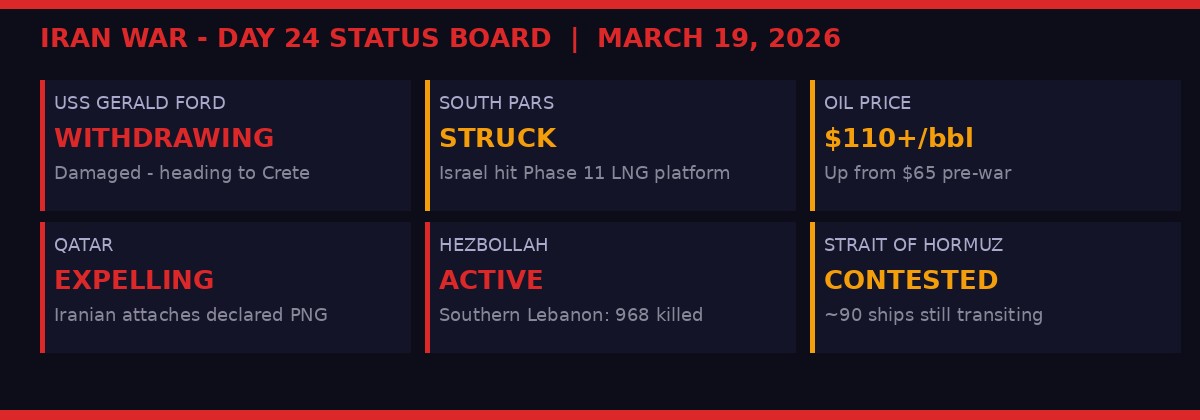
The USS Gerald R. Ford is leaving the fight. According to BBC News and AP News reporting on March 19, the nuclear-powered supercarrier - the most expensive warship ever built at $13.3 billion - has been ordered to sail to Crete for emergency repairs after a fire broke out aboard the vessel during operations in the Iran War theater. The carrier has been central to the US military campaign since the conflict began 24 days ago. Its withdrawal, however temporary, is a significant operational and symbolic moment in a war that has already shattered expectations on every front.
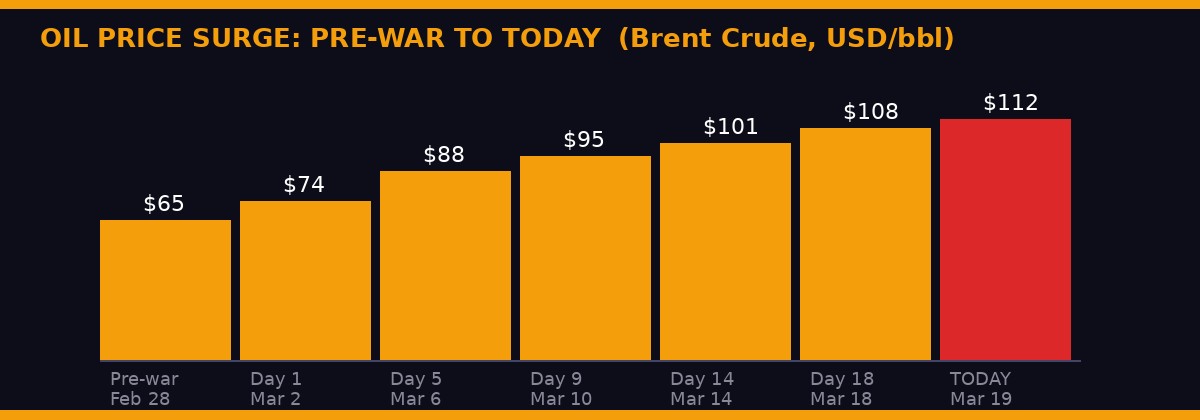
The same morning, Iran launched missile and drone strikes against Qatar's Ras Laffan liquefied natural gas complex, causing what Qatari officials described as "fires and extensive damage." Qatar declared Iran's military and security attaches at the Iranian embassy persona non grata - the diplomatic language for expulsion. Saudi Arabia's Foreign Minister warned Iran that Gulf neighbors' patience is "not unlimited," and that the region has "significant capabilities" to respond. Oil crossed $110 per barrel. Analysts are no longer laughing at forecasts of $200.
Twenty-four days in, and the war is expanding faster than anyone is closing it.
The Ford: What Happened to America's $13.3 Billion Ship

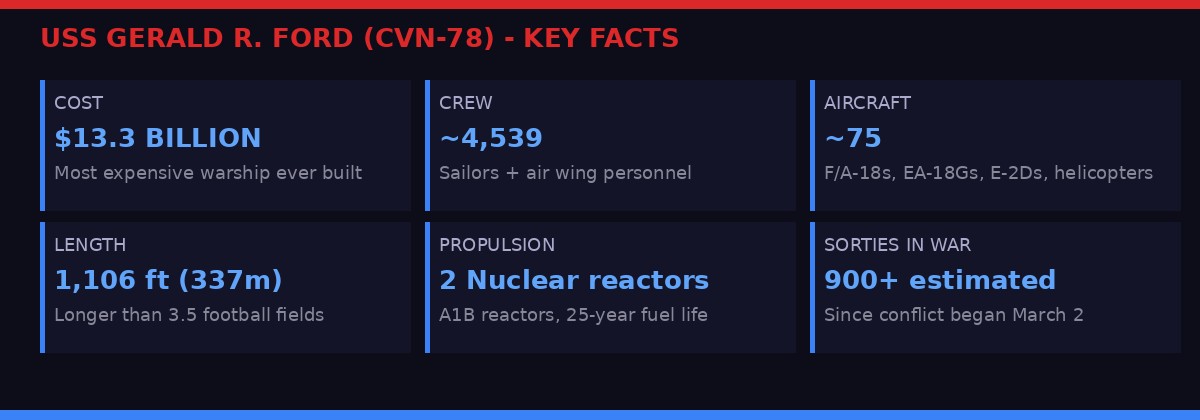
The USS Gerald R. Ford (CVN-78) has been described by the US Navy as the most capable aircraft carrier ever built. It carries roughly 75 aircraft, including F/A-18 Super Hornets, EA-18G Growlers for electronic warfare, E-2D Hawkeyes for airborne early warning, and helicopter squadrons for anti-submarine and logistics operations. Its crew - sailors, aviators, and support personnel combined - numbers approximately 4,500. It cost American taxpayers $13.3 billion to build and commission, a figure that climbed billions above original estimates.
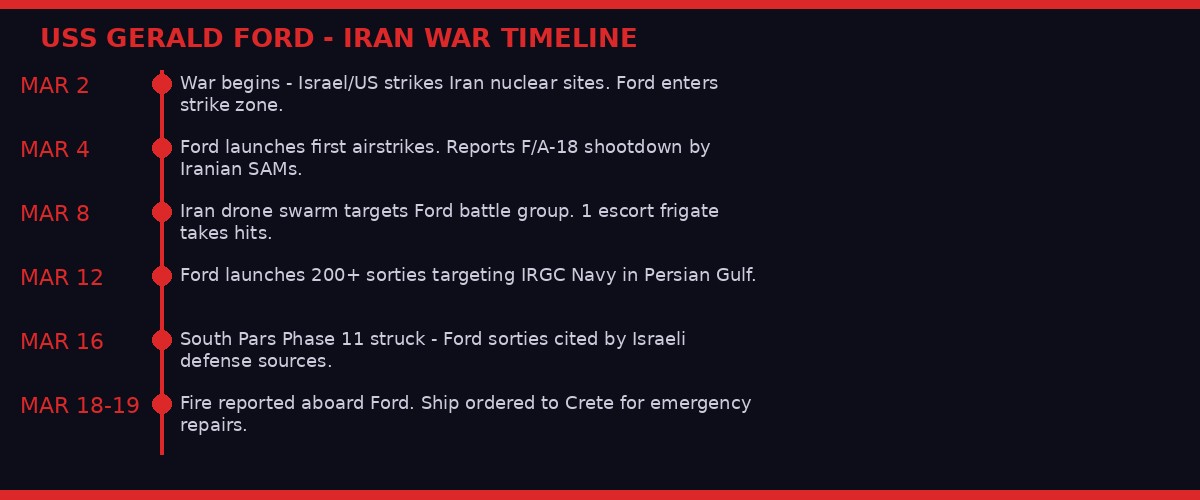
It was the centerpiece of the US naval response when the war began on March 2, positioned in the eastern Mediterranean to launch strikes alongside Israeli forces targeting Iran's nuclear sites. Over the following three weeks, the Ford's air wing flew an estimated 900 or more combat sorties - a punishing operational tempo that puts enormous stress on both the ship's systems and its crew.
A fire broke out aboard the vessel, according to BBC News reporting published March 19. The extent of the damage has not been made fully public by the Pentagon. The Navy announced the ship would proceed to Naval Support Activity Souda Bay in Crete, a US-allied installation that has served as a forward logistics hub throughout the conflict. Repairs are expected to take an unspecified amount of time.
"The USS Gerald R. Ford has played a significant role in US operations during the war with Iran." - BBC News, March 19, 2026
What that statement leaves unsaid: the Ford is now out of the fight for an unknown period. The US still has other carrier assets in the broader region, but pulling the flagship at this moment carries consequences that go beyond hull damage. Carrier strike groups take time to rotate, and the Ford was not just one ship - it was the command-and-control nerve center for the naval side of a complex multi-domain air campaign.
South Pars Strike: Israel Hit Iran's Energy Spine

Alongside reporting on the Ford withdrawal, AP News and BBC News both confirmed that Israel struck the South Pars natural gas field on or around March 18-19. South Pars is not just a gas field - it is the largest natural gas field on earth, shared with Qatar's North Field structure across the Persian Gulf seabed. Iran's Phase 11 section, developed in partnership with Total and CNPC before Western sanctions forced those companies out, produces roughly 50 million cubic meters of gas per day and supplies a large fraction of Iran's domestic energy and industrial needs.
Hitting it is a different category of strike from attacking nuclear centrifuges or missile launch sites. This is economic infrastructure. This is the thing that heats Iranian homes and keeps Iranian factories running. Israel has been building toward this logic throughout the war - first degrading Iran's military capacity, then going after the systems that sustain civilian governance and economic function.
Trump's response to the strike was characteristically unfiltered. He told reporters he "knew nothing" about the Israeli attack beforehand - a statement that raises its own questions about the coordination of a campaign that involves US basing, US munitions, and US carrier strike groups flying close air support. But Trump also issued a warning that most conflict observers read as significant: if Iran continues attacking Gulf states, the US will "massively blow up" South Pars entirely.
"Trump says US will 'massively blow up' major Iranian gas field if Iran attacks Qatar again." - BBC News headline, March 19, 2026
That threat - delivered publicly, to international media - is a statement of intent that Iran's leadership cannot dismiss. South Pars Phase 11 already burning. The rest of the complex explicitly threatened. Iran's energy infrastructure, which was barely surviving under years of sanctions, is now the declared target of American military power.
Qatar's Ras Laffan: Why This Strike Changes Everything

The strikes on Ras Laffan are where the war's implications become global. Qatar's Ras Laffan Industrial City is the production and export hub for the North Field - the same geological structure as Iran's South Pars, divided by an underwater maritime boundary. It is the largest LNG export complex on earth. Qatar supplies roughly 20-25% of the global LNG market. It supplies Europe, Japan, South Korea, India, and China. It is, in the starkest possible terms, the world's gas pump.
Iran's missiles and drones hit it. Qatari officials confirmed on March 18-19 that the attack caused "fires and extensive damage." Ras Laffan runs continuous industrial processes that cannot simply pause and restart. LNG trains - the processing units that liquify gas for export - are extraordinarily complex, sensitive, and expensive. Even partial damage can take months to repair. Even a temporary production disruption sends shockwaves through gas contracts tied to winter heating seasons, industrial power, and fertilizer production across three continents.
Qatar's response was swift and severe. The Qatari government declared Iran's military attache and security attache at the Iranian embassy persona non grata - formal diplomatic expulsion. That is the government of a state that has historically positioned itself as a mediator and regional neutral. Qatar hosts the Al Udeid Air Base, the largest US Air Force installation in the Middle East. It has tried, throughout this conflict, to maintain back-channel communications with all parties.
Attacking Ras Laffan ended that neutrality. Qatar is now a belligerent in everything but formal declaration. And Saudi Arabia's Foreign Minister, speaking on March 19, put the region's posture in language that left no ambiguity: Al Jazeera reported his warning that Gulf neighbors "have significant capabilities" to respond, and that patience is not unlimited.
"Saudi FM warns Iran that patience in Gulf not 'unlimited' amid attacks. Foreign minister warns Iran that regional neighbours have 'significant capabilities' with which to respond to attacks." - Al Jazeera, March 19, 2026
Saudi Arabia, the UAE, Kuwait, Bahrain - these are not minor actors. Saudi Arabia alone possesses an air force that has been trained and equipped by the United States for decades. If Riyadh decides the Ras Laffan strike constitutes a casus belli, the war will no longer be a US-Israeli-Iran conflict. It becomes a regional war with a combined Arab military weight that dwarfs anything currently in play.
Gabbard's Testimony and the Intelligence That Wasn't

While the military and diplomatic situation deteriorates on multiple fronts, the domestic political foundation of the war is also cracking. Director of National Intelligence Tulsi Gabbard appeared before Congress on or around March 18, BBC News and AP News both reported, and her testimony produced headlines that the administration would prefer not to exist.
Gabbard told lawmakers that Iran's regime remains "intact" but "degraded" - which contradicts the Trump administration's implicit suggestion that US-Israeli military action was moving toward regime change or collapse. She also reportedly addressed a more sensitive matter: whether Iran had actually been rebuilding nuclear enrichment capacity prior to the war. Al Jazeera reported that Gabbard's testimony contradicted one of several justifications Trump gave for launching the conflict in the first place.
AP News added a further detail: Gabbard "refuses to discuss talks with Trump about war," raising questions about the chain of command and whether intelligence assessment was actually integrated into the decision to strike. A separate AP report noted that "Trump's failed strong-arming of allies on Iran shows that pressure is losing its effect" - referencing the administration's inability to build the kind of coalition that might have constrained the conflict's scope.
These are not minor political embarrassments. They go to the question of whether the stated rationale for a war that has now pushed oil past $110 per barrel, damaged a $13.3 billion carrier, and threatened the global LNG supply chain was factually accurate. Congress is not going away on this question. Neither is the rest of the world.
Iran, for its part, has been conducting its own internal reckoning. The killing of Ali Larijani - the Islamic Republic's most experienced political operator and former parliament speaker - along with other senior officials in Israeli strikes, has deepened a leadership crisis. Iran announced hundreds of arrests of "traitors" following the killings, suggesting the regime is as concerned about internal security as it is about external military pressure. The IRGC vowed "decisive action" in response to the South Pars strike.
Lebanon: A Third Front That Never Closed

Southern Lebanon is not a sidebar. It is an active military front consuming lives and military resources simultaneously with the main Iran theater. BBC News reported on March 19 that Hezbollah is fighting Israeli troops in southern Lebanon - ground combat, not just rocket exchanges. The Lebanese Health Ministry says 968 people have been killed since March 2, including more than 100 children. Israel has been destroying bridges over rivers in the south, a classic technique for isolating an operational zone and cutting off resupply and reinforcement.
One BBC correspondent visited the scene of an Iranian cluster bomb strike on central Israel, where an elderly couple was killed when munitions struck their apartment building. That detail matters: Iran is not only attacking military assets. Iranian-supplied or Iranian-fired cluster munitions are landing in Israeli residential areas. Israel, meanwhile, is conducting ground incursions into southern Lebanon while simultaneously flying hundreds of sorties against Iranian territory. The operational complexity is staggering.
"'Very difficult to stop': BBC visits scene of Iran cluster bomb strike on Israel. An elderly couple was killed after a bomb flew into their apartment in central Israel and exploded." - BBC News, March 19, 2026
The Lebanon front has its own logic and its own timeline. Hezbollah is fighting for organizational survival. Its leadership has been degraded over two years of Israeli strikes. But the organization retains the ability to launch, to fight, and to inflict casualties. Eliminating it requires a ground campaign that Israel has been reluctant to fully commit to, because the cost in Israeli soldiers' lives would be substantial and the political timeline is measured in years, not weeks.
The 968 dead in Lebanon in 24 days - a rate approaching 40 per day - is producing a humanitarian catastrophe that international organizations are struggling to document, let alone address. The Strait of Hormuz remains contested. The carrier that was supposed to project US air power is now heading to a NATO base for repairs. And Doha is expelling Iranian diplomats after missiles hit the world's largest LNG complex.
The War's Trajectory: Three Scenarios for Week Five

Intelligence analysts and conflict researchers are running three primary scenarios for how Week Five of the Iran War unfolds. None of them are comfortable.
Scenario One: Escalation to Gulf-Wide War. Saudi Arabia and the UAE decide that the Ras Laffan strike constitutes an attack on Gulf Arab economic sovereignty. They activate their own military assets - Saudi F-15s, Emirati F-16s, Patriot batteries - in a combined response targeting IRGC sites in southern Iran and naval forces in the Persian Gulf. This scenario risks pulling the entire Gulf Cooperation Council into active hostilities. The US, with the Ford out of theater, finds itself needing to urgently rotate carrier replacement and provide air cover to two allies simultaneously. Oil hits $150 or beyond. Global recession becomes a near-certainty.
Scenario Two: Controlled Degradation and Negotiated Pause. Iran, facing South Pars damage, leadership losses, domestic unrest, and the prospect of Arab coalition air power entering the fight, signals through back channels - possibly Qatar, despite the diplomatic rupture - a willingness to pause strikes on Gulf infrastructure in exchange for a temporary halt to further Israeli energy infrastructure attacks. The Ford's withdrawal gives Washington a face-saving reason to pull back operational tempo while the ship is repaired. Neither side calls it a ceasefire. Both sides call it a "pause for assessment." The killing stops at 50 to 60 dead per day instead of accelerating.
Scenario Three: Iran Closes the Strait. The most dangerous path. Iran's military has been signaling Hormuz closure as a last resort throughout the conflict. With South Pars hit, Ras Laffan burning, and the regime facing an internal legitimacy crisis, the calculation shifts. Closing Hormuz - mining the channel, threatening tankers with naval and air assets, activating IRGC speedboat swarms - takes roughly 90 ships and their 17-20 million barrels of daily oil traffic and turns them into hostages. AP News reported on March 19 that roughly 90 ships are still transiting Hormuz and Iran continues to export millions of barrels despite the war. That flow can stop.
The $200-per-barrel oil price that analysts cited as "no longer far-fetched" in Al Jazeera reporting assumes Scenario Three. At $200 oil, economies from Germany to India to South Korea face immediate industrial contraction. Airlines start grounding fleets. Fertilizer production - deeply dependent on natural gas - collapses. Food prices spike. The feedback loop between energy prices and political stability in the Middle East, South Asia, and sub-Saharan Africa becomes recursive and potentially uncontrollable.
The Strait of Hormuz scenario is assessed by Gulf security researchers as more probable than in any previous Iranian crisis. The combination of South Pars damage (economic pressure on the regime), leadership losses (decision-making stress), Arab coalition threats (military encirclement), and the Ford's withdrawal (temporary reduction in US carrier air power) creates conditions that make a Hormuz closure move less suicidal - and more tempting - for hardline IRGC commanders than at any point since 2019.
The Human Cost Nobody Is Counting

The war has visible military metrics - sorties flown, missiles intercepted, facilities destroyed. The civilian toll is harder to aggregate but just as real. In Lebanon alone, 968 dead in 24 days. In Iran, the Dorud area reported an attack killing at least 12 on March 19 alone, according to Al Jazeera. In Israel, cluster munitions are reaching residential apartments. And across the region, millions of people who have no military role in this conflict are facing fuel price spikes, food supply disruption, and the anticipation of worse.
The Afghan evacuee crisis - more than 1,100 Afghans stranded in Qatar, whose US resettlement promises are now frozen, BBC News reported - is a microcosm of the war's displacement effects. Qatar's attention is on Ras Laffan and Iranian attaches. The bureaucratic machinery for refugee processing has effectively stopped. People who fled one war find themselves waiting in limbo as another war reshapes the geography around them.
Iran's internal situation deserves more coverage than it typically gets in Western media. The regime announced hundreds of arrests following the killings of senior officials. That sweep - targeting anyone suspected of providing intelligence to Israel or the US - is a form of internal violence that compounds the external. Families of the detained face an invisible terror that produces no battlefield footage but is real nonetheless. The BBC captured one small human moment in a photo series: "After an Iranian drone strike, a photographer captures this quiet human moment" - clothespins in an Iranian neighborhood, blackened by the environmental toll of conflict, revealing how thoroughly war has penetrated daily domestic life.
None of this appears in the oil price charts. All of it is real.
TIMELINE: USS FORD & THE IRAN WAR - KEY EVENTS
What the Ford's Withdrawal Actually Means

The Pentagon will minimize the Ford's withdrawal as routine operational management - a necessary maintenance pause, not a military setback. They are not wrong that carriers rotate, that damage happens, that Crete is close and repairs can be conducted relatively quickly. They are also not giving you the full picture.
A nuclear carrier takes approximately 10 to 20 days to transit, conduct repairs, and return to station, depending on the nature of the damage. During that window, the air wing that was conducting sorties against Iranian targets is not flying those sorties. The combat air patrol over the Hormuz approaches is thin. The strike packages that Israel has been coordinating with US naval aviation lose a significant component. There may be other US carrier assets in the Indian Ocean or further afield that can be surged, but surging takes time, and time is exactly what the Iran War is burning.
The more significant dimension is symbolic. The Ford is the physical embodiment of American naval supremacy. When it was deployed to the eastern Mediterranean, it was a message: the United States is serious, and the most powerful warship on earth is in the neighborhood. When it sails to Crete for repairs, it sends a different message. Iran hit something - or the operational tempo of the fight hit something. The message received in Tehran, in Riyadh, in Doha, and in Beijing will not be the Pentagon's preferred framing.
The broader question is whether the US-Israeli campaign has a coherent strategic endpoint. Gabbard told Congress the Iranian regime is "intact but degraded." That is not regime change. It is not nuclear disarmament. It is a war that has consumed a $13.3 billion carrier's availability, pushed oil above $110, struck the world's largest LNG complex, killed nearly a thousand people in Lebanon, and is now threatening to drag the Gulf Arab states into active hostilities. The question that Congress has not yet formally asked - and that Gabbard's testimony begins to force - is: to what end?
Iran is wounded. Iran is not broken. And a wounded adversary with nothing left to lose and a hardline military establishment looking for reasons to escalate is among the most dangerous configurations in conflict theory.
The Ford is heading to Crete. The war is heading somewhere nobody has mapped.
Get BLACKWIRE reports first.
Breaking news, investigations, and analysis - straight to your phone.
Join @blackwirenews on Telegram