2,500 US Marines Deploy to Middle East as Iran War Enters Week Three
The Pentagon is sending 2,500 Marines to the Middle East. Thirteen Americans are now dead in Operation Epic Fury. Four US military aircraft have gone down since the war began on February 28. Brent crude is above $103 a barrel. And with new Supreme Leader Mojtaba Khamenei reportedly injured but not silenced, the endgame for a conflict Washington called a "precision campaign" is nowhere in sight.
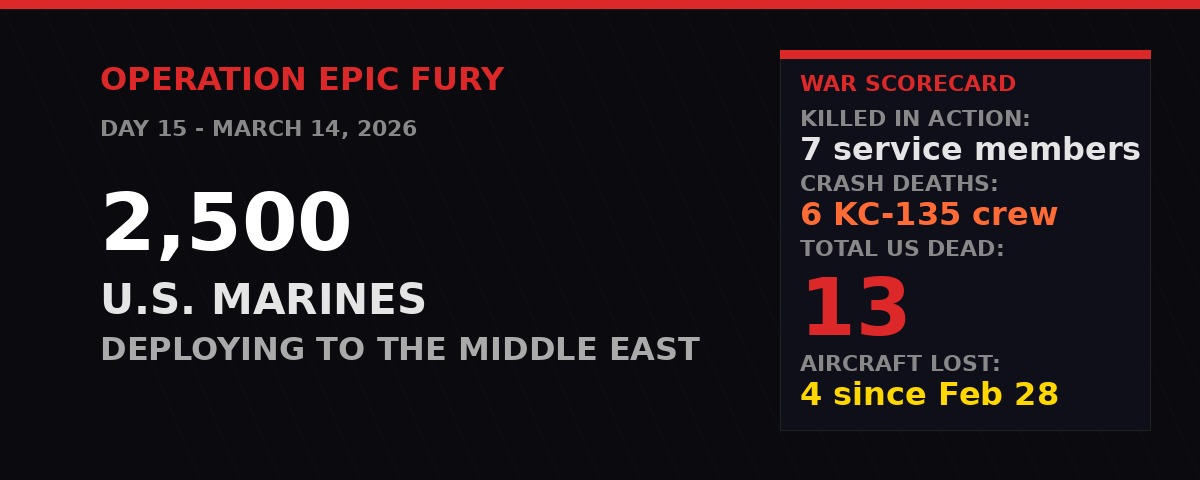
BLACKWIRE graphic - Day 15 war scorecard: 13 US dead, 4 aircraft lost, 2,500 Marines ordered to Middle East. (BLACKWIRE / Generated)
The Marines Order - What It Means
The deployment order is not a minor logistical adjustment. A Marine Expeditionary Unit, or MEU, carries roughly 2,200 to 2,500 Marines and can operate independently for extended periods. It includes ground combat infantry, aviation attack squadrons, combat logistics, amphibious assault capability, and a full command structure. When the Pentagon moves 2,500 Marines toward an active theater, it is not for show. (AP News, March 13, 2026)
The move signals a shift in the character of American military presence in the region. The first two weeks of Operation Epic Fury were almost entirely an air campaign - strikes by carrier-based F/A-18s and F-35s, B-2 bombers flying from Diego Garcia and Whiteman Air Force Base, and Tomahawk cruise missiles from Navy surface ships and submarines. The Navy's presence in the Arabian Gulf and the Red Sea has been the operational spine of the war effort.
Marines change that calculus. They are trained and equipped for a range of missions that go beyond what the Navy or Air Force can provide: seizure of ports and airfields, non-combatant evacuation operations, humanitarian assistance ashore, counterterrorism raids, and rapid ground assault. Their presence in theater does not necessarily mean a ground invasion of Iran is imminent - but it expands the menu of options available to the National Command Authority.
Pentagon spokesman Maj. Gen. Patrick Ryder declined to specify where the Marines would be staged or what their specific mission set would be. Defense Secretary Pete Hegseth, speaking to reporters after the KC-135 crash confirmation, was not asked about the deployment directly. A US official confirmed the order to the Associated Press on condition of anonymity, citing operational security.
Within the region, US Marine presence most naturally flows to pre-positioned facilities in Bahrain, Kuwait, Qatar, Djibouti, and possibly Jordan. The 22nd Marine Expeditionary Unit last rotated through the region in late 2025. It is not yet confirmed which unit or units are filling this order, nor the timeline for their arrival in theater.
KC-135 Down: The Full Picture of a Catastrophic Thursday
The confirmation came Friday morning from US Central Command: all six crew members of a KC-135 Stratotanker that crashed in western Iraq on Thursday are dead. The crash brings the total US death toll in Operation Epic Fury to at least 13 - seven killed in direct combat, six in the aircraft accident. (AP News / CENTCOM press release, March 13, 2026)
CENTCOM stated the loss was "not due to hostile or friendly fire," and that the crash occurred following "an unspecified incident involving two aircraft in friendly airspace." The second aircraft involved - also identified by a US official as a KC-135 - landed safely, reportedly in Israel, according to Israeli Ambassador to the US Yechiel Leiter writing on X.
Gen. Dan Caine, chairman of the Joint Chiefs of Staff, confirmed the details to reporters at the Pentagon on Friday morning. "The crew was on a combat mission," Caine said, adding that the crash occurred "over friendly territory in western Iraq." Hegseth, speaking before the deaths had been publicly confirmed, called the crew "heroes."
"War is hell. War is chaos. And as we saw yesterday with the tragic crash of our KC-135 tanker, bad things can happen. American heroes, all of them." - Defense Secretary Pete Hegseth, March 13, 2026
The KC-135 Stratotanker is one of the US Air Force's most critical and most ancient assets. First delivered to the Air Force in 1956 and based on the Boeing 707 airframe, the last of the production run rolled off the line in 1965. The Air Force currently operates 376 KC-135s across active duty, Air National Guard, and Reserve components. A basic crew runs three personnel: pilot, co-pilot, and boom operator. Aeromedical evacuation variants carry nurses and medical technicians.
The crash is the fourth US military aircraft publicly acknowledged to have gone down since Operation Epic Fury began February 28. Three F-15E Strike Eagles were mistakenly shot down by Kuwaiti friendly fire last week - all six crew members ejected safely in that incident. The KC-135 crash is the first with fatal outcomes from an aircraft loss.
A question now hanging over the investigation is whether the KC-135 involved was carrying parachutes. A 2008 Air Force news release confirmed the service had been pulling parachutes from KC-135 crews, citing statistical analysis showing it was "safer to stay with the aircraft." Former Air Force Safety Center investigator Alan Diehl, who examined previous KC-135 mishaps, raised the issue after the crash was reported - noting that the 2013 KC-135 crash in Kyrgyzstan, which killed three, involved a plane that was not carrying parachutes.
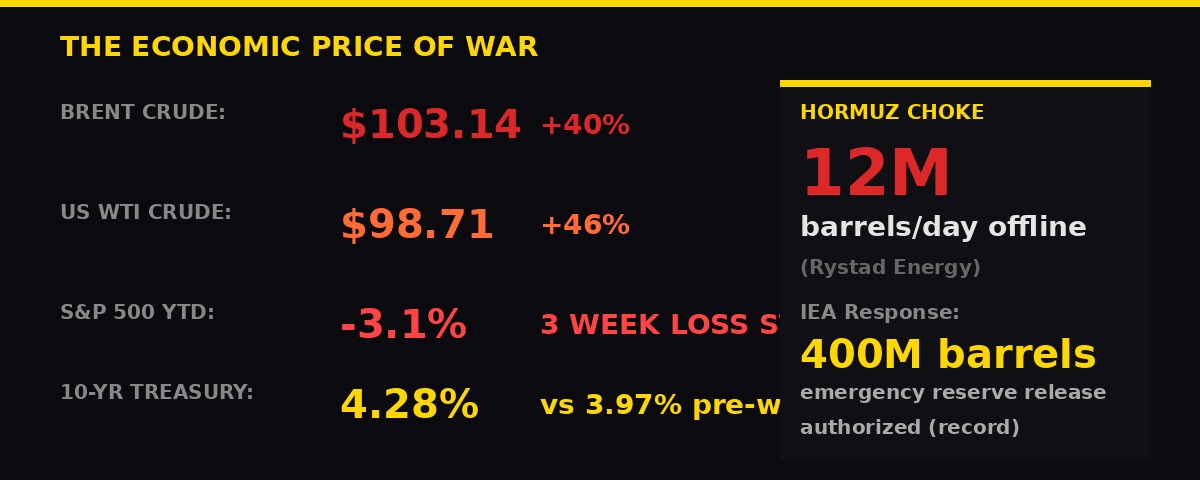
BLACKWIRE graphic - The economic cost of the Iran war: Brent crude above $103, US stocks losing for three straight weeks, 12 million barrels/day offline. (BLACKWIRE / Generated)
Oil at $103 and a Market Running Out of Good News
Wall Street closed Friday with its third straight week of losses. The S&P 500 fell 0.6% on the day - after opening up as much as 0.9% - and is now down 3.1% year-to-date. The Dow Jones Industrial Average shed 0.3%. The Nasdaq composite dropped 0.9%. (AP News, March 13, 2026)
The driver is oil. Brent crude, the international benchmark, closed Friday at $103.14 per barrel, up 2.7% on the session and now roughly 40% higher than where it began the month. US WTI crude settled at $98.71 a barrel, up 3.1% on the day and up approximately 46% in March alone. Both benchmarks briefly dipped in early trading before reversing sharply as news of the KC-135 crash and the Marines deployment filtered through markets.
"Everything's just trading with crude oil at this point," said Michael Antonelli, market strategist at Baird. "We're basically in a holding pattern until we get the hour-by-hour, day-by-day news about the conflict in the Middle East."
The structural reason for the oil spike is the Strait of Hormuz. Iranian forces have effectively shut down cargo traffic through the narrow passage at the bottom of the Persian Gulf, where roughly one-fifth of the world's daily oil supply typically moves. Rystad Energy, the independent research firm, estimates that more than 12 million barrels of oil equivalent per day have been taken offline since the closure began. That is not a small number. Global demand runs roughly 103 million barrels per day.
The bond market is pricing in sustained inflation. The yield on the 10-year US Treasury note climbed to 4.28% on Friday, up from 4.26% Thursday, and sharply above the 3.97% level that prevailed before the war started on February 28. Rising yields ripple through the entire economy - pushing up mortgage rates, corporate borrowing costs, and suppressing valuations on equities and crypto.
The Federal Reserve is scheduled to meet next week for its regular interest rate policy session. Wall Street traders put the probability of a rate cut at below 1%, according to CME Group data. The Fed is trapped: cutting rates would stoke inflation already being fueled by oil. Holding or hiking rates would compound an economy already showing pre-war cracks in consumer spending.
The International Energy Agency moved Wednesday to authorize a record 400 million barrel release from member nations' strategic petroleum reserves. Economists and markets largely shrugged. "That's a couple weeks of missing supply," one energy analyst told BLACKWIRE. "It doesn't unclog Hormuz."
What the Marines Bring: A Force Profile
The Marine Expeditionary Unit that is reportedly being ordered to the Middle East represents the core building block of US Marine Corps power projection. Understanding what 2,500 Marines can and cannot do is essential to reading what Washington is signaling with this deployment.
At the core of an MEU is a Ground Combat Element - an infantry battalion reinforced with tanks, light armored vehicles, assault amphibious vehicles, artillery, engineers, and reconnaissance. In 2025 and 2026 configurations, many MEUs have also integrated unmanned aerial systems, electronic warfare capabilities, and long-range precision fire elements that did not exist in the force a decade ago.
The Aviation Combat Element of a standard MEU includes AH-1Z Viper attack helicopters, UH-1Y Venom utility helicopters, MV-22 Osprey tiltrotors for medium-lift, and a detachment of fixed-wing aircraft that varies by assignment. Some MEUs operating near contested airspace carry F-35B Lightning II aircraft capable of short takeoff and vertical landing - giving an amphibious task force organic air superiority that changes its operational calculus entirely.
The Combat Logistics Element provides the logistics backbone: fuel, ammunition, medical support, maintenance, and the supply chains that allow the force to operate independently for up to 15 days of sustained combat without external resupply. For longer campaigns, that number extends with reinforcement.
None of this is Iran invasion force sizing. Iran has a standing military of approximately 580,000 active personnel, a 350,000-strong Islamic Revolutionary Guard Corps, and mountainous terrain that has frustrated invaders for centuries. But 2,500 Marines positioned in Kuwait, Bahrain, or on amphibious ships in the Arabian Sea give Washington options it does not currently have: the ability to seize a port, extract personnel, strike a target on the ground, or conduct raids against high-value targets that air power alone cannot reach.
The deployment is also political. It signals to Tehran, and to regional allies watching nervously, that the United States is not cycling down. It is cycling up.
The War So Far: A Two-Week Ledger
Operation Epic Fury began February 28, 2026, when the United States and Israel launched coordinated strikes against Iranian nuclear infrastructure, air defense systems, and IRGC command nodes. The stated objective from the Trump White House was the permanent dismantlement of Iran's nuclear weapons program, the degradation of Iran's ability to project force across the region, and the establishment of conditions for what Trump called "a new Iran."
What followed was not the clean five-to-seven-day campaign some Pentagon planners had modeled. Iran's layered air defenses proved more resilient than assessed. The IRGC, operating under pre-planned decentralized command protocols, survived the decapitation of much of its senior leadership and continued coordinated operations. Iran's drone and missile forces - hardened in hardened tunnels in the Zagros and Alborz mountain ranges - absorbed initial strikes and resumed operations within 48 hours.
US-Israeli coordinated strikes hit Iranian nuclear sites, air defense networks, and IRGC leadership nodes. Supreme Leader Ali Khamenei is killed in the initial strikes.
IRGC naval forces begin systematic disruption of Strait of Hormuz traffic. First US service member deaths reported. Iran launches retaliatory drone and missile salvos at Gulf state targets.
Iranian drone and missile attacks strike near the US 5th Fleet in Bahrain and the US Embassy compound in Riyadh. Three F-15E jets downed by Kuwaiti friendly fire - all crew eject safely.
Mojtaba Khamenei, son of the slain Supreme Leader, is named the new head of the Islamic Republic. Iran's leadership structure, expected to fracture, consolidates. Oil reaches $100/barrel.
A US Air Force refueling tanker goes down in western Iraq following a mid-air incident with another KC-135. All six crew members are killed. This is the 4th US aircraft publicly lost since the war began. US death toll reaches 13.
The Pentagon announces the deployment of a Marine Expeditionary Unit-equivalent force to the region, the largest US ground force movement since the war began. Brent crude: $103.14.
Mojtaba, the Wounded Leader, and Iran's Staying Power
One of the core assumptions behind Operation Epic Fury was that Iran's leadership structure would collapse under the pressure of the initial decapitation strikes. That assumption has not held. (Multiple AP and Reuters reports, March 2026)
Mojtaba Khamenei, the son of the slain Supreme Leader Ali Khamenei, was elevated to the position of Supreme Leader in an emergency session of Iran's Assembly of Experts. He was not an obvious successor - his father had reportedly wanted to avoid dynastic succession, fearing comparisons to hereditary monarchies. But in crisis, the Assembly moved quickly.
Defense Secretary Hegseth stated this week that Mojtaba Khamenei had been injured in a US airstrike. Iranian state media did not confirm the injury but continued to broadcast statements attributed to Mojtaba as Supreme Leader. The Iranian president, in a video address, rejected US demands for unconditional surrender, saying: "They should take that dream to their grave."
The IRGC, which operates its own parallel military command structure independent of the Iranian regular armed forces, has absorbed substantial losses but remains operational. Its Quds Force - the external operations wing - has continued to direct proxy operations across the region, including through Lebanese Hezbollah, Iraqi militias, and Houthi forces in Yemen. The multi-front character of the conflict has stretched US and Israeli targeting lists and ISR resources.
Security analyst Yang Uk of South Korea's Asan Institute for Policy Studies noted that Iran's ability to persist reflects a decision made years ago to distribute its military capacity - particularly air defense, missile forces, and drone production - across hundreds of hardened sites spread across a country the size of Western Europe. "They anticipated this," Yang told the AP. "This is not a surprise to them."
The Strait That Controls Everything
The most consequential single geographic fact of Operation Epic Fury is not in Iran. It is 34 miles wide at its narrowest point, flanked by the Iranian coastline to the north and the Omani exclave of Musandam to the south. The Strait of Hormuz is the world's most critical oil chokepoint, and Iran has effectively shut it down.
Before the war, roughly 21 million barrels of oil per day passed through Hormuz - about 21% of global petroleum consumption. That included crude from Saudi Arabia, the UAE, Kuwait, Iraq, and Qatar's massive LNG exports. Since IRGC naval forces began systematic harassment operations against tanker traffic, commercial vessels have diverted away from the Strait or remained at anchor. The drop in throughput has been catastrophic for global energy markets.
Rystad Energy's estimate of 12 million barrels per day offline does not include the full cascading effect. Oil producers in the Gulf have also been curtailing output because their storage is full - crude is arriving at their terminals with nowhere to go. Saudi Aramco is reportedly storing oil in floating storage vessels anchored off its Red Sea terminals. Iraqi Kurdish pipeline flows have increased to compensate, but at nowhere near the needed scale.
The IEA's emergency reserve release of 400 million barrels, while a record intervention, covers roughly 33 days of the missing Hormuz throughput if the entire release lands on market simultaneously - which it will not. The announcement steadied markets briefly but failed to reverse the underlying supply deficit that comes from a physical chokepoint being blocked by an adversary still willing to fire on shipping.
The US Navy has attempted to maintain a corridor for military and some commercial vessels with carrier strike group assets in the Arabian Sea. But keeping Hormuz fully open against an adversary with shore-based anti-ship missiles, fast attack boats, and submarine capability is a different problem than projecting air power. It requires patience, sustained presence, and tolerance for casualties that the American public has not yet fully priced in.
What Week Three Looks Like
Three scenarios are being actively discussed in Washington, according to officials who spoke on background to multiple wire services.
The first is continued air campaign pressure combined with a negotiated off-ramp. Qatar and Oman, both of which maintain back-channel communication with Tehran, are reportedly active as intermediaries. Iran's stated position - no unconditional surrender, negotiations only under cessation of hostilities - does not yet match Washington's stated position of full nuclear dismantlement before any pause. The gap is wide.
The second scenario is escalation. The Marines deployment points in this direction. If Hegseth and the Joint Chiefs recommend targeting IRGC naval assets more aggressively - including mining removal operations, anti-ship missile battery strikes on the Iranian coast, or raids against Quds Force command infrastructure in Iraq and Syria - ground forces provide a capability air power alone cannot.
The third scenario, discussed quietly, is a grinding stalemate. Neither side achieves its objectives in week three. Iran's oil revenues are diminished but it can survive without them for months. The US cannot sustain oil at $103 a barrel into summer without a domestic political crisis. A war that began as a sprint may become something neither party wanted: a marathon.
The Federal Reserve meets next week against this backdrop. Inflation data released Friday showed consumer prices still rising even before the war added its oil premium. The 10-year Treasury yield is four basis points above pre-war levels. If oil stays above $100 through April, those numbers get worse. The economic clock ticking in the background of Operation Epic Fury is not just a market story - it is a strategic constraint on how long the United States can sustain the campaign before domestic pressure forces a decision one way or another.
Thirteen Americans are dead. Four aircraft are down. 2,500 Marines are on their way. And the war that was supposed to last five days is entering its third week with no visible exit ramp in sight.
War start date: February 28, 2026
US service members killed in combat: 7
US service members killed in accidents: 6 (KC-135 crash, Iraq)
Total US dead: 13
US service members injured: ~140 (8 severely)
US aircraft publicly acknowledged lost: 4 (3 F-15Es, 1 KC-135)
Declared cost to Pentagon: $11.3 billion (as of Day 14)
Marines ordered to Middle East: 2,500
Brent crude price: $103.14/barrel (+40% in March)
Hormuz throughput offline: ~12 million barrels/day (Rystad Energy)
S&P 500 year-to-date performance: -3.1%
10-year Treasury yield: 4.28% (vs 3.97% pre-war)
Get BLACKWIRE reports first.
Breaking news, investigations, and analysis - straight to your phone.
Join @blackwirenews on Telegram