Trump Says US 'Obliterated' Kharg Island Military Targets as War Economy Fractures
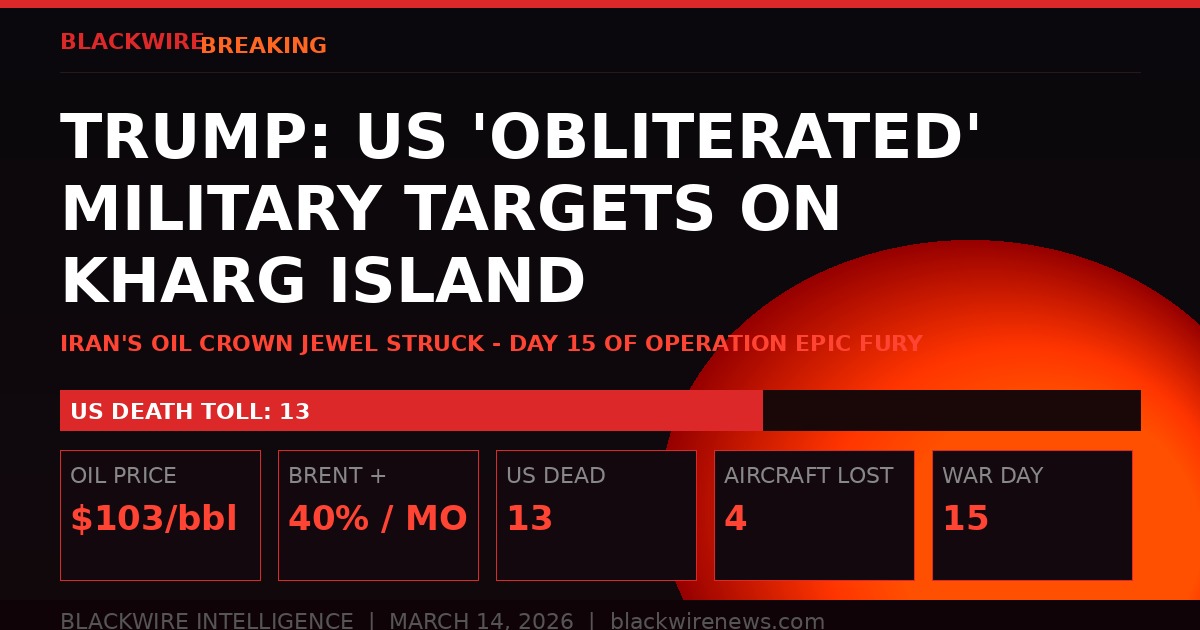
America struck Iran's most critical piece of strategic infrastructure on Friday. President Trump announced the US "obliterated" military targets on Kharg Island - the offshore terminal responsible for roughly 90 percent of Iran's crude oil exports. Six American airmen died the same day when a KC-135 refueling tanker crashed in western Iraq. Oil climbed above $103 a barrel. And the war is showing no sign of stopping.
The Kharg Island Strike
The announcement came via Trump's social media channel, the way many of the most significant military decisions in this war have been communicated to the public. The US "obliterated" military targets on Kharg Island, Trump wrote on Friday. He provided no further specifics on the nature of the targets, the scale of the strike, or what remained standing.
The White House and Pentagon have not issued detailed damage assessments. That silence is itself informative. When a strike goes precisely as planned, the administration tends to elaborate quickly with bomb-damage assessment language and press conference footage. The absence of detail suggests the situation on the island remains fluid, or that the administration is managing what information Iran and global oil markets receive simultaneously.
What is not in question is the strategic weight of the decision. Kharg Island is the crown jewel of Iran's energy infrastructure. Hitting it - even partially - is categorically different from striking missile batteries, Revolutionary Guard barracks, or air defense installations. It is a direct attack on the economic engine of the Iranian state.
"We obliterated military targets on Kharg Island. No one threatens the United States and gets away with it."
- President Donald Trump, via social media, March 13, 2026 (AP News)
Iran has not yet issued a formal government response to the Kharg Island strike as of early Saturday morning. The silence from Tehran may reflect damage assessment of their own, or deliberate strategic ambiguity about the degree of harm the US inflicted on the facility.
What Kharg Island Is - And Why Striking It Changes Everything
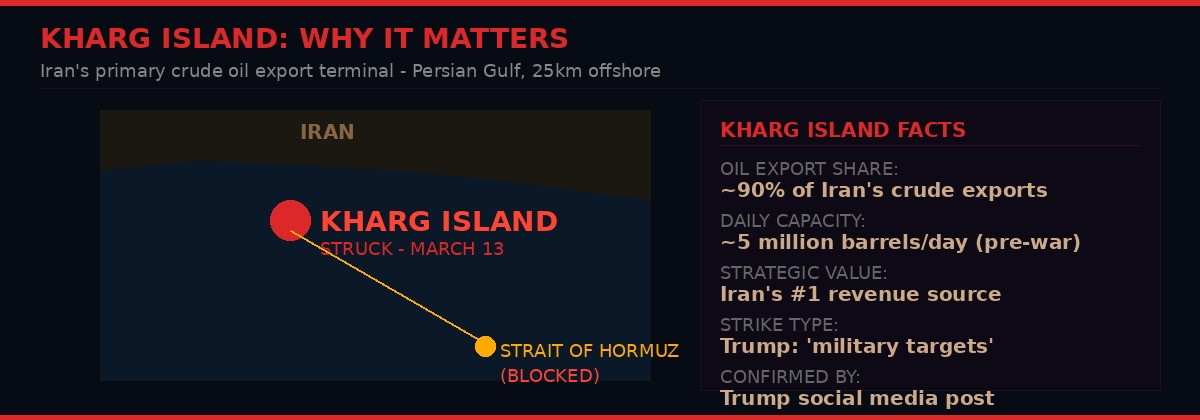
Kharg Island sits roughly 25 kilometers off the Iranian coast in the northern Persian Gulf, in the province of Bushehr. What looks on a map like an unremarkable limestone island roughly 8 kilometers long is, in reality, one of the most consequential pieces of energy infrastructure on earth.
Iran exports approximately 1.5 to 2 million barrels of crude oil per day under normal conditions. Before the war, roughly 90 percent of that crude flowed through Kharg Island's marine terminals - specifically Sea Island and T-jetty, which together can handle supertankers carrying 2 million barrels each. The island also hosts a significant portion of Iran's petroleum storage capacity, pipeline networks, and maritime logistics for the National Iranian Oil Company.
The facility was built largely in the 1950s and 1960s under the Shah, with significant expansion through subsequent decades. It survived the Iran-Iraq War - during which Iraq repeatedly targeted Kharg in the so-called "Tanker War" between 1984 and 1988 - though not without severe damage that required years of repair and reduced Iran's export capacity by roughly 50 percent at peak disruption. Iraq never fully destroyed it. Whether the US strikes will be more precise, or more destructive, remains unknown as of this writing.
The war has already closed the Strait of Hormuz to commercial traffic, with Iran's actions effectively stopping cargo movement through the narrow chokepoint through which a fifth of the world's oil normally sails. According to independent research firm Rystad Energy, more than 12 million barrels of oil equivalent per day have been taken offline since the Strait closure began. Striking Kharg piles devastation on top of devastation for the global oil supply chain. Even with the International Energy Agency's release of 400 million barrels from member-country emergency reserves - announced Wednesday - analysts believe the move does little more than buy time.
The price of Brent crude reflects this reality. It closed Friday at $103.14 per barrel, up 2.7 percent on the day and up approximately 40 percent for the month of March alone. US crude (WTI) settled at $98.71, up about 46 percent for the month. Gasoline prices in the United States have been racing toward $4 per gallon, a politically sensitive threshold that Donald Trump knows well from his time as a candidate criticizing high pump prices under previous administrations.
Six Americans Die in KC-135 Crash Over Iraq
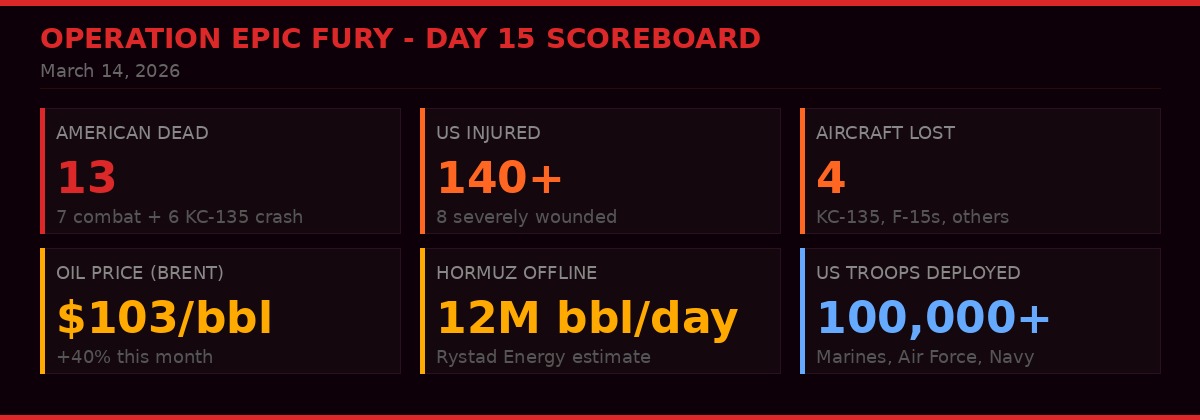
The Kharg Island announcement was not the only devastating news Friday. US Central Command confirmed that all six crew members of a KC-135 Stratotanker refueling aircraft that crashed Thursday in western Iraq are dead. The crash brings the total American death toll in Operation Epic Fury to at least 13.
CENTCOM said the crash occurred "over friendly territory in western Iraq while the crew was on a combat mission" and was "not due to hostile or friendly fire." The circumstances remain under investigation. A US official who spoke on condition of anonymity to discuss the developing situation told AP that the crash followed an unspecified incident involving two aircraft in "friendly airspace" - and that both aircraft involved were KC-135s. The second plane landed safely in Israel, according to Israeli Ambassador to the US Yechiel Leiter, who confirmed it on social media.
"War is hell. War is chaos. And as we saw yesterday with the tragic crash of our KC-135 tanker, bad things can happen. American heroes, all of them."
- Defense Secretary Pete Hegseth, Pentagon press conference, March 13, 2026 (AP News)
Ohio Governor Mike DeWine confirmed three of the six crew members were from his state, deployed with the Ohio Air National Guard's 121st Air Refueling Wing. He did not identify the airmen, citing notification of next-of-kin procedures, but extended condolences to their families via social media.
The KC-135 Stratotanker is a Cold War-era aircraft that has been in continuous service for more than 60 years. Based on the same design as the Boeing 707 passenger jet, the plane refuels fighters and bombers in midair via a fuel boom extended from the rear of the aircraft. A basic crew consists of three people - a pilot, co-pilot, and boom operator - though the number can expand significantly for aeromedical evacuation missions, which require nurses and medical technicians. The US Air Force had 376 KC-135s as of last year, according to the Congressional Research Service, including 151 on active duty, 163 in the Air National Guard, and 62 in Air Force Reserve.
Security expert Yang Uk of South Korea's Asan Institute for Policy Studies told AP it would be rare for a refueling tanker to be downed by enemy fire because such operations are typically conducted well behind the front lines. The investigation into what caused the collision between the two tankers - or what other mechanical factor may have played a role - is ongoing.
A troubling question raised by defense analysts concerns parachutes. A 2008 Air Force news release confirmed the service had been pulling parachutes from KC-135s, reasoning that statistically it was safer to remain with the aircraft, "especially when flying over enemy territory." Former Air Force Safety Center investigator Alan Diehl told AP that whether this KC-135 carried parachutes may become a central question of the investigation. The KC-135 that crashed in Kyrgyzstan in 2013, killing all three aboard, did not carry parachutes.
This is the fourth US military aircraft publicly acknowledged to have crashed since Operation Epic Fury began on February 28. The previous incident - which could have been worse - involved three F-15E Strike Eagle fighters mistakenly downed by friendly Kuwaiti fire last week. All six crew members in those jets ejected safely.
Markets Fracture, Economy Shows Cracks
Wall Street ended Friday with its third straight weekly loss. The S&P 500 fell 0.6 percent on the day and is now down 3.1 percent for the year. The Dow Jones Industrial Average lost 0.3 percent. The Nasdaq composite fell 0.9 percent. Each index briefly rallied in early trading before oil prices rose again and erased the gains.
"Everything's just trading with crude oil at this point," Michael Antonelli, market strategist at Baird, told AP. "We're basically in a holding pattern until we get kind of the hour-by-hour, day-by-day news about the conflict in the Middle East."
Bond markets are sending a parallel warning signal. The yield on the 10-year Treasury rose to 4.28 percent on Friday, up from 3.97 percent before the war started. That jump reflects bond traders pricing in sustained inflation - driven by oil and energy costs spiraling through every sector of the economy. Higher yields push up mortgage rates, auto loans, and corporate borrowing costs. They also suppress stock valuations. The Federal Reserve is scheduled to meet next week, and while Wall Street traders put the odds of a rate cut at less than 1 percent according to CME Group, some economists - including KPMG's chief economist Diane Swonk - have warned the Fed could even discuss raising rates.
New economic data released Friday made the situation look worse than anyone had publicly acknowledged. The Commerce Department issued a sharp downgrade to fourth-quarter 2025 GDP growth, cutting it in half to just 0.7 percent annualized from its initial estimate of 1.4 percent. That is down drastically from 4.4 percent growth in the third quarter and 3.8 percent in the second. A 43-day government shutdown last fall was partly responsible, slashing federal spending and investment at a 16.7 percent annualized rate. But consumer spending was also anemic.
Core inflation came in at 3.1 percent in January - above the Federal Reserve's 2 percent target and the highest reading in nearly two years. This is before the Iran war caused oil and energy prices to spike. Gasoline approaching $4 per gallon is now layered on top of an economy that was already struggling to maintain momentum.
"Underlying inflation pressures were already rising ahead of the war in the Middle East and are set to intensify," Swonk said. Many American households will receive larger-than-usual tax refunds in March and April due to 2025 tax law changes - but economists warn rising gasoline costs could absorb those gains entirely.
The Zelenskyy Complication: Russian Oil and the G7 Fracture
While the primary theater of the war is the Persian Gulf and Iran, its geopolitical ripple effects are reshaping every other major conflict and alliance simultaneously. On Friday, Ukrainian President Volodymyr Zelenskyy publicly rebuked the United States from Paris, calling a US Treasury Department decision to grant a 30-day waiver on Russian oil sanctions "not the right decision."
The waiver, announced Thursday, aims to free up Russian oil cargoes stranded at sea and ease supply shortages caused by the Persian Gulf disruption. In theory, it is an emergency economic pressure valve. In practice, Zelenskyy says it is handing Moscow a financial lifeline during an active invasion of Ukraine.
"This easing alone by the United States could provide Russia with about $10 billion for the war. This certainly does not help peace."
- Ukrainian President Volodymyr Zelenskyy, Paris press conference with President Macron, March 13, 2026 (AP News)
The critique carried weight beyond Kyiv. German Chancellor Friedrich Merz stated that six of the seven G7 member nations - every member except the United States - told Trump directly that the Russian oil waiver was "not the right signal to send." Merz, speaking from Norway, said: "We believe this is the wrong decision. There is currently a price problem, but not a supply problem. And in that regard, I would like to know what additional motives led the US government to make this decision."
French President Emmanuel Macron tried to soften the diplomatic edges, noting that the waiver is "limited" and "taken on an exceptional basis" and does not "broadly or permanently roll back" the original sanctions architecture. But the optics are difficult. The United States is simultaneously fighting a war against Iran while providing sanctions relief to Russia - Iran's de facto strategic partner - because the Iran war has made energy prices unmanageable.
Zelenskyy also revealed Friday that US-mediated peace talks between Moscow and Kyiv - which were gaining tentative momentum before the Iran war began - are now on hold "due to the Iran war," though he said they could resume next week. In the same breath, Trump spurned Ukraine's offer of drone defense expertise on Fox News Radio. "No, we don't need their help on drone defense," Trump said. Ukraine had spent months trying to transfer its battle-tested anti-drone technology to US Gulf partners in exchange for high-end Western weapons Kyiv cannot manufacture domestically.
Operation Epic Fury: Day 15 Timeline and War Ledger
What Kharg Means for the War's Next Phase
The strike on Kharg Island is not just a military escalation - it is a fundamental shift in the war's logic. For the first 14 days, US targeting largely followed a familiar campaign model: degrade air defenses, strike military infrastructure, pressure leadership, attempt to impose costs without triggering full economic collapse or forcing Iran into a corner with no visible exit.
Kharg Island is different. It is not a military target in the conventional sense - it is Iran's treasury. Striking it signals one of two things: either the US has concluded that Iran will not negotiate until its economic survival is threatened at its source, or the administration's targeting criteria have expanded beyond what was originally briefed to Congress and US allies.
The consequences for global oil markets are potentially severe in ways that even the Hormuz closure has not fully triggered yet. The Strait closure cut off exports from multiple Gulf producers simultaneously - Saudi Arabia, Iraq, Kuwait, UAE. Countries with direct Hormuz exposure pulled production because their crude had nowhere to go. That is already causing 12 million barrels per day to sit stranded. If Kharg Island's export infrastructure is seriously damaged, Iran's ability to resume exports in any post-conflict scenario collapses for potentially years - not weeks. The Iran-Iraq War damage to Kharg in the 1980s required sustained reconstruction. A 2026 precision-strike campaign, with potentially heavier munitions, could leave longer-lasting damage.
For Iran, the strike creates a paradox. The country's economy was already under pressure from the war and the resumption of severe sanctions. Destroying or significantly degrading Kharg Island removes Iran's primary peacetime income source. That pressure could compel the regime toward negotiation - or it could compel maximum retaliation, including kinetic strikes on Gulf Arab oil infrastructure that has thus far been largely spared direct targeting.
Saudi Arabia's Aramco facilities at Abqaiq and Ras Tanura - which process and export a combined 7 to 10 million barrels per day - have been on elevated alert since the war began. An Iranian or Iranian-proxy strike on either facility, in retaliation for the Kharg attack, would send oil prices toward $130 or beyond and trigger a genuine global economic emergency. IEA reserve releases cannot offset that scale of disruption.
Iran's other leverage point is the mining of the Persian Gulf itself. Iranian naval forces have been conducting mine-laying operations since early in the war, and several commercial vessels have been damaged. Escalating that campaign in response to Kharg could threaten the maritime safety of the entire northern Gulf, affecting warships and civilian tankers alike.
The Domestic Political Dimension
Donald Trump is conducting this war with the 2026 midterm elections less than eight months away. The political math is complicated. Americans broadly supported the initial strikes against Iran - a country widely viewed as a longtime adversary responsible for decades of regional destabilization and terror financing. But that support is soft and price-sensitive. Wars that keep gas above $4 per gallon for extended periods historically erode public support faster than combat casualties do.
The economic data released Friday told a story that predates the war but will be politically assigned to it: 0.7 percent GDP growth in Q4 2025. Consumer spending barely growing in January. Inflation stubbornly above 3 percent before oil prices started climbing. The University of Michigan consumer sentiment survey showed a notable decline in March, with Americans citing gasoline price hikes since the war began as a primary concern.
Trump's decision to waive Russian oil sanctions is an attempt to stabilize supply - but it has fractured the G7 and handed Zelenskyy a politically damaging talking point at a moment when Ukraine's war is already starved of Western attention. Six G7 allies openly broke with Washington on the Russia waiver. That is an unusual and significant signal of allied frustration - the kind of diplomatic friction that rarely stays contained.
Congress has also been restive. Democrats and several Republican senators have raised concerns about war powers authority. The administration has maintained the strikes fall within existing authorizations, but that legal argument is being tested more rigorously with each passing week and each American casualty.
The Federal Reserve meeting next week adds another variable. If the Fed signals it is considering rate hikes to combat war-driven inflation, stock markets - already down three consecutive weeks - could sell off sharply. A simultaneous market downturn and rising gas prices heading into spring would hand the opposition a potent political narrative.
What Happens Next
The 48 to 72 hours following the Kharg Island strike are the critical window. Iran's response - or deliberate non-response - will determine whether this war's trajectory bends toward some form of negotiated pause or accelerates toward full-spectrum escalation.
If Tehran responds with a major strike on Gulf Arab infrastructure, the war expands from a bilateral US-Iran conflict into a broader regional catastrophe. If Iran absorbs the Kharg strike and continues the current pattern of asymmetric harassment - drone attacks, Gulf mine operations, proxy pressure - it suggests the regime is holding to a strategy of prolonged attrition, betting that economic pain in the US and Europe erodes political will before Iran's military capacity collapses.
The US military's logistical challenge is also real and growing. Four aircraft lost in 15 days. Thirteen dead. One hundred forty wounded. The KC-135 crash highlights a persistent vulnerability: the US air campaign over Iran requires constant aerial refueling, and the tanker fleet - many of which are 60-year-old planes without parachutes - is flying dangerous missions at high tempo. The Air Force's inventory of 376 KC-135s sounds large until you calculate how many are operational, how many are in maintenance, and how many missions per day a sustained campaign over Iran requires.
Refueling tankers will become more critical, not less, as the campaign continues. If Iran's forces retreat deeper into the country - as South Korea's Yang Uk told AP is a likely development - US aircraft will need to fly longer missions into Iranian interior airspace, requiring more refueling sorties over greater distances. The 60-year-old KC-135 fleet is being asked to sustain a war tempo it was not designed to endure indefinitely.
The Kharg Island strike may ultimately prove to be the moment that forced resolution - or the moment that forced catastrophe. At 3 AM on March 14, 2026, the answer is not yet known. Oil markets, allied capitals, and Tehran are all processing the same information simultaneously. The next move belongs to Iran.
Iran has not publicly responded to the Kharg Island strike as of press time. Markets open in Tokyo in approximately 4 hours. Asian trading will be the first real-time pricing signal for what the world thinks Kharg Island's destruction means. This story is developing. Updates will follow.
Sources: AP News live war updates (March 13-14, 2026); AP reporting on KC-135 crash (CENTCOM press release cited); AP markets reporting (Baird, Rystad Energy, IEA); AP economic reporting (Commerce Department BEA GDP data, University of Michigan consumer sentiment); AP diplomatic reporting (Zelenskyy Paris press conference, Merz Norway statement); Congressional Research Service KC-135 fleet data; US Air Force Safety Center records (2013 Kyrgyzstan crash investigation).
Get BLACKWIRE reports first.
Breaking news, investigations, and analysis - straight to your phone.
Join @blackwirenews on Telegram