The $10 Billion Gift: Trump's Russia Sanctions Waiver Hands Putin a Lifeline While Ukraine Burns
The diplomatic fallout from Washington's 30-day Russian oil sanctions waiver is splitting the Western alliance at its worst possible moment. | BLACKWIRE War Desk
On Friday, March 13, the U.S. Treasury Department quietly announced a 30-day waiver on sanctions targeting Russian oil - a maneuver framed as emergency relief for a global energy market choked by the Iran war. By Saturday morning, the decision had exploded into a trans-Atlantic diplomatic rupture.
Standing alongside French President Emmanuel Macron in Paris, Ukrainian President Volodymyr Zelenskyy did not mince words. The waiver, he said, would hand Russia approximately $10 billion to fund its war against Ukraine. That money would buy drones. It would buy missiles. It would buy the ammunition currently killing Ukrainian soldiers on the eastern front.
"This easing alone by the United States could provide Russia with about $10 billion for the war," Zelenskyy told reporters at the joint press conference. "This certainly does not help peace."[AP, March 14, 2026]
German Chancellor Friedrich Merz, speaking from Oslo, was even more blunt. Six of the seven G7 members had explicitly told Trump this was the wrong move during a summit-level discussion this week. He went ahead anyway. "We believe this is the wrong decision," Merz said, carefully not explaining what could have possibly changed Trump's mind beyond the one thing no one at the G7 table was willing to say out loud: the Iran war is eating Washington's attention, and oil prices are a domestic political problem.
The waiver is a 30-day measure. It is, on paper, temporary. But in geopolitics, 30-day measures have a tendency to become 60-day measures, then permanent policy, then the new normal. Kyiv knows this. That is why Zelenskyy flew to Paris. That is why he held a press conference. That is why he is saying these things loudly and publicly rather than in a back-channel cable to the State Department.
Russia's Oil Revenue Was Bleeding Out - Until Thursday
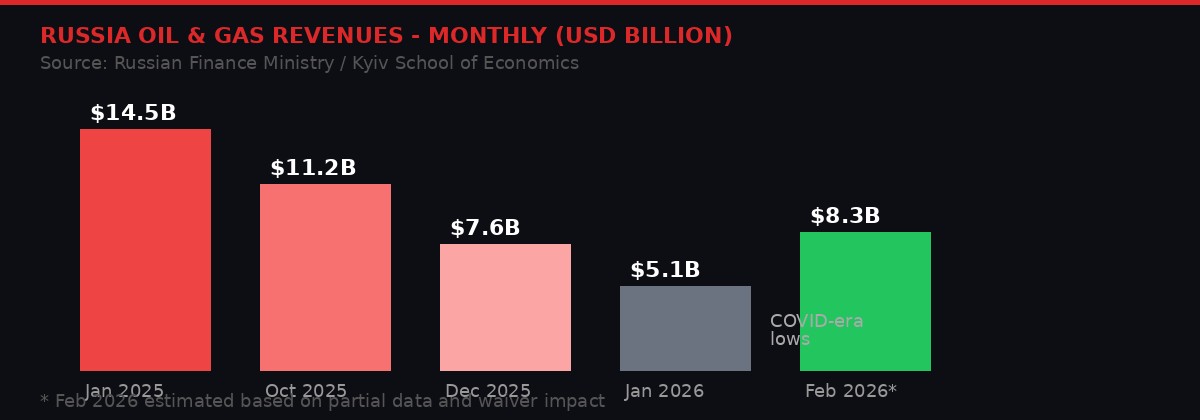
Russia's monthly oil and gas revenues had collapsed to COVID-era lows by January 2026. The US sanctions waiver announced March 13 is projected to reverse that trend. | Source: Russian Finance Ministry / Kyiv School of Economics
The timing matters enormously, because the sanctions were actually working. For the first time since Russia's full-scale invasion of Ukraine began in February 2022, Moscow's oil and gas revenue had fallen to levels not seen since the COVID-19 pandemic.
In January 2026, Russian state revenues from taxing the oil and gas industries hit 393 billion rubles - roughly $5.1 billion. That sounds like a lot until you compare it to January 2025, when the number was 1.12 trillion rubles ($14.5 billion). A 64% collapse in 12 months. The kind of financial hemorrhage that forces governments to make choices between guns and economic stability.[Janis Kluge, German Institute for International and Security Affairs, via AP]
How did it get this bad for Moscow? A combination of three simultaneous pressures. First, the Trump administration's decision to sanction Rosneft and Lukoil directly from November 21, 2025 - the two largest Russian oil companies. Anyone buying or shipping their crude runs the risk of being cut off from the U.S. banking system. For multinational shippers and refiners, that is an existential threat.
Second, the EU began banning fuel refined from Russian crude on January 21, 2026, closing the loophole that had allowed third-country refiners to process Russian oil and sell the finished product into European markets. That door is now shut.
Third, Trump's tariff pressure on India. Russia had spent 2024 rerouting the bulk of its seaborne oil to India and China after the G7 price cap pushed it out of Western markets. India was buying 2 million barrels per day as recently as October 2025. By December, that had fallen to 1.3 million barrels per day - partly because Trump agreed on February 3, 2026 to lower Indian tariffs from 25% to 18% in exchange for Modi's pledge to reduce Russian crude imports.[AP, Reuters]
The sanctions architecture was more effective than it had ever been. Russia was being squeezed on three sides simultaneously. Putin was borrowing from Russian banks and raising taxes to keep state finances intact. The war economy was showing genuine strain - slowing growth, stubborn inflation, a ruble under persistent pressure.
And then the Iran war happened.
Oil prices spiked. Persian Gulf shipping routes were disrupted. Gulf state production and export capacity came under threat. Suddenly Washington had a new problem: oil prices that American consumers would feel at the pump before the 2026 midterms. The solution the Treasury Department reached for was the 30-day Russian oil sanctions waiver - freeing up stranded Russian cargoes to ease supply shortages and push prices down.
The math is elegant from a Washington policy perspective. It is devastating from Kyiv's.
The G7 Rupture: Six Against One
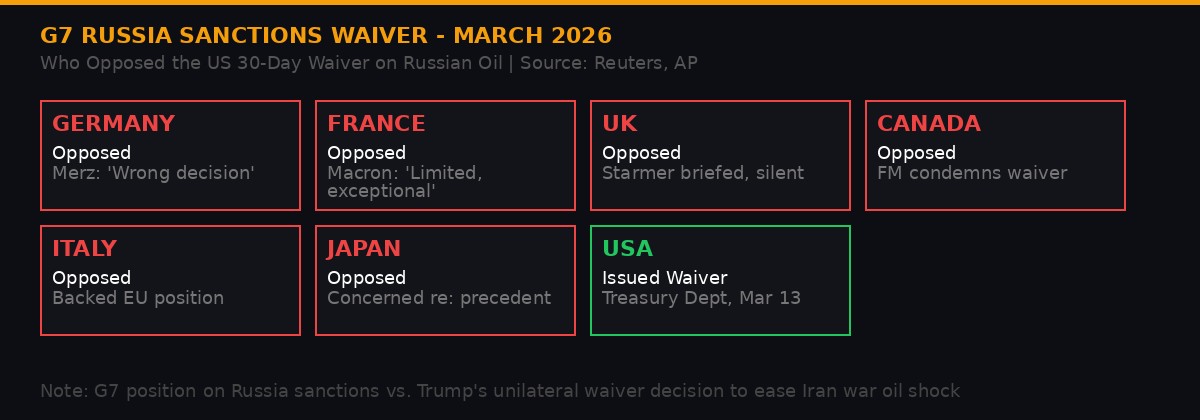
Six of seven G7 members opposed the US 30-day waiver on Russian oil sanctions. Germany's Merz confirmed the breakdown publicly from Oslo on Friday. | BLACKWIRE War Desk
The degree of allied opposition to this decision is striking and worth dwelling on. The G7 - the United States, Germany, France, the United Kingdom, Canada, Italy, and Japan - has been the institutional backbone of Western sanctions enforcement against Russia since 2022. Every major escalation of the sanctions regime has been a joint decision. The price cap. The asset freezes. The Rosneft and Lukoil designations.
This waiver was not a joint decision. It was unilateral. And six of the seven members said so publicly.
"Six members of the G7 expressed a very clear view that this is not the right signal to send. We learned this morning that the U.S. government has apparently decided otherwise. Once again, we believe this is the wrong decision."
- German Chancellor Friedrich Merz, Oslo, March 14, 2026 [AP]
Merz added a question that cuts to the core of European suspicion about Trump's Russia policy: "There is currently a price problem, but not a supply problem. And in that regard, I would like to know what additional motives led the U.S. government to make this decision."
He is not the only one asking. European officials have watched the Iran war drain U.S. attention from Ukraine and redirect American diplomatic energy to the Gulf. They have watched peace talks between Moscow and Kyiv - U.S.-mediated, carefully calibrated - get frozen in place while Washington fights a different war. Now they are watching Washington open a valve on the financial pressure that had, finally, been working.
Macron's response was more measured, almost defensive. He noted that the "broad sanctions on Russia still stand" and characterized the U.S. action as "limited" and "taken on an exceptional basis." "It does not broadly or permanently roll back the sanctions that they themselves decided to apply," Macron said.[AP]
But Macron is in a difficult position. France needs the United States in the Gulf as much as it needs Washington focused on Ukraine. He cannot afford to blow up the relationship with the White House over a 30-day waiver. So he threads the needle - technically correct, politically toothless.
The EU's executive commission chief, Ursula von der Leyen, moved in the opposite direction on Friday, proposing a full ban on shipping services for Russian oil. "We must be clear-eyed: Russia will only come to the table with genuine intent if it is pressured to do so," von der Leyen said. The proposal is symbolically significant - it signals that Brussels intends to tighten, not loosen, the sanctions net regardless of what Washington does.
Analyst Note
The G7 rupture on Russian oil sanctions is structurally significant beyond this individual decision. The price cap and sanctions architecture depend on coordinated enforcement. If the United States demonstrates willingness to unilaterally carve out exceptions for domestic political reasons, it undermines other allies' incentive to bear the economic costs of maintaining the regime.
Russia's shadow fleet - hundreds of aging tankers operating outside the Western sanctions framework - was already a persistent weakness. A U.S. waiver signals to the gray zone shipping networks that Washington's resolve has limits. That signal travels fast.
Ukraine's Drone Offer: Trump Said No
The oil waiver is not the only snub Kyiv absorbed this week. There is a second story running in parallel that, taken together with the sanctions decision, paints a clear picture of how Washington currently values its relationship with Ukraine.
Ukraine has spent the past four years of war becoming one of the most advanced drone warfare nations on earth. Necessity drove the innovation. Russia launched Shahed-136 attack drones by the hundreds. Ukraine could not afford to intercept them with Patriot missiles costing $3-4 million per round. So Ukrainian engineers built low-cost interceptor drones priced at $1,000 to $2,000 each - moving from prototype to mass production within months in 2025.[AP, March 14, 2026]
Now those same Iranian-designed Shaheds - or variants of them - are being launched at Gulf state infrastructure during the Iran war. The Gulf states have been burning through their Patriot missile stocks at an extraordinary rate. According to Zelenskyy, Middle Eastern nations expended more than 800 PAC-3 MSE interceptor missiles in just three days of Iran war combat. Lockheed Martin's entire 2025 production run was 600 units. That is a supply crisis by any definition.
Ukraine saw an opportunity. It offered its interceptor drone technology, its combat-tested expertise, its trained personnel, to the United States and Gulf partners. The pitch was straightforward: we have the system you need, built and proven in the exact threat environment you are now facing. What we need in return is the high-end weapons we cannot manufacture ourselves.
The U.S. had, according to Zelenskyy, already made a formal request for "specific support" against Iranian-designed drones. Kyiv ordered deployment of equipment and experts. The deal seemed to be coming together.
Then Trump spoke on Fox News Radio's "Brian Kilmeade Show" on Friday.
"No, we don't need their help on drone defense."
- President Donald Trump, Fox News Radio, March 14, 2026 [AP]
That is a complete and public contradiction of what Zelenskyy had said the previous day. The Ukrainian president said six countries had requested Ukraine's drone assistance and that expert teams had already been deployed to three of them. One reading of Trump's statement is that he simply did not know what his own military had requested. Another reading - more troubling for Kyiv - is that he knew and decided to publicly overrule the arrangement to avoid appearing dependent on Ukraine.
Either explanation is a problem. The first means the White House is not coordinating with Central Command. The second means political optics are overriding operational military judgment in the middle of a shooting war.
Zelenskyy, from Paris, said Ukraine was "awaiting White House approval" for an agreement on producing battle-tested drones. The approval, evidently, is not coming. Six countries are asking for Ukraine's help. The United States is publicly saying it does not want it.
Peace Talks Frozen: The Iran War Holds Ukraine Negotiations Hostage
The U.S.-mediated peace talks between Moscow and Kyiv that had been slowly, cautiously, developing over the previous weeks are now on hold. The direct reason: the Iran war is consuming the diplomatic bandwidth of the American officials running the process.
Zelenskyy confirmed the pause from Paris. He said talks "could resume next week" - a careful hedge that keeps the door open without committing to anything. That phrasing is diplomatic language for "I don't know if they will resume."
The suspension of peace talks matters for a specific reason beyond the obvious. Russia's financial position, badly weakened by the sanctions pressure documented above, was arguably giving the Kremlin a strategic incentive to reach some kind of negotiated settlement. A cornered economy has different calculus than a flush one. If the oil waiver restores Russian revenue - and analysts across Washington, Berlin, and Kyiv believe it will - that incentive diminishes.
Putin has always played for time. Time is what he needs to stabilize his economy, reconstitute depleted units, absorb losses, and wait for Western political will to erode. Every month of delay is, from Moscow's perspective, a strategic asset. The Iran war just gave him several of those months for free.
The Ukrainian front has not been static during this period. Russian forces have continued grinding operations in the east. The front lines in Zaporizhzhia, Kherson, and Donetsk have not frozen in place while Washington fights in the Gulf. Men are dying there every day, at a pace that tends not to make the international headlines when there is a more dramatic war running simultaneously.
Timeline: How the Iran War Reshaped Ukraine's Position
The KC-135 and the Mounting Cost of Operation Epic Fury
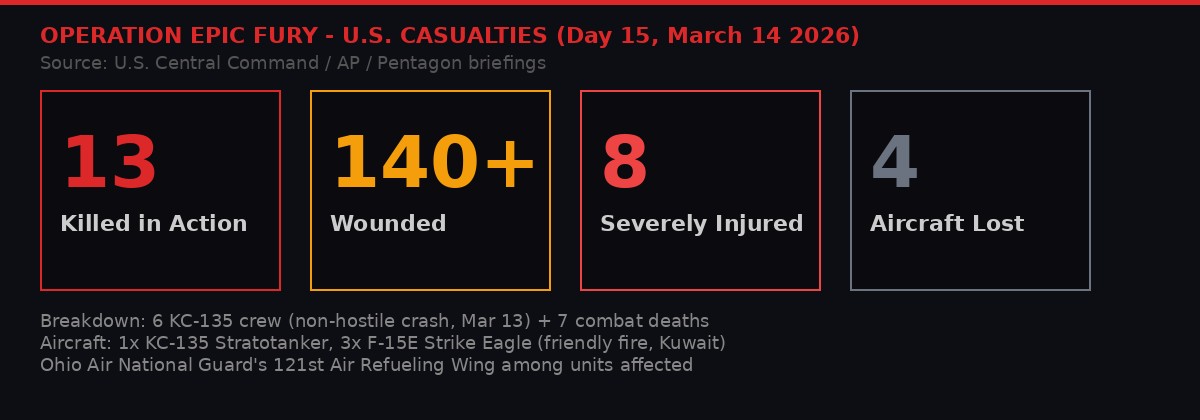
Operation Epic Fury has claimed 13 U.S. service members in 15 days - seven in combat, six in Thursday's KC-135 crash over western Iraq. | Source: U.S. Central Command, Pentagon
While the diplomatic crisis unfolded in Paris and Oslo, the war itself was producing its own grim accounting. The U.S. military confirmed Friday morning that all six crew members of the KC-135 Stratotanker that crashed in western Iraq on Thursday are dead.[U.S. Central Command press release; AP]
That brings the total American death toll in Operation Epic Fury to at least 13 service members - seven killed in combat operations, six in Thursday's crash. More than 140 have been wounded, with eight in severe condition, according to Pentagon briefings earlier this week.
The circumstances of the KC-135 crash remain under investigation. U.S. Central Command said it occurred "over friendly territory in western Iraq" while the crew was on a combat mission, and explicitly ruled out hostile or friendly fire as causes. Another aircraft - also a KC-135, according to a U.S. official who spoke anonymously - was involved in "an incident in friendly airspace" before the crash. That second plane landed safely in Israel, confirmed Israeli Ambassador to the U.S. Yechiel Leiter on X.
General Dan Caine, Chairman of the Joint Chiefs of Staff, told reporters at the Pentagon on Friday that the specifics are still being established. Defense Secretary Pete Hegseth called the crew "heroes" and offered the administration's standard formulation: "War is hell. War is chaos."
The KC-135 Stratotanker has been in U.S. Air Force service for more than 60 years. The last of the aircraft were built in the 1960s, based on the Boeing 707 platform. There are 376 currently in the Air Force inventory according to the Congressional Research Service, and the type is being gradually phased out as KC-46A Pegasus tankers come online. The crash is the fourth U.S. military aircraft publicly confirmed lost since the Iran war began February 28.
Ohio Governor Mike DeWine confirmed that three of the six dead crew members were from his state, deployed with the Ohio Air National Guard's 121st Air Refueling Wing. He did not release their identities pending next-of-kin notification.
The KC-135 loss is not directly connected to the sanctions waiver dispute. But it arrives in the same news cycle for a reason - the Iran war is simultaneously generating diplomatic rifts with European allies, bleeding American air assets, straining missile stockpiles, reshaping the financial architecture around the Ukraine conflict, and killing American airmen over Iraq. Every one of those threads runs back to the same origin point.
What Putin Actually Gets From This
The oil waiver's practical impact on Russian finances will become clearer in the coming weeks, but the directional effect is not in dispute. Analysts cited by both AP and Reuters agree: the waiver eases pressure on stranded Russian oil cargoes, improves market access for Russian sellers, and reverses - at least partially - the revenue decline that had brought Moscow to COVID-era fiscal lows.
Zelenskyy's $10 billion figure is an estimate, not a certified accounting. But even a fraction of that number represents a significant resupply of the Russian defense budget. Russia spent the first months of 2026 borrowing from domestic banks and raising taxes to sustain military spending while oil revenues collapsed. That strategy was creating its own strains - slowing economic growth, inflation, pressure on household incomes. A revenue recovery buys time and stabilizes the political economy of the war at home.
More than money, the waiver sends a signal. The sanctions architecture against Russia was described by its architects as a long game - gradual pressure that would eventually force Moscow to the negotiating table. That logic required consistency. It required allies to believe that Washington would not carve out exceptions when the domestic political cost of enforcement became inconvenient. The Iran war created exactly that inconvenience, and Washington blinked.
"Lifting sanctions will, in any case, lead to a strengthening of Russia's position. It spends the money from energy sales on weapons, and all of this is then used against us. Therefore, ultimately lifting sanctions only so that more drones will later be flying at you is, in my opinion, not the right decision."
- Volodymyr Zelenskyy, Paris, March 14, 2026 [AP]
That last image - drones flying at you - is pointed. Zelenskyy is explicitly connecting Russian oil revenue to the drones that kill Ukrainian soldiers. He is telling his Western audience that the money freed by this waiver has a known, traceable destination: the munitions factories and launch sites targeting Ukrainian cities.
The 30-day waiver expires in mid-April. What happens then is the real question. Energy analysts generally expect that unless the Iran war resolves quickly - which current signals do not support - the pressure to extend or make the waiver permanent will intensify. Oil prices will remain elevated as long as Hormuz is a conflict zone. The domestic political logic that produced the waiver will not have changed.
Ukraine's Shrinking Strategic Options
Zelenskyy arrived in Paris carrying the math. The Iran war has frozen the peace talks that were Ukraine's most credible path to an endgame. It has consumed the diplomatic attention of the one external actor - Washington - with the leverage to broker an agreement. It has driven oil prices high enough that Trump is willing to relax pressure on Russia to bring them down. And when Kyiv offered the one concrete military contribution it could make to the American war effort - a battle-tested drone interceptor system urgently needed in the Gulf - the president publicly dismissed it on a radio show.
France is listening. Macron is engaged. The EU is moving toward tighter, not looser, Russian sanctions. The G7 consensus, minus Washington, is holding. But none of that translates into the direct American military and financial support that Ukraine depends on to sustain its defense.
Ukraine has received requests from six countries for drone expertise assistance, Zelenskyy said. Teams are already deployed to three of them. Unnamed. Classified. But the diplomatic leverage Kyiv hoped to extract from that contribution - advanced weapons in exchange for drone know-how - depends on Washington wanting to play that game. Right now, Washington is not playing.
The peace talks could resume next week. That is Zelenskyy's stated position. But the conditions that would make those talks meaningful - a Russia under genuine financial duress, a Washington focused on Ukraine's negotiating leverage, a Western alliance maintaining unified pressure - have all been degraded in the past 15 days by a war in the Gulf that nobody in Kyiv wanted and none of them can stop.
Russia got a 30-day waiver on sanctions that were bleeding its war economy. Ukraine got a public rebuff on its drone offer and a paused peace process. The math of the Iran war's impact on Ukraine's strategic position is running in one direction. Zelenskyy stood in Paris and said so, as clearly as diplomatic protocol allows. Six of his allies agreed with him. One did not.
That one country is the one that matters most.
Get BLACKWIRE reports first.
Breaking news, investigations, and analysis - straight to your phone.
Join @blackwirenews on Telegram