Britain's Open Door: How Companies House Became the World's Favorite Money Laundering Registry
Three concurrent investigations tie Iranian IRGC operatives, Uzbek state mining kleptocrats, and Venezuelan oil embezzlers to the same mechanism: a UK corporate registry that, for decades, asked no questions, verified nothing, and let the world's dirtiest money dress up in a British suit.
BLACKWIRE / Generated graphic. Three simultaneous investigations by OCCRP, Finance Uncovered, and TRM Labs converge on a single point of failure: the United Kingdom's Companies House registry.
The United Kingdom sells itself as a beacon of rule-of-law governance. Its corporate registry, Companies House, is one of the oldest and most accessible in the world. For decades that accessibility was touted as a feature, a sign of Britain's open-for-business posture in the global economy.
It was also, financial crime investigators have learned, a gift to every kleptocrat, sanctions-evader, and money launderer who needed a respectable Western address.
In the span of a single month, three separate investigative teams published findings that tell the same story from three different directions. An Iranian financier wanted by the US Treasury for funding the Islamic Revolutionary Guard Corps built a billion-dollar crypto empire behind a fictional woman constructed from stock footage. An unknown oligarch linked to Central Asia's ping-pong world laundered tens of millions through Uzbek state mining tenders using a 71-year-old British grandmother as a paper director. And the architects of a $1.2 billion raid on Venezuela's state oil company used Cyprus and the UK's permissive financial corridors to "clean" loot while a lawyer wearing a wire recorded the entire strategy session in a Madrid office block.
Different countries. Different sectors. Different operatives. One registry. One system. One recurring answer to the investigator's oldest question: where did they hide it?
London.
The Ghost Who Ran a Crypto Empire
On paper, Elizabeth Newman is exactly the sort of executive who makes regulators comfortable. She holds degrees from a respectable Turkish university, maintains offices in Covent Garden and Dubai, and serves as director and person of significant control for two thriving cryptocurrency exchanges - Zedcex and Zedxion - registered in the UK.
She does not exist.
An investigation published in late February by the Organized Crime and Corruption Reporting Project (OCCRP) found that the woman presented to UK corporate registries and the wider world as the face of these two exchanges was, in fact, a stock-footage model. Her image was lifted from a clip on Shutterstock titled "Pretty black woman talking to camera." Other supposed employees in the firm's promotional video were also stock footage. The Dominican Republic, which Newman's filings listed as her nationality, did not respond to a request confirming she existed. (Source: OCCRP, February 27, 2026)
What the exchanges did have was real: money, and lots of it.
The US Treasury alleges Zedcex and Zedxion are instruments of Babak Zanjani, a notorious Iranian financier who was sentenced to death in Iran in 2016 for embezzling state oil funds, had his sentence commuted in 2024, and was released in 2025 - apparently to resume managing money for the regime that had imprisoned him. According to a January 2026 Treasury sanctions designation, Zanjani's network provides financial backing for major projects supporting the IRGC and the Iranian state. (Source: US Treasury, January 30, 2026)
The scale is staggering. Since its UK registration in August 2022, Zedcex alone processed over $94 billion in total transactions, according to Treasury figures. The company's official UK filings declared it had done no business at all.
"Treasury will continue to target Iranian networks and corrupt elites that enrich themselves at the expense of the Iranian people. This includes the regime's attempts to exploit digital assets to evade sanctions and finance cybercriminal operations." - US Treasury Secretary Scott Bessent, January 30, 2026
Blockchain analytics firm TRM Labs traced approximately $1 billion in funds linked to the IRGC flowing through wallets attributable to the two exchanges. It also found that the network transferred over $10 million to Sa'id Ahmad Muhammad al-Jamal, a Yemeni national the US has designated as a senior Houthi financial official backed by the IRGC - the same organization coordinating missile and drone attacks on commercial shipping in the Red Sea. (Source: TRM Labs, January 2026)
OCCRP's investigation tracked Zanjani's fingerprints throughout. His name appears in the metadata of a Zedxion white paper written in September 2023. He uploaded a YouTube video of himself sitting before a television showing the Zedcex trading platform. His girlfriend, Solmaz Bani, registered domains used for the exchanges' newsletters. Her cat - identifiable by a distinctive purple bell on its collar - appeared in a Zedxion Telegram post. The same cat, same bell, same furniture in the frame, appeared in photos linked to Bani and then to Zanjani's social media.
The UK's Companies House accepted Newman's registration without verification. Under the Economic Crime and Corporate Transparency Act 2023, the registry is gradually moving toward identity verification. Existing directors like Newman were given a grace period of up to a year to comply. The deadline for Zedcex and Zedxion would have been May 2026 - by which point, the IRGC had already moved billions and the US had already sanctioned the entire operation.
British anti-money laundering expert Graham Barrow, speaking to OCCRP, put the systemic failure plainly: until these measures were introduced, submitting the name of a fictitious executive to Companies House was "actually the easiest thing in the world to do."
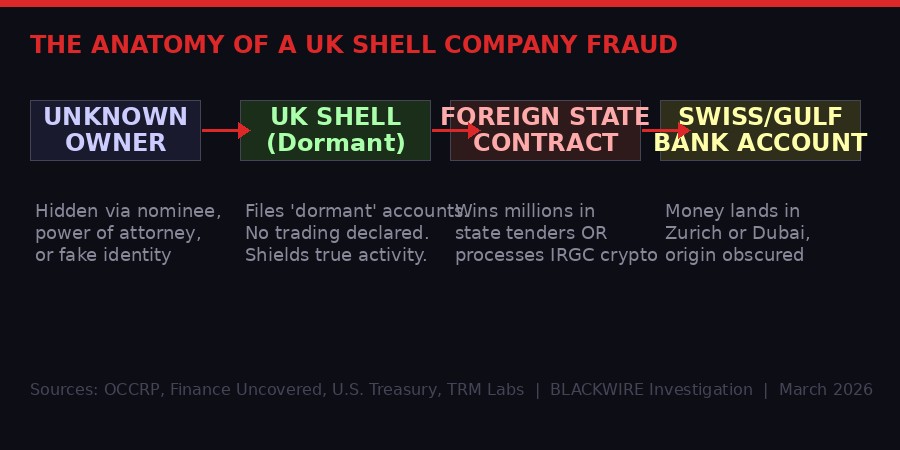
BLACKWIRE / The anatomy of a UK dormant shell company fraud. The same structure recurs across all three cases examined in this investigation.
The Grandmother from Kent and the Uzbek Millions
Wendy Conroy is a 71-year-old British accountant who likes horses and lives in Kent. She has no known connections to Central Asia, no background in mining, no employees, and no evident reason to have won millions of dollars in government contracts from Uzbekistan's largest state-owned enterprise.
Yet for years, she was listed as the sole director and person of significant control for Lemixton Solutions Ltd - a company that, according to official UK filings, was entirely dormant. No trading. No revenue. No transactions worth reporting.
According to Uzbekistan's public procurement registry, Lemixton won at least 63 tenders from Almalyk Mining and Metallurgical Complex (AMMC), a state-owned mining giant that produces copper, gold, and silver and contributes roughly nine percent of Uzbekistan's total tax revenues. The contracts were worth approximately $24.7 million. Import-export data confirmed Lemixton sent hundreds of shipments of industrial equipment to AMMC during the same period its UK filings claimed total dormancy. (Source: OCCRP / Finance Uncovered, February 4, 2026)
A companion company, Golders Business Ltd, won at least $13 million more in AMMC tenders during the same period, also filing as dormant in the UK, also fronted by nominees from the same corporate services firm.
That firm is More Group, a 40-person London corporate services agency founded by Mike Conroy - Wendy Conroy's son. For years, the company supplied clients from the former Soviet Union with British corporate structures designed to keep their true ownership hidden from public view.
The AMMC Shell Network: Key Numbers
- $200+ million in AMMC state tenders awarded to a circle of opaque foreign companies since 2022
- Lemixton Solutions Ltd: 63 tenders worth ~$24.7m, filed as dormant throughout
- Golders Business Ltd: 77 tenders worth ~$21.1m, filed as dormant throughout
- Both companies' contracts directed payments to the same Swiss bank: Banque Richelieu Switzerland (formerly Kaleido Privatbank), Zurich
- True beneficial owner: still unidentified as of publication
- Ownership filings changed three times in December 2025-January 2026 after reporters began asking questions
The contracts signed in Uzbekistan appeared to carry Wendy Conroy's signature - facsimile copies, apparently applied without her knowledge. At least one person whose electronic signature appeared on AMMC contracts told reporters they had never signed the documents and had since reported the matter to British authorities.
When OCCRP and Finance Uncovered contacted More Group in late November 2025, a cascade of rushed corporate filings began. Wendy Conroy was removed as director. A new name appeared: Grigoriy Khvan, a 61-year-old vice president of the Uzbek Table Tennis Federation. Then, weeks later, Khvan was quietly replaced by Felipe Guerrero, a Colombian national living in South Korea with no identifiable background in mining or Uzbekistan. Both men were backdated as having held control since 2018.
The chaotic retroactive rewriting of corporate history did nothing to clarify who actually owns the companies or who received the tens of millions routed through Zurich. The true beneficial owner remains unknown.
More Group's response was categorical denial. "We wish to confirm that we are not associated with the matters referenced, nor do we have any involvement with the information stated or the documents used," the company said in a statement. It called the situation "a major fraud for us" - while simultaneously acknowledging that its own employee had filed the dormant accounts and its own nominee directors had fronted the companies.
"The information provided to Companies House appears to have been of little to no help in identifying who really owns and controls this company. Indeed, the Uzbekistan public procurement register seems to have been of substantially more use in establishing whether it is actually being run from Kent, or Tashkent." - UK Labour MP Phil Brickell, Chair of the All-Party Parliamentary Group on Anti-Corruption
Uzbekistan's President Shavkat Mirziyoyev, speaking at his own National Anti-Corruption Council in March 2025, declared that "corruption is such an evil that it undermines people's trust in the state." AMMC's website states it is "committed to the principles of transparency and accountability in the management of natural resources." The company did not respond to questions from reporters.
The Madrid Meeting: Shadow Bankers on Tape
On a Wednesday afternoon in March 2017, a Venezuelan lawyer named Pedro Binaggia sat in a car in downtown Madrid with a police agent. He was about to walk into an office building and covertly record a meeting with four other men who had gathered to discuss laundering tens of millions of dollars stolen from Venezuela's state oil company.
"Just make sure it's on," Binaggia said, adjusting the microphone hidden on his body.
"Yes, it's on," the agent confirmed.
The recording, obtained by OCCRP and published in January 2026 as the basis of a new podcast series, offers an unfiltered look at the mechanics of white-collar financial crime. It names the principals, describes the techniques, and captures the casual confidence of men who have done this many times before. (Source: OCCRP "White Collars, Dirty Hands" podcast series, January-March 2026)
The meeting was organized by Carmelo Urdaneta, a US-educated lawyer who served as legal counsel to the Venezuelan oil ministry until 2015. Investigators allege he had helped engineer two fraudulent loan schemes that exploited the gap between Venezuela's artificially fixed bolivar exchange rate and real market value - extracting what amounted to $1.2 billion from Petróleos de Venezuela S.A. (PDVSA), the state oil company that sits atop the world's largest proven oil reserves.
Urdaneta ultimately pleaded guilty to conspiracy to commit money laundering before a US court and was sentenced in 2022 to more than four years in prison. His role in the $1.2 billion scheme included receiving more than $49 million in bribes. (Source: US Department of Justice, Operation Money Flight)
The men assembled in Madrid were the financial specialists Urdaneta had hired to "clean" his portion of the proceeds:
The Madrid Money Laundering Team
- Hugo Gois, 46, Portuguese national: Described by associates as the expert in "how to move money from A to B." Indicted in the US for conspiracy to commit money laundering; under investigation in Spain. Told the group his Cyprus brokerage offered "a certain amount of flexibility in terms of compliance."
- Ralph Steinmann, 51, Swiss asset manager: Described his specialty as the "structural" side - designing tax structures, securing money in investment funds "where even the bank is unaware of the ultimate owner," generating "lots of documentation." Indicted in the US; labeled a fugitive; under investigation in Spain.
- José Vicente Amparan, Venezuelan lawyer: Managed a third-party payment system making "many payments a week for many clients" with "a very light KYC." Indicted in the US; under investigation in Spain.
- Carmelo Urdaneta, Venezuelan oil ministry counsel: The client. $49+ million in bribes from the PDVSA scheme. Sentenced 2022 to 4+ years in US federal prison.
The recorded conversation reveals how the money laundering profession actually functions at its upper levels: not through crude cash smuggling, but through the exploitation of regulatory gaps between jurisdictions. The key technique described in Madrid was the use of Cyprus as a "bridge."
Rather than moving dirty money directly into the UK, where compliance scrutiny is tighter, Gois's strategy was to route funds from Binaggia's New Zealand trust through a Cypriot brokerage where Gois served as director, and from there into a UK broker called IFX. The UK firm would receive the funds trusting that KYC had been handled in Cyprus. The responsibility for asking hard questions would rest in Limassol, not London.
"In Cyprus, we have a certain amount of flexibility in terms of compliance that we don't have in England, obviously. The UK broker will receive it trusting that the KYC and compliance is done in Cyprus." - Hugo Gois, recorded in the Madrid meeting, March 2017
Nikhil Gandesha, an expert in global financial crime at the compliance firm Themis, confirmed to OCCRP this was "a common scenario" in laundering schemes. Any responsible UK broker, he said, should apply enhanced due diligence to funds routed through a Cyprus intermediary. The recording captures what happens when that scrutiny does not materialize.
The loot that Urdaneta and his associates were trying to launder came from Venezuelans who had been systematically stripped of the oil wealth that should have funded hospitals, schools, and infrastructure. According to Transparency International's Venezuelan chapter, alleged mismanagement and graft at PDVSA have compromised more than $42 billion of Venezuela's public assets over two decades. While those funds circled the world through New Zealand trusts, Swiss accounts, and Cypriot brokerages, the majority of Venezuelans were navigating extreme poverty, food shortages, and collapsing public services.
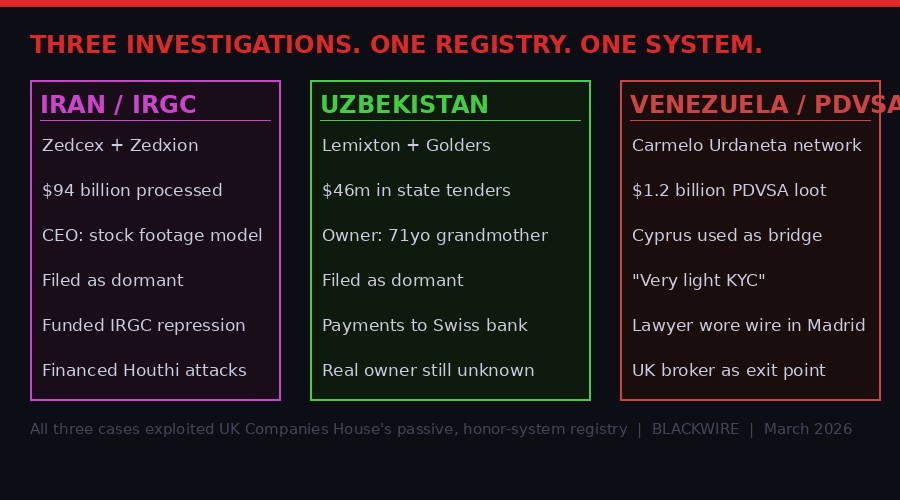
BLACKWIRE / The three cases examined in this investigation span three continents and involve the IRGC, Central Asian state mining, and Venezuelan oil looting. All roads pass through UK corporate structures.
The Pattern: One System, Three Continents
Pull back from the individual cases and the pattern becomes difficult to ignore. The IRGC's crypto laundrette, the Uzbek mining tender fraud, and the PDVSA money laundering ring are not isolated anomalies. They are variations on a single playbook, tested and refined over decades, that exploits the specific properties of British corporate law.
The core mechanism is straightforward. A UK limited company can be incorporated in a matter of hours for less than £50. The incorporator nominates a director - real or fabricated, local or foreign, willing or oblivious. The company declares itself dormant, which in UK law means it has conducted no "significant transactions." The definition is narrow and self-reported; no one audits it. The company can then be used for real-world transactions - winning state contracts, processing billions in crypto, funneling laundered oil money - while its filings say nothing is happening.
The UK address lends the structure legitimacy. Banks in Switzerland, brokerages in Cyprus, state procurement offices in Uzbekistan, and crypto exchange customers worldwide see a British company and reasonably assume it has been subject to British regulatory scrutiny. It has not. Companies House until very recently operated, in the words of anti-money laundering expert Graham Barrow, on an "honesty box" model.
Ben Cowdock, senior investigations lead at Transparency International UK, identified the deeper danger in the AMMC procurement case: "There's a danger around contracted companies being owned in the shadows by politically connected individuals, who might just be using this as a scheme to take money out of a state-owned company." (Source: OCCRP, February 2026)
The scale of abuse is vast and almost certainly undercounted. The UK's own Companies House reform program acknowledges the registry has been systematically exploited. A 2022 Parliament report found the registry had become a mechanism for "state-sponsored corruption and criminality from countries including Russia, China, and others." The Economic Crime and Corporate Transparency Act 2023 was passed specifically to address this. Its identity verification provisions are only now being phased in.
In all three cases examined here, the companies were legal fictions that existed solely to provide cover for activity that would never survive scrutiny. In all three cases, the fiction worked - sometimes for years - precisely because scrutiny was not applied.
The Reform That Arrived Late
The UK government is not unaware of the problem. The Economic Crime and Corporate Transparency Act 2023 introduced mandatory identity verification for all company directors and persons of significant control. Under the new framework, submitting a fictional person - or a stock-footage model - as a director would require falsifying identity documents rather than simply typing a name into an online form.
But implementation is gradual and beset by grace periods. Companies registered before the Act have been given up to a year to comply. Zedcex and Zedxion, the IRGC-linked exchanges, had until May 2026 to verify "Elizabeth Newman" - despite having processed tens of billions of dollars in the interim.
Lemixton Solutions Ltd and Golders Business Ltd incorporated in the UK. Wendy Conroy, 71-year-old accountant, listed as director and person of significant control. No trading declared.
Lemixton and Golders collectively win over $45 million in AMMC tenders in Uzbekistan. Both file as dormant in the UK throughout the period.
Zedcex Exchange Ltd incorporated in the UK at 71-75 Shelton Street, Covent Garden. "Elizabeth Newman" - a stock footage model - named as director. Zedxion follows days later at the same address.
US Treasury sanctions Babak Zanjani and both UK exchanges, alleging they moved approximately $1 billion in IRGC-linked funds. TRM Labs reports Zedcex processed over $94 billion total.
OCCRP publishes investigation revealing "Elizabeth Newman" is a stock-footage construct. OCCRP and Finance Uncovered publish AMMC procurement investigation. More Group initiates chaotic ownership changes at Lemixton and Golders.
OCCRP publishes "White Collars, Dirty Hands" podcast based on 2017 Madrid wire recording. PDVSA money laundering mechanics revealed in granular detail. True owners of the AMMC shell companies remain unidentified.
The Act's director of investigations at Companies House told the Financial Times in 2025 that the registry was processing hundreds of thousands of new registrations per year - too many, critics argue, for meaningful pre-registration scrutiny. The identity verification rollout is expected to catch future abuses. It cannot recover the billions that moved through the system while nothing was asked.
Anti-corruption campaigners argue the reforms, while necessary, are incomplete. Companies still do not need to disclose their ultimate beneficial owners when trusts are involved - a gap that More Group's operation appears to have exploited in the Uzbekistan case. And the UK still lacks the resources to actively audit the 4.5 million companies on its register for suspicious activity patterns.
"This troubling case calls into question the effectiveness of some of our first lines of defence against suspect financial activity." - UK Labour MP Phil Brickell, Chair of the All-Party Parliamentary Group on Anti-Corruption, on the AMMC shell company investigation
In January 2026, British lawmaker Alex Sobel raised concerns in parliament specifically about the Zedcex and Zedxion exchanges, noting that IRGC funds had flowed through UK-registered companies while those companies filed as dormant. The UK subsequently sanctioned Zanjani himself - but unlike the US, did not sanction the two crypto exchanges. The exchanges remain registered. As of publication, Zedxion's identity verification compliance deadline has not passed.
Who Bears the Cost
The abstract language of financial crime regulation - shell companies, dormant accounts, beneficial ownership registers - obscures the human cost of what these structures actually do.
In Iran, the IRGC has used the funds processed through UK-registered exchanges to sustain an apparatus of repression. In January 2026, during nationwide protests triggered by economic collapse - record inflation, a currency in freefall - security forces carried out massacres under a near-total internet blackout. The Center for Human Rights in Iran estimates over 20,000 people may have been killed across the protest cycle. Amnesty International documented thousands of deaths in the January peak. TRM Labs found that IRGC funds processed through the UK exchanges also reached the Houthis, whose naval campaign in the Red Sea has disrupted global shipping and driven up costs for goods transported by sea worldwide. (Source: TRM Labs, January 2026; OCCRP, February 2026)
In Uzbekistan, the money that disappeared into UK dormant companies and Swiss bank accounts represents the asset base of a state enterprise that 36 million people depend on for tax revenue funding healthcare, infrastructure, and public services. AMMC's contribution is roughly nine percent of total Uzbek state revenues. When tens of millions drain into shadow procurement networks, it is not abstract - it is schools unfunded and hospitals underequipped.
In Venezuela, the $1.2 billion stripped from PDVSA was extracted from a population already living through what the United Nations has called one of the worst humanitarian crises outside a war zone. The men who gathered in a Madrid office to discuss laundering that money made jokes about buying Maltese passports and complained about their experiences living abroad, while the people whose oil wealth they had stolen stood in food lines.
In all three cases, UK shell companies were not incidental to the harm. They were load-bearing infrastructure.
The Fixer Economy
What makes the UK system so durable is not just legal permissiveness. It is the ecosystem of professional enablers - accountants, corporate service providers, nominee directors, formation agents - who supply the human infrastructure that the shell company machine requires.
More Group is a case study. Founded by a chartered accountant, with offices previously operating in Moscow and Riga, the firm published its website in English and Russian and explicitly catered to clients from the former Soviet Union seeking UK corporate structures. The Conroy family - mother as nominal director, son as beneficial service provider - supplied the face of British respectability that the system required.
When reporters started asking questions, More Group denied everything and accused unnamed clients of fraud. Companies House records began changing at speed. The underlying problem - that a professional services industry has been organized around helping foreign clients hide their money in plain sight behind UK company numbers - does not change with the filing of new paperwork.
Ben Cowdock at Transparency International UK told OCCRP that in a high-corruption jurisdiction, privatization of state assets is "a big risk" unless "transparency is baked into the privatization process." His comment was specifically about AMMC's planned IPO on a foreign stock exchange. The broader point is harder to avoid: any system that allows entities of unknown ownership to win state contracts, process billions in transactions, or serve as laundering infrastructure is a system with its priorities inverted.
The UK's reform program is real. The Economic Crime and Corporate Transparency Act 2023 represents a genuine shift from passive registry to active gatekeeper. Identity verification will make the simplest frauds harder. Beneficial ownership disclosure improvements will make some hidden structures visible.
But three concurrent investigations, published within six weeks of each other in early 2026, all pointing to the same registry, the same dormancy abuse, the same nominee director playbook - that is not the signature of a problem that has been solved. It is the signature of a system still being exploited at scale, even as the law that was supposed to stop it finishes rolling out.
The question for the UK government is not whether the reforms are adequate in theory. It is whether they will arrive in time to prevent the next Zanjani network from routing its next billion through a London address while a stock-footage model serves as its public face. Based on the cases published in the first quarter of 2026, the answer is not reassuring.
The world's kleptocrats did not pick Britain by accident. They picked it because it worked. In some respects, it still does.
Get BLACKWIRE reports first.
Breaking news, investigations, and analysis - straight to your phone.
Join @blackwirenews on Telegram