UK Opens Its Bases. Trump Calls NATO "Cowards." Oil Holds at $108.
Britain reversed three weeks of careful hedging today, granting the US military access to its bases for strikes on Iranian sites threatening the Strait of Hormuz. Trump still wasn't happy. Iran threatened tourist sites worldwide. Twenty thousand sailors are stranded. And Brent crude, after hitting $119 mid-week, sits at $108 with nowhere comfortable to go.

The Reversal London Spent Three Weeks Avoiding

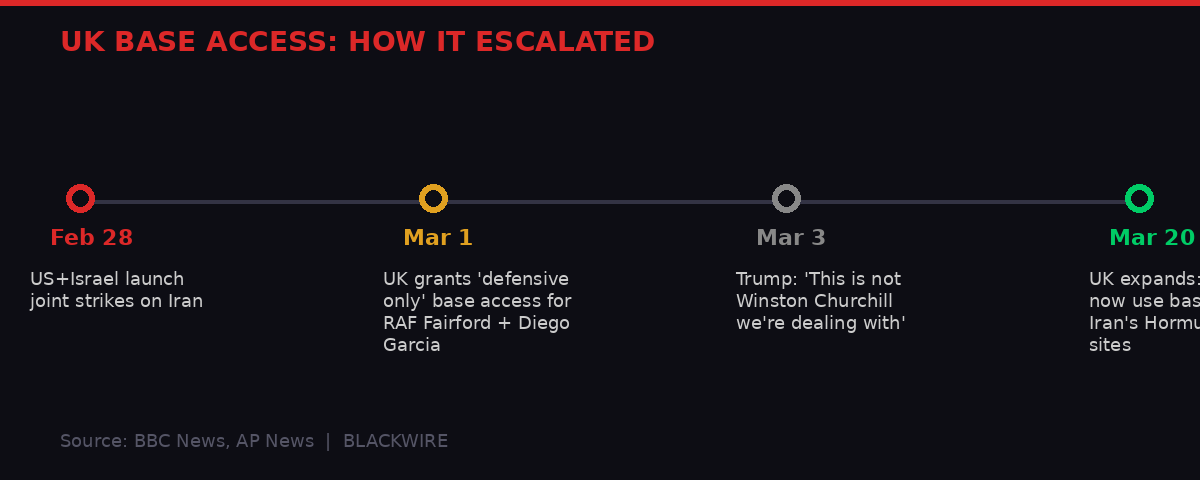
When the US and Israel launched joint strikes on Iran on February 28, the UK government made a calculated bet: grant limited base access for defensive purposes only, hold the line on offensive operations, and avoid becoming a direct participant in a war that most Britons do not support.
That calculation held for twenty-one days. Today it cracked.
Shortly after President Donald Trump publicly labeled NATO allies "cowards" for failing to help secure the Strait of Hormuz, Downing Street announced that US forces may now use RAF Fairford in Gloucestershire and the British territory of Diego Garcia in the Indian Ocean to launch strikes against Iranian installations that are attacking shipping in the strait.
The BBC's Damian Grammaticas was precise about what changed and what did not: "From the first weekend of the war, the UK agreed to let the US use British bases for specific and limited defensive action against missile facilities in Iran which were involved in launching strikes at regional allies. Now the US can use those bases to target Iranian missile and other sites being used to attack shipping in the Strait of Hormuz."
British forces themselves are still not cleared for offensive operations. No RAF Tornados are going to Tehran. No British warships are entering the Persian Gulf on a strike mission. The UK government's official line remains that it is "acting in accordance with international law and not getting drawn into the wider conflict."
Iran sees it differently. Tehran had already warned that allowing the US to use British bases constituted "participation in aggression." That warning was issued before today's expansion. Its diplomatic implications are not abstract.
"This decision by the Prime Minister reminds us all of the disaster of Iraq and shows how we're being drawn further and further down Trump's slippery slope." - Calum Miller, Liberal Democrats foreign affairs spokesperson (BBC, March 20, 2026)
The Liberal Democrats and the Green Party both called for a parliamentary vote on the terms of the base-use agreement. Tory leader Kemi Badenoch, who has been broadly hawkish on the conflict, called today's decision "the mother of all U-turns" - a reference to Starmer's earlier insistence that the UK would not broaden its involvement beyond defensive action.
Trump: "They Should Have Acted a Lot Faster"

Trump was heading to Florida for the weekend when reporters caught him on the White House lawn. His comments on the UK were pointed and ungrateful - a pattern that has defined his relationship with Starmer throughout the conflict.
"They should have acted a lot faster." - President Donald Trump, responding to the UK's expanded base agreement (Reuters via BBC, March 20, 2026)
On NATO's refusal to commit forces to Hormuz operations, Trump was blunter. "It's a simple military maneuver," he said. "But you need a lot of help, in the sense that you need ships. And NATO could help us, but they so far haven't had the courage to do so."
He pointed specifically to Japan and China as nations that depend on Hormuz traffic and should be contributing. "It would be nice if those countries would get involved," he said. Neither country has shown any willingness to do so.
On a ceasefire: "I don't want to do a ceasefire. You don't do a ceasefire when you are literally obliterating the other side." He described Iran's leadership as "thugs, animals and horrible people" and said he believes Israel will be ready to end the war "when the US is ready."
The message is clear from Washington: the war continues until Iran's military capacity is destroyed or its government collapses. Neither outcome appears imminent. What is imminent is the third week closing with no diplomatic off-ramp in sight and oil markets pricing in further disruption.
For the UK, the political math is brutal. Starmer came under pressure from Washington on one side and from a large portion of his own parliamentary party on the other. Today's decision to broaden base access was almost certainly the minimum required to keep the transatlantic relationship functional. Trump's "should have acted faster" tells you exactly how Washington reads the gesture.
The Strait: A Chokepoint Tightening by the Week

The Strait of Hormuz is 21 miles wide at its narrowest. Under normal conditions, roughly 138 ships per day transit the waterway carrying crude oil, liquefied natural gas, and cargo from the Persian Gulf states to markets in Asia, Europe, and beyond. That figure represents around 20 percent of the world's oil supply.
Since March began, 99 ships have passed through the Strait in total. Not per day. Total. BBC Verify confirmed the figure, drawing on IMO data.
Iran's new Supreme Leader, Mojtaba Khamenei - son of the Ayatollah Ali Khamenei who was killed in the opening strikes of the war - said last week that Iran should continue using the "lever of blocking" the Strait. The statement is as much political performance as military doctrine. Iran needs the Strait itself; roughly 90 percent of Iran's own oil exports transit it. But the disruption calculus has shifted: Iran is betting that economic pain felt in Tokyo, Berlin, and Mumbai creates more international pressure than US bombs create on Tehran.
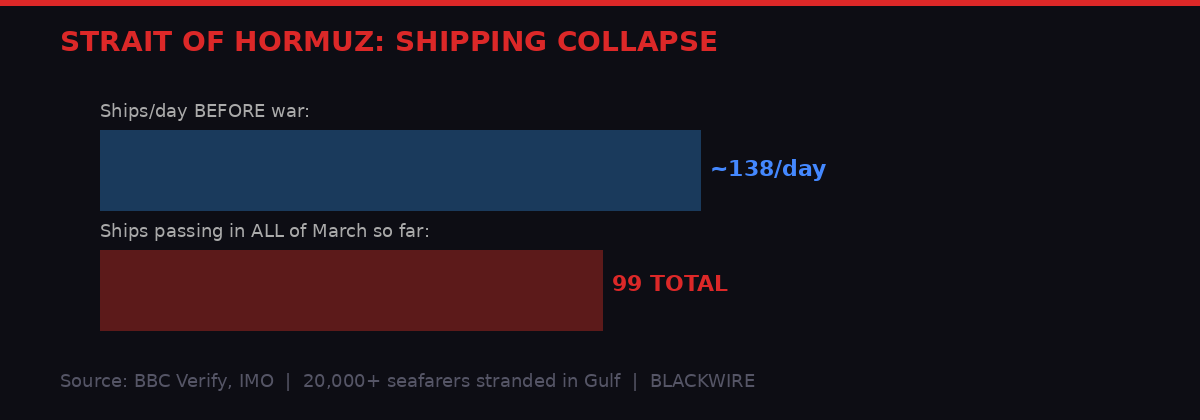
The United Nations International Maritime Organisation reported Thursday that approximately 20,000 seafarers are currently stranded in the Gulf west of the Strait - crew members on vessels that cannot safely transit due to Iranian drone and missile attacks on shipping. That is 20,000 individuals caught between an Iranian military threat and the inability of the world's most powerful navy to fully clear the waterway.
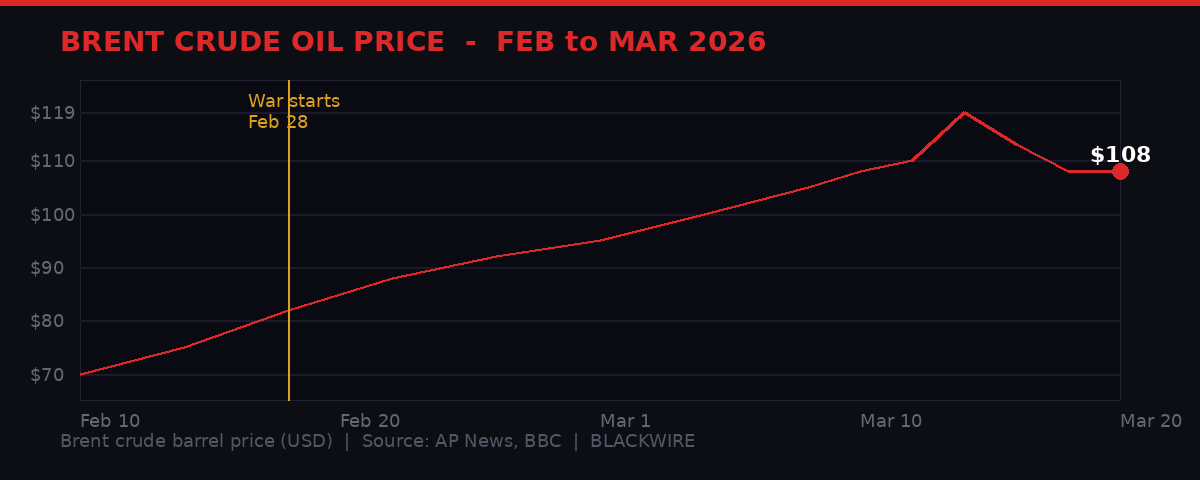
Brent crude peaked at $119 per barrel on Thursday following Israel's strike on Iran's South Pars natural gas field - the world's largest. By Friday it had fallen back to around $108. The pre-war price was roughly $70. US drivers are paying an average of $3.88 per gallon of regular gasoline, up from $2.98 before the conflict began - a 30 percent increase in three weeks.
The economic damage is spreading beyond fuel. Food prices are rising as transportation and fertilizer costs climb. Shipping insurers have suspended or heavily restricted coverage for Gulf transits, effectively functioning as a secondary blockade even where Iranian weapons are not present.
Iran's Leadership Vacuum and the Tourist Threat

Three weeks into the war, the question of who is actually running Iran remains genuinely unanswered - even by Israel's own prime minister.
"I'm not sure who's running Iran right now," Benjamin Netanyahu said during a Thursday night press conference. "Mojtaba, the replacement ayatollah, has not shown his face. Have you seen him? We haven't, and we can't vouch for what exactly is happening there."
The new Supreme Leader, Mojtaba Khamenei, was named to succeed his father after the elder Khamenei was killed in the opening strikes on February 28. His wife, Zahra Haddad Adel, was also killed in that strike. US and Israeli officials have suggested Mojtaba was wounded in the same attack. He has not appeared in public.
Iran's top military spokesman, General Abolfazl Shekarchi, did appear publicly Friday to deliver a warning: "parks, recreational areas and tourist destinations" worldwide will not be safe for the country's enemies. The statement appeared designed to threaten the kind of asymmetric attacks Iran has historically coordinated through proxy networks - attacks on soft civilian targets rather than military assets.
The threat carries weight because of precedent. Iranian-linked groups have carried out attacks on tourist and commercial targets before. The warning almost certainly triggered security reviews in European capitals, major sporting venues, and tourist-heavy cities in Israel's allied nations.
Late Friday, Iran's state television reported that General Ali Mohammad Naeini - a Revolutionary Guard spokesman who had publicly claimed Iran was still manufacturing missiles - had been killed in an airstrike shortly after making those statements. The symbolism was deliberate: the US and Israel responded to Iran's missile-manufacturing claim with direct action. The killing also illustrates the pace and reach of targeting operations that CENTCOM says have hit more than 7,800 sites since February 28.
"Leadership matters, and the loss of key decision-makers spanning politics, intelligence, internal security and the army will have transformative consequences. The fixation on the terminology of 'regime collapse' is obscuring the fact that the regime is already changing." - Burcu Ozcelik, senior research fellow, Royal United Services Institute, quoted by AP News, March 20, 2026
The International Crisis Group's Iran project director, Ali Vaez, put it more directly: "The Revolutionary Guard is the state now." Iran's civilian political apparatus has been effectively decapitated. What remains is the paramilitary structure that has always been the regime's enforcement arm - now operating without clear civilian oversight for the first time since 1979.
Oil Markets, the Global Economy, and Who Actually Wins
The economic fallout is stratified by geography and energy dependency in ways that will shape geopolitics for years.
The clearest winners are oil-producing nations outside the conflict zone: Norway, Canada, Russia. As Gulf states face attacks on their own infrastructure, buyers are seeking alternative sources. Moscow stands to earn up to $5 billion more by the end of March alone, according to BBC analysis - a substantial windfall delivered by the very country leading the sanctions regime against it.
Trump has claimed that when oil prices rise, America "makes a lot of money." The reality is more complicated. US oil producers will see windfall revenues, but American consumers are the planet's largest per-capita oil users. At $108 per barrel, the average American household is feeling the squeeze at the pump, on heating bills, and eventually at the grocery checkout as transportation and food production costs filter through. Oxford Economics has modeled the risk: if Brent crude reaches $140 and holds there, the US economy contracts.
Qatar's Ras Laffan Industrial City - the hub of the world's LNG export system - has had its export capacity cut by 17 percent following Iranian missile attacks, per the state-run energy company. ExxonMobil, which has operations there, is directly exposed. Saudi Arabia has intercepted multiple ballistic missiles targeting Riyadh and reports continuous drone interceptions over its oil-rich Eastern Province. The UAE says it has now intercepted more than 2,000 drones and missiles since the war began.
Kuwait's Mina Al-Ahmadi refinery - one of the largest in the Middle East at 730,000 barrels per day processing capacity - was hit by two waves of Iranian drones Friday, sparking a fire. The cascading damage to Gulf energy infrastructure is precisely the outcome Iran's military doctrine anticipated: hit allies hard enough that their pain translates into diplomatic pressure on Washington.
Europe's dependence on imported gas makes it acutely vulnerable. Market developments since the war began could add roughly 0.5 percent to European inflation by year's end, according to economists - enough to tip already-stagnant economies toward recession. Britain, already absorbing Brexit costs, is in a particularly exposed position.
NATO Fractures and Retreats From Iraq

The organizational fractures in the Western alliance are becoming harder to paper over.
NATO's supreme commander, General Alexus Grynkewich, confirmed Friday that the alliance has withdrawn several hundred personnel from Iraq, relocating them to Europe. They were part of NATO's Security Advisory Mission established in 2018 to assist Iraqi defense forces. The withdrawal followed a string of Iranian attacks targeting British, French, and Italian positions in the country.
The symbolism matters beyond the numbers. NATO's advisory mission in Iraq represented years of post-ISIS stabilization work and significant diplomatic investment. Its evacuation signals that the alliance cannot protect its own personnel from Iranian proxy attacks in Iraq - and is unwilling to escalate to change that calculus.
Trump's "cowards" characterization of NATO allies cuts in two directions. On one level it's the standard transactional pressure he applies to every alliance relationship. On another level it reflects a genuine strategic reality: NATO as a collective fighting force has chosen not to engage. Individual members - the UK, France with its carrier presence, Italy - have contributed various degrees of defensive capability. But there is no NATO operation in the Hormuz, no alliance decision to treat the Strait's closure as a casus belli.
The gap between what the US is doing unilaterally and what the broader Western alliance is willing to endorse creates a legitimacy problem that will outlast this war. If the US succeeds in degrading Iran's military without formal NATO backing, Trump's argument that the alliance is useless gets empirical legs. If the operation stalls or expands in ugly directions, America carries the cost without having shared the decision.
For Britain specifically, today's expansion of base access represents a real political bet. Starmer is wagering that keeping the US relationship intact - and preventing Trump from using British reluctance as a wedge against the alliance - is worth the domestic political cost of appearing to follow America into another Middle Eastern war. The "mother of all U-turns" tag from Badenoch will stick.
The Road Ahead: No Exit Visible

The United States and Israel entered this war with at least two stated objectives: foment a popular uprising that topples Iran's government, and eliminate Iran's nuclear and missile programs. On both counts, the picture after 22 days is sobering.
There are no visible signs of a popular uprising in Iran. Iranians were observing Nowruz - the Persian New Year - Friday, and while the holiday was muted under wartime conditions, the BBC's reporting from Iranians inside the country did not suggest the imminent collapse of public order or mass protests against the regime.
Iran's missile manufacturing continues. General Naeini claimed as much publicly before being killed for saying so. The US and Israel have struck what CENTCOM describes as thousands of military targets, including weapons facilities, leadership infrastructure, and energy assets. But the distributed, hardened, and partially underground nature of Iran's military-industrial base means destruction is incremental rather than complete.
The war's trajectory points toward a prolonged attrition campaign - the US and Israel steadily degrading Iran's capabilities while Iran steadily raises the economic cost for the world. The Strait of Hormuz is Iran's most powerful remaining lever. Blocking it inflicts pain on Japan, South Korea, India, China, and Europe without requiring direct military engagement with US carrier groups. The US can protect the waterway partially, but not completely, without the kind of large-scale amphibious and ground-support operation that Trump has publicly ruled out.
Britain's expanded base authorization gives the US slightly more operational flexibility - particularly from Diego Garcia, which provides attack range over the Gulf of Oman and the broader Iranian coastline. But it does not change the fundamental arithmetic: Iran can absorb more punishment than the US political consensus is prepared to deliver, and the world's economies cannot indefinitely absorb $108-plus oil.
Trump says he has no ceasefire plans. Iran says it will keep fighting. NATO is in the awkward position of being simultaneously indispensable and sidelined. The Strait moves 20 percent of the world's oil when it is open. Right now it is functionally closed. There are 20,000 sailors who would very much like someone to fix that. It is not yet clear who can.
Key Facts - Day 22 (March 20, 2026)
- UK expands base access: US may now use RAF Fairford and Diego Garcia to strike Iranian Hormuz-threat sites
- Trump calls NATO "cowards" for not committing forces to Hormuz operations
- Trump on UK reversal: "They should have acted a lot faster"
- Iran threatens tourist sites, parks and recreational areas worldwide
- Iran's IRGC spokesman General Naeini killed in airstrike hours after claiming missile production continues
- NATO withdraws several hundred personnel from Iraq advisory mission
- Kuwait's Mina Al-Ahmadi refinery (730,000 bpd capacity) hit by Iranian drones
- Brent crude at $108/barrel (pre-war: $70); peaked at $119 Thursday
- Only 99 ships transited Hormuz in all of March vs. 138 per day pre-war
- 20,000+ seafarers stranded in Gulf, per UN IMO
- CENTCOM reports 7,800+ targets struck in Iran since February 28
- 1,394 killed in Iran since war began including 210 children, per HRANA
- 13 US service personnel killed since war start, per Pentagon
- Iran's Supreme Leader Mojtaba Khamenei has not been seen in public since assuming power
Get BLACKWIRE reports first.
Breaking news, investigations, and analysis - straight to your phone.
Join @blackwirenews on Telegram