Eight Years for Fighting Racism: Tunisia Jails Its Most Famous Anti-Discrimination Voice
Saadia Mosbah, 66, spent fifteen years building the organisation that gave Black Tunisians and sub-Saharan migrants a legal voice. On Thursday, a Tunis court sentenced her to eight years in prison and fined her $35,000 for money laundering. Her son got three years. Rights groups call it the harshest sentence ever handed to a North African civil society leader - and a clear template for dismantling every organisation that has pushed back on President Kais Saied's authoritarian drift.
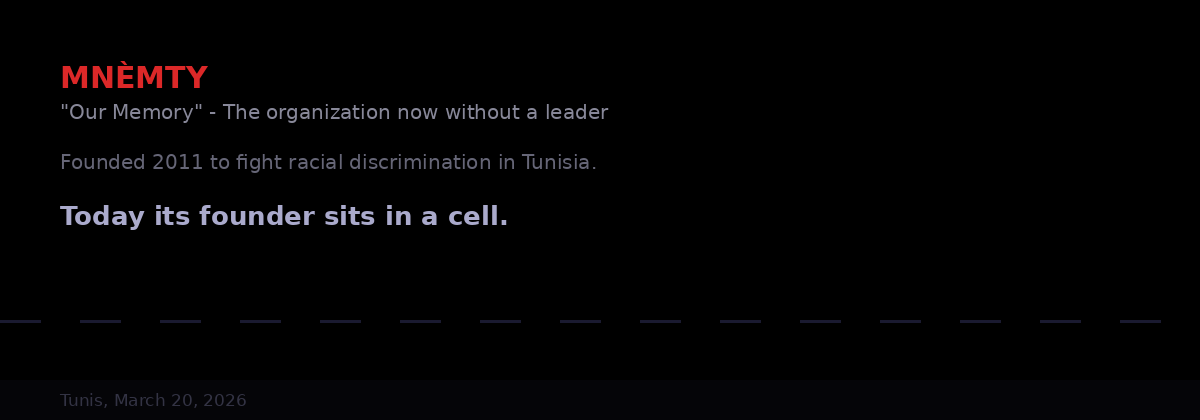
Mnèmty - meaning "My Dream" in Tunisian Arabic - was Tunisia's first and only registered anti-racism organisation. It now operates without its founder, after a Tunis court sentenced Saadia Mosbah to eight years.
Who Is Saadia Mosbah
Saadia Mosbah did not come from the protest tradition. She came from Mahdia, a coastal city in eastern Tunisia, from a family that understood what it meant to be seen as lesser. She grew up in a country where casual racism toward Black Tunisians and Black Africans - the kind that is never named, never challenged, and therefore never ends - was simply a feature of daily life. She named it. She challenged it. She built the infrastructure to fight it.
In 2011, as Tunisia's Arab Spring toppled President Zine El Abidine Ben Ali after 23 years in power, Mosbah saw a narrow window. The country was rewriting its social contract in real time. Citizens were drafting a new constitution. Parliament was being rebuilt from scratch. She saw an opening that might not stay open long, and she moved. She founded Mnèmty - meaning "My Dream" in the Tunisian dialect - as the country's first organisation specifically dedicated to combating racial discrimination. It was not glamorous work. It was documentation, legal assistance, public education, community outreach, and the slow exhausting business of convincing both a government and a skeptical public that the problem even existed.
Two years later, the effort paid off in a way that surprised even Mosbah. In 2013, Tunisia became the first Arab country to pass a specific law criminalising racism - Act 50 of the Organic Law on Combating Discrimination. Human rights observers at the time called it a regional model. The African Commission on Human and Peoples' Rights repeatedly cited Mnèmty's documentation work. International foundations supported the organisation. Mosbah gave testimony at the African Union. She attended UN sessions in Geneva. She was, to use a word that does not overstate the case, historic - a woman who had taken on a problem her own country refused to acknowledge and had gotten a law passed.
For the decade that followed, she continued expanding Mnèmty's reach. The organisation documented harassment of students from sub-Saharan Africa at Tunisian universities, particularly in coastal cities like Sfax where tensions between local communities and migrants ran high. Mnèmty provided legal support to migrants detained at the southern border with Libya. It tracked patterns of violence in southern Tunisian towns that intersect the migration routes from sub-Saharan Africa toward the coast. It ran legal clinics in Tunis for migrants who had nowhere else to turn when employers refused to pay wages, landlords refused to return deposits, or police demanded bribes.
This work made Mosbah one of the best-known civil society figures in North Africa among human rights circles internationally. It also made her one of the most visible targets for a government that was preparing to use migrants as a political weapon.
"The verdict is a major shock, and it is part of a broader effort to dismantle civil society groups and shift responsibility for the state's failure to address the migrant issue onto these groups." - Hela Ben Salem, Mosbah's defence lawyer, speaking to Reuters, March 20, 2026
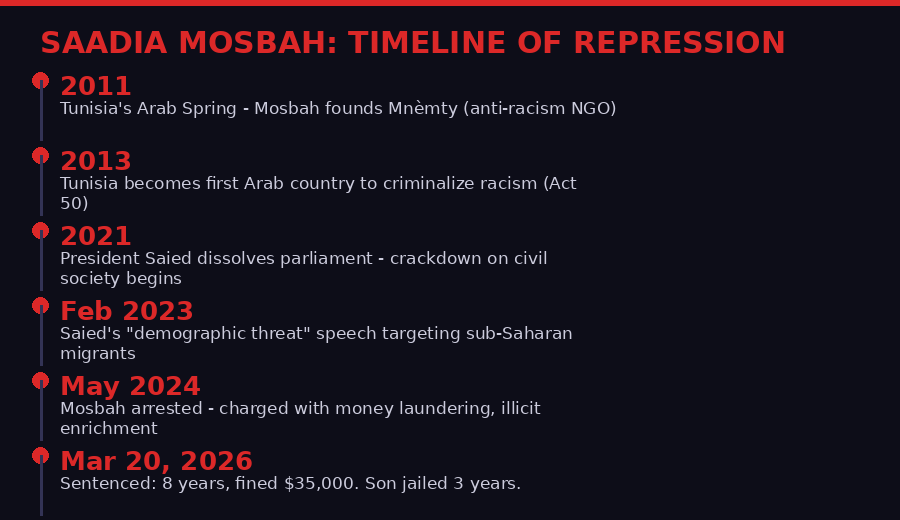
From founding a landmark NGO in 2011 to an 8-year sentence in 2026: the trajectory of Tunisia's anti-racism movement under authoritarian pressure.
The Charges That Buried Her
In May 2024, police arrested Saadia Mosbah. She was 65 years old. The charges were money laundering and illicit enrichment. She was held in pre-trial detention for nearly a year before Thursday's verdict was handed down.
The charges never made intuitive sense. Mosbah had spent roughly three decades working for non-governmental organisations that operate, by definition, on tight budgets with externally audited funding flows. Mnèmty received grants from international foundations - the kind of transparent, documented philanthropy that is standard for civil society organisations across the world. Her lawyers argued throughout the trial that all financial records had been submitted to the court and clearly showed lawful sources. There was no evidence of personal enrichment. There was no obvious motive beyond political.
International human rights organisations recognised the prosecution for what it was. Amnesty International declared Mosbah a prisoner of conscience before the trial concluded. Human Rights Watch described the charges as pretextual. The Observatory for the Protection of Human Rights Defenders - a joint programme of the International Federation for Human Rights (FIDH) and the World Organisation Against Torture (OMCT) - issued multiple statements calling for her release on humanitarian grounds.
The day before Thursday's verdict, the Observatory and OMCT released a joint public statement calling on Tunisian authorities to release Mosbah immediately, citing her age, her deteriorating health, and what they described as a systematic pattern of targeting civil society leaders in Tunisia. The statement documented the broader context: the crackdown on press freedom, the restrictions on NGO foreign funding, the prosecutions of opposition politicians, the targeting of anyone who publicly criticised the government's migration policy.
It made no difference. On Thursday March 20 - the spring equinox, the first day of the Persian New Year, a day that in many traditions marks renewal and hope - a Tunis court sentenced Saadia Mosbah to eight years in prison. Her son was sentenced to three years. Another activist who had worked alongside her received two years. Mosbah was fined the equivalent of $35,000 USD. The fine is designed to financially destroy what the prison sentence physically removes from the public square. Her lawyers say they will appeal. The outcome of that appeal, in a judicial system that now operates entirely within the orbit of presidential power, is anyone's guess.
Key Facts
- Saadia Mosbah, 66, sentenced to 8 years in prison on March 20, 2026
- Charged with money laundering and illicit enrichment - charges her lawyers say are fabricated
- Her son sentenced to 3 years; a fellow activist to 2 years
- Fined $35,000 USD (approximately 26,000 GBP)
- Arrested May 2024 - held in pre-trial detention for nearly a year
- Founded Mnèmty in 2011 - Tunisia's only anti-racism NGO
- Led the campaign that produced the 2013 anti-racism law - first in the Arab world
- Named prisoner of conscience by Amnesty International before verdict
- Sources: BBC News Africa, Reuters, OMCT, Observatory for the Protection of Human Rights Defenders
Saied's War on Civil Society
To understand the verdict, you need to understand what Tunisia has become under President Kais Saied. In 2021, Saied dissolved parliament, suspended the constitution, and assumed executive control in what critics described as a constitutional coup wrapped in democratic language. He held a referendum the following year that rewrote the constitution to concentrate power in the presidency. He has since governed by decree, targeting judges who ruled against him, arresting opposition politicians, restricting the press, and systematically dismantling the institutional architecture that Tunisia's 2011 revolution had created.
Civil society - the hundreds of NGOs that emerged in the years after Ben Ali's fall - became a primary and explicit target. Saied and his allies began publicly describing these organisations as foreign-funded subversives working to destabilise the country at the behest of unnamed external powers. A 2023 decree introduced sweeping new restrictions on foreign funding for civil society, creating legal exposure for any organisation that accepted grants from international foundations. Which is to say: most of them.
Then, in February 2023, Saied gave a speech that changed the country in ways that cannot be undone. In a national security council meeting, he described undocumented sub-Saharan African migrants as an "abnormal" phenomenon threatening to alter Tunisia's demographic identity. He spoke of "hordes of illegal migrants" bringing "violence, crime and unacceptable practices." He described the migrant presence as a deliberate plan to transform Tunisia from an "Arab-Muslim" country into something else. The language was the European far-right's standard playbook, transplanted to North Africa.
The effect was immediate and violent. Pogroms broke out across Tunis within days. Migrants were beaten in their homes, evicted by landlords, rounded up by police and expelled toward the desert border regions with Libya and Algeria. UNHCR documented thousands stranded without water or food. Several died from exposure. The coastguard, funded by the European Union, intensified interceptions at sea, with Human Rights Watch documenting cases of migrants being beaten and forced back onto the water without supplies.
Mosbah spoke out. She documented the attacks systematically - names, dates, locations. Mnèmty became the primary responder for displaced migrants in and around the capital. She gave media interviews to international outlets. She filed complaints with Tunisian courts. She appeared before international bodies. She did exactly what a civil society organisation exists to do.
Fourteen months after the February 2023 speech, she was arrested.
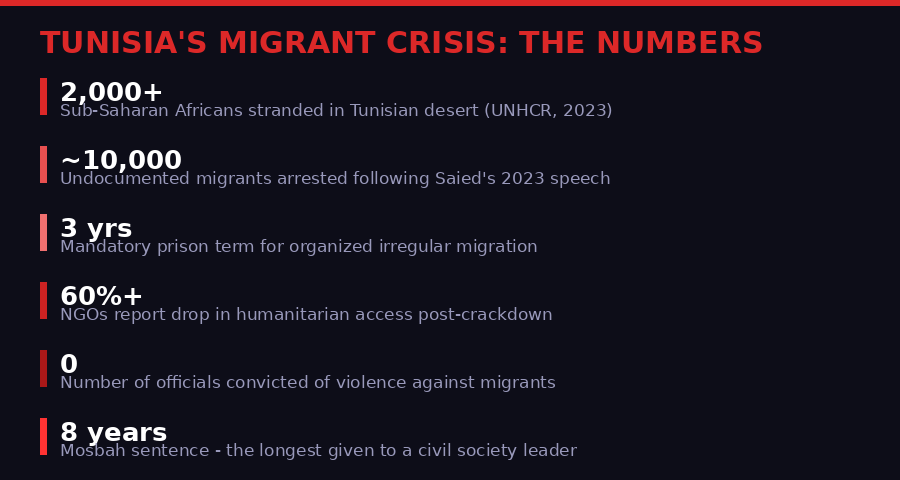
The scale of Tunisia's crisis following Saied's 2023 speech - and the contrast with zero accountability for official violence against migrants.
How Governments Silence Activists Without Killing Them
The Mosbah case follows a template that has become the preferred tool of authoritarian governments worldwide over the past decade. Open violence against activists - detention without charge, torture, disappearances - carries too much international blowback in a world where documentation is immediate and global attention can be mobilised rapidly. Instead, governments have learned to use legal systems as weapons. The technique is often called "lawfare."
Financial charges are particularly effective instruments of lawfare. Money laundering and illicit enrichment accusations are technically complex, procedurally opaque, and almost impossible to disprove to the satisfaction of a court that has already decided the outcome. They allow governments to present what is fundamentally political persecution as a scrupulously legal process. The accused is financially and psychologically drained through years of proceedings. Their organisation is paralysed. Supporters hesitate to associate themselves publicly with someone under active criminal investigation. By the time a verdict arrives, the movement has already been hollowed out.
The Mosbah case does not stand alone. Egypt sentenced human rights lawyer Ibrahim Metwally to fifteen years in prison on charges that international observers described as politically fabricated. Morocco imprisoned journalist Nasser Zefzafi for twenty years. Bahrain has prosecuted dozens of human rights defenders on financial and cybercrime charges. Across the Gulf, governments have used anti-terror financing laws to shut down organisations that document labour rights abuses.
What makes the Mosbah case specifically disturbing is that she was not even primarily a political opposition figure. She was a social welfare activist working on a humanitarian cause. She was not running for office, not organising electoral campaigns, not challenging Saied directly. She was giving legal aid to migrants. The decision to prosecute her sends a message that extends far beyond political opposition: anyone who documents what the government does to the people it has defined as threats is a legitimate target.
"Her prosecution forms part of a broader pattern of intensifying repression of civil society in Tunisia, including cases brought against rights defenders, media smear campaigns, and new restrictions on NGOs working on migration." - Joint statement, Observatory for the Protection of Human Rights Defenders and OMCT, March 19, 2026
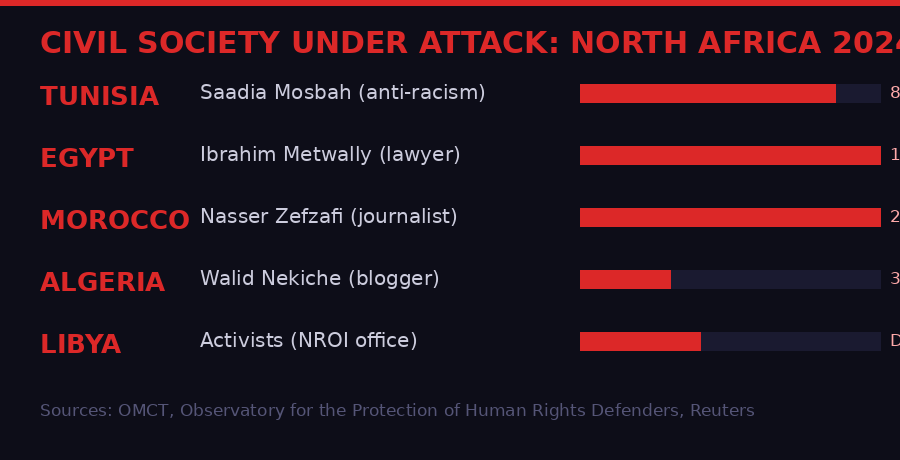
Mosbah joins a growing list of North African civil society leaders jailed on financial or security charges that international observers have widely rejected as politically motivated.
The Migrants Left Behind
The people with the most to lose from Mosbah's imprisonment are the ones who never made the news cycle to begin with. The tens of thousands of sub-Saharan Africans who came to Tunisia in transit to Europe, or to study at Tunisian universities, or to work, and who found themselves trapped in a country that turned hostile and kept turning.
Tunisia sits at a critical migration geography. It is the primary departure point for the central Mediterranean route to Italy - a two-day boat journey that kills hundreds of people every year in waters that are warm in summer and merciless in winter. The European Union has been paying Tunisia to keep migrants on the African side of that crossing. In 2023, the EU struck a migration containment deal with Saied worth 105 million euros, explicitly to fund Tunisian coastguard operations that intercept boats. Rights organisations documented coastguard personnel beating migrants, confiscating and sinking their boats, and in documented cases directly contributing to deaths at sea through the deliberate ramming of migrant vessels.
Mnèmty was one of the few organisations filing complaints about these incidents. It tracked deaths. It interviewed survivors. It provided testimony to the European Parliament, the UN Human Rights Council, and the African Commission. After Mosbah's arrest in May 2024, the organisation continued functioning but with dramatically reduced capacity and visibility. After Thursday's sentence, it faces an existential question about whether it can continue at all while its founder and its credibility are both behind bars.
For the migrants who remain in Tunisia - the students from Cameroon and Senegal and Ivory Coast who came for university degrees and found themselves stranded when the campus climate turned hostile, the workers from Mali and Guinea who had built lives in Tunis only to find their neighbours suddenly willing to attack them in the street - the legal void left by Mnèmty's paralysis is not abstract. It is the difference between having someone to call and having no one at all.
A 25-year-old Cameroonian man living in Tunis, who spoke to the BBC on condition of anonymity last year, described Mnèmty's significance with disarming directness: "They were the only place I could go and they would listen to me as a person. Not as an illegal. As a person." He did not know then what was coming for Saadia Mosbah. He does now. And the silence that replaces her is loud.
Europe's Complicated Silence
The European response to Thursday's verdict was swift and almost entirely inconsequential. Amnesty International issued a statement calling the sentence "a grave injustice." Human Rights Watch called it "politically motivated persecution." The European Parliament - which has passed multiple non-binding resolutions criticising Saied's crackdown since 2021 - will likely pass another one. The Tunisian government will ignore it, as it has ignored all the previous ones.
The harder structural reality is that the European Union has a direct financial stake in Saied remaining in power and continuing to contain migration. The 2023 deal was worth 105 million euros specifically for migration. An additional 150 million euros in broader development assistance flows to Tunisia annually. Saied has delivered on the one metric that European governments actually care about: fewer boats crossing the Mediterranean. From 2023 to 2025, irregular arrivals in Italy from Tunisia declined. That decline was produced through methods that human rights organisations describe as mass expulsions, systematic beatings, and deliberate abandonments in desert zones. But the numbers went down.
When civil society organisations were prosecuted for documenting those methods, the EU's response was a spokesperson statement expressing "concern" and calling for "respect for the rule of law and fundamental rights." When Mosbah was arrested in May 2024, a European Parliament resolution called for her release. She remained in prison for nearly a year before being sentenced. The resolution had no effect whatsoever.
This gap between European stated values and European actual priorities is not new or surprising. It is the structural logic of the EU's migration policy: outsource containment to authoritarian partners, maintain diplomatic distance from the worst abuses, issue statements that satisfy domestic audiences without changing external behavior. Tunisia is the current most explicit example of this logic. Mosbah's eight-year sentence is, among other things, a product of it.
What This Verdict Says About Where We Are
Eight years. A 66-year-old woman with a serious lung condition, sentenced to a prison term that may be a death sentence given the state of Tunisian prison healthcare for people her age with her medical history. The appeal will take months, perhaps longer. The international condemnations will continue to arrive and continue to be ignored.
Tunisia was supposed to be the Arab Spring's singular success story. One country among several that began that wave of revolutions where the outcome was not military takeover, not civil war, not the return of the old regime in new clothes. Tunisia got a real constitution in 2014, praised globally as a regional model. It got functioning elections. It got civil society organisations that functioned and had real impact. Saadia Mosbah's 2013 anti-racism law was part of that moment - one of the most concrete legislative victories of the post-revolution era.
Saied has spent five years dismantling that era piece by piece. The constitution is gone. The parliament is a rubber stamp. The press operates under a cybercrime law that criminalises "false news" - which in practice means any news critical of the president. Judges who ruled against the government have been purged. Opposition politicians are behind bars. And now Saadia Mosbah is behind bars.
The message of Thursday's verdict is that none of the gains of 2011 were permanent. That the legal tools built for protection can be turned against the people who built them. That a woman who spent fifteen years creating infrastructure to protect migrants can be jailed using the very legal system she helped reform. That building something that lasts is not enough if the state decides it wants to destroy it.
There are hundreds of people across North Africa and the broader Arab world doing exactly what Mosbah did - documenting abuses, providing legal aid, filing complaints, making visible what governments prefer invisible. They are watching Thursday's verdict. They are calculating the risk. Some will continue. Some will stop. Some will leave. The sentence is designed to shift that calculation in every country, not just Tunisia.
The spring equinox was Thursday. In Persian tradition it marks Nowruz - the new year, the return of light, the beginning of something better. In Tehran, people were marking it under airstrikes. In Tunis, a courtroom handed a 66-year-old woman eight years for the act of caring about the people no one else would care about. Neither feels like a beginning. Both feel like a statement about what kind of world we are building.
Get BLACKWIRE reports first.
Breaking news, investigations, and analysis - straight to your phone.
Join @blackwirenews on TelegramSources: BBC News Africa (reporting by Jean Otalor), Reuters, Observatory for the Protection of Human Rights Defenders, World Organisation Against Torture (OMCT), UNHCR Tunisia, Human Rights Watch, Amnesty International, AP News. Quotes attributed to named individuals sourced from published news reports. Migrant testimony drawn from BBC Africa reporting, 2025.