TRUMP Whale Nets $2.5M Before Gala Went Public, Hayes Bets HYPE Hits $150, and XRP's Broken Math
A dormant wallet bought $7 million in TRUMP tokens hours before the Mar-a-Lago gala announcement. Arthur Hayes sees HYPE at $150. XRP hits record network activity but the token is down 62%. Pi Network pumps 30% after Kraken lists what Bybit's CEO publicly called a scam. Friday delivered.
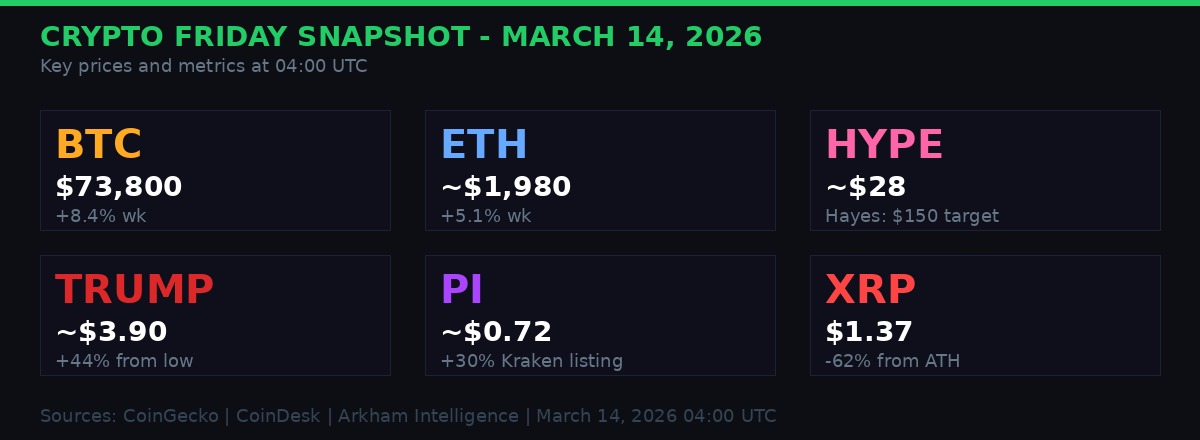
Key crypto prices and metrics as of March 14, 2026. BTC holds $73,800. TRUMP surges 44% from all-time low. XRP still bleeds relative to its own network activity. Source: BLACKWIRE / CoinGecko data.
Five months of silence. Then a dormant crypto wallet woke up at 01:49 UTC on Thursday, March 13 - and bought $7 million in TRUMP tokens across four transactions in under 30 minutes. By 8:00 AM, the token was up 60%. By publication, the wallet was sitting on a $2.47 million unrealized profit.
The gala announcement had gone out hours earlier. The Arkham Intelligence onchain trace shows the sequence clearly. Someone knew something - or was very, very lucky.
That was the headline story from one of crypto's most turbulent Fridays in months. But it wasn't the only one. Arthur Hayes published his thesis for HYPE at $150. XRP's network hit a 12-month high for daily transactions while the token stayed 62% below its all-time high. And Kraken listed Pi Network - the exact project Bybit's CEO publicly refused to touch after warnings from Chinese police that it targeted elderly investors.
Here's what happened, why it matters, and what it signals for the week ahead.
The TRUMP Whale: Timeline of a Front-Run
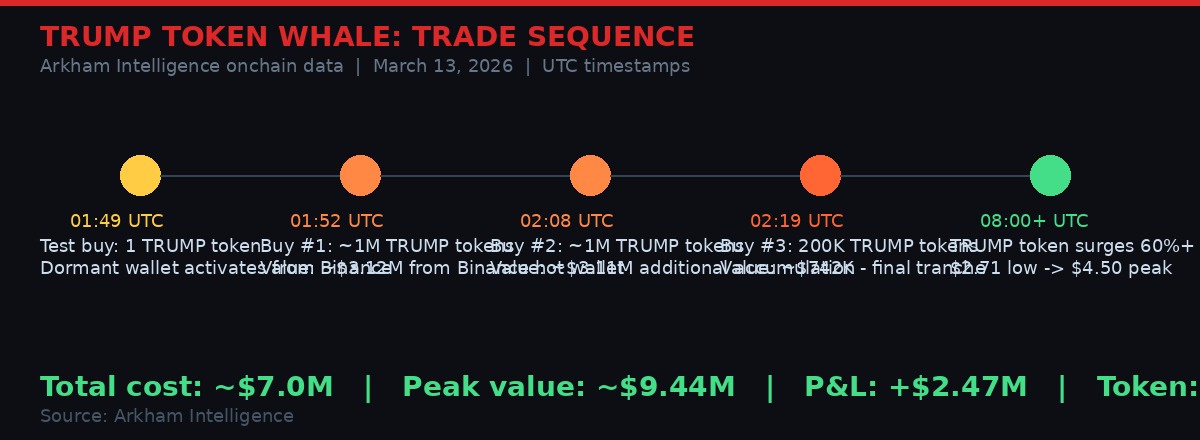
Onchain trade sequence from Arkham Intelligence. The wallet had been dormant for five months before activating on Binance's hot wallet. All four buys preceded the token's 60% surge. Source: Arkham Intelligence / BLACKWIRE.
The trade sequence, documented by Arkham Intelligence, is precise enough to tell a story even without knowing who's behind it.
At 01:49 UTC on March 13, a wallet that had sat completely inactive for five months executed a single test buy: one TRUMP token. Classic probe trade. Confirm the wallet works, confirm the routing works, then go big. Two minutes later, the first major tranche: approximately 1 million TRUMP tokens worth around $3.12 million, pulled directly from Binance's hot wallet. At 02:08, a near-identical second buy - another million tokens at roughly $3.11 million. At 02:19, a final cleanup tranche: 200,000 tokens for $742,000.
Total cost: approximately $7 million. Total accumulation: 2.2 million TRUMP tokens. Time elapsed from test to final buy: 30 minutes.
The TrumpMeme account on X had announced the gala earlier that morning - a conference and gala luncheon at Mar-a-Lago on April 25, open to the top 297 TRUMP token holders by time-weighted average balance between March 12 and April 10. The announcement was the first concrete event-based incentive for TRUMP holders since the May 2025 dinner at Trump National Golf Club.
TRUMP had been sitting near its all-time low of $2.71 when the gala was announced. After the whale's accumulation became visible onchain - and after retail momentum kicked in - the token spiked to $4.50, a gain of more than 60% from the trough. It pulled back to around $3.90, still representing a 44% bounce from the low. The whale's position, at that pullback price, was worth approximately $9.44 million on total cost of about $7 million. Unrealized gain: $2.47 million in under 8 hours.
TRUMP TOKEN WHALE - KEY NUMBERS
- Wallet dormant period 5 months
- Test buy (01:49 UTC) 1 TRUMP
- Total accumulated ~2.2M TRUMP
- Total cost ~$7.0M
- Peak position value ~$9.44M
- Unrealized P&L at pullback +$2.47M
- TRUMP low to high $2.71 to $4.50 (+66%)
- Source Arkham Intelligence
The critical question - and the one that has no clean answer yet - is whether this was insider knowledge or an extremely well-timed speculative bet. Crypto has no insider trading laws in the same formal sense as equities. There is no SEC rule preventing someone from buying an asset before event-driven news, even if they had advance knowledge of it. What exists is reputational damage and, in the case of securities, potential regulatory exposure. TRUMP is a memecoin, not a registered security. The legal framework is murky.
What the Arkham data does definitively establish: the buying began before significant retail momentum, before the token started its surge, and in a pattern - test buy then rapid large tranches - that is consistent with deliberate accumulation rather than spontaneous retail FOMO. The 5-month dormancy period adds weight to the idea that this was a prepared position rather than an active trading account that happened to catch the news.
The TRUMP Token's Collapse and What the Gala Is Selling
To understand why the whale bet landed, you need to understand how wrecked the TRUMP token had become before Thursday.
TRUMP launched in January 2025, days before the presidential inauguration, and immediately became one of the most controversial financial instruments ever associated with a sitting U.S. president. The token hit an all-time high of approximately $74, generating enormous paper gains for early buyers and its creators while attracting widespread criticism from ethics watchdogs, congressional members, and financial commentators who argued that a sitting president profiting from a speculative token creates profound conflicts of interest.
By March 2026, TRUMP had fallen roughly 96% from that high. The mechanics are simple: token supply unlocks create constant sell pressure, the speculative narrative erodes when there are no new catalysts, and retail investors who bought near the top are deeply underwater. The May 2025 Mar-a-Lago dinner had briefly revived the token by creating a real-world incentive - top holders got presidential face time. The event drew criticism from both Democratic and Republican lawmakers who viewed it as a direct financial benefit flowing from public office. The White House characterized it as a private capacity event.
The new April 25 gala follows the same blueprint. Top 297 TRUMP holders by time-weighted average balance between March 12 and April 10 get access. A disclaimer on the event website states Donald Trump will appear in a personal capacity with no private meetings, a direct response to the criticism the May 2025 dinner generated.
Congressional critics have called for legislation prohibiting sitting presidents from issuing or profiting from speculative tokens. None has passed. The ethical framework that governs presidential financial conflicts does not neatly address this situation, and the Trump administration has shown no inclination to address it voluntarily.
As of Friday morning, TRUMP was trading around $3.90, roughly 95% below its all-time high, with no fundamental business model, no utility layer, and no mechanism for sustained value outside of event-driven catalysts and Trump's continued public profile.
Arthur Hayes Makes the Case for HYPE at $150
While the TRUMP whale story was playing out, Arthur Hayes - the founder and former CEO of BitMEX, and one of the more reliably contrarian voices in crypto market analysis - published his most detailed bull thesis yet on Hyperliquid's HYPE token.
In an interview with CoinDesk, Hayes said HYPE could reach $150 in 2026, driven by what he characterized as real trading activity, disciplined token supply management, and a revenue profile that most DeFi protocols can only dream about.
The numbers Hayes cited are worth taking seriously. Hyperliquid generates close to $1 billion in annualized revenue based on 30-day fee data - that's the kind of figure that would make traditional fintech investors pay attention. For context, that run rate puts Hyperliquid ahead of many mid-tier centralized exchanges on a pure revenue basis, while operating as a decentralized on-chain protocol.
"Hyperliquid has separated itself from competing perpetual futures exchanges with real usage rather than incentive-driven volume." - Arthur Hayes, CoinDesk interview, March 13, 2026
Hayes' methodology for evaluating DEXs is worth noting: he uses the ratio of trading volume to open interest, arguing that a low ratio indicates genuine trading demand rather than wash trading or programmatic activity designed to inflate volume metrics. He said Hyperliquid has the lowest ratio among major perpetual DEXs, suggesting its volume is the most "real" relative to its open interest base.
The token supply discipline point matters because it addresses one of the most common vectors for price destruction in the crypto space. Hayes said he sold his firm's HYPE position around $50-55 anticipating unlock-driven sell pressure, then turned bullish again after the development team chose not to sell most of its monthly token allocations. When insiders decline to take profit at scale, it signals either extreme conviction or an agreement to manage supply deliberately. In this case, it appears to have been conviction backed by strong fundamentals.
HYPE TOKEN - HAYES BULL CASE
- Hayes price target $150
- Annualized revenue run rate ~$1B
- Perp DEX market share ~70% of perp DEX revenue
- HIP-3 listings Oil, equity indices, crypto
- Max leverage available 10x-20x (vs 2-3x TradFi retail)
- Hayes prior exit price $50-55
- Key risk factors Competitor fee undercutting, FOMO P/E expansion
The product evolution angle is the most structurally interesting part of Hayes' thesis. Hyperliquid's HIP-3 permissionless listing system has allowed the platform to expand beyond crypto perpetuals into assets like crude oil and equity index proxies. This is significant: retail traders can now access 10x-20x leverage on oil or Nasdaq-correlated assets 24/7 on-chain using stablecoins, while traditional brokerages offer 2x-3x at best and are closed on weekends.
The weekend geopolitical risk dimension is real and growing. The ongoing Iran conflict - which has driven oil prices sharply higher and created significant volatility in crypto markets - has pushed traders to use Hyperliquid on weekends when the Chicago Mercantile Exchange and traditional oil futures markets are dark. A platform that lets you trade oil at 15x leverage on a Saturday at 2 AM when OPEC announces something is offering a product that simply doesn't exist anywhere else in retail finance.
Hayes' exit trigger: if HYPE's price-to-earnings ratio expands sharply and market sentiment becomes overwhelmingly bullish, he will sell again. He characterized the current moment as favorable - the revenue is real, the supply is managed, and the use case is expanding. HYPE was trading around $28 as of Friday morning. Hayes is targeting $150. That's a 435% move. The 30-day revenue run rate and the platform's genuine competitive moat make the thesis internally consistent, even if the price target involves aggressive assumptions about market multiple expansion.
Hayes also flagged privacy-focused crypto as a developing narrative, specifically citing Zcash's cryptographic upgrades as a reason to favor it over Monero. He reiterated his Bitcoin price target of $250,000 by end of 2026, despite having missed earlier interim targets.
XRP's Network Is on Fire. The Token Is Not.
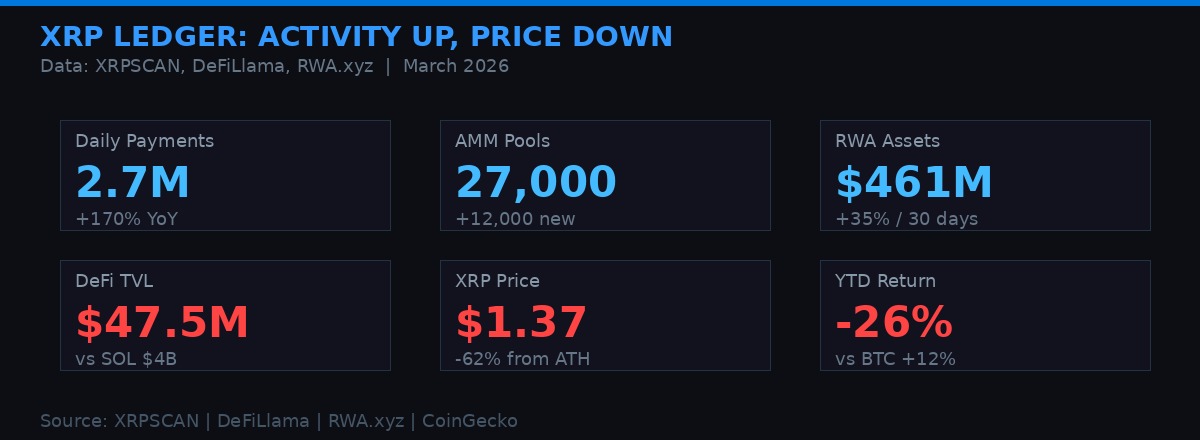
XRPL metrics are at 12-month highs across nearly every category. The XRP token is down 62% from its all-time high and 26% year-to-date. The gap between network activity and token price is the defining tension in XRP right now. Source: XRPSCAN / DeFiLlama / RWA.xyz / BLACKWIRE.
The XRP Ledger has never been busier. And XRP the token has rarely looked this disconnected from its own network's success.
Daily successful payments on XRPL hit a 12-month high of over 2.7 million as of this week, according to XRPSCAN data. That's up from roughly 1 million in late 2025 - a 170% increase in payment volume in under four months. The network is processing 20 to 26 transactions per second, near its practical throughput limits.
Automated market maker pools have exploded to nearly 27,000 active pools supporting more than 16,000 unique tokens. Tokenized real-world asset value on the ledger climbed to $461 million, up 35% in the past 30 days, according to RWA.xyz. Stablecoin transfer volume over the same period hit $1.19 billion. Stablecoin market cap on the ledger is $339 million with 35,800 holders.
XRP is trading at $1.37. It's down 26% year-to-date. It's 62% below its late-2025 high of $3.65.
The standard framework for utility tokens says this shouldn't be possible. More network usage means more demand for the native asset. That's the thesis that drove Ethereum's value during DeFi summer and Solana during the meme coin era. XRP is breaking the model - and the reason why is structural rather than a temporary glitch.
XRPL's growing activity is increasingly driven by RLUSD, Ripple's stablecoin, and tokenized assets that flow through XRP as a bridge currency. Here's the mechanical problem: a cross-border payment that uses XRP for three seconds to settle between two fiat currencies doesn't generate sustained demand for the token the way staking or DeFi lockups do. XRP gets used and immediately sold or swapped. The network gets busier, but XRP's scarcity doesn't increase, because the token is transient rather than locked.
XRPL ACTIVITY METRICS - MARCH 2026
- Daily payments (12-month high) 2.7M
- TPS (current range) 20-26 TPS
- AMM pools ~27,000
- Unique tokens on DEX 16,000+
- RWA tokenized value $461M (+35%/30d)
- Stablecoin transfer vol (30d) $1.19B
- DeFi TVL $47.5M (vs SOL $4B, ETH $40B+)
- XRP price $1.37 (-62% from ATH)
The DeFi numbers make the problem starkly visible. DeFiLlama shows XRPL's total value locked at $47.54 million. That's the entire DeFi ecosystem on a chain whose native token carries an $84 billion market cap. For comparison: Solana carries roughly $4 billion in TVL, Ethereum has over $40 billion. XRP's DeFi layer is a rounding error relative to its own valuation. The market cap is still overwhelmingly driven by speculative positioning, ETF expectations, and residual post-lawsuit momentum from the Ripple SEC settlement, rather than productive capital locked into the protocol.
The native DEX compounds this. Daily volume runs between $4 million and $8 million on recent data - modest for any Layer 1, and especially thin for one ranked fifth by global market cap. The AMM pool growth is real, with 27,000 pools and 12 million XRP deposited, but the dollar value of that liquidity remains thin relative to the token's scale.
The one area where the data genuinely supports a bull case is the RWA picture. Ripple has made tokenized real-world assets a core strategic focus, and the $461 million in distributed asset value puts XRPL ahead of several larger chains in specific tokenization categories. The 30-day RWA transfer volume of $149 million - up over 1,300% - suggests real institutional testing rather than wash trading. The RLUSD stablecoin is gaining genuine adoption as collateral and settlement infrastructure.
Historically, March has averaged an 18% return for XRP, and the $1.27-$1.30 support zone has held through multiple tests. If the Iran conflict moves toward any resolution and macro risk appetite recovers, a technical relief bounce to $1.60 or above is plausible. But the structural disconnect between XRPL's transient-use model and the tokenomics required to make XRP scarce remains the central problem the Ripple team hasn't publicly addressed.
Pi Network: Kraken Lists What Bybit's CEO Called a Scam
The most pure exchange drama of the week came from a project that has been generating controversy for years: Pi Network's PI token surged more than 30% on Thursday after Kraken announced it would list the asset. The backdrop to that listing makes the price move more complicated than it looks.
In February 2025, Bybit's CEO Ben Zhou publicly refused to list Pi Network and called the project a scam. He cited a 2023 warning from Chinese police alleging that Pi Network had targeted elderly users, collected excessive personal information, and caused some victims to lose pension savings. The warning was specific and came from an official law enforcement source. Zhou's public refusal was notable precisely because exchanges typically decline listings quietly rather than making public statements about their reasoning.
Pi Network is a mobile-first cryptocurrency project that replaces traditional proof-of-work mining with a phone-based trust graph, where users tap a mobile app daily to "mine" tokens. The consensus mechanism is derived from the Stellar protocol. The project launched its externally connected mainnet in February 2025 after years operating as a closed ecosystem, reporting approximately 19 million KYC-verified users and roughly 10 million accounts migrated to the main chain.
Pi is currently listed on OKX, Gate, and Bitget, as well as smaller exchanges. Kraken's listing adds a major Western exchange to that list for the first time, significantly expanding Pi's liquidity profile and signaling to retail investors that the project has cleared at least one tier of exchange due diligence.
"Bybit previously declined to list the mobile crypto mining platform, with CEO Ben Zhou citing warnings from Chinese police that the project is a scam." - CoinDesk, March 13, 2026
The 30% price surge on the Kraken announcement is straightforward exchange listing premium mechanics - new distribution channel, new retail access, immediate buy pressure from traders who anticipated the move. What it doesn't resolve is the substantive question Zhou raised about Pi's business model and user protection history.
The core criticism of Pi Network has always centered on its data collection practices and the psychological mechanism of the daily tap - a low-friction engagement loop that has been compared by critics to social media habit formation, deployed in a financial context toward users who may not fully understand what they're participating in. The elderly targeting allegation from Chinese police, if accurate, represents a more serious harm than typical crypto speculation risk.
Kraken did not publicly address the Chinese police warning or Ben Zhou's statements in its listing announcement. The exchange's standard due diligence framework presumably evaluated the project against its listing criteria, but the public record on what those criteria include - particularly regarding regulatory warnings in non-US jurisdictions - is limited.
The PI token remains deeply speculative. It has no clear utility layer beyond the internal Pi ecosystem, no major DeFi integration, and its tokenomics rely heavily on continued user growth to maintain any value proposition. The Kraken listing creates liquidity. It doesn't create a business model.
The Week That Was: Bitcoin's War Rally and Market Structure Shifts
The TRUMP whale, Hayes' HYPE thesis, XRP's disconnect, and the Pi drama all played out against a broader market backdrop that has been defined by one overriding variable: the Iran war.
Bitcoin hit a one-month high of $73,800 on Thursday, according to CoinDesk data, continuing a pattern of outperformance that has persisted since the conflict began. BTC climbed 2% to break $72,000 while U.S. equity futures slipped, the dollar strengthened, and tech equities trod water. In a week where oil prices remained elevated and Treasury yields moved higher, Bitcoin's resilience has been notable - and increasingly hard to explain through traditional macro correlations.
The prevailing explanation among analysts is that Bitcoin is being used as a geopolitical hedge by investors in conflict-adjacent regions and by institutions that view its fixed supply as protection against the inflationary pressure that extended military conflict creates. This is the "digital gold" thesis playing out in real time, though skeptics note that Bitcoin dropped sharply in the early days of the conflict before recovering - a pattern more consistent with initial risk-off selling followed by deliberate rotation than a clean safe-haven dynamic.
The USDC/USDT volume story - reported Thursday by CoinDesk - added another layer to the market structure narrative. Circle's USDC processed more daily transaction volume than Tether's USDT for the first time since 2019, prompting a sell-side price target hike on Circle stock. USDC's growth has been driven by its MiCA-compliant status in the European Union - where USDT's MiCA compliance remains uncertain - and by institutional preference for a US-regulated dollar stablecoin in the current geopolitical environment. Tether has acknowledged the compliance gap and is working toward addressing it, but the regulatory tailwind behind USDC is real and likely to persist through at least mid-2026.
Separately, the tokenized Treasury market hit a new all-time high of $11 billion in assets under management. Circle's USYC fund crossed $2.2 billion to overtake BlackRock's BUIDL fund as the largest single tokenized Treasury product. The growth reflects increasing institutional demand for on-chain yield - T-bill returns delivered through blockchain infrastructure, usable as DeFi collateral. This market was essentially zero three years ago. At $11 billion it's still small relative to traditional money markets, but the trajectory is unambiguous.
FRIDAY MARKET SUMMARY - MARCH 14, 2026
- Bitcoin (BTC) $73,800 (+8.4% wk)
- Ethereum (ETH) ~$1,980 (+5.1% wk)
- HYPE ~$28 (Hayes target: $150)
- TRUMP ~$3.90 (+44% from ATL)
- PI ~$0.72 (+30% on Kraken listing)
- XRP $1.37 (-62% from ATH)
- Tokenized Treasury AUM $11B (new ATH)
- USDC vs USDT volume USDC leads (first time since 2019)
The BlackRock ETHB fund - its new staked ether ETF - launched this week with over $100 million in initial assets and traded more than $15 million on day one. The fund offers exposure to Ethereum plus staking rewards, filling a gap in institutional access to ETH yield that the original spot Ethereum ETFs couldn't provide. A $15 million first-day volume number is modest by equity ETF standards but meaningful for a new crypto product. The staking yield component gives institutions a reason to hold ETH beyond pure price appreciation - a structural shift in the demand profile for the asset.
What Happens Next: Scenarios for the Week Ahead
The near-term path for crypto markets runs through a set of variables that are largely exogenous to crypto itself.
The Iran conflict remains the dominant macro input. Fresh escalation on Thursday temporarily dropped Bitcoin 3.5% before buyers absorbed the dip. The market has demonstrated that it can recover from conflict headlines - BTC's rise from $60,000 to $73,800 since the war began shows genuine institutional buying rather than panic selling on geopolitical news. But a significant escalation - particularly anything that disrupts oil supply chains at scale or triggers direct involvement by a new major power - would likely test the safe-haven thesis more severely than what the market has seen so far.
The TRUMP token will be event-driven through April 10, when the time-weighted average balance calculation for the Mar-a-Lago gala closes. Every pump-and-fade cycle will create another opportunity for well-positioned traders. The question of whether the whale position documented by Arkham constitutes market manipulation or insider dealing has no current legal framework to answer it in the crypto context - which means the behavior will continue until either specific regulation targets it or reputational damage forces change.
For HYPE, Hayes' thesis sets a price discovery target that the market will either confirm or refute through its own supply-demand mechanics. The $1 billion revenue run rate is a genuine fundamental anchor. The $150 price target implies significant multiple expansion from current levels. The risk Hayes himself identified - fee competition from lower-cost competitors - is real, as several alternative perpetual DEX platforms have been reducing fees explicitly to gain market share from Hyperliquid's 70% revenue dominance.
XRP's resolution requires either a structural change in how XRPL handles token demand - perhaps through DeFi mechanisms that lock XRP rather than use it transiently - or a significant catalyst like an XRP spot ETF approval that brings fresh speculative capital into the token independently of its network utility. Neither is imminent. The $1.27-$1.30 support zone remains critical. A break below that level could accelerate selling from technical traders and further invalidate the bull thesis.
Pi Network's Kraken listing will generate continued speculation through the near term. The 30% pump is already partially faded. Whether PI develops into a legitimate DeFi ecosystem or remains a data-collection and engagement mechanism with a speculative token attached is the fundamental question that no listing announcement resolves.
The tokenized Treasury market at $11 billion, USDC's volume leadership, and Bitcoin's war resilience all point toward the same structural shift: institutional money is building permanent exposure to crypto infrastructure, not just price speculation. That process doesn't reverse quickly. It compounds.
Friday's wildness - the TRUMP whale, Hayes' bold target, XRP's paradox, Pi's Kraken pump - was surface noise on top of a market that is quietly growing up. The question for the week ahead is whether the Iran situation allows that growth to continue, or whether a shock forces another reset.
Get BLACKWIRE reports first.
Breaking news, investigations, and analysis - straight to your phone.
Join @blackwirenews on Telegram