"I Told Him, Don't Do That": Trump-Netanyahu Rift Cracks Open on Day 20 of the Iran War
Israel struck Iran's South Pars gas field without Washington's blessing. Oil spiked to $119. Iran retaliated across the Gulf. And Trump broke with his ally in public - for the first time since the war started.

Gulf energy facilities across four countries were hit by Iranian strikes Thursday in the war's most dangerous energy escalation. Photo: Pexels
Donald Trump said it out loud. "I told him, 'Don't do that.'" Three words and a name that wasn't spoken - but everyone knew who he meant. Benjamin Netanyahu ordered the strike on Iran's South Pars gas field on Wednesday. He didn't warn Washington. He didn't ask permission. And the consequences hit every energy market on the planet within hours.
Brent crude briefly surged above $119 a barrel Thursday morning - up more than 60 percent from the roughly $70 per barrel price before the war started on February 28. Iran responded by launching missiles and drones at energy infrastructure across four Gulf states: Saudi Arabia, Qatar, Kuwait, and the UAE. A vessel was set ablaze off the UAE coast. Qatar's Ras Laffan LNG facility, already offline, suffered "extensive damage." The war entered a new and more dangerous phase.
And for the first time in 20 days of war, the two leaders running it appeared to be pulling in different directions - on record, in public, with the entire world watching.
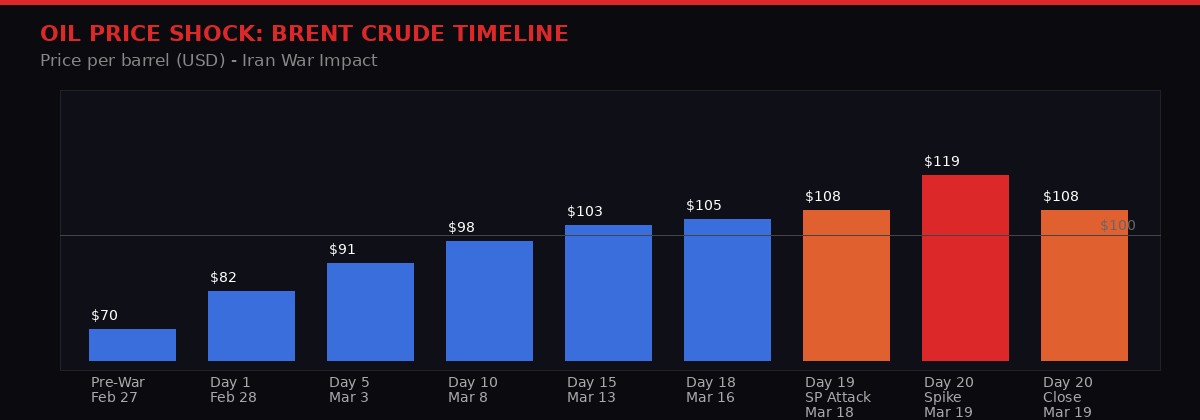
Brent crude oil chart: the price trajectory from pre-war $70 through Thursday's $119 intraday spike. Data: AP News / markets reporting.
The Strike Nobody Admitted Knowing About

South Pars - the world's largest natural gas field, shared by Iran and Qatar. Israel's strike on the Iranian side triggered the Gulf-wide energy crisis. Photo: Pexels
The South Pars gas field sits under the Persian Gulf in a formation shared between Iran and Qatar. On the Iranian side, the field supplies roughly 80 percent of the country's natural gas, according to the Center on Global Energy Policy at Columbia University. It heats homes, generates electricity, and powers industry across the Islamic Republic.
On Wednesday, Israel hit facilities connected to South Pars at Asaluyeh. The attack was strategically calculated: not to destroy Iranian exports - Iran barely exports gas - but to strangle the domestic population. No gas, no heat. No heat, no electricity. No electricity, and the civilian pressure on Iran's new supreme leader Mojtaba Khamenei becomes unbearable.
That was the Israeli theory. Trump's team had a different calculation entirely.
Trump's first public statement came hours after the strike - a "fiery social media post" on Truth Social, according to AP News, in which he declared the U.S. "knew nothing" about the attack in advance. In capital letters, he wrote: "NO MORE ATTACKS WILL BE MADE BY ISRAEL pertaining to this extremely important and valuable South Pars Field."
There was a problem with Trump's "knew nothing" claim. Two people familiar with the matter, speaking to AP on condition of anonymity, said the U.S. was made aware of Israel's plan before the strike was carried out. Israeli newspapers reported the attack had been coordinated in advance. Centrist Israeli paper Yedioth Ahronoth stated the strike "was co-ordinated in advance with the United States." Right-wing Israel Hayom went further, claiming Trump himself had "discussed the upcoming Israeli strike in Asaluyeh with leaders of three Persian Gulf states over the weekend."
Whether Trump knew or didn't, his decision to go public with his displeasure - however the facts ultimately land - marked the first visible fracture in the US-Israeli partnership that launched the war three weeks ago.
"I neither agreed with nor approved of the attack." - President Donald Trump, on Israel's strike on South Pars, via AP News
Netanyahu Fires Back - and Then Backs Down

Netanyahu held a press conference Thursday in Jerusalem, defending the South Pars strike and pledging not to hit the field again - at Trump's request. Photo: Pexels
Netanyahu held a press conference Thursday in Jerusalem. He was not apologetic. He was defiant, calibrated, and very careful about what he said.
"Israel acted alone," Netanyahu said. He then immediately pivoted to pledging he would comply with Trump's request to hold off on further South Pars attacks - a simultaneous assertion of independence and accommodation that only a politician of Netanyahu's experience could attempt with a straight face.
He pushed back hard on any suggestion of a real rift. "I don't think any two leaders have been as coordinated as President Trump and I," Netanyahu said. "He's the leader. I'm his ally. America is the leader." The words were conciliatory. The logic underneath them was not.
Netanyahu spent the press conference making the case that the war had already achieved decisive results. Iran's air defenses, he said, "have been rendered useless." The Iranian navy "is lying at the bottom of the sea." Iran's air force is "nearly destroyed." He claimed Iran no longer has the ability to enrich uranium or make ballistic missiles - though he offered no evidence for either claim.
But the more revealing section of his remarks concerned the political goal that the U.S. has never officially endorsed: regime change. Netanyahu said he hopes the Iranian people will "rise up against the Islamic Republic." He conceded it's "too early" to know if that will happen. There has been no sign of organized opposition inside Iran since authorities crushed mass protests in January, according to AP reporting.
On the question of whether the strike was wise, multiple Israeli media outlets framed the South Pars attack as a deliberate escalation aimed at cutting gas supply to Iranian civilians - generating pressure from below. "The gas supply to citizens is being shut off, and that will bring the uprising closer," one official told Yedioth Ahronoth's Yossi Yehoshua. This is a war aim the Trump administration has never publicly shared.
Iran's Response: Hit Everything in Range
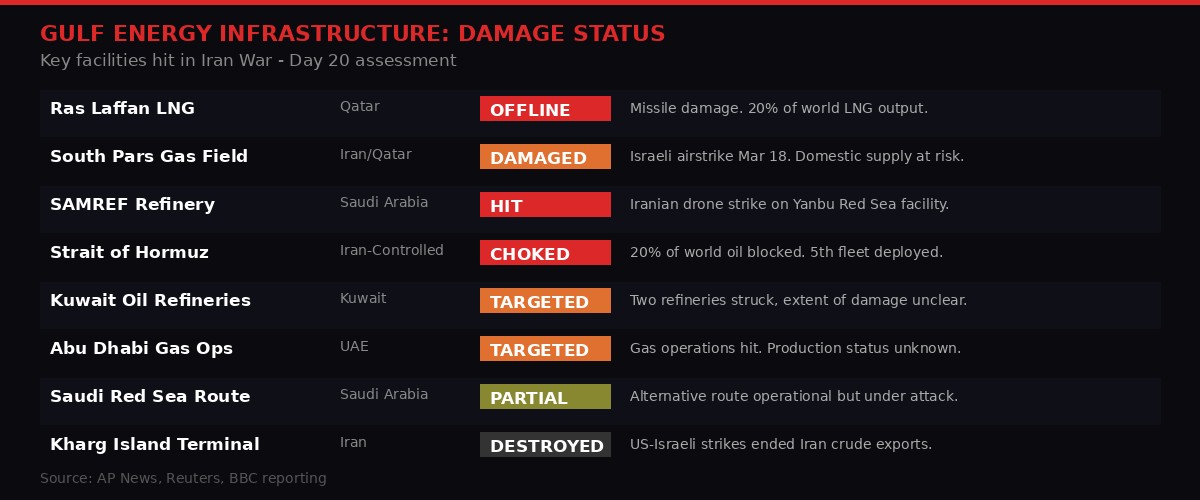
Gulf energy infrastructure damage status as of Day 20. Multiple key facilities across four countries hit or taken offline. Data: AP News, Reuters, BBC.
Iran's retaliation was fast, wide, and designed to inflict maximum economic pain across the entire Gulf.
Saudi Arabia's SAMREF refinery in the Red Sea port city of Yanbu was struck by an Iranian drone. Riyadh had been routing increasing oil volumes through the Red Sea to bypass the Iranian-choked Strait of Hormuz - the alternate route is now under direct attack. Qatar reported Iranian missiles caused "extensive damage" to its Ras Laffan liquefied natural gas facility, which had already been shut down after earlier strikes. Ras Laffan is the world's largest LNG export terminal, responsible for roughly 20 percent of global LNG supply. Two refineries in Kuwait and gas operations in Abu Dhabi were also targeted.
In Israel, millions of people fled to shelters as sirens warning of Iranian ballistic missiles sounded across central Israel, Jerusalem, and the West Bank. Iran fired drones over Turkey and Azerbaijan - two countries not party to the war - demonstrating both the reach of its strike capability and its willingness to create wider regional instability.
A vessel was set ablaze off the UAE coast. Another was damaged off Qatar. Iranian missiles struck the Strait of Hormuz's surrounding waterways and the Red Sea bypass simultaneously - squeezing the energy supply chain from both ends.
The Arab League Secretary-General Ahmed Aboul Gheit called Iran's strikes on its Gulf Arab neighbors "a dangerous escalation." Qatar, Saudi Arabia, and the UAE - none of which are participating in the US-Israeli campaign - condemned the attacks. Iran showed no sign of pulling back.
"These strikes are part of a dangerous escalation - a grim warning for the LNG market." - Energy Intelligence data and analytics firm, quoted by AP News
Markets Melt Down, Then Partially Recover

Global markets took the brunt of Thursday's energy escalation. European and Asian indexes dropped 2-3 percent before oil partially pulled back. Photo: Pexels
Thursday's energy escalation triggered a global market chain reaction that illustrated exactly how exposed the world economy remains to Persian Gulf supply disruptions.
When Brent crude briefly touched $119 per barrel in Thursday morning trade, stock markets across Europe and Asia cracked immediately. Japan's Nikkei fell 3.4 percent. Germany's DAX dropped 2.8 percent. South Korea's KOSPI shed 2.7 percent. European natural gas benchmark prices also surged sharply - European gas has roughly doubled in the past month, according to AP reporting.
The economic cascade doesn't stop at gasoline and home heating. Energy Intelligence firm analysis flagged that helium - used in semiconductor manufacturing - and sulfur, a key raw material for fertilizer - are being blocked along with oil tankers. Computer chips, food prices, and industrial supply chains all face secondary shocks. The Philippines has government offices open only four days per week. Vietnam is urging citizens to work from home.
U.S. markets proved more resilient. American companies are less exposed to Middle Eastern oil than their Asian and European counterparts. The S&P 500 finished with a modest 0.3 percent decline after coming back from an early 1 percent loss. The Dow Jones dropped 203 points. But Treasury yields swung violently - the two-year yield hit 3.96 percent before pulling back to 3.79 percent, a major single-session move that signals bond traders are reassessing their entire rate outlook based on energy shock risk.
The Federal Reserve held interest rates steady Wednesday - but markets are now nixing expectations for rate cuts, as traders recalibrate around the probability that oil-driven inflation stays elevated for longer than previously modeled. Economists who expected two or three rate cuts in 2026 have gone quiet.
Netanyahu's late-Thursday statement that Israel would halt further South Pars attacks allowed prices to partially retrace. Brent settled at $108.65 - up just 1.2 percent on the day after the earlier intraday chaos. But the settlement price of $108 still represents a 54 percent increase from pre-war levels of roughly $70, and analysts warn the structural damage to Gulf production and infrastructure means prices could stay elevated well beyond any ceasefire.
The $200 Billion War Bill - and Who's Going to Fight Over It

The Pentagon's $200 billion supplemental war funding request lands in Congress as polls show the American public remains skeptical of the conflict. Photo: Pexels
The Pentagon formally sent the White House a request for $200 billion in additional funding to cover the Iran war's rising costs, according to a senior administration official cited by AP News. The figure landed on Capitol Hill Thursday and immediately generated a political fight that will define the next phase of the conflict as much as any battlefield development.
The $200 billion ask comes on top of the Defense Department's existing annual budget of $838.7 billion - already approved by Congress in January. The Pentagon said the war cost the U.S. $11.3 billion in its first week alone. The conflict enters its fourth week on Saturday.
Defense Secretary Pete Hegseth, asked to justify the request, offered a summary that will not age well in congressional testimony: "It takes money to kill bad guys." He elaborated that the department needs funds for "what we may have to do in the future" - a phrase that alarmed lawmakers already uneasy about the war's open-ended scope.
Trump framed the request as ammunition replenishment. "We want to have vast amounts of ammunition, which we have right now - we have a lot of ammunition, but it was taken down by giving so much to Ukraine," he said. It was a swipe at the prior administration's Ukraine aid program delivered while asking Congress to spend nearly as much on a different war.
Democratic opposition was immediate and sharp. They noted that the total savings from DOGE cuts - the administration's signature austerity drive - totaled $175 billion, less than the war's supplemental request. A one-year extension of health insurance subsidies Democrats unsuccessfully fought for last year would have cost $35 billion. The food aid budget for lower-income Americans runs $100 billion per year.
Democrat Jim Himes invoked a line that will be heard repeatedly before any vote: "If you want me there for the landing, make sure I'm there at the takeoff" - a reference to Congress being excluded from the war's launch decision. The war started without a formal Authorization for Use of Military Force. Now the administration needs Congress to write the check.
Republicans, who control both chambers, are expected to ultimately provide the votes. But with November midterms less than eight months away, and polls showing majority American opposition to the war, the political price could be steep. Pentagon officials have projected the war could last another one to three weeks. Every extra week it extends changes the midterm math.
What Tehran's Strategy Actually Is
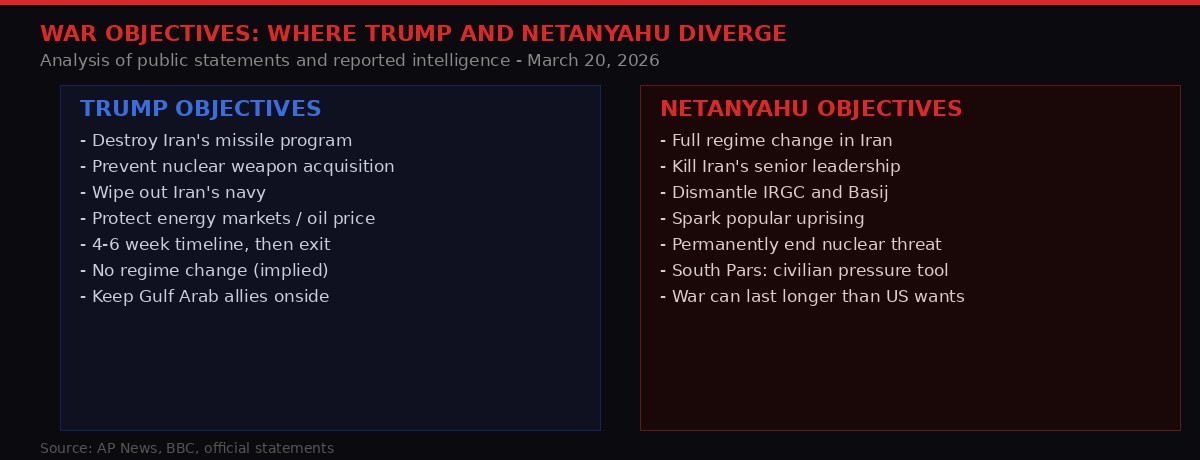
Analysis of publicly stated and reported war objectives for Trump and Netanyahu - where they converge, and where the gap is growing. Source: AP News, BBC, official statements.
Iran is not trying to win this war militarily. It cannot. The U.S. and Israeli air campaign has, by most credible accounts, severely degraded its military capabilities in three weeks. Its navy is largely destroyed. Its air defenses are compromised. Multiple senior commanders have been killed. But Iran is still firing.
The strategy is clear, according to analysts cited by AP: Iran is trying to raise the cost of the war high enough that someone - U.S. allies, the American public, Trump himself - forces a halt before the Islamic Republic collapses. It is a survival play built on endurance, not victory.
"The Iranians are banking on basically out-stomaching him, and exhausting him and his allies to the point where they would basically have a diplomatic off-ramp," said Ellie Geranmayeh, deputy director of the Middle East and North Africa program at the European Council on Foreign Relations, as quoted by AP News.
The energy warfare is the most sophisticated expression of this strategy. By targeting Qatar, Saudi Arabia, Kuwait, and the UAE - neutral parties who have not joined the US-Israeli coalition - Iran is forcing Washington to manage an ever-widening circle of aggrieved allies. Gulf Arab states have been calling on Trump to rein in Israel. Japan, South Korea, and European nations are absorbing energy shocks from a war their populations largely oppose.
Iran's new supreme leader Mojtaba Khamenei - the son of Ayatollah Ali Khamenei, killed in the opening airstrike on February 28 - is assessed by analysts as even less willing to negotiate than his father. Israel killed the original hardliner and got a harder one.
"Iran is upping the costs for this U.S. military campaign and regionalizing it from the get-go, as they promised they would if America restarts the war again with Iran." - Ellie Geranmayeh, European Council on Foreign Relations, via AP News
The Leadership Decapitation Question: Does It Work?
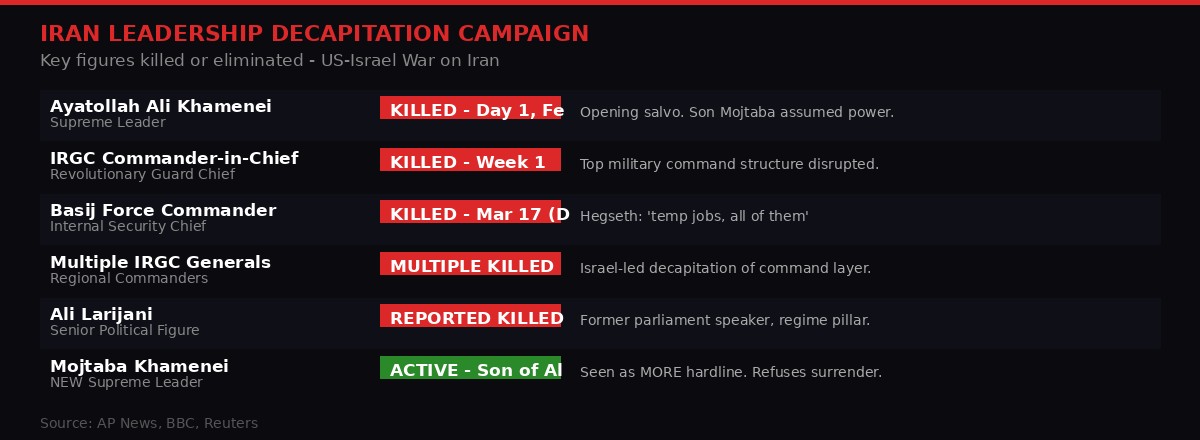
Key figures killed or eliminated in Israel's Iran leadership decapitation campaign. Mojtaba Khamenei - assessed as more hardline than his father - has assumed the supreme leader role. Source: AP News, Reuters.
Israel's parallel campaign to eliminate Iran's senior leadership is unprecedented in scale when applied to a state. Ayatollah Khamenei was killed in the war's opening salvo. Multiple IRGC generals have been killed or driven underground. The Basij force commander was killed by Israel this week. Former senior political figure Ali Larijani has reportedly been killed in airstrikes.
Netanyahu presented these killings Thursday as decisive achievements. But history offers a more complicated verdict.
Israel killed Hezbollah leader Hassan Nasrallah in 2024. Hezbollah resumed missile and drone attacks on Israel days after the current war began. Israel killed Hamas's entire top leadership over 18 months of war in Gaza. Hamas still controls half of Gaza and has not laid down arms. In 1992, an Israeli airstrike killed Hezbollah's leader Abbas Musawi. Under his replacement, Hassan Nasrallah, Hezbollah grew into the region's most powerful armed group and fought Israel to a stalemate in 2006.
"Even dictators need to rely on entire networks that support them," said Jon Alterman, chair of Global Security and Geostrategy at the Center for Strategic and International Studies, as quoted by AP. "The impact of targeted killings often fades over time."
The specific problem in Iran's case: Mojtaba Khamenei, the replacement supreme leader, is described by analysts as more ideologically rigid and less diplomatically experienced than his father. He has shown no interest in any negotiated off-ramp. The killing of Iran's original leadership has not, so far, produced a more moderate Iran - it has produced a more cornered and more reckless one.
Meanwhile, Gen. Dan Caine, chairman of the Joint Chiefs, said U.S. forces are now attacking deeper into Iranian territory - warplanes hunting Iranian boats in the strait, helicopters striking Iranian drones, 5,000-pound bombs dropped on underground weapons storage facilities. An F-35 fighter jet made an emergency landing Thursday after flying a combat mission over Iran; CENTCOM said the pilot was stable and the incident was under investigation. Iran's state TV claimed its air defense hit the aircraft - the U.S. did not confirm the cause.
Day 20: Where the War Stands and What Comes Next

U.S. air campaign over Iran enters its fourth week as Pentagon requests $200 billion in supplemental funding and officials hint at possible escalation against remaining IRGC leaders. Photo: Pexels
Twenty days in, the Iran war has produced a situation that neither Washington nor Tel Aviv fully anticipated. Iran has been severely degraded - but not broken. The Gulf energy market has been severely disrupted - but not collapsed. The US-Israeli alliance is intact - but visibly strained in public for the first time.
The immediate question is whether Thursday's events represent a turning point or a temporary spike. Netanyahu has agreed not to strike South Pars again - at Trump's explicit request. Iran has signaled through its retaliation that any attack on its domestic energy infrastructure will be met with regionwide escalation. The Gulf Arab states are demanding restraint. Trump is demanding unconditional surrender from Iran while privately restraining his most aggressive ally.
Pentagon officials have estimated the war could last four to six weeks total - meaning, at Day 20, somewhere between zero and two weeks remain if those projections hold. But "could last" and "will last" are different propositions. The decapitation campaign has not triggered the popular uprising Netanyahu is counting on. The oil shock has not triggered the allied pressure Trump would need to negotiate a clean exit. Iran's new leadership is holding.
Hegseth's comments Thursday hinted that the target list is not finished. Referring to the IRGC and Basij leadership, he said: "The last job anyone in the world wants right now: Senior leader for the IRGC or Basij, temp jobs, all of them." That is not the language of a war winding down. That is the language of a war where the targeting is still expanding.
Trump's "I told him, don't do that" moment will be studied for what it reveals about the alliance's internal dynamics. It could be the first sign of a genuine strategic divergence. It could be theater designed to give Gulf Arab allies cover. It could be Trump managing his own domestic political exposure by distancing himself from the energy shock Israel triggered. Most likely it is some combination of all three.
What it is not: a signal that the war is ending. The oil is still choked. The missiles are still flying. The bills are still being counted. And in Jerusalem, Netanyahu is still deciding which target comes next.
Key Facts: Iran War Day 20
- War began February 28, 2026 - U.S. and Israel jointly launched strikes on Iran
- Ayatollah Khamenei killed Day 1; son Mojtaba assumed power as supreme leader
- Israel struck South Pars gas field March 18 (Day 19) - without stated US approval
- Iran retaliated: struck Saudi Arabia, Qatar, Kuwait, UAE energy infrastructure
- Brent crude spiked to $119/barrel intraday; settled at $108.65 - up 54% since war
- Qatar's Ras Laffan LNG facility hit again - 20% of world LNG supply disrupted
- Pentagon seeks $200 billion supplemental war funding from Congress
- An F-35 made emergency landing after Iran combat mission; investigation ongoing
- Iran has killed 11 people in Israel with ballistic missiles; 1,045 deaths reported in Iran
- Trump: "I told him, don't do that" - first public break with Netanyahu over war tactic
- Netanyahu agreed not to hit South Pars again - at Trump's request
- Pentagon officials: war could last another 1-3 weeks; Hegseth hints more strikes coming
Timeline: The South Pars Escalation
Weekend
Day 19
Hours later
AM
Midday
Evening
Overnight
Get BLACKWIRE reports first.
Breaking news, investigations, and analysis - straight to your phone.
Join @blackwirenews on Telegram