"COWARDS": Trump Turns on NATO Over Strait of Hormuz as Iran War Enters Week Four
As the world's most critical oil transit choke point remains closed and energy prices spiral, the US president publicly humiliates America's oldest allies. An Iranian man is arrested at the gate of the UK's nuclear submarine base. And the IEA says this is the worst global energy crisis in recorded history.

Shipping traffic through the Strait of Hormuz has collapsed since the Iran war began February 28. (Reuters/file)
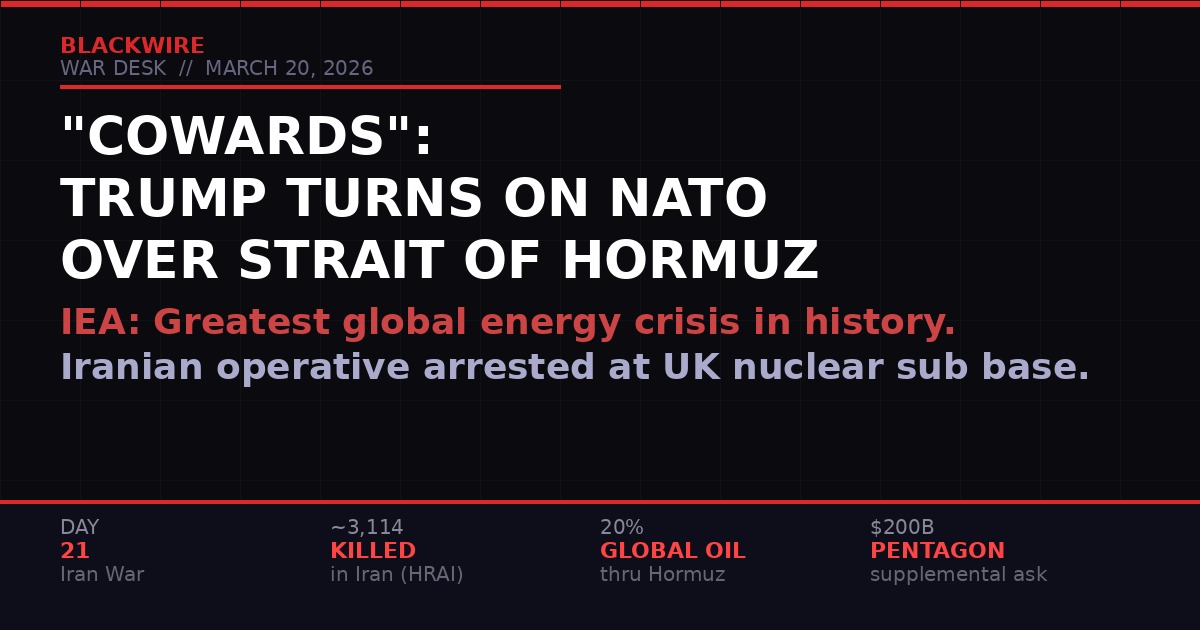
The message arrived on Truth Social in all-caps fury. "NATO IS A PAPER TIGER," Donald Trump wrote on Thursday evening. "COWARDS, and we will REMEMBER." Twenty-one days into a war that has already killed more than 3,100 people in Iran alone, the US president publicly broke with the alliance that has underpinned Western security for 77 years - because its members won't help force open a shipping lane.
The Strait of Hormuz has been effectively closed since early March, when Iran began systematically targeting oil tankers in response to US and Israeli airstrikes. Around 20% of the world's daily oil supply - roughly 20 million barrels - passes through that 33-kilometre chokepoint at the mouth of the Persian Gulf. Right now, almost none of it is getting through. The International Energy Agency said this week the world has never faced an energy security crisis this severe. Not the 1973 Arab oil embargo. Not the 2022 Russian gas cutoff after the Ukraine invasion. Worse than both.
NATO won't send warships to escort tankers through. Trump says that's cowardice. Europe says that's sovereignty. The chasm between those two positions - playing out on a Truth Social post on a Thursday afternoon - is the real story of Day 21.

The Strait of Hormuz remains the single most contested waterway on the planet. (Pexels)
The Truth Social Post That Fractured an Alliance
Trump's full post read: "Without the U.S.A., NATO IS A PAPER TIGER! They didn't want to join the fight to stop a Nuclear Powered Iran. Now that fight is Militarily WON, with very little danger for them, they complain about the high oil prices they are forced to pay, but don't want to help open the Strait of Hormuz, a simple military maneuver that is the single reason for the high oil prices. So easy for them to do, with so little risk. COWARDS, and we will REMEMBER!"
It is worth parsing each claim carefully, because several are contested. Trump declares the fight "Militarily WON." Three weeks in, Iran's nuclear programme has been significantly degraded and its military chain of command has been systematically decapitated - the supreme leader is dead, the intelligence chief Esmail Khatib was killed in an Israeli airstrike last week, and numerous IRGC generals have been eliminated. But Iran is still firing. It struck Israel's Haifa oil refinery on Thursday. It launched cluster munitions at the West Bank two days ago, killing three Palestinian women in a beauty salon. Its proxies in Iraq are still targeting Kurdish bases daily. "Militarily WON" is not how the Marines trapped in Bahrain would describe it.
The "simple military maneuver" claim is similarly contested. Opening the Strait against Iranian opposition would require clearing Iranian mines, neutralizing coastal missile batteries on a 150-kilometre stretch of Iranian coastline, and providing continuous armed escort for dozens of tankers daily - under threat from fast-attack boats, submarines, and shore-launched anti-ship missiles. The British and French navies, which Trump is most directly pressuring, do not have the capacity to do this alone. They have told Washington this, privately and now publicly.
"We are in a war zone. Calling us cowards for not sending our sailors to die in a conflict we had no vote on - that is not leadership. That is blame-shifting." - European NATO diplomat, quoted anonymously by BBC Diplomatic Correspondent Tom Bateman, March 20, 2026
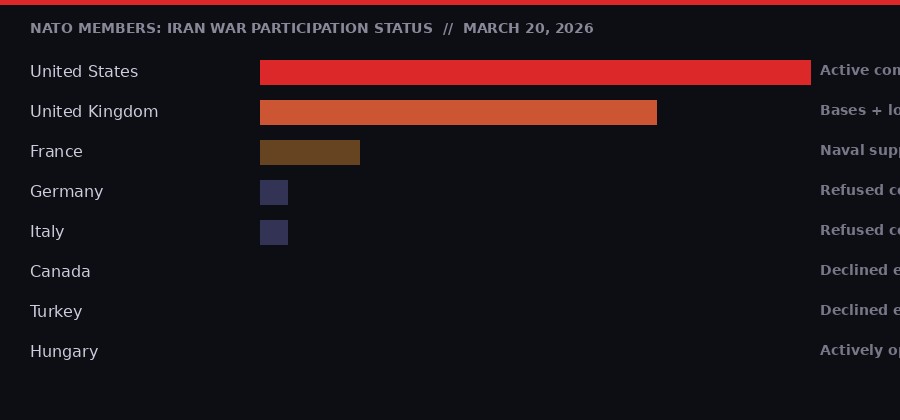
NATO member participation status in the Iran war - BLACKWIRE analysis, March 20, 2026
At the White House later on Thursday, Trump confirmed at the Commander in Chief trophy presentation that he stands by the characterization. "We like it that way," he said, describing Iran's military as effectively eliminated - no navy, no air defense, no radar. "We're doing really well." He also acknowledged the diplomatic contradiction at the heart of the Hormuz problem: "We want to talk to them but we have nobody to talk to." The US killed the people it would need to negotiate with.
What the IEA Is Actually Saying
The International Energy Agency was created in 1974, in the direct aftermath of the Arab oil embargo that brought Western economies to their knees. For more than fifty years, its job has been to manage energy security crises - maintain strategic reserves, coordinate demand response, prevent shortages from becoming economic catastrophes. When the IEA chief Fatih Birol tells a BBC interviewer that this is the "greatest global energy security challenge in history," that is an institution using language it has never used before.
Birol's specific warnings this week: even if the Strait of Hormuz reopens tomorrow, the damage to Gulf energy infrastructure - refineries, processing plants, pipelines, the Ras Laffan LNG complex in Qatar that was struck by Iran on Wednesday - will take "months and months" to repair. The world cannot simply flip a switch and return to pre-war supply levels. The infrastructure is broken.
"I believe the world has not yet well understood the depth of the energy security challenge we are facing today. It is bigger than the natural gas price shock after Russia's invasion of Ukraine, with major problems facing fertilisers and petrochemicals, as well as oil and gas." - Fatih Birol, IEA Director General, BBC interview, March 20, 2026
The specific damage to Qatar's Ras Laffan industrial complex - home to the world's biggest liquefied natural gas processing plant - is particularly significant. Qatar's prime minister, Mohammed bin Abdurrahman Al-Thani, said after the strike that 17% of the country's LNG export capacity was affected and warned of "significant repercussions for global energy supplies." Qatar supplies roughly a third of Europe's LNG. This is not an abstraction for German factories or British home heating bills.
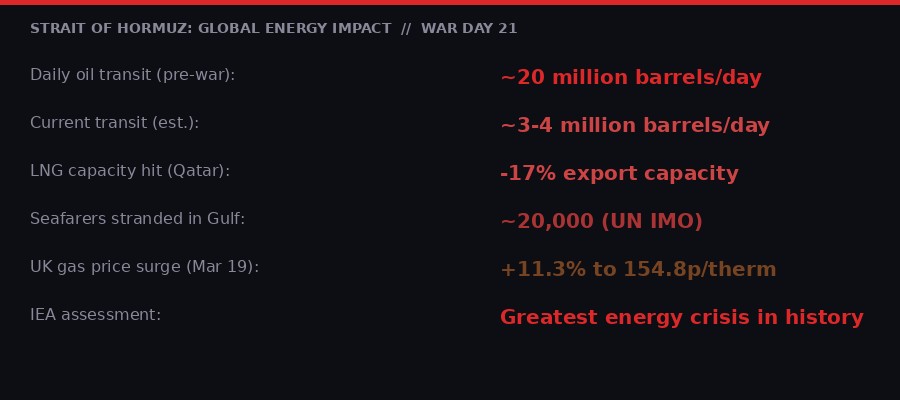
The scale of the Hormuz energy disruption - BLACKWIRE data, March 20, 2026
UK benchmark gas prices peaked briefly at 183 pence per therm on Thursday before pulling back to 154.8p - still an 11.3% jump in a single day. European prices rose more than 10%. US stocks sank on fears the war with Iran would keep interest rates high, according to AP. The IEA's recommendation: slow motorway speeds, work from home, cut energy use in factories. The same playbook from 1973. Fifty years later, the same emergency, worse scale.
An Iranian Man at the Gate of Britain's Nuclear Weapons Base
In the same 24-hour window that Trump was calling NATO "cowards" for not doing enough in the war, British police were arresting an Iranian man who tried to enter HM Naval Base Clyde at Faslane, Scotland - the home port of Britain's entire nuclear deterrent.
Police Scotland confirmed a 34-year-old Iranian man and a 31-year-old woman were arrested at approximately 17:00 on Thursday after they "unsuccessfully attempted" to enter the base. The Royal Navy confirmed the pair did not gain access. Inquiries are described as "ongoing."
Faslane is not a routine military installation. It is home to all four of Britain's Vanguard-class submarines, each carrying Trident nuclear missiles. It is, in the most literal sense, the physical location of the United Kingdom's nuclear deterrent. An Iranian national attempting to penetrate that base on Day 21 of a war in which Iran has publicly threatened to strike UK territory over the use of British airfields - is not a routine security incident.
Iran's Foreign Minister Abbas Araghchi told UK counterpart Yvette Cooper this week that allowing the US to use British bases for operations against Iran constitutes "participation in aggression." The UK hosts US air assets at Akrotiri (Cyprus) and Diego Garcia that have been used in Iran strikes. This creates a direct threat vector that the Faslane incident now makes concrete.

Britain's Faslane naval base houses the entire UK nuclear submarine fleet. (Pexels/illustrative)
The UK government has not publicly responded to the Foreign Ministry warning. Cooper was in Washington earlier this week for talks that officials described as focused on "coordinating allied policy on Iran." The government's position is that hosting US assets at British bases does not constitute direct participation in the conflict. Iran disagrees.
The Faslane incident lands in the middle of that argument. Whether it was an intelligence operation, an opportunistic probe, or something more alarming will emerge from the investigation. But the timing - the same day Trump accuses European NATO members of being too cowardly to help with the war - is a reminder that Europe is already in this conflict whether it wants to be or not.
Iran's Executions: The Regime's Internal War
While the external war grinds through its third week, Iran's government is simultaneously prosecuting a domestic campaign of lethal repression that human rights organizations say has no modern precedent in the country.
On Thursday, Iran executed three men convicted of killing police officers during the anti-government protests that erupted in January and spread to all 31 of the country's provinces. Among them was Saleh Mohammadi - a teenager and member of Iran's national wrestling team - according to sources cited by CBS News, the BBC's US partner. The executions took place in Qom province after the Supreme Court upheld death sentences that rights groups say were extracted under torture.
A day earlier, Iran hanged Kouroush Keyvani, a dual Iranian-Swedish national convicted of spying for Israel. Sweden's foreign minister said the legal process was not "legally secure." Keyvani had been arrested during what Iranian state media described as a 12-day war with Israel in June 2025 - a separate conflict from the current escalation that began February 28.
"It is clear to us that the legal process that led to the execution of the Swedish citizen has not been legally secure." - Swedish Foreign Minister, statement March 19, 2026
The January protests that triggered these executions were themselves extraordinary. The US-based Human Rights Activists News Agency (HRANA) estimates at least 7,000 people were killed in the security crackdown, including 6,488 protesters and 236 children. Protests spread to 180 cities. The government deployed near-total internet shutdowns to limit documentation and coordination.

Anti-government protests in Iran spread to all 31 provinces in January before a violent crackdown. (Pexels/illustrative)
The timing of the Thursday executions - on the eve of Nowruz, the Persian new year - carries unmistakable symbolic weight. Nowruz falls on March 20. It is one of the oldest human festivals on earth, 3,000 years of tradition marking spring, rebirth, and renewal. The regime chose the day before the new year to execute a teenage wrestler and two others, in a city 140 kilometres south of Tehran, with the country under aerial bombardment.
"This year? Every day feels so long. It's like I've lost track of time," Mina, a woman in her 50s in Damavand, northeast of Tehran, told BBC Persian. "I wish everything could be wiped from our memories like we just woke up from a bad dream."
According to the US-based Human Rights Activists in Iran organization, 3,114 people have been killed since the airstrikes began on February 28, including 1,354 civilians, among them at least 207 children. These numbers cannot be independently verified because Iran has severely restricted international press access and internet connectivity.
The US-Israel Fracture Over South Pars
The most consequential military development in the last 48 hours is not the NATO fallout - it is the visible crack between Washington and Jerusalem over the South Pars gas field strike.
On Wednesday night, Israeli jets struck South Pars - the world's largest natural gas field, shared between Iran and Qatar. Iran responded by striking Qatar's Ras Laffan industrial complex, home to the world's largest LNG processing facility. Global gas prices spiked. Trump posted on Truth Social that he "knew nothing" about the attack and that Israel had "violently lashed out." In capitals, he ordered: "NO MORE ATTACKS WILL BE MADE BY ISRAEL pertaining to this extremely important and valuable South Pars Field."
Netanyahu held a press conference on Thursday to address the fallout. He said Israel "acted alone" - but then said Trump had asked Israel to hold off from further such attacks. He also said the attack had been coordinated with Trump in advance, which directly contradicts Trump's "knew nothing" claim. Israeli newspapers Yedioth Ahronoth and Israel Hayom both reported the strike was coordinated with Washington and that Trump personally discussed it with Gulf leaders over the weekend.
"Does anyone really think that someone can tell President Trump what to do? I don't think any two leaders have been as coordinated as President Trump and I. He's the leader. I'm, you know, his ally." - Benjamin Netanyahu, press conference, March 19, 2026
Former US special envoy David Satterfield offered the most precise analysis of the divergence to BBC: Trump "wishes to find a means to credibly declare a victory that does not ring empty." Netanyahu's goal, Satterfield said, is Iran's "chaotic breakdown" - a desirable outcome for the Israeli government, one that Washington does not share.
The difference is not trivial. It shapes targeting decisions. It shapes when to stop. Netanyahu has made clear for decades he wants the Islamic Republic gone. Trump wants a win - a declaration, a deal, a headline. Those are different wars.

Iran's Ras Laffan LNG complex in Qatar was struck in retaliation for the South Pars attack. (Pexels/illustrative)
The Ground Picture: Kurds, Proxies, and 20,000 Stranded Sailors
The operational picture on the ground is more fragmented than the high-level political drama suggests. Several threads are running simultaneously.
In northern Iraq's autonomous Kurdish region, approximately 8,000 to 10,000 Iranian Kurdish fighters with the PAK (Kurdistan Freedom Party) and other opposition groups are waiting - hoping the war creates the conditions for them to cross into Iran's Kurdish-majority Kermanshah province, from which most were exiled after the 1979 Islamic Revolution. They won't move without US air cover. The US has reportedly discussed mobilizing them but no formal agreement exists. Iran-backed Iraqi militias have been striking their bases with drones "near-daily" since the war started, according to PAK commander Rebaz Sharifi, who described hiding in a mountainside crevice when a drone struck his base.
"We don't want to go now because we know we will die because of Iranian airstrikes and missiles," Sharifi told AP. "It's not the right time for this because Iranian forces still have power to control the skies." The window these fighters have waited nearly 50 years to exploit may close before they can use it.
In the Gulf, the UN's International Maritime Organisation reports approximately 20,000 seafarers are stranded west of the Strait of Hormuz. Ships cannot move. Crews cannot be rotated. The humanitarian logistics of that number of people stuck on vessels in a combat zone - without a defined exit - are significant and largely unreported.
In Ukraine, President Zelenskyy announced on Friday that 228 Ukrainian drone experts are currently deployed across five Gulf states - UAE, Saudi Arabia, Qatar, Kuwait, and Jordan - helping build Shahed interceptor systems. Ukraine has more operational experience against Iranian drones than any other military force on earth, because Russia has been firing Iranian Shahed-136s at Ukrainian cities for years. That expertise is now being deployed in the war against Iran's patron. The irony is not lost on Kyiv.
"Our teams are already working with five countries on countering Shahed drones - we have provided expert assessments and are helping build a defense system." - Ukrainian President Volodymyr Zelenskyy, X, March 20, 2026
Meanwhile, trilateral US-Russia-Ukraine ceasefire talks remain frozen. The Iran war has consumed Washington's diplomatic bandwidth. Russia is described as "dragging its feet." A senior Kremlin official said Friday a new round of talks will "likely take place soon." For Ukraine, every week the Iran war monopolizes attention is another week Putin can push his forces forward.
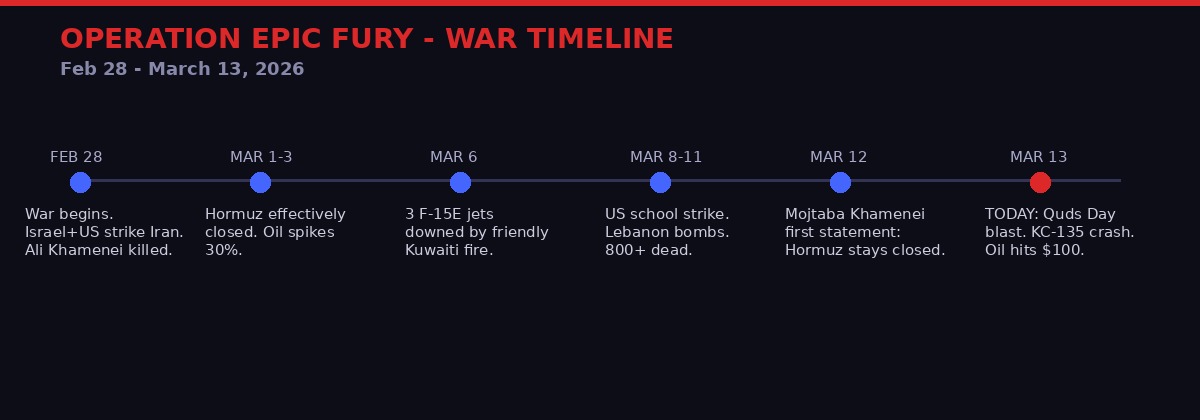
Key events from Day 1 to Day 21 of the Iran war - BLACKWIRE timeline
What Happens in Week Four
Three scenarios are now visible.
The first: Iran blinks on the Hormuz closure. Iran's new supreme leader - who replaced Khamenei after his death - said last week that the strait is a "lever" to be used. Levers have two positions. If Iran calculates the economic damage to itself from the closure - the Gulf states that supply food and medicine through those routes are also feeling it - and decides a negotiated reopening buys time and breathing room, Trump gets his win. NATO allies don't have to do anything. The coalition holds, shakily.
The second: NATO breaks under the economic pressure. If German and French economic data in April shows the LNG crisis biting hard enough, domestic political pressure may force European governments to either join the convoy escort operation or demand Washington negotiate. The fracture Trump accelerated on Thursday could widen into a formal split - NATO's first real internal rupture over a combat operation in the alliance's history.
The third, and least discussed: the Israeli operations deepen. Netanyahu's stated goal - weakening the regime to a point where Iranian internal opposition can topple it - is a months-long project, not a days-long one. The Caspian Sea naval strikes he mentioned on Thursday. The Haifa refinery retaliation. The PAK fighters waiting in the mountains of Iraq. Every day this continues, the question of where it ends becomes harder to answer.
On Thursday, Trump said: "We're wanting to talk to them but we have nobody to talk to." He was describing the systematic decapitation of Iran's military and intelligence leadership. Whether that was a feature or a bug of the targeting strategy depends on what the endgame was supposed to be. Twenty-one days in, that endgame is less clear than it was on Day 1.
The Persian new year began Friday at dawn. In Tehran, some people put out Haft Sin tables - the seven symbolic items of Nowruz - between air raids. Others didn't bother. The last time Iranians celebrated this festival at war was the 1980s, fighting Iraq. That war lasted eight years.
Get BLACKWIRE reports first.
Breaking news, investigations, and analysis - straight to your phone.
Join @blackwirenews on TelegramSources: AP (March 20, 2026), BBC News (March 20, 2026), BBC Persian, IEA press statement March 20, Reuters, Tasnim News Agency, HRANA (Human Rights Activists in Iran), UN International Maritime Organisation, Zelenskyy/X statements.