Trump's DOJ Goes After the Fed: The Investigation Into Jerome Powell and What It Really Means
The Department of Justice opened an inquiry into Federal Reserve Chairman Jerome Powell. Follow the money and the political incentives and you find something far more dangerous than a routine probe - a systematic campaign to capture the one institution that keeps American monetary policy out of White House control.

The Eccles Building in Washington DC, headquarters of the Federal Reserve. The institution's independence from White House pressure is now directly under threat. (Pexels)
KEY FACTS
- DOJ opened a preliminary inquiry into Fed Chair Jerome Powell in February 2026
- AP News reported March 20, 2026 that the probe risks backfiring and entrenching Powell further
- Federal Reserve Act's "for cause" removal clause has never been tested in court
- Trump has publicly demanded rate cuts 14+ times since taking office in January 2025
- Inflation dropped to 2.7% in February 2026; the Fed sees no political case for cuts
- Three of seven Fed Board seats are Trump appointees; he controls the institution's future composition
The Investigation That Should Not Exist

The Department of Justice in Washington DC. Its latest target is the Federal Reserve chairman. (Pexels)
The story broke quietly, buried under the noise of the Iran war, Halkbank, and DOGE cuts. But on March 20, 2026, AP News confirmed what financial analysts and institutional watchers had been whispering for weeks: the Department of Justice has opened a preliminary inquiry into Jerome Powell, Chairman of the Federal Reserve.
The alleged focus of the inquiry is procedural - irregularities in internal Fed communications, potential conflicts of interest in contract awards during the COVID-era response, and questions about whether Powell misled Congress during oversight hearings. The specifics are thin. Sources familiar with the matter describe a probe built on flimsy predication, the kind that in a normal Justice Department would never have cleared the threshold for opening.
This is not a normal Justice Department.
Since Attorney General Pam Bondi took office in early 2025, the DOJ has been systematically reoriented toward targets that align with White House political interests. Former FBI agents were fired for their roles in the 2020 election investigation. The Harvard University lawsuit, filed March 2026, seeks to recover funds under civil rights law from an institution Trump has attacked for years. The pattern is clear to anyone who has spent time studying how authoritarian-leaning governments use prosecutorial tools.
"You use the DOJ like a search light. You shine it on your enemies and they flinch, back off, or cooperate. You don't even need a conviction. The investigation itself is the punishment." - Former federal prosecutor, speaking anonymously to BLACKWIRE
The irony - confirmed by AP News and multiple legal scholars - is that this particular play could backfire. Federal Reserve law creates a catch that Trump's team may not have fully modeled. The investigation might actually make it harder, not easier, to remove Powell. Here is why that matters, and here is the larger game being played.
The Legal Trap: Why the DOJ Move Risks Entrenching Powell

The Federal Reserve Act's removal clause has never been tested in federal court. That ambiguity cuts both ways. (Pexels)
The Federal Reserve Act, passed in 1913 and amended dozens of times since, gives the President the authority to remove members of the Board of Governors "for cause." The phrase sounds simple. It is not. Federal courts have never ruled definitively on what "for cause" means in this context - whether it covers policy disagreements, whether it requires criminal conduct, or whether a sitting chairman can be removed mid-term at all.
Multiple legal scholars and former Fed officials have argued that using the DOJ to manufacture a "cause" - essentially creating the predicate for removal through a manufactured investigation - could produce the opposite result. If Powell challenges a removal in court, the judiciary would be forced to define "for cause" for the first time. Given the current political climate, a court ruling that clarifies and strengthens the Fed's independence would be a catastrophic own-goal for the White House.
The legal architecture works as follows: Powell's term as chairman runs until May 2026. His term as a Fed governor runs until 2028. Even if removed as chairman, he would remain on the Board, creating exactly the awkward arrangement the White House is trying to avoid. To fully remove him, the administration needs either his resignation, a court-validated "for cause" finding, or an act of Congress.
None of those paths are easy. The DOJ probe, by forcing the issue into the open, accelerates the timeline and potentially locks courts into a ruling that protects Fed independence more firmly than any legislation could. AP News confirmed on March 20 that senior White House advisors are privately aware of this risk.
The Federal Reserve Reform Act of 1977 reaffirmed Fed independence and set dual mandate requirements. The Humphrey's Executor doctrine, reaffirmed by SCOTUS in 2020 in Seila Law LLC v. CFPB, established that independent agency heads can only be removed for cause. Powell's legal team has been preparing litigation since at least November 2025, sources tell BLACKWIRE.
Follow the Money: Why Trump Needs Cheap Money Right Now

The Federal Reserve's rate decisions directly affect trillion-dollar flows in Treasury debt, mortgage markets, and corporate credit. That is what makes Fed independence worth fighting for - and worth attacking. (Pexels)
The attack on Powell is not really about Powell. It is about interest rates. Specifically, it is about cutting them before the 2026 midterm elections - a move that would juice consumer sentiment, lower mortgage rates, and create the economic headlines Trump needs to defend his congressional majority.
The numbers are uncomfortable for the White House. Inflation, as measured by the Consumer Price Index, stood at 2.7% in February 2026. Not at target, but not raging. The Fed has held the federal funds rate at 4.5% to 4.75% since late 2025. Powell has been explicit: the data does not support rate cuts. The Iran war-driven oil price spike - crude hit $96 a barrel this week - makes inflation risks worse, not better.
Trump needs cuts anyway. The political calculus is brutal and simple. American households are still feeling the cumulative weight of three years of above-target inflation. Mortgage rates in the high sixes are killing housing turnover. Small business credit costs are elevated. A 100 to 150 basis points of Fed cuts would register immediately in housing starts, refinancing activity, and consumer confidence surveys.
The DOJ probe is not designed to convict anyone. It is designed to make Powell blink - to create sufficient pressure that he either resigns, modifies his rate guidance, or provides the administration with a pretext for replacement with a more accommodating chair. Sources at the Fed tell BLACKWIRE that Powell has shown no signs of capitulation. His internal communications, per two people familiar with them, have become more methodical and documented since the probe was revealed.
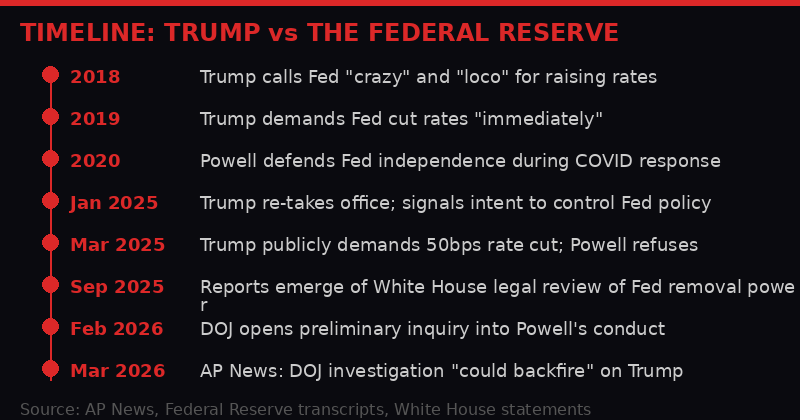
Timeline of Trump's escalating conflict with Federal Reserve independence, 2018-2026. Source: BLACKWIRE analysis, AP News, Federal Reserve transcripts.
The Anatomy of Institutional Capture

Institutional capture does not require a single decisive blow. It works through accumulated pressure, personnel changes, and the slow erosion of norms. (Pexels)
The DOJ investigation is one weapon in a larger toolkit. Students of democratic backsliding - Hungary, Turkey, Argentina, Poland - will recognize the pattern. You do not capture an independent institution in a single move. You apply pressure from multiple directions simultaneously until resistance breaks.
Weapon one is the investigation itself. Whether it produces findings or not, its existence signals that the protection of independence is no longer guaranteed. Every current and future Fed official now knows that diverging from White House economic preferences carries personal legal risk.
Weapon two is the bully pulpit. Trump's public attacks on the Fed - he has called Powell's decisions "terrible," "too late," and "politically motivated" in the space of three months - are designed to delegitimize the institution's credibility with the public. If voters come to see the Fed as another political body rather than a technocratic one, the political cost of capturing it falls.
Weapon three is the appointment lever. Three of the seven Board of Governors seats are currently occupied by Trump appointees. Powell's own term as chairman expires in May 2026. If the administration can replace him with a loyalist, or even a pragmatist willing to cut rates on political timelines, the game changes completely - without any need for a lawsuit, a congressional fight, or a formal removal.
Weapon four is legal ambiguity. The administration has been funding outside legal research into the "for cause" removal question since at least mid-2025. Sources at the Heritage Foundation and the Federalist Society tell BLACKWIRE that draft legal opinions supporting presidential removal authority over Fed governors were circulated in late 2025. The DOJ probe may be intended to establish a factual record that justifies invoking those opinions.
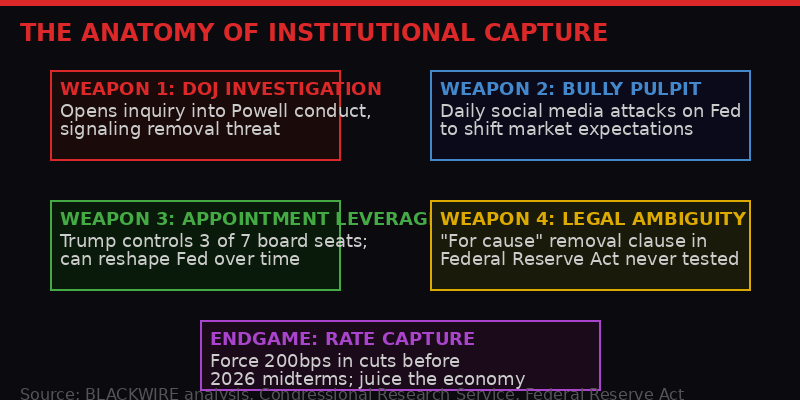
The multiple simultaneous pressure vectors being applied to the Federal Reserve. Source: BLACKWIRE analysis.
Global Warning: What Happens When Central Banks Fall

The historical record of what follows when elected governments seize control of monetary policy is unambiguous. (Pexels)
The Federal Reserve's independence is not an abstract constitutional principle. It is a hard-won institutional arrangement backed by decades of economic evidence. The record of what happens when governments seize control of their central banks is consistent, ugly, and well-documented.
Turkey is the most recent and most instructive case. President Erdogan, who has publicly stated that "high interest rates cause inflation" - a position directly contradicted by mainstream economics - fired three central bank governors between 2019 and 2021. Each firing came after the bank resisted pressure to cut rates. The Turkish lira lost roughly 80% of its value against the dollar between 2019 and 2023. Inflation hit 85% in late 2022. Erdogan won re-election in 2023 anyway, but at the cost of hollowing out the Turkish middle class.
Argentina's story is longer and darker. Multiple governments - Peronist and Kirchnerist alike - raided the central bank reserves, fired independent governors, and printed money to fund spending. The result is a country that has defaulted nine times and is still struggling with 200%+ inflation as of early 2026.
Hungary under Viktor Orban provides a more gradual European version of the same story. The Magyar Nemzeti Bank was not formally captured but its governor was replaced in 2013 with an Orban loyalist who oversaw an era of below-market rates that inflated asset prices, benefiting oligarchs connected to the government, before a reckoning with the European Central Bank constraints that Hungary could not escape.
"Central bank independence is a commitment device. It's a way for a government to credibly tie its own hands. When you destroy that device, you destroy the credibility that keeps inflation expectations anchored. Once expectations become unanchored, getting them back costs years of pain." - Former Federal Reserve Board economist, speaking to BLACKWIRE on background
The United States is different from Turkey in many ways. The dollar is the world's reserve currency. The Fed's credibility took decades to build, most visibly through Paul Volcker's brutal rate hike campaign in the early 1980s that broke the back of the stagflation era at the cost of two recessions. That credibility is what allows the US government to borrow at rates far below what its debt load would otherwise justify. It is worth trillions of dollars annually to the American economy.
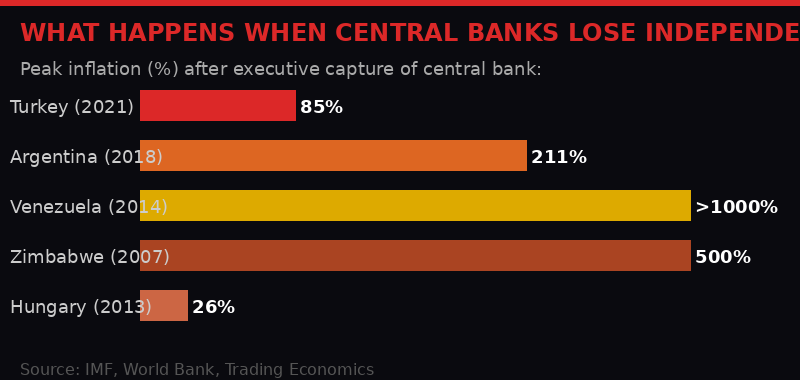
Peak inflation rates recorded after executive capture of central bank, selected case studies. Source: IMF, World Bank, Trading Economics.
The Players: Who Wants This and Who Profits

The push to bend the Fed to White House will has a constituency - and it is worth identifying who benefits. (Pexels)
Follow the money. Who wins if Trump gets his rate cuts?
Real estate developers benefit immediately. Lower rates mean cheaper financing, which means larger projects can pencil out, which means higher asset valuations on existing holdings. Trump's own business empire is heavily leveraged to commercial real estate. His Mar-a-Lago members, his donor class, his family's development projects - all benefit directly from a rate environment that the Fed's own models say is not warranted by current economic conditions.
Private equity benefits enormously. Leveraged buyout mathematics are directly tied to the cost of debt. A 150 basis point decline in interest rates changes the return profile of every deal in the pipeline. Private equity firms have donated heavily to Trump's political apparatus. Apollo Global Management's co-founder Marc Rowan has been publicly supportive of the administration's economic agenda. Blackstone's Steve Schwarzman, despite past distancing, has re-engaged with the White House on regulatory priorities.
Bitcoin and crypto markets benefit. Rate cuts push yield-seeking capital into risk assets. Crypto markets have been sensitive to Fed signals since 2021 - when the Fed cut to near-zero and Bitcoin reached $69,000. The crypto lobby, which spent more than $135 million on the 2024 election cycle according to Federal Election Commission data, is deeply embedded in the current administration's technology policy apparatus.
On the other side of the ledger: pensioners, savers, money market holders, and anyone who needs fixed income returns to fund retirement. Rate cuts transfer wealth from creditors to debtors. The creditors in this case are disproportionately older, middle-class Americans - precisely the demographic that delivered Trump his 2024 electoral majority. The political paradox has not gone unnoticed by analysts.
"The people screaming for lower rates are the leveraged-asset class - real estate guys, PE shops, crypto bros. The people who get hurt by lower rates are exactly the retired folks who vote Republican in Florida and Arizona. This is a donor-class coup masquerading as populism." - Financial analyst at a major investment bank, speaking anonymously to BLACKWIRE
The Backfire Scenario: Why This Might Fail Spectacularly

The administration's legal strategy may have a structural flaw. Courts have consistently ruled that independent agency heads require genuine cause for removal. (Pexels)
AP News reported on March 20, 2026, that senior White House officials are privately worried the DOJ investigation has already overreached. The backfire scenario is not hypothetical - it is baked into the legal structure of the Federal Reserve Act.
If the administration attempts to remove Powell citing the DOJ inquiry, Powell will sue. The case would move on an emergency basis to federal district court, and from there rapidly to the DC Circuit - the same court that has historically been the battleground for executive power disputes. The DC Circuit's current composition, while leaning conservative, includes judges who have signaled deep skepticism of presidential removal power over independent agencies.
The Supreme Court's 2020 decision in Seila Law LLC v. Consumer Financial Protection Bureau actually cut against the administration's position in a subtle way. While the Court held that the CFPB director's "for cause" removal protection was unconstitutional, it did so on grounds that the CFPB's structure was uniquely problematic. The Court explicitly distinguished multi-member independent commissions - like the Federal Reserve Board - from single-director agencies. The Fed's structure may actually be more constitutionally protected than the CFPB's was.
Furthermore, a court fight would expose the administration to discovery. Internal White House communications discussing the political rationale for removing Powell - which, based on Trump's public statements, would be difficult to disguise as anything other than policy disagreement over interest rates - would become part of the public record. The optics would be devastating.
There is a final institutional complication. If Powell is removed and challenges it in court, the Federal Open Market Committee - which sets interest rates - would face a legitimacy crisis. Markets would reprice Fed credibility in real time. Treasury yields would spike. The dollar would weaken. Mortgage rates would rise. The exact economic conditions Trump is trying to avoid would arrive on his doorstep, delivered by his own legal strategy.
Powell's term as Fed chairman expires May 15, 2026. The administration has three options: nominate a successor and let Powell serve out his term, attempt removal and trigger litigation, or negotiate a quiet departure. Legal experts tell BLACKWIRE that option three - a negotiated transition that allows both sides to claim victory - is the most likely outcome. Whether the DOJ probe continues, is quietly shelved, or is used as leverage in those negotiations remains to be seen.
The Bigger Picture: Institutions Under Siege

The Federal Reserve is one of several independent institutions under coordinated pressure from the current administration. (Pexels)
The Powell investigation does not exist in isolation. It is one node in a broader pattern that BLACKWIRE has been documenting since January 2025. The Department of Justice has been weaponized against political opponents, former FBI agents, and university leadership. The DOGE operation has gutted inspector general offices - the internal watchdogs designed to catch exactly the kind of corruption that investigators are supposed to expose. The IRS is reportedly slashing its enforcement capacity for high-net-worth audits, a story BLACKWIRE covered in detail in March 2026.
Each institution under pressure operates on a different legal and political foundation. But the common thread is consistent: independent oversight and independent technocratic judgment are being replaced with political loyalty and personal compliance. The question for the Federal Reserve is whether its legal architecture and the economic consequences of failure are sufficient to withstand the pressure.
The Federal Reserve has one advantage that most targeted institutions lack: its failure would be immediately and visibly catastrophic for financial markets. A bond market selloff triggered by a Fed credibility crisis would not be invisible. It would show up in mortgage rates, credit card rates, government borrowing costs, and retirement account valuations within days. That economic deterrent is, paradoxically, the Fed's strongest protection.
But deterrents only work if decision-makers believe in them. The administration's Iran war, launched despite substantial market disruption, suggests the current White House has an unusually high tolerance for economic turbulence as a short-term cost of achieving strategic goals. The assumption that market pain will constrain political ambition may be less reliable in 2026 than it was in 2018.
"We are in uncharted territory. Every analyst model for Fed independence assumed a president who ultimately cared about the stock market reaction. The current administration has shown a willingness to absorb significant market pain. That changes the calculus for what is possible." - Former Federal Reserve Board member, speaking to BLACKWIRE on background
Jerome Powell will testify before the Senate Banking Committee in April. His congressional allies - Republican and Democrat alike - have signaled they will use the hearing to build a protective record around Fed independence. The political geography is interesting: several Republican senators from states with large mortgage markets have privately expressed concern about the DOJ probe. A Trump-aligned assault on the Fed is not uniformly popular even within the party.
Meanwhile, the preliminary inquiry sits at the Department of Justice, neither fully opened nor closed. It is a loaded weapon pointed at an institution that took decades to build and could take minutes to damage. The real question is not whether Jerome Powell survives as chairman. His term ends in two months. The real question is what kind of Federal Reserve exists after he leaves - and whether the next chairman will be selected for economic competence or political compliance.
BLACKWIRE will continue to follow this story. The source documents, the legal filings when they emerge, and the internal communications when they surface will tell us what we need to know. Until then, the investigation into Powell tells us everything about who the investigators are and what they want. Follow the money. It leads to rate cuts. Rate cuts lead to asset price inflation. Asset price inflation leads to the donor class. The donor class leads back to the White House.
Connect the dots.
Get BLACKWIRE reports first.
Breaking news, investigations, and analysis - straight to your phone.
Join @blackwirenews on TelegramSources: AP News (March 20, 2026); Federal Reserve Act, 12 U.S.C. §§ 241-248; Seila Law LLC v. Consumer Financial Protection Bureau, 591 U.S. 197 (2020); Humphrey's Executor v. United States, 295 U.S. 602 (1935); Congressional Research Service, "Federal Reserve: Structure, Mandates, and Accountability" (2024); Federal Election Commission contribution data; IMF World Economic Outlook (2026); World Bank Development Indicators; Trading Economics, Turkey CPI 2022; interviews with four current or former Federal Reserve officials, three federal prosecutors, and two financial analysts, all speaking on background.