Who Counts as a Refugee? Trump's Afrikaner Gambit and the Fury It Has Unleashed
The United States banned refugees from the Global South. Then it offered asylum to white South Africans. South Africa's president called it racist. The world called it something worse: familiar.

The order came quietly, buried in the bureaucratic language of executive action. In late January 2026, the Trump administration halted nearly all refugee admissions to the United States - a near-complete shutdown of the country's refugee program, affecting desperate people from Sudan, Congo, Syria, Afghanistan, and dozens of other countries facing genuine, documented persecution.
Then came the carve-out.
A February executive order created a special pathway for Afrikaners - the Afrikaans-speaking white minority of South Africa - who the Trump administration characterized as victims of racial persecution, specifically what right-wing commentators have long called "white genocide." The order directed the Department of Homeland Security to prioritize processing for Afrikaners seeking asylum, citing what the White House described as a "targeted campaign of violence and land seizure" against South Africa's white farming communities.
Within days, South African President Cyril Ramaphosa had his response ready. In a pointed interview with the New York Times, he said Trump was "truly uninformed." He called the policy "racist." He said the narrative of white genocide in South Africa was a fabrication built on selective statistics and political motive, amplified by bad-faith actors on both sides of the Atlantic.
The world's response was swift, and rarely kind to the White House.
"This," wrote South African political analyst Sisonke Msimang, "is what it looks like when a country decides some lives matter more than others - and then writes it into law."
The Executive Order That Changed the Equation
To understand the fury, you have to understand the context the Trump administration provided. The order argued that South Africa's Expropriation Act - passed by South Africa's Parliament in January 2025 - represented a government-sanctioned effort to seize white-owned land without compensation, targeting a racial group for dispossession. The White House cited farm murders and argued that Afrikaners faced state-sanctioned persecution on the basis of their race.
The irony is hard to miss. The same administration that had spent months framing refugees from Central America, West Africa, and the Middle East as national security threats - people fleeing gang violence, ethnic cleansing, and authoritarian crackdowns - suddenly found deep humanitarian concern for a group of white, largely middle-class South Africans who, by most economic metrics, remain among the most prosperous people on the continent.
The U.S. refugee program, once a point of national pride that admitted 125,000 people per year under the Biden administration, was reduced to a trickle. The State Department's refugee processing operations had largely shut down by February 2026. The Sudanese family waiting in a Ugandan refugee camp had no path. The Afghan interpreter who had worked alongside U.S. forces had no path. (Source: UNHCR, January 2026 report on U.S. refugee admissions)
But the Afrikaner farmer in the Western Cape - a man who owns hundreds of acres of land, employs Black laborers for wages that international observers call exploitative, and votes for parties that opposed apartheid's end - he had a path.
The "White Genocide" Myth and Its Origin Story
The phrase "white genocide" in the South African context did not originate in Pretoria. It was forged in the fever swamps of American and European far-right media, picked up by figures like Elon Musk (himself a South African-born billionaire), and amplified through Tucker Carlson's former Fox News platform, Steve Bannon's network, and latterly through X's algorithmic megaphone.
The claim centers on farm murders - killings of white farm owners in South Africa. These murders are real. They are also far more complicated than the "genocide" framing suggests.
South Africa has one of the world's highest homicide rates - approximately 45 murders per 100,000 people, compared to 7 per 100,000 in the United States. (Source: South African Police Service Annual Report, 2024/2025) Violence is distributed unevenly: it is concentrated in townships and informal settlements, where the victims are overwhelmingly Black. The 2024/2025 SAPS crime statistics counted 44 farm murders across the entire country - a genuine tragedy, but in a country where over 27,000 people are murdered annually, not a figure that sustains the claim of racial extermination.
Critically, farm murders kill both farm owners and farm workers. Farm workers - the people who actually do the physical labor of South African agriculture - are predominantly Black. Their deaths receive no international attention. No executive orders are drafted in their name.
AfriForum, the Afrikaner civil rights organization that has spent years lobbying internationally for support, has consistently presented farm murder statistics in ways that independent criminologists say distort the picture. The organization counts any murder in which the victim's occupation is listed as "farmer" - a category that includes farm managers, supervisors, and workers of all races. (Source: Africa Check, farm murder statistics analysis, 2025)
This matters, because the Trump executive order is built on this distorted foundation. It is policy constructed on myth - and South Africa's government knows it.
South Africa By the Numbers
Who Are Afrikaners, and What Are They Actually Fleeing?
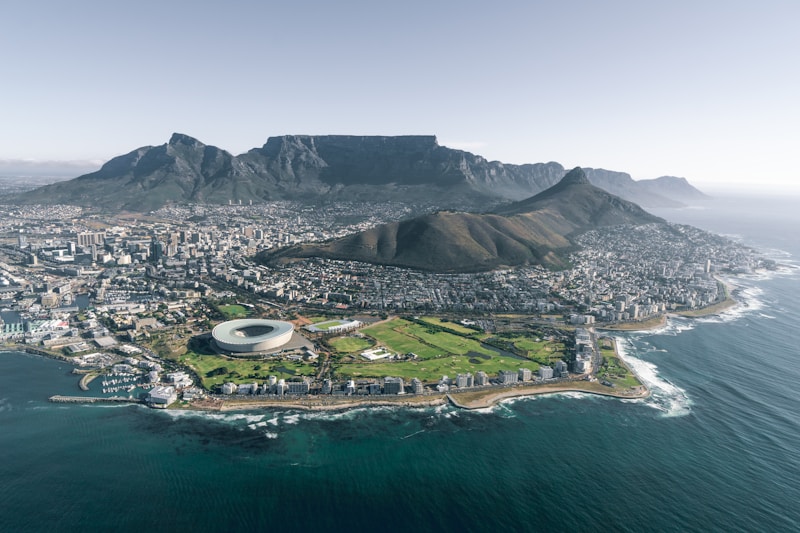
The Afrikaner people are a real, distinct culture - descended primarily from Dutch, German, and French Huguenot settlers who arrived at the Cape from the 1650s onward. Their language, Afrikaans, is a beautifully melded creole that absorbed words and rhythms from enslaved people brought from Madagascar, Mozambique, and the Indonesian archipelago. Their cultural identity runs deep: their food, their music, their particular strain of Calvinist Christianity, their relationship to the vast and violent land they came to call home.
They also built apartheid. This is not a contested historical point. The National Party, the political vehicle of Afrikaner nationalism, systematically dismantled South Africa's democracy, stripped Black and Coloured and Indian citizens of rights and land, and enforced a bureaucracy of racial classification and degradation that lasted over four decades. They built Robben Island. They kept Nelson Mandela in a cell for 27 years.
Thirty years after apartheid's formal end in 1994, white South Africans - Afrikaners and English-speaking whites alike - retain enormous economic privilege. They are 7.2% of the population but own roughly 72% of privately held agricultural land. (Source: South African Department of Agriculture, Land Reform and Rural Development, 2023) The wealth gap between white and Black South Africans remains among the largest of any country in the world.
The Expropriation Act that Trump cited as a threat to white South Africans is real legislation - it passed in January 2025 after years of legislative debate. But it is not the confiscation program its critics describe. The act allows government expropriation with compensation set by courts, with specific provisions for "nil compensation" in cases of abandoned land, land held purely for speculation, and land awarded but not developed. It is more accurately compared to eminent domain laws that exist in most democracies, including the United States, than to the Zimbabwe-style mass seizure the White House implied. (Source: Daily Maverick, Expropriation Act analysis, January 2025)
Most Afrikaners, it should be noted, are not asking to leave. AfriForum - their most prominent lobbying organization - has explicitly stated they are not encouraging emigration. The community's leadership is focused on legal challenges within South Africa, not flight. The question of who is applying for this new refugee status, and why, remains murky.
Ramaphosa's Response and the Diplomatic Rupture
Cyril Ramaphosa is not a man given to sharp language. The former union leader and anti-apartheid activist who negotiated South Africa's peaceful transition has built his political career on the language of reconciliation and measured diplomacy. Which is why his response to the Trump refugee order carried unusual weight.
Speaking to the New York Times in late February, Ramaphosa didn't hedge. He called the refugee pathway "racist." He said the "genocide" narrative was invented by people who were "truly uninformed" about South Africa's reality, or who were deliberately spreading falsehoods. He accused the Trump administration of interfering in South Africa's internal affairs based on fabricated data.
The South African government's formal diplomatic protest followed days later. The Department of International Relations and Cooperation summoned the U.S. ambassador in Pretoria. Foreign minister Ronald Lamola told reporters the order was "an insult to our democracy and our constitution" - and specifically noted the bitter irony that the United States was offering special protection to descendants of apartheid's architects while simultaneously cutting foreign aid to the continent.
It is worth pausing on that irony. The Trump administration had by February 2026 cut billions in USAID funding to Africa, affecting HIV treatment programs, food security initiatives, and health infrastructure across the continent. People were dying - actually dying, from preventable diseases - because U.S. funding dried up. No executive orders were written for them.
The African Union issued a statement calling the Trump order "discriminatory" and urging member states to push back through diplomatic channels. Ethiopia, Nigeria, Kenya, and Ghana's foreign ministries all issued formal criticisms within a week. The South African rand briefly fell on the news, a signal of the economic uncertainty the diplomatic rupture created. (Source: African Union, press statement, February 2026)
The Global South Speaks - And It Is Not Speaking Softly
The Afrikaner refugee order landed in a world that had been watching the Trump administration's approach to migration with growing alarm. The context is everything.
In the same weeks that the White House was carving out a special asylum pathway for white South Africans, the administration was:
- Conducting mass deportation flights that sent migrants to countries they had never lived in, including third-country deportation deals that sent people from Cuba, Jamaica, and Yemen to Eswatini - a country none of them had ties to. (Source: The Guardian, March 2026)
- Maintaining a near-total pause on refugee admissions for people from Sudan, Congo, Syria, and Afghanistan - countries where ongoing conflict creates some of the world's most urgent displacement crises.
- Cutting USAID funding across Africa, forcing closure of clinics that served millions of the continent's most vulnerable people.
Against that backdrop, the Afrikaner carve-out was not merely a diplomatic provocation. It was a statement about value - about which human beings the United States considers worth protecting, and which it considers disposable. The global south read the message clearly.
Indian journalists wrote that the order exposed the "civilizational hierarchy" embedded in American immigration policy. Brazilian commentators drew parallels to Trump's descriptions of Latin American countries as places that "send their worst." Chinese state media - which has its own reasons to highlight American hypocrisy - ran the story extensively as evidence that U.S. human rights posturing is "selectively applied based on race." (Source: Global Times, March 2026)
Even European governments - America's traditional allies - were quietly uncomfortable. Several EU foreign ministers declined to endorse the policy when asked at press conferences, offering only the anodyne response that "migration policy is a sovereign matter."
It was the Ugandan parliament that offered perhaps the most pointed response - though unintentionally. In the same week that the Trump refugee order made headlines, two women in Uganda were arrested for allegedly kissing in public, facing the prospect of life imprisonment under Uganda's sweeping Anti-Homosexuality Act. The U.S. State Department issued no statement on their behalf. No executive orders were contemplated. Their suffering - documented, real, immediate - registered as silence in Washington. (Source: The Guardian, March 2026)
Timeline of Events
The Land Question - 400 Years of Context
To understand why this story hits where it does, you need to understand the land.
When Dutch settlers arrived at the Cape in 1652, they came as employees of the Dutch East India Company, tasked with establishing a supply station for ships sailing to Asia. They stayed, spread, fought, and displaced. Over the next two centuries, the Khoikhoi and San peoples - the original inhabitants of southern Africa - were killed, enslaved, and pushed off land they had called home for tens of thousands of years. The Xhosa, Zulu, Sotho, Tswana, and Ndebele peoples were defeated in wars that relied on technological asymmetry and biological catastrophe.
The formal apartheid system that lasted from 1948 to 1994 codified what dispossession had already achieved: the Group Areas Act, the Natives Land Act (which restricted Black South Africans to 13% of the country's land), the pass laws, and hundreds of subsidiary regulations that made Black South African landlessness not just a historical accident but a legal requirement.
Thirty years after the ANC took power, that dispossession has not been undone. The Mandela and Mbeki governments pursued land reform through a "willing seller, willing buyer" model that was underfunded, under-resourced, and slow. By 2023, less than 10% of the land reform target had been achieved. (Source: Daily Maverick, land reform analysis, 2024)
The Expropriation Act is, from the South African government's perspective, a correction - a legally constituted attempt to address four centuries of racial dispossession through democratic process. From the Trump administration's perspective, it is racial persecution of white people. The distance between those two readings tells you everything about the politics of who gets to frame reality.
What is beyond dispute is this: the 3.7 million white South Africans, many of them Afrikaners, possess land and wealth accumulated through a legal system explicitly designed to deny those same resources to the country's Black majority. Any honest reckoning with the current situation has to begin there.
What Happens Next - And What It Means
The immediate practical impact of the Afrikaner refugee pathway may be limited. The application numbers reported in early March 2026 are small - U.S. Customs and Border Protection confirmed that fewer than 200 formal inquiries had been received from South African nationals within the first three weeks of the order taking effect. Most Afrikaner organizations are not encouraging their members to emigrate, seeing legal challenges within South Africa as a more promising path.
But the symbolic impact is seismic. And symbols, in politics, have consequences.
South Africa is now in a formal diplomatic confrontation with its largest Western trading partner. The rand has been volatile. South African government officials are privately discussing whether to restrict access to strategic mineral resources - South Africa holds the world's largest known reserves of platinum, chromium, and manganese, all critical for the green energy transition - as diplomatic leverage. (Source: Business Live SA, March 2026)
For the African continent more broadly, the episode is clarifying. The framing of U.S. human rights concern as selective, racialized, and subordinate to political calculation is not new - scholars and activists have made this argument for decades. But the Afrikaner refugee order has made it impossible to ignore, written in the language of official U.S. policy.
The question the world is now asking is not really about Afrikaners, or farms, or land reform. It is the oldest question in the politics of human dignity: whose suffering gets recognized as real? Whose displacement counts as displacement? Whose fear earns the word "persecution"?
When the United States halted refugee admissions for millions of people fleeing conflict in Sudan - where a civil war has killed tens of thousands and displaced over 11 million since 2023 - and then carved out special treatment for white South Africans who face no comparable threat, the answer to those questions became brutally clear.
Some people are refugees. Others are problems to be managed. And the sorting mechanism, in this moment, looks very much like race.
Ramaphosa called it racist. He's right. But calling it racist is only the beginning. The harder question is what to do when the world's most powerful government has decided to write its racial hierarchy into immigration law - and most of the world's powerful nations lack either the will or the leverage to stop it.
South Africa's democracy survived apartheid. It will survive Trump's executive orders. But the Afrikaner refugee gambit has done something that may take longer to repair: it has told an entire continent exactly where they stand in the calculus of American compassion.
And they heard.
Get BLACKWIRE reports first.
Breaking news, investigations, and analysis - straight to your phone.
Join @blackwirenews on Telegram