Buried Alive by the State: How South Africa Starved 93 Miners Underground
For five months, the South African government deliberately cut off food, water, and medicine to hundreds of men trapped 1,300 metres underground. 93 died. The bodies of some were eaten by the living. When survivors climbed out on Christmas Day, police put them in handcuffs. Zero officials have faced accountability.

The shafts at Stilfontein became tombs for 93 men. The South African government's stated goal was to force the miners out by starvation. (BLACKWIRE visualization)
The Shaft That Became a Tomb
Patrick didn't know what month it was anymore. Underground, 1,300 metres below the town of Stilfontein in South Africa's North West Province, time had collapsed into cycles of thirst, darkness, and the sound of men getting weaker.
He had gone down the shaft months earlier to mine gold illegally - a zama zama, as they are called, from the Zulu phrase meaning "try your luck." Now the only water was a foul seep oozing from the rock face. The food was gone. The rope pulley that their families above used to send down supplies had been disabled by police. The government's position was explicit: starve the men into surrendering.
When Patrick stumbled into Shaft 11 hoping to find something to eat, he found men cooking over a fire. One approached him: "Do you want to buy some meat? Some pork?" According to an Al Jazeera longform investigation published March 14, 2026, it was human flesh. Men had taken it from bodies of those who had fallen and died while trying to climb out. They were not punished. Down there, in that darkness, with that level of desperation, judgment required a different calculus than anything above ground.
"No, man, you can't do that. It's not our time to die here. We must believe in God. Our graves are not going to be this deep. We will go out. We've got families outside." - Patrick, to a miner who said he would throw himself into a flooded shaft below
On Christmas Day 2024, Patrick climbed out. He had cut himself on sharp steel girders for more than a kilometer of vertical shaft. He was half-blind from the sudden sunlight. The first thing he saw was a police officer. The first thing that happened to him was handcuffs and a white van. He was dimly aware of a crowd outside watching and shouting angrily as he was shoved in.
This is a story about what a democratic government can decide to do to its most desperate citizens - and then do nothing about afterward.
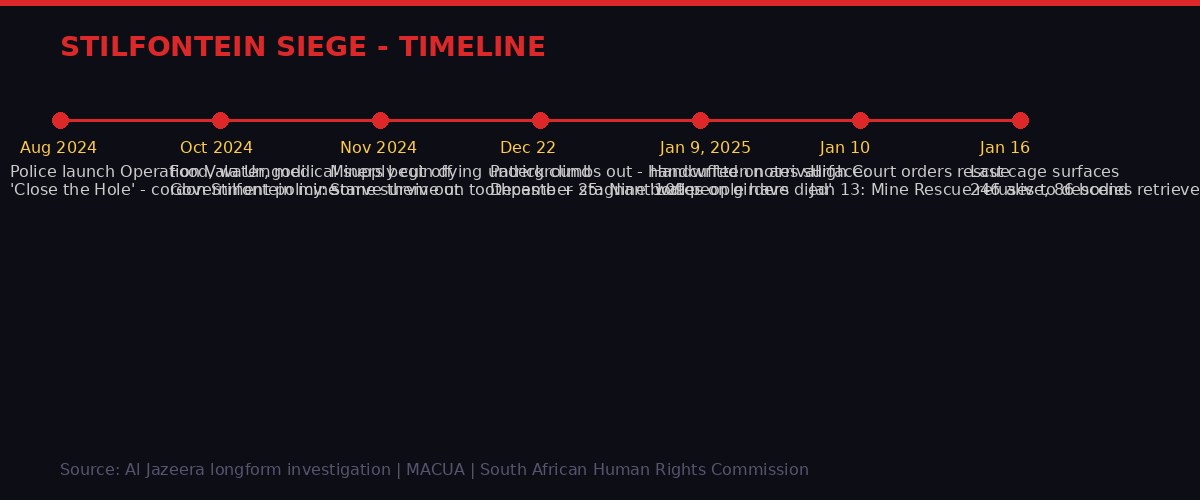
A five-month siege: from Operation Vala Umgodi in August 2024 to the last cage surfacing January 16, 2025. (BLACKWIRE)
Operation Vala Umgodi: Close the Hole
South Africa has a well-documented illegal mining problem. Artisanal miners known as zama zamas - mostly migrants from Zimbabwe, Lesotho, Mozambique and other neighboring countries - have for decades descended into abandoned mine shafts, many sealed by companies after the gold ran low or the operations became too expensive. The miners use basic equipment, risk collapse and toxic gas, and extract gold that the formal economy had written off.
According to parliamentary estimates cited in 2023, between 30,000 and 60,000 zama zamas operate across South Africa at any given time. The formal gold mining industry has long lobbied for a crackdown, estimating losses of R21 billion (roughly $1.1 billion) annually to illegal operations. Some zama zama networks are tied to organized crime syndicates. Others are simply men who have no other economic options.
In August 2024, the South African Police Service launched Operation Vala Umgodi - "Close the Hole" - its most aggressive effort to clear illegal miners from active and abandoned shafts. At Stilfontein, police cordoned the perimeter and cut off access to the shafts. Their stated strategy was not to send in officers but to force miners to the surface by making it impossible to stay underground.
Which meant cutting off food. Water. Medical supplies.
The siege at Stilfontein was not a mistake or a breakdown in communication. South African officials at cabinet level approved the strategy of denying essential supplies to force miners to the surface. When rights groups challenged it in court, the government defended the approach. It is policy that killed 93 people.
Families of the trapped men gathered above the shafts for months. Community organization MACUA - Mining Affected Communities United in Action - coordinated relief efforts, lowering food and water via a handmade rope-and-pulley system. Police periodically disrupted and dismantled those systems. The community rebuilt them.
Human rights lawyers filed court applications. Protests erupted. And underground, men kept dying.
The Women Who Refused to Leave
Above ground, the siege had another face - the women and family members who refused to give up.
Zinzi came every day to the shaft entrance after learning her brother Ayanda was underground. She had helped coordinate care for her mother at home, then walked to the mine site to look for updates. There were rarely any. The police provided almost no information. No official count of who was underground. No lists of the missing. No confirmed death notifications.
According to the Al Jazeera investigation, she stayed strong for her family through the weeks and months of waiting. She watched the rescue cage - a red metal container, barely big enough for six men but sometimes loaded with 12 - rise and fall over three days in January 2025 after a High Court order finally forced the rescue operation.
On January 16, when the last cage surfaced, Zinzi collapsed mentally. Ayanda was not in it. Neither was Bahlekase, the boyfriend of another woman, Nthatisi, who had also waited at the shaft through the long summer months.
Their names are not in government records. Bahlekase and Ayanda's bodies were not among the 86 retrieved. They remain underground, in a sealed shaft, in the dark.
"Mothers and fathers, we come in peace. People around us are dying by the hour, and currently, 109 people have died." - Handwritten note pulled up from underground, January 9, 2025
The note, carried up in the handmade pulley system that the community rebuilt after police removed the original anchoring rocks, was addressed to the families and the world above. A second note asked for more food. Neither the government nor the police publicly responded to either.
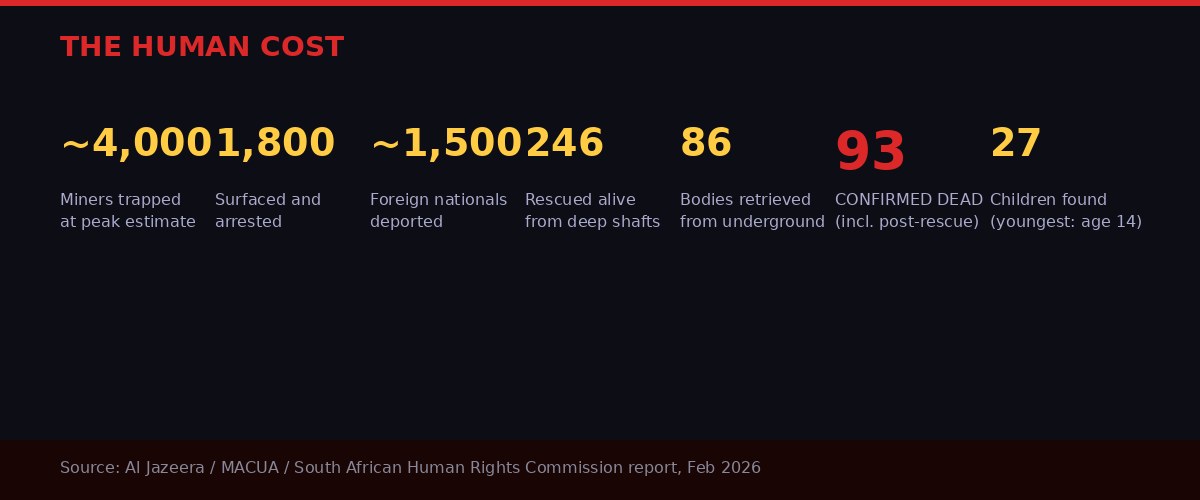
The numbers from Stilfontein - and what they mean for the 93 who did not make it out. (BLACKWIRE / Source: Al Jazeera, MACUA, SAHRC)
When the State Won't Save You, the Community Must
The Stilfontein crisis reveals something about how South Africa works - or fails to work - for its most marginalized residents. Every meaningful humanitarian action at Stilfontein was initiated by the community, by civil society organizations, or by the judiciary. The state's role was almost uniformly obstructive.
It was community leaders Johannes and Mandla who organized and pleaded at the shaft entrance for months. It was rights groups and lawyers who forced the High Court order. It was MACUA who rebuilt the pulley system after police removed it. And it was Mandla himself who volunteered to be the first to descend in the rescue cage on January 13, 2025, to verify to Mine Rescue Services that the men below were unarmed and not being held by a crime kingpin - because Mine Rescue Services refused to go down without confirmation.
Twenty-five minutes in a dark shaft to reach men dying around decomposing corpses. Mandla descended himself so that the professionals the state employs would feel safe enough to do their jobs.
"I did try to fight with our government and told them that they are killing you, but they didn't listen to us. But we're here to save your bones at least. We have to get you to your families." - Mandla, speaking to miners underground before the rescue, January 2025
The language of that sentence - "save your bones at least" - speaks to what the community understood. They had already failed to save the men alive. Now they were trying to save what was left.
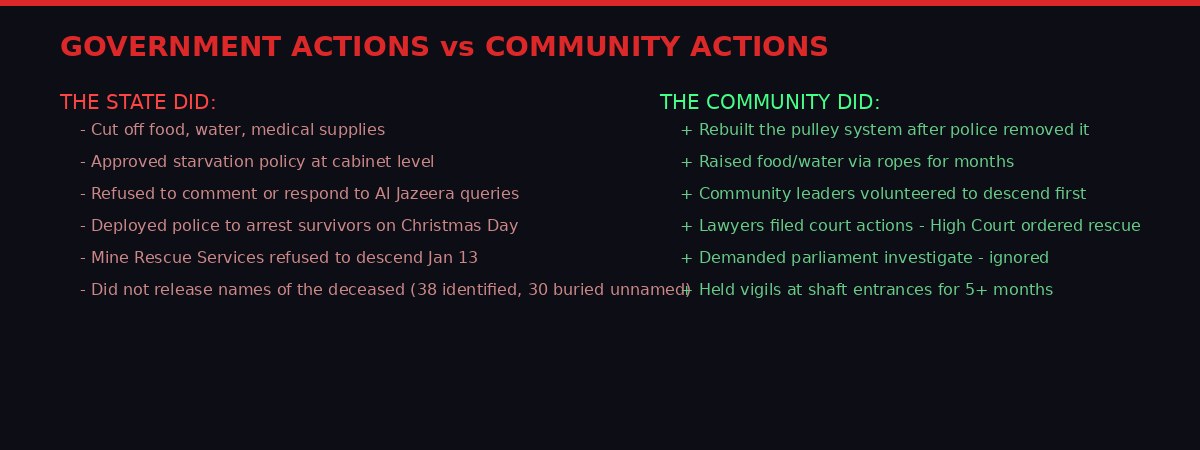
The contrast is stark: every life-saving act at Stilfontein came from below the state, not from it. (BLACKWIRE)
Who Were the Zama Zamas?
The South African government's framing of the Stilfontein siege centered on criminality. The men underground were illegal miners. Some were connected to organized crime networks that controlled the shafts, taxed other miners, and engaged in violence. The operation was, officially, a law enforcement action.
The framing is not wrong, exactly. But it is deeply incomplete.
South Africa has one of the highest unemployment rates in the world. As of 2024, the official unemployment rate exceeded 32 percent, and the expanded definition - including those who have stopped looking - reached above 42 percent, according to Statistics South Africa. In townships like Khuma, adjacent to Stilfontein, economic activity has effectively collapsed since the formal mining industry withdrew.
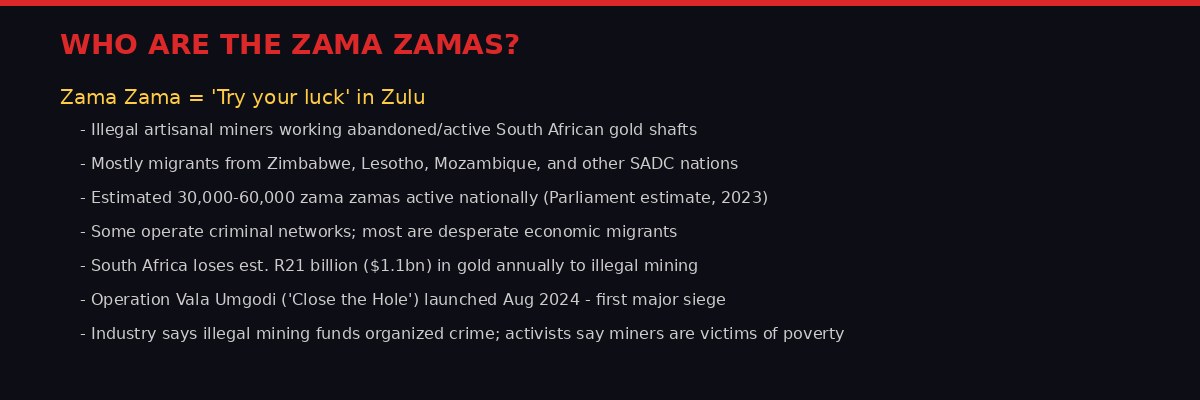
The zama zamas are not a monolith - they range from organized criminal syndicates to desperate economic migrants with no other options. (BLACKWIRE)
Most of the men at Stilfontein were from neighboring countries - Zimbabwe, Lesotho, Mozambique - drawn to the shafts because wages in those economies are lower still, and gold, even scraped from an abandoned mine, fetches real money. They are, by most definitions, economic refugees operating in a legal gray area that South Africa has never resolved through policy, only through periodic enforcement.
The youngest person pulled from the mine was 14 years old. The government handed him to the Department of Social Development. Twenty-six other children were also recovered. The fact that children were among those trapped underground - children - tells you something about the desperation that drives people into those shafts.
Christopher Rutledge, executive director at MACUA, described what the organization sees: "The operation, which was approved at cabinet level, must ultimately be held to account and pay reparations," he told Al Jazeera. The language is legal and measured. What it means, plainly, is that the government deliberately allowed people to die and should pay for it.
Twenty-six children total were found underground.
The racial and national dimensions of who died at Stilfontein are not incidental. South Africa's poorest - Black South Africans and migrants from neighboring countries - bore the entire weight of the government's enforcement strategy. No senior official was underground. No government minister's family member was in that shaft. The people who starved and died were people the state had calculated it could afford to let starve and die.
The Accountability Void
As of March 2026, more than 14 months after the last cage surfaced, the accountability picture at Stilfontein looks like this: almost nothing has happened to anyone responsible.
MACUA requested a parliamentary inquiry. It was referred to the Portfolio Committee on Mineral and Petroleum Resources. No investigation has begun. The organization has also questioned why there has been no Independent Police Investigative Directorate (IPID) inquiry into the conduct of the police operation - IPID exists precisely for this kind of question. There has been no such inquiry.
The South African Human Rights Commission held an initial investigation in September 2025 and concluded that depriving the miners of essential supplies violated their human rights. It held a follow-up inquiry in February 2026. Its findings are expected in May 2026. That finding will not, by itself, result in any prosecutions or consequences for the officials who approved the policy.
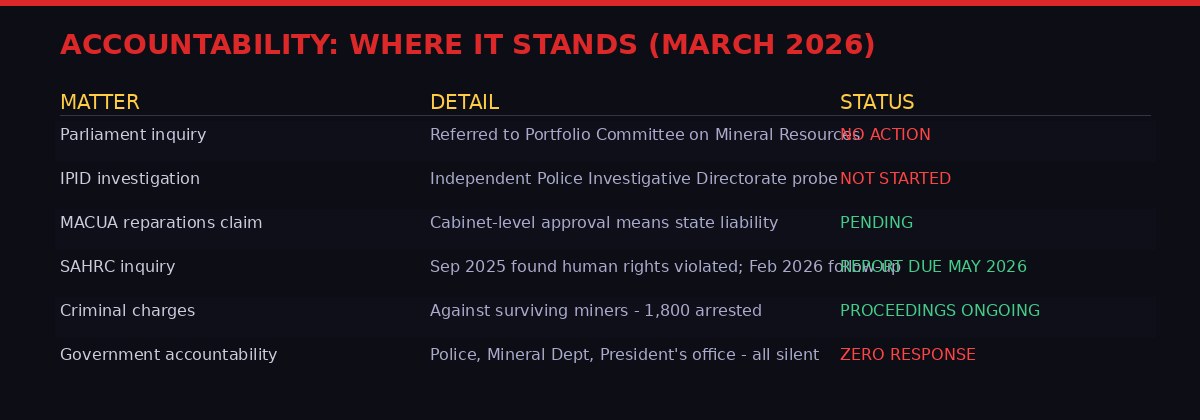
Every accountability mechanism initiated has stalled, been ignored, or returned no consequence. The state that killed 93 people has faced no consequences. (BLACKWIRE, March 2026)
Al Jazeera reached out to the South African Police Service, the president's office, and the Department of Mineral Resources and Energy. None responded. The police have not released the full list of names of those who died underground. Of the 86 bodies retrieved, 38 were identified. At least 30 others were given funerals without family - unnamed, buried in silence.
Meanwhile, about 1,800 miners who surfaced were arrested. Approximately 1,500 of them - mostly foreign nationals - were deported. They were the victims of a government policy that arguably violated their right to life under both South African and international law. They were deported before any legal challenge on their behalf could complete.
"The operation, which was approved at cabinet level, must ultimately be held to account and pay reparations." - Christopher Rutledge, Executive Director, MACUA, to Al Jazeera
In February 2026, protests erupted briefly in Khuma. Residents barricaded roads with logs, stones and burning tyres. They were demanding jobs and basic services. The protests fizzled. There is little money in the township. Most people stay home, waiting, the economy hollowed out by a mining industry that left and a police operation that killed the men who stayed to scratch a living from what remained.
What Stilfontein Reveals About the Social Contract
There is a version of this story where it is simply about illegal mining and the state's right to enforce the law. That version is not false - it is just a choice about where to stop the analysis.
The longer version asks why the shafts at Stilfontein still had gold worth dying for after formal companies abandoned them. It asks why the zama zama economy exists at the scale it does in a country where formal employment has been contracting for decades. It asks why a state with a constitutional guarantee of human dignity decided that its best option was to let people die underground rather than develop a more humane policy for the illegal mining sector it has refused to address structurally for 30 years.
South Africa is a country that explicitly confronted its apartheid past through the Truth and Reconciliation Commission, that wrote some of the most progressive human rights guarantees in the world into its 1996 Constitution, and that has since presided over one of the widest wealth gaps on the planet with a government that, under the ANC, has remained in power for three decades while delivering little to the majority of its people.
The human rights infrastructure exists. The law is good on paper. The problem is enforcement, will, and political economy: the interests of the formal mining industry, the anxiety about migration, the arithmetic of whose deaths can go unnoticed in an election year.
Sheryl Lightfoot, a political science professor at the University of Toronto and vice-chair of the UN Expert Mechanism on the Rights of Indigenous Peoples, described a parallel dynamic in her work on Canada's Indigenous communities facing fast-tracked resource extraction: "Economic or geopolitical pressures are being used to justify bypassing human rights and environmental safeguards." The phrase fits Stilfontein precisely, even though the contexts differ. Everywhere, the calculation is the same: whose rights can be suspended when the state decides it is convenient.
The Shafts Are Sealed Now
The shafts at Stilfontein have been sealed. The police presence has returned to routine local patrols. The township of Khuma is quiet. The Al Jazeera investigation describes dusty, almost deserted streets, people gathering at taverns to talk because there is nothing else to do.
Zinzi's brother Ayanda is still down there, somewhere in the dark, in a sealed shaft. So is Bahlekase, and dozens of others whose families never received a notification, never got a body, never got a name on an official record.
That is not an accident. Silence about the dead protects the living officials who made the decisions that killed them. The 30 unnamed bodies buried without family represent a deliberate anonymization of victims - harder to demand reparations for people who don't have confirmed identities in any record.
Patrick survived. He climbed a kilometer of girders over three days, found light on Christmas morning, and was put in handcuffs within seconds of surfacing. His experience - surviving something almost impossible only to be criminalized immediately on emergence - is a compressed metaphor for what South Africa offers its most economically desperate citizens: the right to survive, if you're strong enough, combined with the certainty that the state will punish you for it.
The SAHRC report is due in May 2026. MACUA continues to push for a parliamentary inquiry. Lawyers are still pressing the reparations argument. The wheels of accountability are moving, slowly, in the way they always do when the state is both the perpetrator and the institution through which accountability must flow.
Ninety-three men are dead. Dozens more remain underground, unrecovered. A government policy killed them and no official has been held accountable. In the shaft entrances of Khuma, this is not an abstraction or a story from somewhere far away. It is what happened to their neighbors, their brothers, their boyfriends, their sons.
The world looked away. The shafts were sealed. The government said nothing.
But the community above those shafts watched every day, waited at every cage surfacing, and then collapsed when the last cage came up and the people they were waiting for were not in it. That grief is real and it is unresolved and it belongs to a story that is not finished - not because the mines are still open but because the people responsible are still in their jobs, and the people who died are still unnamed.
Get BLACKWIRE reports first.
Breaking news, investigations, and analysis - straight to your phone.
Join @blackwirenews on Telegram