
Nyawan Koang walked for two days through Jonglei state with five children, none of them old enough to understand why they were running. She had been in Ayod, a remote pastoralist county in eastern South Sudan, when the fighting closed in. (BBC Africa, March 17, 2026)
She does not know which side fired the airstrike that killed her parents. The thatched-roof hut they were sheltering in is gone. She only knows what she saw. "Fire came from the sky and burned them," she said.
She is one of more than 280,000 people who have been displaced by the renewed fighting in Jonglei state - a figure that may already be outdated. The army has intensified its air operations. The SPLA-IO opposition forces continue to hold and advance. The civilians are caught between them, with nowhere clean to go.
The United Nations has issued a direct warning: South Sudan, the world's youngest nation, born in 2011 after a referendum that ended Africa's longest civil war, is sliding back toward full-scale conflict. The question being asked quietly in Juba, in Nairobi, and in the corridors of the UN is no longer whether this is a crisis. It is whether the international community has enough attention left - stretched thin across Ukraine, Gaza, Sudan, Myanmar, and the Iran war - to do anything about it before the killing reaches the scale of 2013 again.
What Is Happening in Jonglei
Jonglei state, in the northeast of South Sudan, has been the epicenter of the renewed conflict since the beginning of 2026. Forces loyal to the Sudan People's Liberation Army in Opposition - the SPLA-IO, aligned with detained First Vice-President Riek Machar - have been seizing towns and consolidating positions across the state. They have been advancing toward Bor, the state capital, in a push that has triggered a ferocious government military response.
That response has included air operations. BBC Africa's Kalkidan Yibeltal, reporting from Jonglei in March 2026, documented the pattern: government forces striking not just armed positions but areas where civilians live, travel, and shelter. Nyawan Koang lost her parents to one such strike. Others lost everything else.
"We were wedged between two forces: the SPLA-IO and the government. And their bullets kill us."
- Nyawan Koang, 30, mother of five, displaced from Ayod county, Jonglei state. (BBC Africa, March 17, 2026)
The government's own information ministry does not deny that civilians are dying. Information Minister Ateny Wek Ateny told the BBC in Juba: "There's no army in the world that actually fought without civilians being caught in the crossfire." He said the army was "responsible" in its conduct and that measures had been taken to protect civilians. He then acknowledged: "Civilians who find themselves in the wrong place at the wrong time might be caught in the crossfire. There's no way you can prevent that." (BBC Africa, March 2026)
The UN Office of the High Commissioner for Human Rights has a different characterization. In a January 2026 report, OHCHR documented 189 civilian deaths - in a single month. The body's head, Volker Turk, said: "Civilians are bearing the brunt of a spike in indiscriminate attacks including aerial bombardments, deliberate killings, abductions and conflict-related sexual violence." (UN OHCHR, 2026)
The word "indiscriminate" is not a bureaucratic abstraction. It is the legal threshold that separates lawful military operations from war crimes.
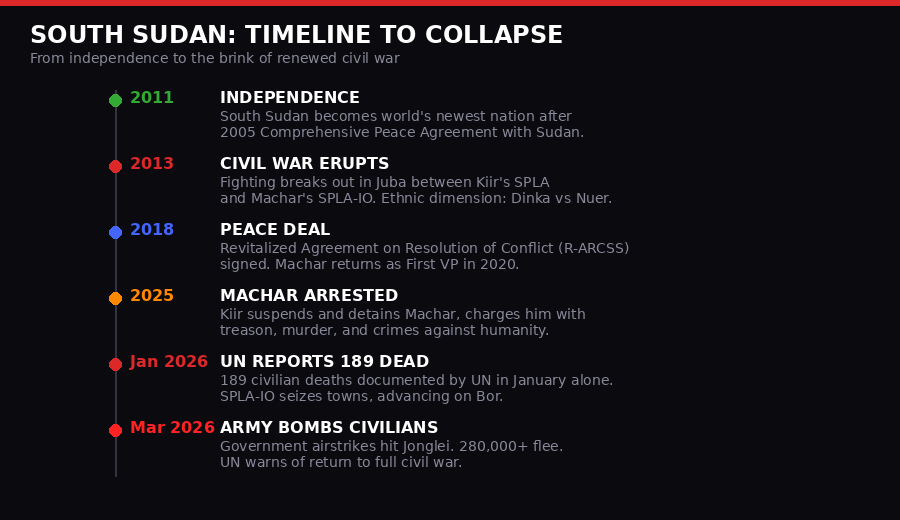
From independence in 2011 to renewed aerial bombardment in 2026 - a timeline of South Sudan's unfinished peace. (BLACKWIRE / GHOST)
The Executions in Ayod
The most damaging admission of the current crisis did not come from a UN report or a human rights organization. It came from the South Sudanese army itself.
In the last week of February 2026, government forces retook the town of Ayod from SPLA-IO fighters. After they did, soldiers from two platoons executed more than 20 civilians at close range - women and the elderly among them. The army launched an internal investigation. Army spokesman Maj Gen Lul Ruai Koang confirmed to the BBC that the soldiers and their commanders were now in detention and faced court martial. (BBC Africa, March 2026)
This is significant not as evidence of a rogue unit - armies fighting irregular wars routinely produce rogue units - but as evidence of the breakdown of command discipline that precedes atrocity escalation. In 2013, when the civil war began, it started with killings in Juba that spread rapidly as ethnic targeting became both policy and reflex across multiple armed factions. What happened in Ayod has the same shape.
The victims were unarmed civilians. They were killed after the fighting was over. They were killed by the force that is supposed to protect them. And the government's response, while technically correct - detention, court martial proceedings - follows the same script that did not prevent the spiral in 2013.
Nobody knows the full civilian death toll from the current conflict. "It is not clear how many people - civilians or combatants - have been killed in the renewed conflict," the BBC reported. (BBC Africa, March 2026) The UN number of 189 civilian deaths covers January 2026 alone. It does not include February. It does not include March. It does not include the dead who were never counted because their village had no phone signal and nobody was close enough to document the bodies.
Kiir and Machar: The Same War, Again
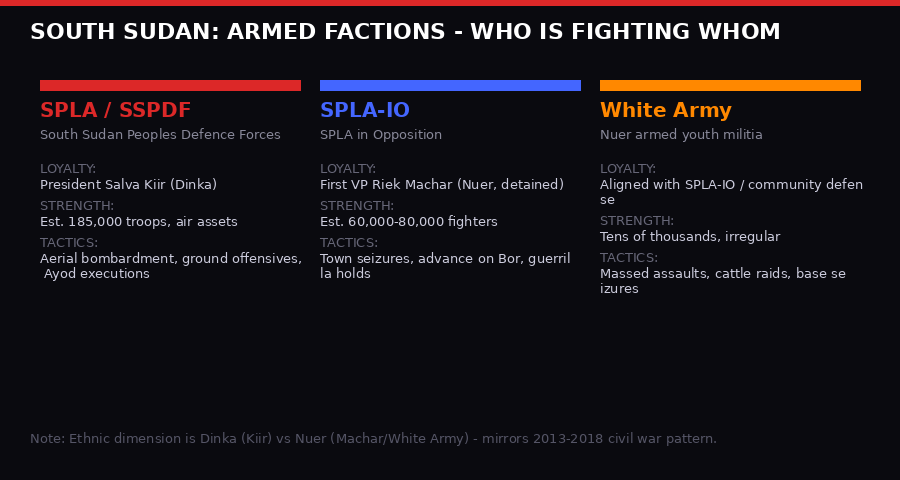
The three main armed forces in the current conflict - their loyalties, estimated strength, and documented tactics. (BLACKWIRE / GHOST)
To understand what is happening in Jonglei in 2026, you need to understand what has not changed since 2011.
South Sudan's independence was not a clean break. It was a political arrangement between two men: Salva Kiir, the president, a Dinka, and Riek Machar, his deputy, a Nuer. The Dinka and Nuer are the two largest ethnic groups in South Sudan. Their rivalry goes back generations, through colonial administration, through the Sudan war, through the independence movement itself. When Kiir and Machar worked together, they held the country. When they fell apart, the country fell apart with them.
That first falling-apart happened in December 2013, when fighting broke out in Juba between presidential guard units. Within days it had spread across the country, with soldiers and militia targeting civilians by ethnicity - Dinka killing Nuer, Nuer killing Dinka, in patterns that UN investigators later described as ethnic cleansing. Nearly 400,000 people died before the 2018 Revitalized Agreement on Resolution of Conflict in South Sudan (R-ARCSS) was signed. Machar returned as First Vice-President in 2020.
The peace was always fragile. Machar's forces were never fully integrated into the national army. Armed commanders loyal to him maintained independent structures. Ethnic tensions along the Dinka-Nuer fault line remained unresolved. The 2018 deal bought time. It did not buy transformation.
In 2025, Kiir moved to end the arrangement. He suspended Machar from the vice-presidency and placed him under house arrest in Juba, facing charges of treason, murder, and crimes against humanity. The charges relate to alleged links between Machar and White Army fighters who seized a military base from the national army in 2024. Machar denies the charges. His supporters call the prosecution politically motivated, a violation of the power-sharing agreement that was supposed to be the bedrock of the peace. (BBC Africa, Reuters, 2026)
In January 2026, the SPLA-IO - Machar's armed wing - began seizing towns in Jonglei. The White Army, a Nuer youth militia historically aligned with the SPLA-IO as a community defense force, expanded its operations alongside them. The government responded with military force. And now 280,000 people are displaced and the UN is using the phrase "return to full-blown civil war."
The Humanitarian Catastrophe Already Underway
Displacement in South Sudan is not a new emergency. It is a chronic condition layered on top of endemic food insecurity, flooding from the Nile tributaries, and cattle disease cycles that determine whether pastoral communities eat. When fighting begins, it does not simply add a security threat to an otherwise functioning environment. It collapses everything simultaneously.
Aid organizations are operating at capacity in Jonglei. The UN Assistance Mission in South Sudan (UNMISS) has some 13,000 peacekeeping troops in the country but has repeatedly found itself unable to access frontline areas where civilians are under fire. When the SPLA-IO took towns in January and February, communities fled. When the government retook them, communities fled again. Many families have been displaced twice in three months. (Reuters, UN Reports, 2026)
The town of Duk, which has become an improvised refuge point for those fleeing Ayod and Uror counties, had food, medicine, and basic essentials being provided by aid organizations as of the BBC's reporting in March. The provision is precarious. Aid convoy access depends on ceasefires that do not exist and on road conditions in a region that floods heavily through the rainy season. The rainy season begins in April.
Hoth Wan Kornyom, a community leader and father of seven who took refuge in Duk, lost his brother to gunfire and had his house burned. He described parents becoming separated from their children in the flight from Uror county. In a conflict where whole villages have been torched, separation means children who have no adults who know who they are or where they came from. It means children who exist outside every registration and protection system. (BBC Africa, March 2026)
"Civilians are bearing the brunt of a spike in indiscriminate attacks including aerial bombardments, deliberate killings, abductions and conflict-related sexual violence."
- Volker Turk, UN High Commissioner for Human Rights, 2026
The UN estimate of 189 civilian deaths in January alone - not a wartime total but a single month's count - suggests the actual toll since fighting resumed is several times that figure. In conflict zones with limited access, official documentation tracks between 10 and 30 percent of actual deaths. If January's confirmed count is 189, the realistic January toll is likely between 630 and 1,890 people. That is one month. The fighting has continued for three months as of this writing.
The International Response: Absent
The world has limited bandwidth. This is not a metaphor. It is an operational constraint on diplomacy, on media attention, on donor funding, and on the political will that drives all of the above.
In March 2026, the Strait of Hormuz is partially blocked by an active US-Israel war with Iran. A million people are displaced in Lebanon. Sudan's civil war between the SAF and the Rapid Support Forces has created what the UN calls the world's worst humanitarian crisis, with 8 million people facing famine and 10 million displaced. The DRC conflict continues to grind through eastern Congo. Myanmar's military government is conducting operations against multiple armed resistance groups. Somalia faces renewed Al-Shabaab pressure in Puntland.
South Sudan fits into this context not as an outlier but as an additional drain on a system that is already past its operational capacity. The African Union, which brokered the 2018 peace deal, has called for de-escalation. China, which has significant oil interests in South Sudan and has historically been one of the few outside powers with consistent leverage, warned both parties to "remain calm and exercise restraint" - language that has not produced a ceasefire. The United States, whose USAID programs have been gutted in 2025-2026 under the Trump administration's foreign aid cuts, no longer has the institutional presence it once used to backstop South Sudanese peace processes.
IGAD - the Intergovernmental Authority on Development, the regional body that includes Kenya, Ethiopia, Uganda, and Sudan - is itself under strain. Sudan is in civil war. Ethiopia is managing its own post-Tigray fragility. Kenya is focused on its own economic and political pressures. The regional architecture that kept the 2018 peace alive through diplomatic pressure has lost several of its load-bearing pillars simultaneously. (Reuters, BBC, 2026)
Timeline: From Independence to the Edge
South Sudan formally separates from Sudan following the 2005 Comprehensive Peace Agreement and a January 2011 independence referendum. Salva Kiir becomes president, Riek Machar vice-president. The country is born into extreme poverty and armed factionalism but genuine hope.
Fighting erupts in Juba between presidential guard units. Ethnic targeting spreads rapidly - Dinka forces kill Nuer civilians, Nuer forces retaliate. SPLA-IO is formed under Machar. The war kills an estimated 383,000 to 400,000 people by 2018.
The R-ARCSS is signed in Addis Ababa after years of negotiations. Machar returns from exile in 2020 as First Vice-President. A transitional government is established. Key provisions - including army unification and elections - are repeatedly delayed.
White Army fighters, a Nuer irregular militia historically aligned with the SPLA-IO, seize a national army base. The government holds Machar responsible. Kiir fires Machar's wife, Interior Minister Angelina Teny, along with other senior officials.
President Kiir suspends Machar from the vice-presidency. Machar is placed under house arrest in Juba facing charges of treason, murder, and crimes against humanity. He denies all charges. His supporters call the prosecution politically motivated.
SPLA-IO forces begin seizing towns in Jonglei and neighboring states, advancing toward Bor. UN OHCHR documents 189 civilian deaths in January alone - a figure that excludes combatants and the uncounted dead in inaccessible areas.
Government forces retake Ayod. Over 20 civilians - women and the elderly - are executed at close range by soldiers from two platoons. The army confirms the killings and announces court martial proceedings. This is the clearest documented evidence of deliberate civilian targeting.
Aerial bombardments continue in Jonglei. Over 280,000 people have fled their homes. The army issues an evacuation warning for 50,000 people near Jonglei's capital, Bor, as a major military offensive is planned. The UN warns the world's youngest nation is on the brink of returning to full civil war.
What Happens if It Breaks
The last South Sudanese civil war lasted five years and killed between 383,000 and 400,000 people. Those figures include battlefield deaths, massacre deaths, and deaths from famine and disease that followed the collapse of food systems, healthcare infrastructure, and trade routes.
South Sudan in 2026 starts from a worse position than South Sudan in 2013. A decade of conflict has hollowed out state capacity. Oil production - the country's primary revenue source - has declined due to aging infrastructure and pipeline damage from flooding. The foreign investment that was supposed to develop alternatives never arrived. Per capita income is among the lowest on Earth. Child malnutrition rates in Jonglei state were already at emergency levels before the current fighting began.
If the conflict escalates to 2013-level intensity, the death toll will not be constrained by 2013-era conditions. It will be amplified by a population that is already hungry, a healthcare system that was already inadequate, and a humanitarian response system that is already committed elsewhere. The UN World Food Programme is simultaneously managing emergency operations in Sudan, Gaza, Syria, DRC, Haiti, and Yemen. Adding a South Sudan emergency of 2013 scale would not stretch that system - it would break it.
There is also the regional spillover risk. South Sudan shares a long, porous border with Sudan, which is itself in civil war. Armed groups cross freely. Weapons circulate through trading networks that follow the same routes as cattle and grain. Ethiopian refugee flows from the Tigray conflict aftermath have not stabilized. A South Sudan implosion would add pressure to refugee and smuggling networks across a region that is already at its breaking point.
The Silence Is Itself a Choice
Every day that South Sudan's crisis does not appear on major front pages is not an absence of news. It is a choice about what matters. The choice is made by editors, by producers, by platforms that amplify what gets clicks and what gets airtime. It is made by governments that respond to coverage, not to crises, when they are competing for the same diplomatic bandwidth.
Nyawan Koang does not have a press secretary. Her five children do not generate engagement metrics. The 280,000 people in displacement camps in Jonglei will not trend on any platform. Their story will not move oil prices or affect NATO deliberations or drive Twitter algorithms.
This is not a complaint about journalism. It is a description of how wars that do not have geopolitical stakes for powerful countries get processed: slowly, incompletely, and usually too late to stop what they eventually describe.
The UN warning about South Sudan is not a prediction. It is a diagnosis of a condition that is already advanced. The question is not whether the international community will intervene before the situation deteriorates - it already has deteriorated. The question is whether anyone will be paying attention when the full accounting of what happened in Jonglei in the first three months of 2026 finally becomes possible.
By then, the number 280,000 will look like an early chapter. The 189 dead in January will look like a preface. And Nyawan Koang's walk through the smoke of her parents' house will look like the opening scene of something much larger and much worse.
The fire has been falling from the sky for months. The world has not looked up. (BBC Africa, UN OHCHR, Reuters, March 2026)
Get BLACKWIRE reports first.
Breaking news, investigations, and analysis - straight to your phone.
Join @blackwirenews on Telegram