Saudi Arabia's Red Line: How the South Pars Strike Pushed the Gulf to the Brink
Israel hit Iran's most valuable gasfield. Iran retaliated against Qatar, Saudi Arabia, and the UAE. Now Riyadh is warning Tehran that patience is "not unlimited." This is what the energy war looks like when it goes live.
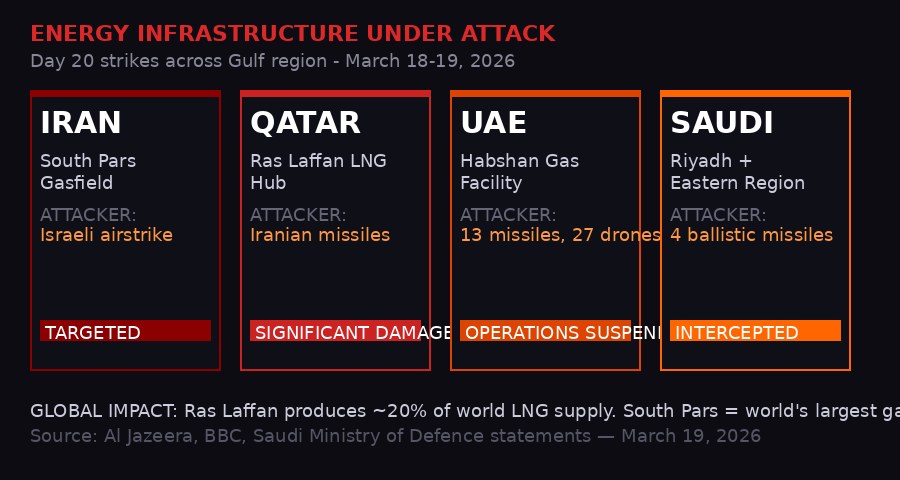
Energy sites struck or threatened across the Gulf on March 18-19, 2026. South Pars, Ras Laffan, Habshan, and Riyadh all took fire within a 24-hour window. Compiled by BLACKWIRE from defence ministry statements and field reports.
For 19 days, both sides in the Iran war observed an unspoken rule: do not hit the oil and gas fields. Hit the military installations, the missile batteries, the command posts. Hit the bridges and the highways. Hit the leadership, the intelligence chiefs, the generals. But do not touch the wells and the pipelines and the LNG terminals, because once you cross that threshold, the economic consequences spiral beyond anyone's ability to control them.
On Wednesday, March 18, that rule died.
Israeli aircraft struck Iran's South Pars gasfield - the world's largest natural gas deposit, an offshore complex in the Persian Gulf off Iran's Bushehr province that supplies a significant share of Tehran's energy revenue and is jointly developed with Qatar. Within hours, Iran's Islamic Revolutionary Guard Corps launched retaliatory strikes that hit Qatar's Ras Laffan Industrial City, the single most important liquefied natural gas export hub on earth, accounting for roughly 20 percent of global LNG supply. Four ballistic missiles were fired at Riyadh. Two more targeted Saudi Arabia's eastern region. Thirteen ballistic missiles and 27 drones flew toward the United Arab Emirates, targeting the Habshan gas facility.
The air defences of Saudi Arabia and the UAE intercepted the incoming fire. Qatar was not so fortunate. Ras Laffan sustained what Qatari officials described as "significant damage." European gas prices spiked more than 25 percent on Thursday morning. (Source: BBC, March 19, 2026)
The question now is whether Saudi Arabia - an oil superpower that has so far stayed out of the shooting war - will stay out much longer.
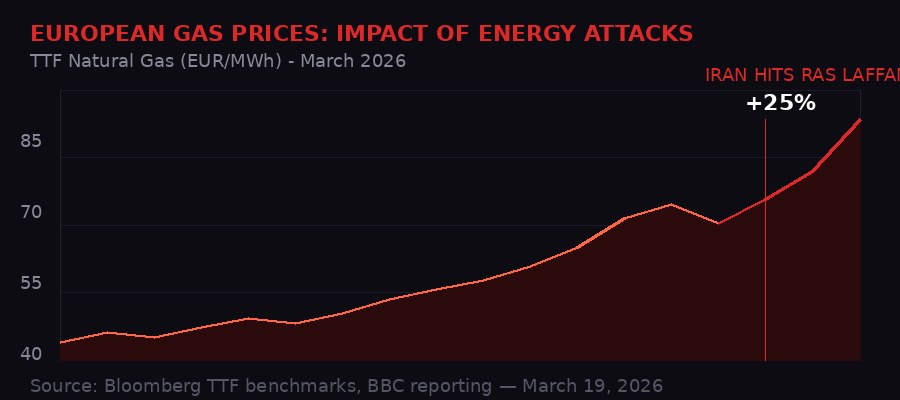
European TTF natural gas prices surged more than 25% on Thursday morning following the Iranian strike on Qatar's Ras Laffan facility. Analysts warned oil could approach $200 a barrel if the Strait of Hormuz remains closed. Chart compiled by BLACKWIRE from Bloomberg TTF benchmarks and BBC market reporting.
What South Pars Actually Is - and Why Hitting It Changed Everything
South Pars is not just a gasfield. It is the foundation of Iran's economy. The offshore complex, straddling the maritime boundary between Iran and Qatar - where Qatar's side is called North Field - holds an estimated 51 trillion cubic meters of natural gas. It is the world's largest single reservoir of natural gas. Full stop. Iran draws roughly 75 percent of its domestic gas production from South Pars, and the field is the primary source of the petrochemical feedstocks that keep what remains of Iran's industrial economy functioning. (Source: AP News, "South Pars natural gas field is an energy lifeline for Iran," March 19, 2026)
For 19 days, analysts had observed that both US-Israeli forces and Iran appeared to be deliberately avoiding direct strikes on fossil fuel production infrastructure. The reasoning was straightforward: hitting oil and gas production would trigger energy price catastrophe globally, which would undermine whatever political support remained for the war in Europe and other allied capitals, and it would hand Iran a retaliation rationale with implications far beyond the military domain.
That calculus changed on March 18.
Israeli aircraft struck South Pars facilities off Bushehr province. Iranian state media confirmed damage to facilities linked to the field. The Wall Street Journal reported, citing US officials, that Trump had approved the strike in advance, viewing it as "a message to Tehran over its block of the Strait of Hormuz." The same officials said the president believed "Iran got the message" and was now opposed to further attacks on Iranian energy infrastructure.
Within hours, those assessments looked catastrophically wrong.
"The level of accuracy in some of this targeting - you can see it in our neighbours as well as the kingdom - indicates that this is something that was premeditated, preplanned, preorganised and well thought out." - Prince Faisal bin Farhan Al Saud, Saudi Foreign Minister, press conference March 19, 2026 (Al Jazeera)
The IRGC - the Islamic Revolutionary Guard Corps, Iran's elite military and political force - did not hesitate. They had their target list prepared. Within hours of the South Pars strike, missiles and drones were flying toward Qatar, Saudi Arabia, and the UAE. The logic was blunt: if Iran's energy infrastructure is legitimate target, so is everyone else's.
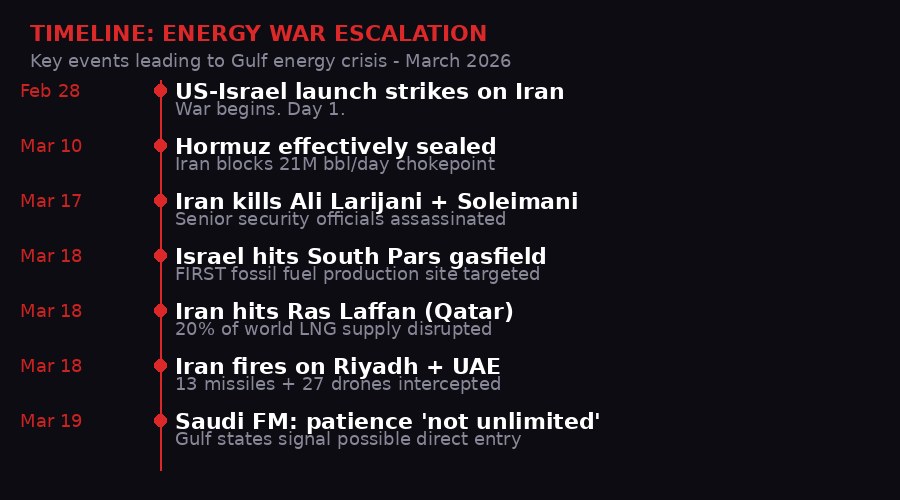
Key escalation events from February 28 through March 19, 2026. The transition from military target sets to energy infrastructure marks a qualitative shift in the conflict. Compiled by BLACKWIRE from field reporting across multiple sources.
Ras Laffan: The Facility That Powers European Winters
When the IRGC picked Ras Laffan as its first major retaliation target outside Iran, it was not an accident. Ras Laffan Industrial City, located roughly 80 kilometers northeast of Doha, is the production and export hub for Qatar's entire LNG industry. It is, by volume, the single largest liquefied natural gas facility on earth. An estimated 20 percent of global LNG trade moves through Ras Laffan. For European countries that spent years pivoting away from Russian gas after the 2022 invasion of Ukraine, Qatari LNG is not a luxury - it is a strategic lifeline.
Qatar's Ministry of Foreign Affairs confirmed the attack caused "significant damage" to the Ras Laffan complex. Qatar expelled Iranian diplomatic staff with military or security credentials - the embassy's military and security attaches were declared persona non grata. (Source: Al Jazeera, March 18-19, 2026)
The cascading market effects were immediate. European gas futures surged more than 25 percent in early Thursday trading. Analysts who had previously dismissed the $200-a-barrel oil scenario began publicly revising their positions. One key consideration: whether the Ras Laffan damage was structural - affecting production capacity long-term - or operational, meaning production could resume relatively quickly. As of Thursday morning, that assessment was still pending full damage surveys.
Iran's ambassador to Qatar initially denied that the IRGC had targeted Ras Laffan intentionally - a position that was difficult to sustain given the IRGC had explicitly threatened Qatari energy infrastructure as retaliation for the South Pars strike. Iranian state media later acknowledged that strikes had taken place in retaliation for Israeli aggression, without specifically naming which targets had been hit.
Qatar, which hosts the largest US military base in the Middle East - Al Udeid Air Base, from which a significant portion of US airstrikes on Iran have been coordinated - found itself in the extraordinary position of being attacked by Iran while simultaneously hosting the US forces that Iran is at war with. The geopolitical bind that Gulf states had been walking since February 28 had now become an open wound.
Saudi Arabia's Warning: The Calculation Behind the Words
Saudi Arabia's Foreign Minister Prince Faisal bin Farhan did not mince his words at Thursday's press conference in Riyadh. The meeting had gathered foreign ministers from Arab and Islamic states to coordinate a response to the expanding conflict. What emerged from Riyadh was not a diplomatic statement. It was a warning.
"I'm not going to lay out what would and would not precipitate a defensive action by the Kingdom because I think that is not a wise approach to signal to the Iranians. But I think it's important for the Iranians to understand that the kingdom, but also its partners who have been attacked and beyond, have very significant capacities and capabilities that they could bring to bear should they choose to do so." - Prince Faisal bin Farhan Al Saud, Saudi Foreign Minister, March 19, 2026 (Al Jazeera)
"The patience that is being exhibited is not unlimited. Do they have a day, two, a week? I'm not going to telegraph that. I would hope they understand the message of the meeting today and recalculate quickly and stop attacking their neighbours. But I am doubtful they have that wisdom." - Prince Faisal, March 19, 2026
This was not Saudi Arabia talking about what other countries might do. This was Riyadh describing its own potential military action in the direct and unmistakable language of imminent threat. Saudi Arabia had intercepted four Iranian ballistic missiles targeting Riyadh and two targeting its eastern region in the previous 24 hours. Its air defences worked. But Saudi leadership is calculating something more fundamental: at what point does continued Iranian escalation cross a threshold that demands a military response that goes beyond interception?
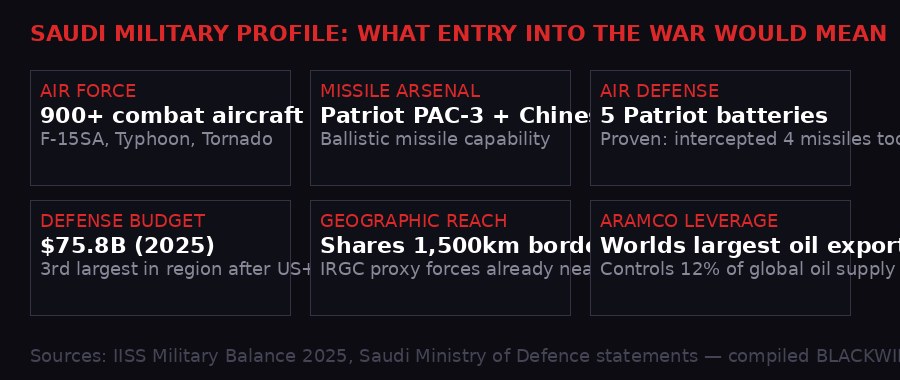
Saudi Arabia's military profile. The Kingdom maintains one of the region's most capable air forces and advanced missile defence systems. Its potential entry into the conflict as an active combatant would fundamentally alter the war's scope. Source: IISS Military Balance 2025, compiled by BLACKWIRE.
The foreign minister also stated something important about the longer-term view. He described Iran's targeting strategy as something "built into their war planning" over the past decade - not improvisation, but premeditation. "When this war eventually ends, in order for there to be any rebuilding of trust, it will take a long time," he said. "And I have to tell you, if Iran doesn't stop immediately, I think there will be almost nothing that can re-establish that trust."
This is Saudi Arabia drawing a line. It is not yet the line crossed. But it is clearly visible from where they are standing.
Trump's Contradiction: Approved, Then Disavowed
The diplomatic wreckage from the South Pars strike extends to Washington. Trump's handling of the episode reveals a White House managing a war it is increasingly struggling to control - particularly Israel's operational decisions within it.
The Wall Street Journal reported on March 19, citing US officials, that Trump had been briefed on and approved the Israeli plan to strike South Pars in advance. The strike was framed internally as "a message to Tehran over its block of the Strait of Hormuz." The officials said the president believed Iran had received the message and was now against further attacks on Iranian energy infrastructure. That belief had a shelf life of approximately four hours before Iranian missiles started hitting Qatar and Saudi Arabia.
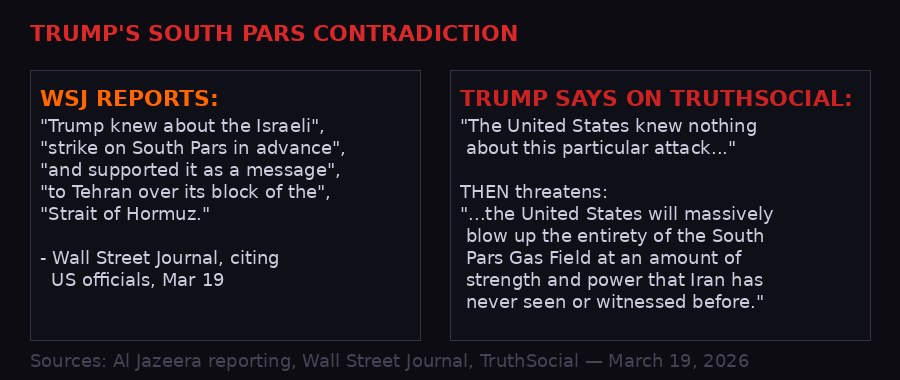
The gap between what the Wall Street Journal reported - citing US officials - and what Trump stated publicly on TruthSocial. The contradiction raises serious questions about US-Israeli coordination and the White House's ability to manage Israeli military operations. Sources: Al Jazeera, Wall Street Journal, TruthSocial - March 19, 2026.
Trump's public response was to claim the US had "nothing to do" with the South Pars strike. In a TruthSocial post, he described Israel as having "violently lashed out" at the facility - language that suggested frustration rather than coordination. "The United States knew nothing about this particular attack," he wrote.
Within the same post, he then issued a direct threat of his own: if Iran attacks Qatar again, the United States will "massively blow up the entirety of the South Pars Gas Field at an amount of strength and power that Iran has never seen or witnessed before." The threat of destroying South Pars entirely - while simultaneously claiming the US had nothing to do with the strike on it - created a logical contradiction that analysts and foreign governments noticed immediately. (Source: Al Jazeera, March 19, 2026)
Al Jazeera's Rosiland Jordan, reporting from Washington DC, noted that the episode "raises some questions about whether the Israelis did tell the US that they were planning to attack South Pars before the attack." The gap between the WSJ's reporting and Trump's public statement is either a deliberate diplomatic maneuver - maintaining plausible deniability while communicating via threat - or evidence of a breakdown in coordination between Washington and Tel Aviv. Either interpretation has alarming implications.
The AP's reporting on March 19 tracked a broader pattern: Trump's attempted "strong-arming" of allies on the Iran war was losing effect. European governments were hesitant to assist in securing the Strait of Hormuz. The political stakes for the president were "only growing" as oil prices climbed and the odds of a quick resolution "appeared to be dwindling by the day."
Lebanon: The Second Front Expands
While the energy war dominated Thursday's news cycle, Israel's operations in Lebanon continued to grind forward on a parallel track. The Lebanese front, which reopened on March 2, has now produced 968 confirmed deaths - more than 100 of them children, according to Lebanon's health ministry. More than one million people have been displaced, per UN figures. (Source: BBC, March 19, 2026)
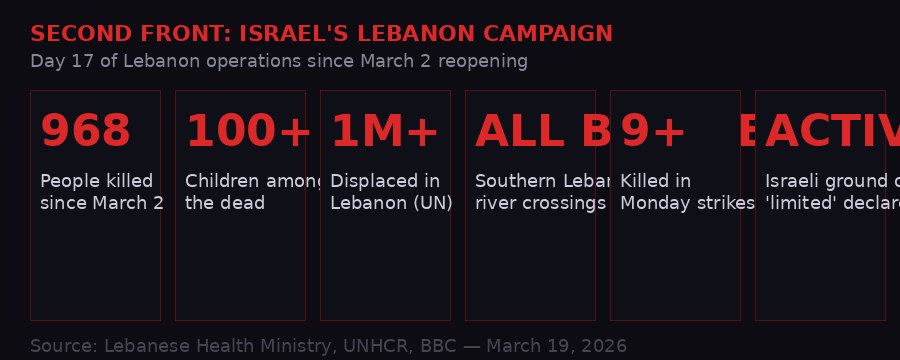
Lebanon front statistics as of March 19, 2026, Day 17 of renewed Israeli operations. The UN reports over one million displaced. Israeli forces destroyed river bridges in southern Lebanon, severing key logistical routes. Source: Lebanese Health Ministry, UNHCR, BBC.
On Wednesday and into Thursday, Israeli forces destroyed river bridges in southern Lebanon - a deliberate infrastructure campaign designed to sever logistical routes used by Hezbollah. The BBC reported that the health ministry cited more than 100 children among the dead. Nine people were reportedly killed in Israeli strikes on Monday alone.
Israel described the operations as "limited" ground operations targeting "Hezbollah strongholds." The gap between "limited" and the casualty numbers suggests either the description is diplomatic understatement or collateral damage rates are extremely high in this operating environment.
At the same time, Israeli intelligence - which had already demonstrated its ability to reach deep inside Iran with the killings of security chief Ali Larijani and Gholamreza Soleimani on March 17 - struck again Wednesday with the death of Iran's intelligence minister Esmail Khatib. Iranian President Masoud Pezeshkian confirmed Khatib's death. (Source: BBC, March 19, 2026)
The systematic elimination of Iran's senior security and intelligence apparatus represents one of the most significant sustained decapitation campaigns in modern conflict history. Each killing forces Tehran to promote less experienced officials into critical positions, creates internal uncertainty about the reliability of communications and operations, and - crucially - forces the IRGC to conduct security sweeps and arrests that further destabilize internal cohesion. Iran announced on March 18 that hundreds of people had been arrested as "traitors" following the Larijani and Soleimani killings.
"We know for a fact that Iran has been building this strategy over the last decade and beyond. This is not something that is a reaction to an evolving circumstance where Iran is improvising. This has been built into their war planning: targeting their neighbours and using that to try and put pressure on the international community." - Saudi FM Prince Faisal bin Farhan, March 19, 2026
The US Reinforcement Question and the Jones Act Signal
Two developments on Thursday pointed toward US escalation that goes beyond airstrikes.
First, Al Jazeera reported that the United States is actively weighing sending thousands of additional troops to the region. The report noted that such deployments would "further entrench US in a foreign war" - a political liability Trump has been publicly trying to minimize while operationally expanding the campaign. The consideration of ground troop reinforcement suggests either a Hormuz-clearing operation is being planned, or US military planners are preparing for scenarios in which the conflict spreads to Gulf state territory in ways that trigger mutual defense obligations.
Second, Trump suspended the Jones Act for 60 days. The Jones Act - a 1920 maritime law that requires goods shipped between US ports to travel on US-built, US-flagged, US-crewed ships - was suspended to allow foreign-flagged vessels to carry goods between American ports during the supply chain disruption caused by the war. The suspension is a domestic economic measure, but it signals the depth of concern in Washington about energy supply chains. If Hormuz remains closed and Ras Laffan is offline, the US East Coast faces real LNG supply pressure as Europe competes for whatever supply remains available. (Source: Al Jazeera, March 19, 2026)
The AP further reported that Trump eased Venezuela oil sanctions as part of a broader effort to boost global oil supply during the Iran war. The administration is pulling every available lever to manage the price shock, but the structural problem remains: roughly 21 million barrels of oil per day flow through the Strait of Hormuz under normal conditions. That strait has been effectively sealed for the better part of two weeks.
What Comes Next: Three Scenarios
The war entered genuinely new territory on March 18. For the first time since the US-Israeli campaign began on February 28, the conflict has directly struck the economic infrastructure that keeps the global energy economy running. The scenarios from here branch in ways that range from managed de-escalation to catastrophic regional expansion.
Scenario One: Managed Freeze. Iran pulls back from further strikes on Gulf energy infrastructure after reading Saudi Arabia's warnings as credible. The IRGC absorbs the South Pars damage without retaliating further against Qatar, UAE, or Saudi Arabia. Ras Laffan damage is contained and repairable within weeks. Gas prices stabilize. The Hormuz blockade becomes the primary leverage point rather than energy infrastructure strikes. This scenario requires Iran to back down from a position of strength - something the IRGC has historically been reluctant to do while under attack.
Scenario Two: Slow Burn Expansion. Iran continues low-level energy harassment - periodic strikes on Gulf facilities, drone probes, continued Hormuz restrictions - without triggering full Saudi military entry. Gulf states absorb the economic damage while maintaining air defence operations. The war settles into a prolonged attrition phase. Oil prices stabilize at painfully high levels. Global recession pressures build. This is the scenario that benefits no one and produces no decisive outcome, but it is also the one most likely if no party is willing to escalate to direct Gulf war or accept the terms required for ceasefire.
Scenario Three: Saudi Entry. Iran conducts another strike on Saudi energy infrastructure that either breaches air defences or causes significant economic damage. Riyadh makes the calculation that continued restraint invites more attacks, and activates its air force against IRGC positions - whether in Iran, Iraq, or Yemen. This would be the most consequential expansion of the conflict since it began. Saudi Arabia's air force, equipped with F-15SA advanced fighters and Typhoons, represents a qualitatively different threat than the Houthi proxy forces Iran has been directing against Saudi territory for years. A Saudi-Iran military exchange would likely draw in other Gulf Cooperation Council members and could destabilize whatever diplomatic framework has kept the conflict from going nuclear in the metaphorical sense - the broader regional war that every neighboring government has been trying to prevent.
Prince Faisal's language on Thursday was calibrated to make Scenario Three feel plausible without committing to it. That is how these warnings work. The question is whether Tehran's leadership - already under sustained air attack, its intelligence apparatus systematically decapitated, its economy under maximum pressure - is capable of reading the signal accurately and responding rationally.
Saudi Arabia's foreign minister answered that question himself. "I am doubtful they have that wisdom," he said.
From the first US-Israeli strike on February 28 to the Saudi warning on March 19: twenty days that transformed a targeted military campaign into a full-spectrum regional energy war. Every week has brought a new threshold crossed. BLACKWIRE timeline compiled from field reports.
The Energy War's Global Arithmetic
Strip away the military analysis and what you have left is an arithmetic problem that has no good answer. The world consumes roughly 100 million barrels of oil per day. Under normal conditions, 21 million of those barrels - 21 percent of global consumption - transit the Strait of Hormuz. That strait has been effectively closed for most of the past ten days.
Qatar's Ras Laffan produces roughly 77 million metric tons of LNG annually - approximately 20 percent of global LNG trade. That facility has now sustained "significant damage" from an Iranian missile strike, with no clear timeline for restoration. Europe, which redirected its energy import strategy away from Russia after 2022 and toward Qatari LNG as a cornerstone of energy security, is now watching its replacement strategy take fire from the same regional war it was hoping to stay out of.
Oil markets had already been pricing in the Hormuz closure. The Ras Laffan strike added a new variable. Analysts who had previously treated the $200-a-barrel scenario as a tail risk are now publicly revising their probability assessments. "Prices are likely to rise substantially if the Strait of Hormuz remains, in effect, closed," one analyst told Al Jazeera on March 19. The word "substantially" is doing a lot of work in that sentence.
Trump's suspension of Venezuela oil sanctions is a pressure-relief valve - it marginally increases global supply if Venezuelan production can actually be scaled up in the short term, which is not guaranteed given years of underinvestment and sanctions-related infrastructure degradation. The Jones Act suspension prevents domestic supply chain bottlenecks from compounding the import disruption. Neither measure addresses the structural problem: the energy routes that the modern global economy depends on are now active war zones.
The West Bank continued to record casualties on Thursday as well - three Palestinian women killed when missile debris from Iranian interceptions landed in Beit Awwa during the night's strikes. A Thai worker was also killed by falling shrapnel in Israel itself. The war's collateral geography keeps expanding, even in the spaces between the front lines. (Source: BBC, March 19, 2026)
Twenty days in, the Iran war has consumed an intelligence minister, a security chief, a former head of the judiciary, and multiple senior IRGC figures on one side. It has produced 968 confirmed dead in Lebanon, kept the Strait of Hormuz closed, driven European gas prices to their highest levels since the winter of 2022, struck the world's largest LNG export facility, and drawn Saudi Arabia to the point where its foreign minister is issuing military warnings with a one-to-two-day timeline attached.
The unspoken rule - do not touch the gasfields - lasted 19 days. The next unspoken rule - do not drag the Gulf states into direct combat - is under the same pressure.
From where this reporter sits, it has a shorter shelf life than the last one.
Primary sources: Al Jazeera (Saudi FM press conference, Qatar Ras Laffan reporting, Trump South Pars statement, March 19, 2026); BBC (gas price spike, Lebanon casualties, Khatib killing, Strait of Hormuz analysis, March 19, 2026); AP News (Trump allies strong-arming analysis, Venezuela sanctions, Jones Act, South Pars explainer, March 19, 2026); Wall Street Journal (Trump pre-approval of South Pars strike, citing US officials, March 19, 2026); Saudi Ministry of Defence (missile intercept confirmation); UAE Ministry of Defence (drone/missile intercept figures).
Get BLACKWIRE reports first.
Breaking news, investigations, and analysis - straight to your phone.
Join @blackwirenews on Telegram