Sarkozy on Trial Again: The $58 Million Gaddafi Question and the Global Elite Impunity Crisis
France's ex-president returns to court for the eighth time in a decade, appealing a historic prison sentence over alleged blood money from Libya's dictator. His legal marathon is not an exception - it is the rule for the world's most powerful men when they face accountability.

The justice system was built to hold power accountable. But for men like Sarkozy, it has become an obstacle course with built-in delays. Photo: Unsplash
The hearings began on March 16, 2026 in a Paris courtroom. Nicolas Sarkozy, 71 years old, former president of the French Republic, sat across from prosecutors who say he traded France's foreign policy for Libyan cash. It is not his first time in this position. It will probably not be his last.
In September 2025, a Paris criminal court handed Sarkozy the most devastating legal verdict of his life: five years in prison for criminal conspiracy in what became known as the "Libyan financing" case. The charge: that he was willing to accept 50 million euros - roughly $58 million - from the late Libyan dictator Muammar Gaddafi to bankroll his successful 2007 presidential campaign, in exchange for helping rehabilitate Gaddafi's image on the world stage.
He served 20 days before an appeals court ordered his release pending a new trial. The trial that opened this week is that new trial. If convicted again, he could face up to 10 years in prison. A verdict is expected in October 2026.
To understand what Sarkozy's courtroom marathon means, you have to understand the landscape around it. This week, as he took his seat in the dock in Paris, three interconnected corruption scandals were playing out simultaneously: a 20-year visa-selling racket inside South Africa's immigration apparatus, the forced dissolution of a UK-registered crypto exchange used to funnel sanctions-busting cash to Iran's Revolutionary Guard, and fresh testimony implicating the Greek government in a domestic spyware operation targeting its own citizens.
The thread connecting all of them is the same: power protects itself, and the machinery of accountability moves slowly enough that powerful actors can run out the clock, appeal the verdict, launder the money, and retire before the gavel falls.

Paris, where the Sarkozy trial is playing out - a city that has prosecuted its leaders more aggressively than most, but still struggles to put them behind bars for more than three weeks. Photo: Unsplash
The Gaddafi Money Trail: What We Know
The allegation at the heart of the Sarkozy Libya case is precise: in the run-up to the 2007 French presidential election, Sarkozy's campaign received or was promised 50 million euros in Libyan state funds controlled by Muammar Gaddafi. In return, the claim goes, Sarkozy facilitated Gaddafi's rehabilitation in European capitals and granted Libya diplomatic concessions after taking office.
The case began in 2013 when French anti-corruption NGO Sherpa filed a lawsuit after investigative outlet Mediapart reported on a leaked Libyan intelligence memo referencing the alleged funding deal. Sarkozy dismissed the document as a forgery - a claim the September 2025 court actually supported, ruling the memo could have been fabricated. But the court convicted him anyway, on the broader charge of criminal conspiracy, finding he was willing to accept the money even if the full transaction was never fully proven.
"By allowing stolen public resources to be used to buy influence networks, political decision-makers - and in this case the Sarkozy clan - weaken democracy, undermine citizens' trust, and contribute to depriving the affected populations of essential resources." - Sandra Cossart, Executive Director of Sherpa, speaking to OCCRP, March 2026
Two of Sarkozy's closest former ministers were also convicted in the September verdict. The case is not a solo prosecution - it implicates an entire network of French political elites who, anti-corruption groups allege, deliberately turned a blind eye to where the money came from when Libya was writing cheques to European capitals.
Gaddafi, for his part, told France24 in 2014 that Sarkozy had personally sought financial support from him while still serving as interior minister, before the 2007 vote. He gave no amounts and no transaction details. He was killed in 2011 during the Libyan civil war, taking whatever direct evidence he held to his grave.

Following political money across borders has become one of the defining investigative challenges of the 21st century. Photo: Unsplash
Key Facts: The Libya Financing Case
- Alleged Libyan funding: 50 million euros (~$58 million) for Sarkozy's 2007 presidential campaign
- September 2025: Paris court sentenced Sarkozy to 5 years - first French president to face real prison time
- November 2025: Released after just 20 days when appeals court ordered a new trial
- March 16, 2026: Appeal hearings begin; expected to run until early June
- October 2026: Verdict expected - could result in up to 10 years prison if reconvicted
- Sarkozy also faces separate ongoing charges from the FA over unregistered agent payments
- This is his 8th major legal proceeding in under a decade
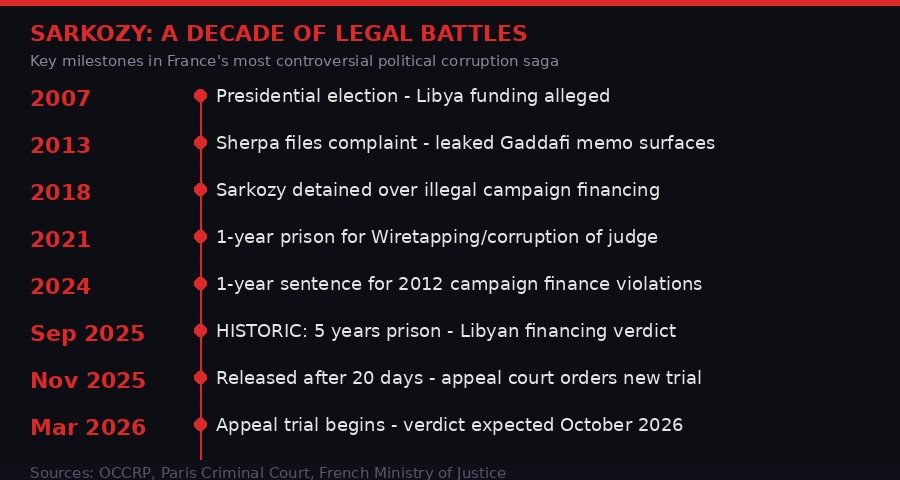
A decade of courtrooms: Sarkozy's legal battles have spanned multiple cases, multiple judges, and multiple verdicts. Source: BLACKWIRE Analysis, OCCRP, French courts.
Eight Prosecutions, Zero Prison Nights: The Anatomy of Elite Legal Delay
Sarkozy is, by a wide margin, the most prosecuted former head of government in French history. He has faced legal action for corruption, wiretapping, illegal campaign financing in his 2012 re-election bid, illegal financing in his 2022 primary campaign attempt, and now the Libya case. He has been convicted multiple times. He has served, in total, 20 nights in actual custody.
This is not a coincidence. It is a feature of how legal systems interact with the very powerful. Appeals take years. Defense lawyers are among the best money can buy. The political networks that once protected a president do not evaporate the moment he loses office - they slow-walk investigations, question judges' impartiality, and launch public campaigns to delegitimize the judiciary itself.
Following his September conviction, the French judicial system faced what OCCRP described as "fierce attacks questioning its impartiality." These attacks came not from anonymous online trolls but from Sarkozy's allies in the French establishment. The message was precise: do not trust the courts. Do not believe the verdict. Justice is political.
"It is all the more important to reiterate this given that there have even been attacks against the judicial institution itself, against the independence of the judiciary. The other important point is to see the justice system operate calmly, with the need for political leaders to take responsibility for upholding the independence of the judiciary." - Sandra Cossart, Sherpa, March 2026
This pattern - the weaponization of doubt against judicial processes - is not unique to France. It shows up everywhere elites face accountability. Across the world this week, the same playbook is playing out on different stages.

The architecture of justice can be imposing. But for those with resources and connections, it is a maze with many exits. Photo: Unsplash
South Africa: Twenty Years of Selling the Border
While Sarkozy fought his corner in Paris, South Africa's parliament was demanding answers about a corruption scandal that makes French campaign financing look almost quaint in its scope.
On March 18, 2026, the Portfolio Committee on Home Affairs called for faster investigations after hearing from the Special Investigation Unit (SIU) that officials at the Department of Home Affairs had been selling visas, permits, and other immigration documents to criminal syndicates - continuously, systematically, for twenty years. From 2004 to 2024.
The SIU's interim report, published in February, documents a marketplace inside South Africa's immigration system. Applications arrived via WhatsApp. Approvals went back the same way. The money did not go directly to officials - it went to their spouses, routed through accounts held by family members to obscure the bribe trail. The officials themselves lived in mansions they could not plausibly afford on government salaries.
"South Africa's immigration system has been treated as a marketplace, where permits and visas were sold to the highest bidder." - South Africa Special Investigation Unit Report, February 2026
The parliamentary committee was clear about the consequences. This was not an administrative failure. It was a national security threat. Foreign nationals - potentially including criminals, persons under sanctions, and those connected to hostile intelligence services - moved through South Africa's borders with documents that bypassed standard vetting. The true scale of who bought what, and what they did with it, remains unknown.
Home Affairs Minister Leon Schreiber welcomed the SIU report. Opposition parties seized on it. The Economic Freedom Fighters called the findings "evidence of the direct consequences of corruption inside Home Affairs." The Democratic Alliance described it as "proof of a long-running corrupt permit and visa scheme."
What investigators now face is a specific operational problem: South Africa's departmental computer systems are not integrated. Evidence of individual transactions is fragmented across platforms that cannot talk to each other. The parliamentary committee has urged digital modernization as a prerequisite for faster investigations - but the people who benefited from 20 years of fragmentation are not rushing to fix it.

South Africa's Home Affairs department sold visas for two decades. The parliamentary committee wants answers faster than the slow wheels of investigation are delivering them. Photo: Unsplash
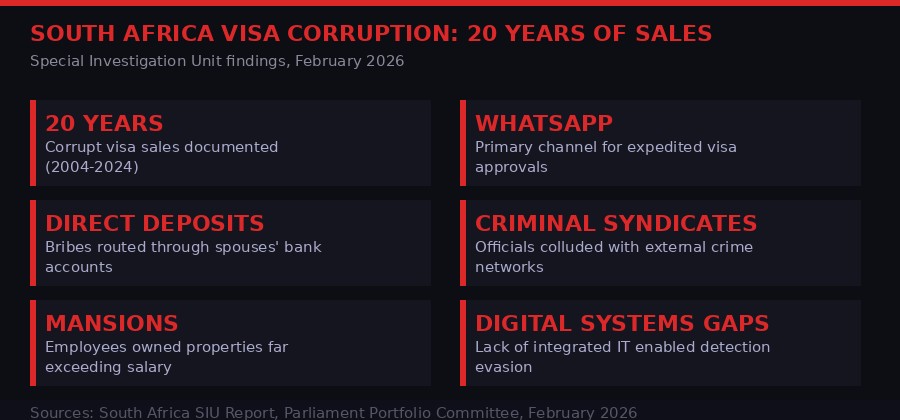
The mechanics of South Africa's immigration corruption: 20 years of documented visa sales, routed through WhatsApp and family bank accounts. Source: SIU Report, February 2026; BLACKWIRE Analysis.
The Phantom CEO: How Iran's Revolutionary Guard Used London to Move $1 Billion
The same week Sarkozy sat down in his Paris courtroom, Britain's Companies House registry moved to forcibly dissolve a cryptocurrency exchange with a fake CEO, a dormant filing record, and - according to U.S. authorities - roughly $1 billion in transactions linked to Iran's Islamic Revolutionary Guard Corps.
The company was called Zedxion Exchange Ltd. It was registered in the United Kingdom. Its listed director was a woman named Elizabeth Newman, described as a Dominican national with correspondence addresses ranging from a Caribbean beachfront property to a 68-story Dubai skyscraper. She had significant control over the company. She also, according to OCCRP's investigation published in February, does not exist.
OCCRP reporters traced "Elizabeth Newman" to a stock-footage model from a video titled "Pretty black woman talking to camera" on Shutterstock. The same marketing video listed a "finance administrator" and "team leader" whose images were also pulled from stock footage libraries. Nobody named Elizabeth Newman could be found in Dominican Republic migration records, global corporate registries, or any social media platform.
Behind the phantom CEO was Babak Zanjani, a sanctioned Iranian financier with one of the more extraordinary biographies in the world of international financial crime. Iran sentenced him to death in 2016 for embezzling state oil funds. His sentence was commuted in 2024. He was released - though prison records seen by OCCRP suggest he may have been allowed to leave as early as 2019, five years before his official release. He was active enough while nominally on death row to incorporate a UK cryptocurrency company in 2021.
The U.S. Treasury Department's Office for Foreign Assets Control sanctioned Zanjani and both Zedxion and its sister company Zedcex in January 2026, stating that "multiple Zedcex and Zedxion-attributed addresses have processed funds for wallets linked to the IRGC." TRM Labs, a blockchain analytics firm, reported that despite filing dormant company accounts, the two exchanges processed approximately $1 billion in stablecoin transactions linked to IRGC financing.
"Treasury will continue to target Iranian networks and corrupt elites that enrich themselves at the expense of the Iranian people. This includes the regime's attempts to exploit digital assets to evade sanctions and finance cybercriminal operations." - U.S. Treasury Secretary Scott Bessent, January 2026
TRM Labs also identified transfers of over $10 million to a Yemeni national the U.S. has designated as a senior Houthi financier - payments routed through the same UK-registered exchange that reported doing no business at all to British regulators.
The Companies House dissolution notice, issued in March 2026, cites "information or a statement in an application for incorporation that is misleading, false, or deceptive." Britain's Economic Crime and Corporate Transparency Act 2023 was supposed to close exactly this kind of loophole. But it came too late to stop Zedxion and Zedcex from operating for years behind a stock-footage face, moving money for a military organization currently fighting a war in the Middle East.
Note that this BLACKWIRE outlet has previously covered the Zanjani/Zedcex story in detail. The Companies House dissolution this week represents the regulatory endgame of that investigation - and a case study in how slowly the machinery of enforcement moves compared to the speed of the transactions it is supposed to stop.
Greece: The Spyware Verdict That Opened Pandora's Box
In Greece, a surveillance scandal that broke in 2022 reached a new inflection point in March 2026 when the convicted founder of the Intellexa spyware company issued a statement that inflamed the country's opposition parties.
Tal Dilian, a former Israeli intelligence officer who built the Intellexa consortium and its flagship product Predator, was convicted in February 2026 along with three co-defendants in a landmark Greek wiretapping trial. Each received sentences of 126 years and eight months - though under Greek law, the maximum time served for such misdemeanor-tier convictions is capped at eight years. The four defendants have the right to appeal.
The Greek scandal centered on the surveillance of at least 87 verified targets - politicians, journalists, military officials, and civil society figures - using Predator spyware. Nikos Androulakis, head of the PASOK opposition party, was among the confirmed targets. The government of Prime Minister Kyriakos Mitsotakis insisted throughout the investigation that private actors had deployed the software without state knowledge or authorization.
Then Dilian issued his post-conviction statement. Asked directly whether Intellexa collaborated with state agencies or private individuals to conduct the surveillance, Dilian wrote: "We operate strictly under European and international export regulations, providing technology exclusively to authorized governments and law enforcement agencies." He added that Intellexa does not conduct surveillance itself - the responsibility for lawful use "rests with the sovereign authorities that acquire and operate them."
In other words: the government bought it. The government used it.
"Predator and illegal surveillance were the weapons of a deep state, set up by the prime minister and the Maximos Mansion. Half of his cabinet, the heads of the armed forces, journalists, and state officials were illegally monitored. After Dilian's cynical admission, the prime minister cannot pretend to be ignorant and misled." - Nikos Androulakis, PASOK opposition leader, March 2026
The Greek government's spokesman Pavlos Marinakis dismissed the accusation as a political distraction, noting the Supreme Court had previously cleared state officials of criminal involvement. Syriza's leader called it "a profound institutional crisis." The head of the New Left said Dilian's statement "removes any doubt" that the Greek government and the National Intelligence Service were Intellexa's clients.
The U.S. Treasury had already sanctioned Intellexa in 2024 for developing spyware used to target American government officials and journalists. The Greek trial, and the political eruption following Dilian's statement, adds a domestic dimension: a European Union member state may have turned commercial surveillance technology against its own citizens and its own elected officials - then spent years denying it.

Commercial spyware sold to "authorized governments" has a way of ending up on the phones of opposition leaders and journalists. Greece's Predator scandal is a case study in how that happens. Photo: Unsplash
The Pattern: When the System Works for the People Inside It
What connects Nicolas Sarkozy in a Paris courtroom, South Africa's visa-selling officials, Iran's stock-photo cryptocurrency CEO, and Greece's surveillance apparatus? The answer is the same: these are not system failures. They are system features.
Every one of these cases ran for years - some for decades - before hitting a moment of formal accountability. The South Africa corruption ran for 20 continuous years, from 2004 to 2024. The Sarkozy investigation has been active since 2013. The Greek surveillance scandal broke in 2022 but the surveillance itself predates that by years. Zedxion operated from 2021 to 2026 while filing dormant accounts.
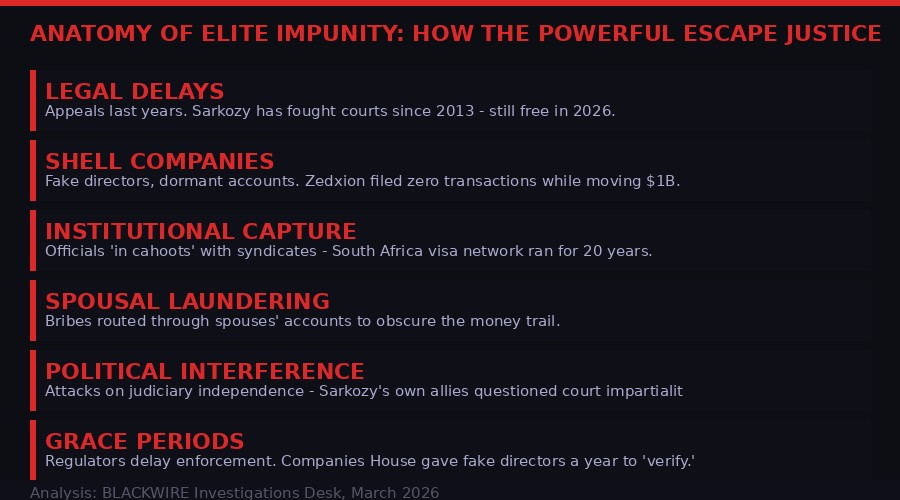
Six mechanisms through which the powerful delay, deflect, and defeat accountability. Each one visible in this week's headlines. Source: BLACKWIRE Investigations, March 2026.
Anti-corruption researchers have a term for this: "accountability gaps." The distance in time between the commission of a corrupt act and the moment a state's enforcement machinery catches up with it. In every one of this week's cases, that gap measured in years. During those years, damage compounded. Money moved. Reputations were spent. People were surveilled, bribed, and killed.
The legal mechanisms that eventually produce accountability were not designed to move fast. Appeals courts exist because miscarriages of justice are real. Due process protections exist because prosecutorial abuse is real. But for those with the resources to exploit every procedural right available - and to fund attacks on the credibility of courts when verdicts go against them - the system's fairness becomes its vulnerability.
Sarkozy's legal team has been working his cases for over a decade. They understand the appeal system better than most. The October 2026 verdict on the Libya case could be appealed again to France's Court of Cassation. A final final verdict could conceivably arrive in the late 2020s - two decades after the alleged crime.
Sandra Cossart of Sherpa frames the Sarkozy case in terms of its downstream victims. The Libyan people, she says, were deprived of resources that Gaddafi funnelled into European political pockets. The corruption "impacts people's lives - and in this case, the lives of the Libyan population, because it means less money invested in health care or education."
This is the framing that elite corruption trials rarely force their subjects to confront. Sarkozy denies everything and has called the Libya verdict "a scandalous injustice." His lawyers argue the case lacks evidence. The question of what the Libyan people lost, what South Africans lost when their borders were sold from underneath them, what Greeks lost when their phones became surveillance devices - those questions do not fit neatly inside courtroom procedure.
What Accountability Actually Looks Like: The Hard Cases
Against the backdrop of serial legal near-misses, it is worth noting that accountability does occasionally land. The Intellexa founders received maximum sentences under Greek law, even if the ceiling is eight years served. The UK government is dissolving Zedxion after OCCRP exposed its fake director. South Africa's parliament is publicly demanding faster investigations. The Premier League hit Chelsea with its largest ever fine for what it described as "obvious and deliberate" financial deception orchestrated under Abramovich.
These are not nothing. They are, however, small compared to the scale of what went undiscovered for years and the structural conditions that allowed each scandal to persist.
The Greek spyware trial is instructive. Four individuals were convicted. None of them is the prime minister. None of them is the head of the National Intelligence Service. The prosecutor explicitly argued in court that the evidence warranted further investigation into potential felony charges, including espionage - but that investigation has not yet produced further indictments. Dilian's statement this week may accelerate that. Or it may produce another round of denials and counter-accusations that pushes final accountability further out.
In South Africa, the parliamentary committee is demanding speed. But it also acknowledged that the lack of integrated computer systems means investigators cannot retrieve information quickly. The people who designed those systems, or chose not to integrate them, or delayed their modernization while corruption ran undetected for 20 years, are not in the dock.
The Zedxion dissolution is a corporate death sentence for a company that had already moved most of its money and served its purpose. Babak Zanjani remains a free man, formally released in 2024 after a commuted death sentence. The $94 billion in total transactions processed by Zedcex alone, according to U.S. Treasury, have already moved.

The transactions are already done. The money is already moved. What remains is the slow machinery of justice catching up with decisions made years ago. Photo: Unsplash
October 2026: What Hangs on the Sarkozy Verdict
The appeal trial that opened in Paris this week is expected to conclude its hearing phase by early June. The verdict will come in October 2026. Anti-corruption groups are watching it as a test of whether European democracies can actually put their former heads of state in prison - not for 20 days, but for years.
Sandra Cossart of Sherpa says her organization expects the appeal to reaffirm "that no one is above the law." But she added an important caveat: "given that there have even been attacks against the judicial institution itself," the most important thing is to see justice operate without political interference.
That is the live question. Sarkozy's defense will spend the next months arguing that the September verdict was wrong, that the evidence is insufficient, that the judicial process itself was tainted. His allies in French political life will continue casting doubt on the courts. The three civil parties - Sherpa, Anticor, and Transparency International France - will argue that the conviction stands and should be reinforced.
At 71, Sarkozy is not a physical flight risk. What he represents is a symbolic one: the idea that no matter how many courts convict you, no matter how many investigators pursue you, a former president of a major European democracy cannot actually be made to serve meaningful prison time for corruption. If October 2026 produces a second conviction and a sentence that sticks, it will be the first time in modern French history that this idea is tested to destruction.
If it produces an acquittal or another suspended sentence, the message to every other powerful person watching from every other country will be equally clear: the system bends. Long enough, hard enough, and with good enough lawyers, the system bends.
"There is no satisfaction in seeing a corrupt political class, particularly when they interfere with a foreign state, especially a dictatorial state with terrorists at its head. But there is satisfaction in seeing that the justice system manages to function despite the attacks it faces." - Sandra Cossart, Sherpa executive director, March 2026
What gives anti-corruption advocates reason to hold on is not confidence in the system. It is the persistence of investigators, journalists, and civil society groups who refuse to let the cases die. OCCRP identified the phantom CEO behind Iran's IRGC crypto network using stock footage databases and corporate records. Bellingcat has done the same kind of open-source forensics on intelligence operations. The Sarkozy case survived 13 years of legal attrition because Sherpa stayed in it. The South Africa visa scandal broke because the SIU kept investigating a department where everyone knew corruption existed but nobody wanted to formalize the proof.
Accountability, when it comes, comes because people made it their job to wait it out.
The Gaddafi money - whether it was ever actually paid, whether it ever reached Sarkozy's campaign, whether the full truth will ever be established in a court of law - is 19 years old. The investigation is 13 years old. The first historic prison sentence arrived in September 2025 and lasted 20 days. The appeal hearing opened this week in March 2026.
October 2026. That is the next date. Write it down.
Get BLACKWIRE reports first.
Breaking news, investigations, and analysis - straight to your phone.
Join @blackwirenews on Telegram