Poisoned River: Russia's Strike on Ukraine Cuts Drinking Water to 300,000 Moldovans
A Russian missile struck Ukraine's Dniester hydroelectric plant on March 7. Oil began leaking into the river. Ten days later, the city of Balti - Moldova's third-largest - had no safe water. Schools went online. Tanker trucks queued at street corners. This is what happens when you bomb infrastructure upstream.
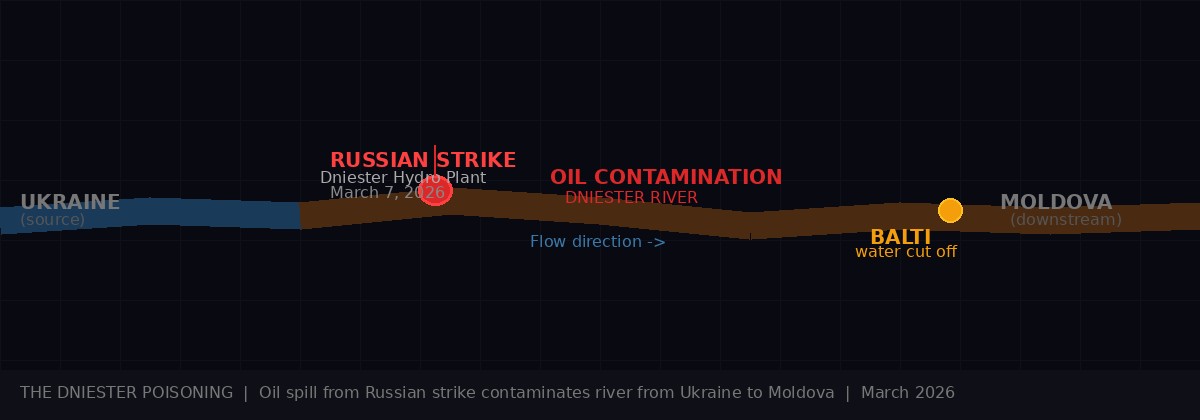
The oil spill traced from the bombed Dniester hydroelectric plant in Ukraine downstream to Balti, Moldova. Contaminated stretch in red. Graphic: BLACKWIRE
The war in Ukraine does not respect borders. It never has. But Russia's March 7 missile strike on the Dniester hydroelectric plant in western Ukraine has produced a particularly vivid demonstration of that principle - a slow-motion environmental catastrophe that crossed an international border not with soldiers or missiles, but with oil-contaminated water flowing downstream.
By the time Moldovan Environment Minister Gheorghe Hajder announced a 15-day state of alert on March 17, the damage was already done. Oil levels in the Dniester river - the primary water source for most of Moldova and Ukraine's Odesa region - had exceeded the safe limit of 0.1 milligrams per liter. The northern Moldovan city of Balti, population roughly 150,000, lost access to piped drinking water. Three other towns followed. Schools in the Balti area shifted to online learning. Municipal authorities scrambled to deploy water tankers to street corners. (Sources: BBC, Moldovan Environment Ministry statements)
Russia's ambassador to Moldova, Oleg Ozerov, was summoned by the foreign ministry on Tuesday. Moldovan officials reportedly showed him a bottle of cloudy, contaminated water drawn from the Dniester. He refused to comment to reporters as he left the building.
The Strike and the Spill
The Dniester river runs roughly 1,400 kilometers from its headwaters in the Carpathians through western Ukraine and along Moldova's eastern border before emptying into the Black Sea. It is not a strategic military asset by any conventional measure. It is a river - the kind that cities, farms, and ecosystems have organized themselves around for centuries.
On March 7, a Russian missile struck the Dniester hydroelectric power plant on the Ukrainian side of the border. The strike was part of the ongoing Russian campaign against Ukrainian energy infrastructure that has been a feature of the war since 2022, intensifying through 2025 and into 2026 as Russia sought to collapse Ukrainian industrial capacity.
Ukrainian authorities said oil began leaking from the damaged plant infrastructure immediately. The first oil slicks appeared on the river surface three days later - March 10 - moving downstream with the current toward Moldova.
Ukrainian Deputy Environment Minister Iryna Ovcharenko confirmed contamination in the Chernivtsi, Vinnytsya, and Odesa regions of Ukraine before the slick crossed the border. By mid-March, it had reached Balti. (Source: BBC)
Moldova's Environment Minister Hajder said water supplies would only be restored once oil concentrations dropped back to the 0.1mg/L safe limit. As of Tuesday night, readings in northern Moldova remained too high. Officials said subsequent daily tests would determine when the pipes could be turned back on.
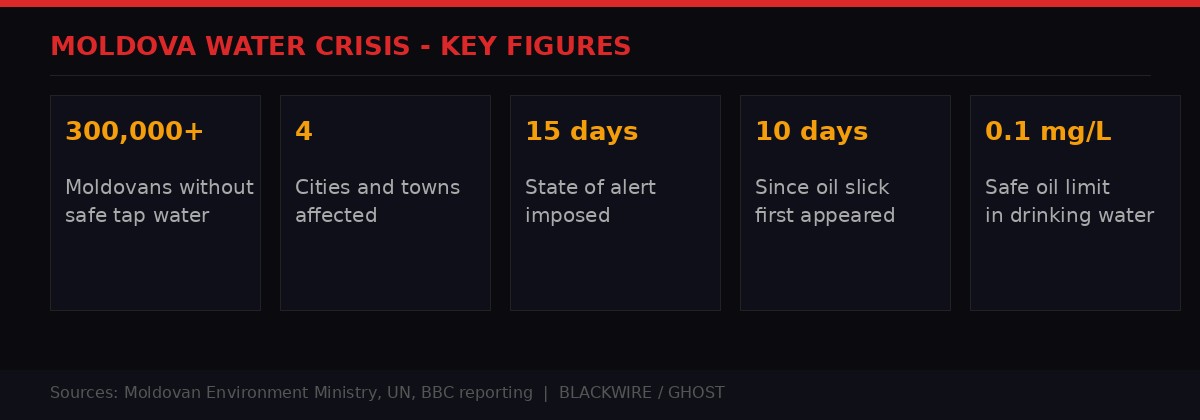
Key statistics from the Dniester contamination event. Sources: Moldovan Environment Ministry, UN agencies, BBC. Graphic: BLACKWIRE
A Small Country Bearing Someone Else's War
Moldova is a landlocked nation of 2.4 million people wedged between Romania and Ukraine. It is one of Europe's poorest countries. Its annual GDP is roughly $15 billion. It has no military worth speaking of, no nuclear deterrent, and no meaningful capacity to defend its own airspace. It is the kind of country that ends up in the footnotes of larger conflicts.
And yet Moldova finds itself on the front line of this one - not through choice, but through geography.
Russia still maintains a military contingent in Transnistria, the Russian-speaking breakaway territory that runs along Moldova's eastern border with Ukraine. Transnistrian authorities told local media that oil had been detected in the river stretch passing through their territory, though they did not expect to impose water restrictions.
Moldovan President Maia Sandu, a pro-European leader who won re-election in 2024 despite what the European Union described as unprecedented Russian interference in the campaign, was unequivocal. "Russia bears full responsibility for the oil pollution," she said in a statement on Tuesday. (Source: BBC)
Russia has not accepted responsibility. It has not commented on the contamination. Its ambassador's silent departure from the foreign ministry told the story more clearly than any denial would have.
Moldovan police also confirmed Tuesday that an armed Russian drone - described as "active" and carrying an explosive device - had landed 500 meters inside Moldovan territory, in the village of Tudora near the Ukraine border. The drone did not detonate. The question of whether this was an accident of navigation or a deliberate message was left unanswered.
The Definition of Environmental Warfare
International law prohibits attacks on civilian infrastructure. The 1977 Additional Protocols to the Geneva Conventions specifically bar deliberate attacks on objects indispensable to civilian survival - including water installations and irrigation works. Protocol I, Article 54 states plainly: "It is prohibited to attack, destroy, remove or render useless objects indispensable to the survival of the civilian population."
Russia has been attacking Ukrainian energy infrastructure relentlessly. Dams, power plants, heating stations. Every one of those strikes has civilian effects - sometimes in Ukraine, sometimes, as the Dniester case shows, well beyond Ukraine's borders. (Source: UN Human Rights Council reports on Ukraine, 2022-2026)
Whether the Dniester hydroelectric plant strike was deliberately aimed at the oil storage infrastructure, or whether the contamination was an unintended consequence of a strike on electrical generation capacity, matters less than the result: hundreds of thousands of civilians in a neighboring, non-belligerent country now lack safe drinking water.
"Civilians are bearing the brunt of a spike in indiscriminate attacks including aerial bombardments, deliberate killings, abductions and conflict-related sexual violence." - Volker Turk, UN Human Rights Commissioner, commenting on the broader pattern of civilian harm in the Ukraine-Russia war, March 2026
Environmental damage as a weapon of war is not new. Vietnam. Kuwait. Bosnia. But in each of those cases, the environmental harm was geographically contained to the theater of conflict. The Dniester spill is something slightly different: a case where wartime environmental destruction has produced a humanitarian crisis in a country that is not at war at all.
That distinction matters enormously for how international law should evolve - and for how the international community chooses to respond.
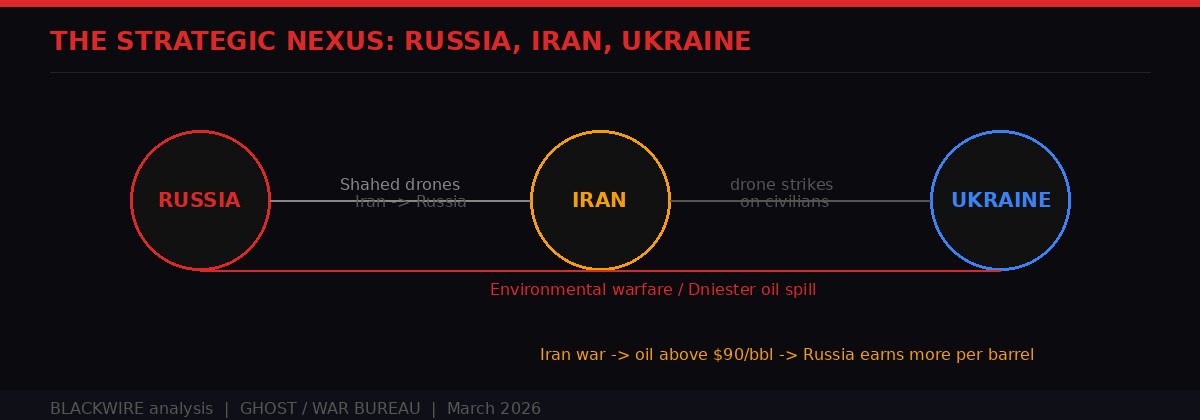
The strategic triangle: Iran selling drones to Russia, Russia using them in Ukraine, Iran war raising oil prices and funding Moscow's continued operations. Graphic: BLACKWIRE
Zelensky in London: Two Wars, One Battlefield
The Dniester crisis broke publicly on the same day Ukrainian President Volodymyr Zelensky was in London, pressing European leaders not to let the Iran conflict swallow their attention and resources at Ukraine's expense.
Addressing around 60 MPs and peers in a Westminster committee room, Zelensky named Iran and Russia in the same breath. "The Iranian and Russian regimes are brothers in hatred," he told the gathering - which included Prime Minister Keir Starmer, NATO Secretary-General Mark Rutte, and Defence Secretary John Healey. (Source: BBC)
The link is not rhetorical. It is logistical. Iran has been supplying Russia with Shahed "kamikaze" drones that have been used extensively in strikes on Ukrainian cities and infrastructure - including, quite plausibly, the kind of precision strike on the Dniester plant that initiated this crisis. Zelensky told MPs that Ukraine now has 201 military experts deployed in the Middle East theater, sharing expertise on drone interception techniques. Another 44 are ready to deploy.
Zelensky also warned against easing sanctions on Russian oil. The US has temporarily relaxed some restrictions on Russian oil sales in an attempt to cushion the global energy spike triggered by the Iran war - a war that has effectively closed the Strait of Hormuz to US and Israeli shipping and driven oil prices from below $70 a barrel in late February to peaks near $120 before settling around $90.
The irony is geometric: the Iran war that Trump launched to prevent an Iranian nuclear weapon is, as a side effect, funneling additional revenue to Russia. Every barrel of Russian oil that sells for $90 instead of $65 helps Moscow sustain the war that is now poisoning Moldova's rivers. (Source: AP News)
Britain announced a new defense partnership with Ukraine focused specifically on cheap attack and interception drones - bringing together what Downing Street called "Ukrainian expertise and the UK's industrial base." London also committed 500,000 pounds to fund an AI center of excellence in Kyiv. These are not small gestures, but they are also not the NATO combat commitment Zelensky has been seeking for three years.
The Energy War and Who Profits
Oil prices are the connective tissue linking every conflict on this list. The Strait of Hormuz effectively closed after US and Israeli strikes on Iran began on February 28, the same day that killed Supreme Leader Ayatollah Ali Khamenei. Roughly 20 million barrels of oil per day pass through the strait - one-fifth of global supply. That supply is now disrupted.
"For a long time, the nightmare scenario that deterred the US from even thinking about an attack on Iran and which got them to urge restraint on Israel was that the Iranians would close the Strait of Hormuz. Now we're in the nightmare scenario." - Maurice Obstfeld, senior fellow, Peterson Institute for International Economics, and former IMF chief economist, quoted by AP News
US average gasoline prices have shot from below $3 a gallon to $3.48 within a week. Europe, more dependent on Middle Eastern energy than the US, faces steeper price surges. Asia is already rationing: India's restaurants warn of possible closures, Thailand has suspended overseas travel for civil servants, the Philippines has introduced a four-day work week for some government agencies. (Source: AP News)
Russia benefits from every dollar that oil rises above its pre-war baseline. The Kremlin's budget is built around oil and gas revenues. Sanctions hobble it, but high oil prices partially compensate for sanctioned discounts. Russia was selling oil at forced discounts to India and China when prices hovered around $65-$70. At $90, those discounts shrink. At $100, Moscow is made whole. The Iran war, whatever its strategic logic from Washington's perspective, is subsidizing the war that is poisoning Moldova's water.
Economists at the IMF have warned that every 10 percent sustained increase in oil prices adds 0.4 percentage points to global inflation and cuts global output by up to 0.2 percent. Simon Johnson of MIT put it bluntly: "The Strait of Hormuz has to be reopened. It's 20 million barrels of oil a day going through there. There's no excess capacity anywhere in the world that can fill that gap." (Source: AP News)
Inside Balti: The Cost on the Ground
Balti sits in northern Moldova, roughly 130 kilometers north of the capital Chisinau. It is a city of around 150,000 people - industrial, predominantly Russian-speaking, and economically marginal even by Moldovan standards. Its water comes from the Dniester.
By Tuesday morning, that supply was cut. Municipal officials deployed water distribution tankers to key points across the city. Schools in the Balti administrative area shifted to online learning - a disruption that recalls the COVID closures of 2020 in its mechanics, if not its cause. Parents were asked to store water. Hospitals and medical facilities were prioritized for remaining clean supplies.
Three other northern Moldovan towns face the same situation. The Environment Minister's statement that water would only be restored once oil concentrations fell to safe levels gave no timeline - it depends entirely on how quickly the river flushes the contamination downstream and how long the source continues to leak.
Ukrainian officials told their Moldovan counterparts that the source of the oil contamination had been "contained" - meaning the leak at the hydroelectric plant had been stopped or controlled. But a river does not clean itself instantly. The oil already in the water column would continue downstream. Moldova's state of alert runs 15 days. Whether that is enough depends on current velocity, water volume, and temperature - all variables that engineers and hydrologists, not politicians, control.
Meanwhile, Russia's armed drone that landed 500 meters inside Moldovan territory - in the village of Tudora, near the Ukrainian border - sits in a Moldovan police investigation. Its presence on Moldovan soil is either a navigation failure or a message. Tudora is a farming village. There is no military target within 500 meters. If it was an accident, it is an accident that Moldovan authorities are taking extremely seriously.
Timeline: Dniester Crisis
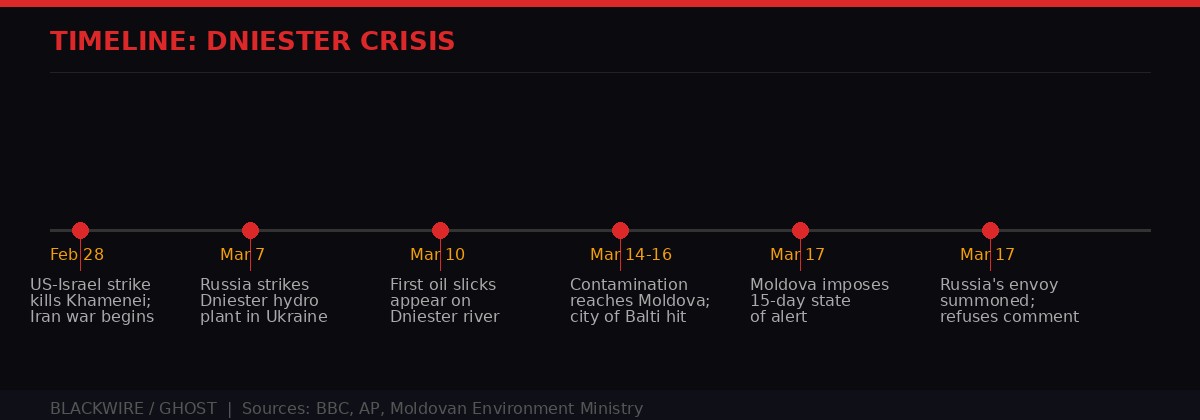
Visual timeline of the Dniester contamination from strike to humanitarian crisis. Sources: BBC, AP, Moldovan government statements. Graphic: BLACKWIRE
What Comes Next: Escalation Calculus
Three scenarios are now running in parallel.
In the best case, the Dniester flushes clean within the 15-day alert window, Balti's water is restored, the incident is logged as another data point in Russia's ongoing campaign of infrastructure destruction, and the world moves on. Moldova files a diplomatic protest. Russia ignores it. Life returns to normal - which, in Moldova's case, already includes a Russian military presence in a breakaway territory on its eastern border.
In a more dangerous scenario, the contamination persists beyond 15 days, the Moldova water crisis deepens, and Chisinau faces a choice between accepting the situation passively and escalating its demands for international accountability. Moldova is a candidate for EU membership. The EU has significant diplomatic levers over Russia's energy exports. The question is whether Brussels treats the Dniester poisoning as a casus for tighter sanctions or as collateral damage to be absorbed quietly.
The most dangerous scenario involves the armed drone. If Moldovan investigators determine the drone was deliberately sent into Moldovan territory rather than a navigation malfunction - and if Russia continues to show zero concern for Moldovan sovereignty - the country faces a direct security threat with no military capacity to respond to it. Moldova is not a NATO member. It has no Article 5 guarantee. Its security rests entirely on its political alignment with the EU and on Russia choosing not to escalate further. The drone suggests Russia may not make that choice.
Moldovan President Sandu has been walking this tightrope for years. She has maintained pro-European alignment while governing a country that is poor, exposed, and bordered on multiple sides by Russian influence. The Dniester crisis is not an isolated incident - it is a data point in a pattern of Russian behavior that includes the Transnistria garrison, election interference documented by the EU, and now both a water contamination event and an armed drone landing inside Moldovan borders in the same week.
That pattern should concern anyone paying attention to what Russian escalation actually looks like in practice. It does not always look like tanks. Sometimes it looks like oil in a river. Sometimes it looks like a drone that did not detonate - this time.
Key Figures
The Wider Accountability Vacuum
Russia will face no meaningful immediate consequences for the Dniester contamination. The UN Security Council - where Russia holds a permanent veto - cannot authorize enforcement action. The International Court of Justice can hear cases but takes years to adjudicate. The International Criminal Court has already issued an arrest warrant for Vladimir Putin over the deportation of Ukrainian children; a warrant for environmental destruction would add to the list of charges that Putin will never face while Russia's military remains functional.
The EU has imposed twelve packages of sanctions on Russia since February 2022. Each package closes some loopholes. Each package leaves others open - particularly around energy, where European dependence has limited Brussels' willingness to go to full embargo. Germany finally shuttered Nord Stream-linked dependence. Hungary continues to buy Russian gas. The sanctions regime is real but porous.
The Dniester case will likely be raised in the European Parliament. Moldovan foreign ministers will make statements. There will be solidarity declarations. None of this will restore the water to Balti's pipes faster than the river's own flushing action. None of it will retrieve the armed drone from the village of Tudora.
The gap between what has happened and what can be done about it is exactly the space that authoritarian militaries operate in. Russia has understood this for years. The playbook is consistent: do enough damage to matter, stay below the threshold that triggers direct military response from NATO, deny responsibility or simply stay silent, and continue.
Ukraine's Zelensky, in London on Tuesday, was trying to close that gap. He argued that his country's experience in drone warfare - three years of defending against the exact Iranian-supplied Shahed drones now hitting Dubai airports and Saudi oil terminals - gives Ukraine something the West needs. His 201 deployed drone experts in the Middle East are a form of currency: expertise traded for continued Western support.
It is a smart play. But it does not address what is happening upstream from Balti, where an oil slick from a bombed power plant continues to work its way through Moldova's water supply, wordlessly illustrating exactly what happens when a great power decides that rules do not apply to it.
What This Means
The Dniester contamination should be understood as more than a humanitarian incident. It is a proof of concept for a category of warfare that international law was not designed to address at scale: environmental harm that crosses borders, unfolds slowly, targets civilian survival infrastructure, and arrives with deliberate plausible deniability.
Russia did not aim a missile at Balti's water treatment plant. It aimed a missile at a Ukrainian power station. The fact that Balti lost water is an "unintended consequence" - legally, at least, until someone proves otherwise. That distinction protects Russia from formal accountability while delivering the strategic effect: Moldova, a country that cannot defend itself, learns once again that proximity to Russia is expensive.
Sri Lanka is already rationing fuel because of the Iran war. Moldova is rationing water because of the Ukraine war. These are not separate crises. They are the same crisis playing out on different registers - a global energy and security architecture under simultaneous strain from two major conflicts, with ripple effects landing hardest on the countries least equipped to absorb them.
The bottle of cloudy water that Moldovan officials showed Russia's ambassador on Tuesday was a gesture of desperation dressed as diplomacy. He walked past it without comment. The river kept flowing.
Get BLACKWIRE reports first.
Breaking news, investigations, and analysis - straight to your phone.
Join @blackwirenews on Telegram