The Phantom Investor: How a Wanted Meth Kingpin Bought Georgia's Football Club and Called Himself a Tycoon
In May 2022, thousands of fans packed the Stadioni Dinamo Batumi arena on the Black Sea coast of Georgia. They had come to watch the champions of Georgian football. But the most photographed man that night was not a player. He was a slight Taiwanese man in a navy blue suit who walked to center pitch, accepted a gilded plaque, and was declared honorary president of FC Dinamo Batumi.
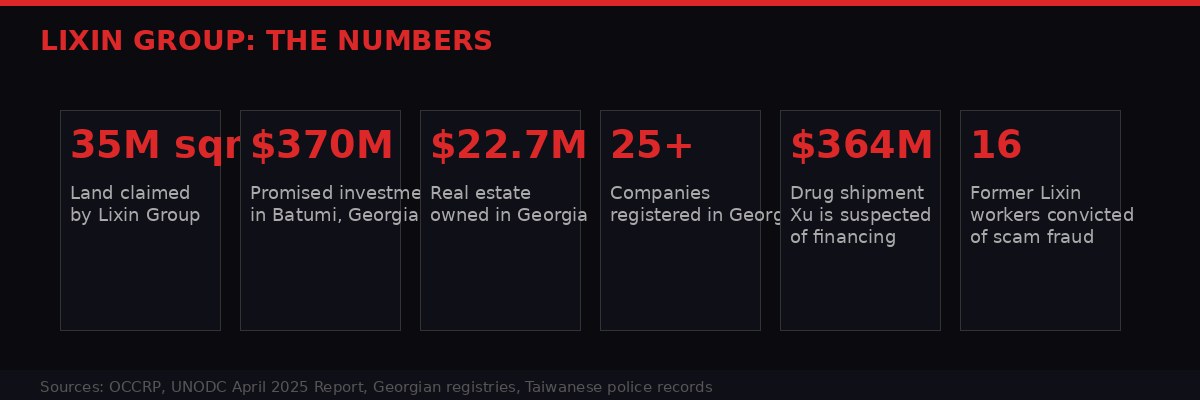
His name, the plaque read, was Thomas Xu - founder of the Lixin Group, a fast-growing Cambodian conglomerate promising to pour $370 million into Georgia's economy, build the tallest tower in the Caucasus, and shower Batumi with philanthropy.
The crowd did not know that Thomas Xu did not exist.
The man accepting their applause was Hsu Ming-chin: a convicted methamphetamine manufacturer from Kaohsiung, Taiwan, who had been sentenced to 20 years in prison, escaped using forged documents, and spent the better part of a decade constructing false identities across Southeast Asia before landing in Georgia. The Taiwan High Prosecutors Office still wants him. Police in three countries suspect him of financing a $364-million drug shipment. And the United Nations Office on Drugs and Crime has, in its own careful bureaucratic language, identified the empire behind him as something far worse than a property developer.
The Lab in Kaohsiung
The story starts in an apartment building in October 2009. Hsu Ming-chin was 29 years old. He had recruited a deeply indebted chemical engineer to manufacture crystal methamphetamine inside a rented apartment in Kaohsiung, an industrial port city on the southern tip of Taiwan. The operation was run on a shoestring and under pressure from the beginning.
On their first attempt to synthesize the drug, the chemical engineer failed to wear gloves. The resulting static charge ignited nearby hydrogen gas. The engineer survived but spent five days in hospital with burns. According to three Taiwanese court judgments reviewed by OCCRP, Hsu Ming-chin ordered him back to work before his wounds healed.
Complaints from neighbors about the foul smell, combined with fears of police surveillance, forced the lab to relocate three times. Eventually, the engineer succeeded in extracting ephedrine from 2,000 cold medicine tablets. The crystal meth was ready for export.
The operation collapsed when a drug consignment to Indonesia was intercepted in Jakarta in March 2010. Enraged, Hsu and four associates kidnapped a man they suspected of tipping off the police. They held him for 21 hours, demanding compensation for the lost shipment. That act of fury sealed Hsu's fate in Taiwan's courts.
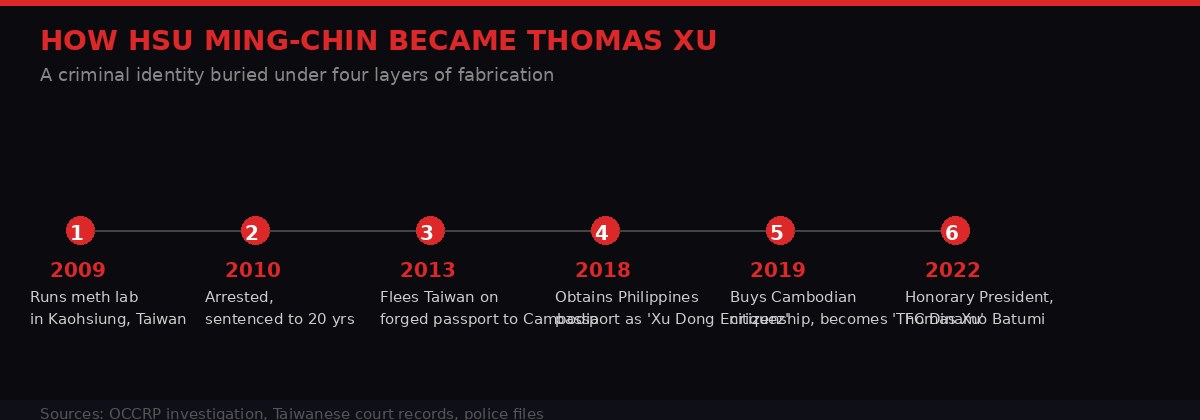
He was arrested, tried, and sentenced to 12 years for drug manufacture and financing, plus an additional eight years for robbery and unlawful detention - a total of 20 years. He lost his final appeal in late December 2013. Within weeks, he was gone.
"He fled to Cambodia using a forged passport and, along with his older brother Hsu Ming-chao, has been running real estate and other businesses there." - Taiwanese police file, 2017, obtained by OCCRP
Social media posts show Hsu was already photographing Angkor Wat temple ruins and posting from Cambodia on December 13, 2013 - the same month he exhausted his final legal appeal and before Taiwan could execute his sentence. He has never served a day in prison.
Four Identities, One Man
Building a new life required more than geography. It required a new person. Between his flight from Taiwan and his arrival in Batumi as a celebrated investor, Hsu Ming-chin shed his identity four times.
He began in Cambodia under his birth name, operating in the shadows while his older brother Hsu Ming-chao provided the public face of what would become Lixin Group. Several Cambodian companies were incorporated in 2015 with Hsu Ming-chao as director. The conglomerate grew quietly.
In October 2018, Hsu Ming-chin obtained a Philippine passport bearing his photograph but a different name: Xu Dong Enriquez. The passport falsely listed Quezon City as his birthplace. Using these fraudulent credentials, he applied for and obtained Cambodian citizenship the following year. In the process, he adopted his final identity: Thomas Xu.
The transformation was complete. Taiwan's most-wanted pharmaceutical criminal was now a legitimate Cambodian citizen with an internationally recognized travel document, a family he could present to the world, and a corporate vehicle - Lixin Group - to carry his ambitions forward.
Taiwanese police were not idle. Files obtained by OCCRP partner The Reporter document how investigators tracked Hsu's movements through leaked border data, social media posts, and intelligence from regional law enforcement. They found his footprints in Cambodia, traced his Philippines passport, and watched his real estate deals multiply. What they could not do - given the absence of an extradition treaty between Taiwan and Cambodia - was bring him back.
The $364 million drug shipment suspicion sits in that gap. Police in three countries believe Hsu financed a drug consignment linked to a major Asian syndicate. No charges have been filed. Extradition is not available. The case rests on suspicion and intelligence, not courtroom evidence. But it sits alongside a documented criminal history that Georgia never investigated before welcoming him as its savior.
Batumi, the Perfect Stage
Georgia in 2021 was a country hungry for foreign investment. The Black Sea resort city of Batumi had been booming for a decade, its skyline filling with gleaming towers funded by Turkish, Emirati, and Chinese capital. Oversight was light. Due diligence on foreign investors was minimal. The appetite for transformative money was enormous.
Thomas Xu arrived at the perfect moment. He arrived with promises of 1 billion Georgian lari - roughly $370 million - in investment through Lixin Group. He arrived with architectural renderings of the Halcyon, a pair of space-age skyscrapers that would become "the tallest building in Georgia." He arrived with a private jet, children photographed on ski trips, and an identity as a Cambodia-born success story who had fallen in love with Batumi.
Georgian media was captivated. The outlet Primetime published a glowing profile that described Xu's family, his travels, and his vision for Batumi's future. When a seven-story residential building in the city collapsed in October 2021, Lixin Group donated more than $100,000 to the victims. The company began sponsoring a local summer festival and a volleyball tournament. Xu was building a reputation.
"No one has shown interest in uncovering what kind of financial groups and interests actually stand behind the so-called 'major investor.'" - Malkhaz Chkadua, Transparency International Georgia, Batumi office coordinator
Transparency International Georgia's Chkadua told OCCRP that Xu's "opaque" investments in the city "expose the weakness of public and institutional oversight" in Georgia. The country, he said, had simply not asked the questions that any basic background check would have answered immediately: Who is this man? Where is his money from? Does Taiwan have an outstanding warrant for his arrest?
The answer to all three questions was bad.
The Asset Transfer: Cleaning His Hands
Something shifted in 2023. Xu began moving his Georgian assets out of his own name. Methodically. Quietly. One by one.
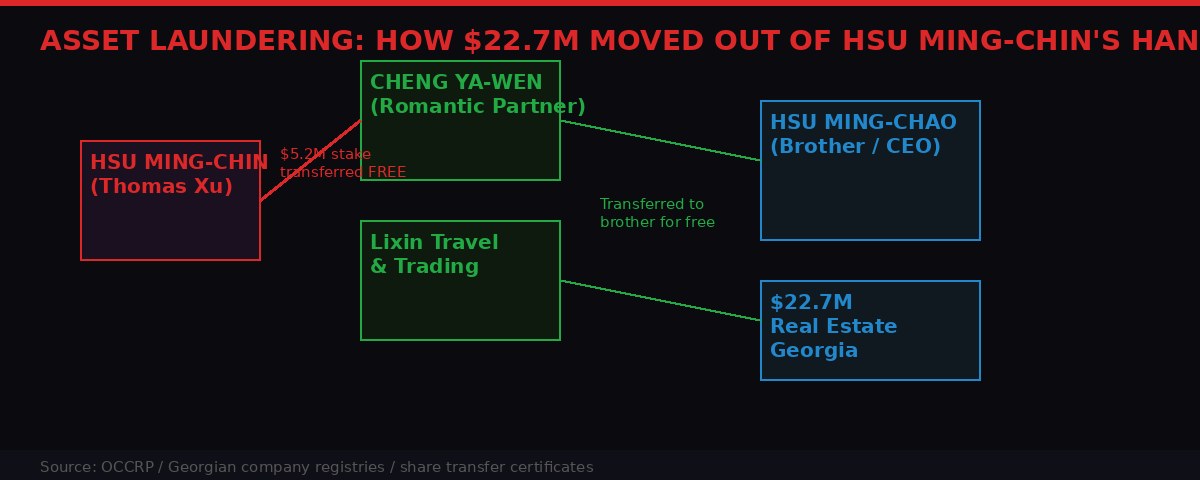
He transferred his $5.2-million stake in the flagship Halcyon development to his romantic partner, Cheng Ya-wen, for a nominal sum - effectively giving it away. Cheng then transferred that stake to Xu's brother, Hsu Ming-chao, the public CEO of Lixin Group, for free. She also transferred two other Georgian companies she had incorporated - Lixin Travel and Lixin Trading - to Hsu Ming-chao.
The result: Hsu Ming-chao now owns or co-owns almost $22.7 million worth of real estate in Georgia. Hsu Ming-chin's name has disappeared entirely from Georgian company registries. The wanted man has no documented footprint in the country where his football club cheers his memory.
Georgian share transfer certificates - corporate filings that are theoretically public documents - recorded every step of this process. OCCRP obtained them. Georgian authorities, apparently, were not looking.
The Halcyon project itself has still not broken ground. Four years after its launch, the promised twin towers remain a rendering on a website. Lixin Group's representative Grant Tao told reporters the project was still "in the early conceptual planning stage." Reporters also found that the architectural image Lixin posted online bears a striking resemblance to a Zaha Hadid-designed building in Shenzhen Bay, China - a design the late architect created for a completely different client.
When OCCRP asked about the design, Tao said the posted image was "a preliminary concept, not the final design results." He did not address the resemblance to the Hadid tower.
What the UN Found
In April 2025, the UN Office on Drugs and Crime published a major report on organized crime in the Mekong region. Hidden inside it was a case study on a Cambodia-based real estate conglomerate identified only as "Business Group 2" or "BG 2." The language was measured, as UN language tends to be. The findings were not.
UNODC described BG 2 as a "major Mekong-based criminal enterprise" with "an expansive portfolio of interests in land-based and online gambling, cyber-enabled fraud operations, and large-scale drug trafficking." The report said the group had been "started by two Taiwanese nationals - including one still wanted in Taiwan for drug trafficking" - and had expanded from Cambodia into Georgia. It noted that BG 2 had "invested millions of dollars to become the main sponsor of a top-flight Georgian football club."
Multiple people involved in preparing the report confirmed to OCCRP, on condition of anonymity, that BG 2 was Lixin Group.
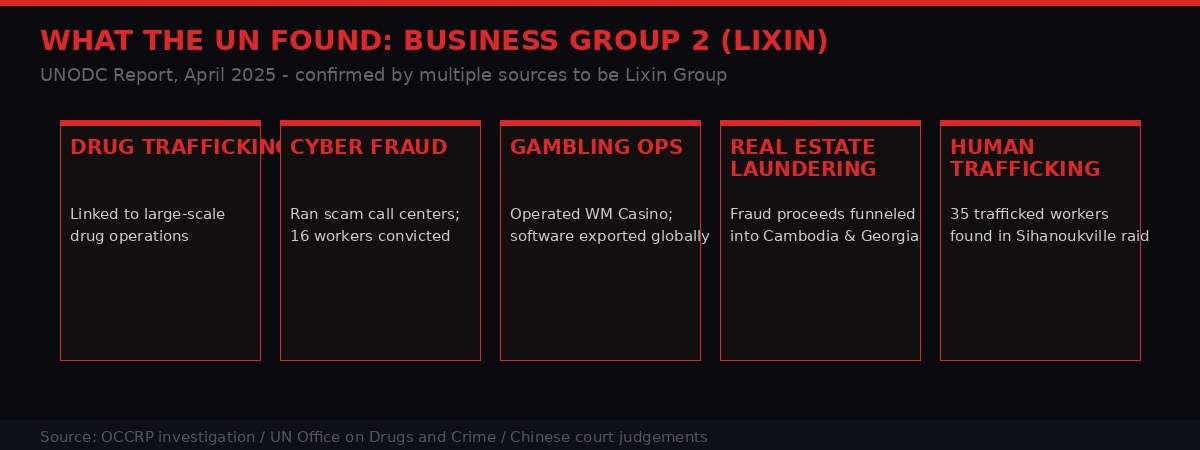
The report identified a "large business park" in Sihanoukville, Cambodia, where "multiple raids... have resulted in rescues of people claiming to be detained there and forced to engage in online crimes." Multiple sources told OCCRP this referred to Lixin Harbour City, a compound that made headlines in August 2022 when Cambodian police raided it and found 35 trafficked workers inside. A manager working in one of Lixin's buildings was arrested. Whether formal charges were ever pursued remains unclear - Cambodian government and court officials did not respond to OCCRP's questions.
Lixin's lawyers told OCCRP the compound had been developed by the group but denied any involvement in "project operation and management" at the site. They also denied it had ever been raided - a denial that appears directly contradicted by contemporaneous Cambodian news coverage and police statements.
Chinese Courts, Scam Factories, and the Property Department
The UNODC report was careful. It used a pseudonym. It spoke in bureaucratic hedges. Chinese court records are less forgiving.
OCCRP obtained two Chinese court judgments detailing fraud operations run inside a facility in Sihanoukville referred to repeatedly by defendants, witnesses, and the court itself as belonging to "Lixin." Chinese nationals were recruited to work in the operation - many under false pretenses. They were placed in "sub-groups" within a structured organization. Their job was fraud.
One category of victim: people lured on social media into chat groups where fake investors manufactured enthusiasm for bogus stock and cryptocurrency schemes. Another: victims enticed onto rigged gambling platforms designed to let them win initially, then drain their accounts through fabricated losses.
One defendant's confession, cited in the court judgment, described the internal structure in detail: a business department that assigned workers to fraud groups, a logistics department that procured the tools of deception, and a property department. The property department "invested the illicit earnings into real estate developments in Cambodia and other overseas investments" - in what the court called "an attempt to legitimize the proceeds of crime."
Sixteen Chinese nationals were convicted of telecommunications fraud. China has no jurisdiction over Lixin itself, which operates from Cambodia, and the cases targeted individual employees. But the court described the operation as a "foreign fraud syndicate" running "telecommunications network fraud" - and named Lixin repeatedly as the entity those workers reported to.
Lixin's lawyers denied any connection between the company and the individuals convicted in those cases. But many of the convicted defendants and witnesses used "Lixin" to describe the organization they had joined - including specific references to a "Lixin 3rd Building" in Sihanoukville as the site of the operation.
"An attempt to legitimize the proceeds of crime." - Chinese court judgment on the Lixin-linked fraud operation's property department
The Denial Machine
When OCCRP presented Lixin Group with its findings, the company's response was thorough - and notable for what it erased from the internet rather than what it admitted.
Lixin's lawyers insisted Thomas Xu "has no connection to Lixin Group" and dismissed press releases and promotional materials identifying Xu as the company's founder and chairman as "factually incorrect." The lawyers denied involvement in cyber fraud, human trafficking, drug trafficking, and illegal gambling.
Within days of OCCRP making inquiries, Lixin Group removed references to Thomas Xu as chairman from its website and YouTube channel. Videos showing Xu's appearances at Lixin events were deleted. The glowing profile in Primetime was taken down from the internet. The digital trail was being trimmed.
But photographs from the May 2022 ceremony at Dinamo Batumi's stadium remained online - showing the man with the navy blue suit and the gilded plaque, surrounded by fans, standing where he should not have been able to stand. An officially sanctioned video of the event, posted on Facebook by the football club's media accounts, was still accessible. The crowd was still cheering in it.
Lixin also denied that Xu had "ever been honorary president" of the football club - despite the video, the photographs, the contemporary press releases, and the club's own social media posts. The company said it had "ceased sponsoring" the club, without explaining why.
After OCCRP's inquiries, Lixin retroactively filed new documents at U.K. corporate registries adding then removing a person named Grigoriy Khvan - a figure in Uzbek ping-pong circles - as a "person of significant control," backdated to 2018, before replacing him weeks later with a Colombian national named Felipe Guerrero, also backdated to 2018. Neither man has any identifiable background in Cambodian real estate.
The Oversight Failure: Georgia, Cambodia, and the U.K.
The Lixin story is a story about three countries that failed, in different ways, to ask obvious questions.
Georgia welcomed Thomas Xu without checking whether he existed. The country has no mandatory background verification system for large foreign investors. The press coverage was adulatory. The football club sponsorship was a public-relations triumph. The building permits for Halcyon were approved. Nobody called Taiwan.
Cambodia provided the infrastructure. The country's governance is weak, its property registration system is opaque, and its appetite for Chinese investment - particularly in the casino-heavy south - has historically outpaced its appetite for due diligence. Lixin Group grew there because it could. It built towers and sponsored prime ministers' biographies because it was allowed to.
The United Kingdom provided the legitimacy. Several companies associated with the Lixin network are registered at Companies House in London. U.K. corporate registration has, for decades, functioned as an honor system - companies submit information and the registry accepts it. The country's Economic Crime and Corporate Transparency Act of 2023 aims to change this, requiring verification of directors and "persons of significant control." But the grace period for existing directors means the change came too late to catch any of the entities in this network before they had served their purpose.
The pattern - criminal money in, real assets out, identity erased, legitimate public face preserved - is exactly the kind of structure that national and international financial regulators have been warning about for years. Georgia's investment promotion bodies did not investigate. Cambodia's authorities arrested 35 trafficking victims from a Lixin compound and appear to have done little more. The U.K. registry accepted nominations it never verified.
Malkhaz Chkadua of Transparency International Georgia put it plainly: "No one has shown interest in uncovering what kind of financial groups and interests actually stand behind the so-called 'major investor.'" That disinterest has consequences. The Halcyon towers are still just a rendering. The money Xu and his brother poured into Georgian real estate came from somewhere. Nobody has publicly asked where.
Timeline of Events
What Comes Next
Hsu Ming-chin is still wanted in Taiwan. The warrant has not expired. The sentence - all 20 years of it - has never been served.
The investigation leaves several questions unanswered. Georgian prosecutors have not announced any inquiry into Lixin Group or Thomas Xu. Cambodia's authorities made arrests at the Harbour City compound and, apparently, stopped there. The U.K.'s Companies House has begun its verification regime, but many of the relevant entities have already served their purpose and declared themselves dormant.
The Halcyon towers still exist only as a rendering on Lixin's website. Four years after the announcement, no foundation has been poured. The $370 million investment promise has produced no tower, and Batumi's waterfront looks much as it did before Thomas Xu arrived.
What the $22.7 million in Georgian real estate that Hsu Ming-chao now controls is actually worth - and where the money to buy it actually came from - remains an open question that Georgian authorities have not publicly attempted to answer.
The UN called Lixin a criminal enterprise. Chinese courts convicted 16 of its workers. Taiwan has an outstanding warrant. Three countries' police suspect the man behind the enterprise of financing a $364-million drug shipment. A Georgian football club cheered him as a hero.
The football club no longer lists him as honorary president. The sponsorship has ended. The plaque from May 2022 is presumably still somewhere in Batumi, bearing a name that belongs to a man who does not legally exist.
Get BLACKWIRE reports first.
Breaking news, investigations, and analysis - straight to your phone.
Join @blackwirenews on Telegram